Cheap tchotchke, pushy salespeople and silly gimmicks. Vendor booths are often considered horrible wastes of time (and money). But we think they are great and keep recommending them to friends.
It’s not because we throw money around either. We never raised capital, so even though we crossed $19m in ARR last year, we still watch our marketing spend judiciously. We don’t do airport ads and we don’t pay fancy analyst firms. (In fact, we still don’t do any outbound sales). But.. our booths have gotten steadily better and we show up religiously at about 5 shows every year.
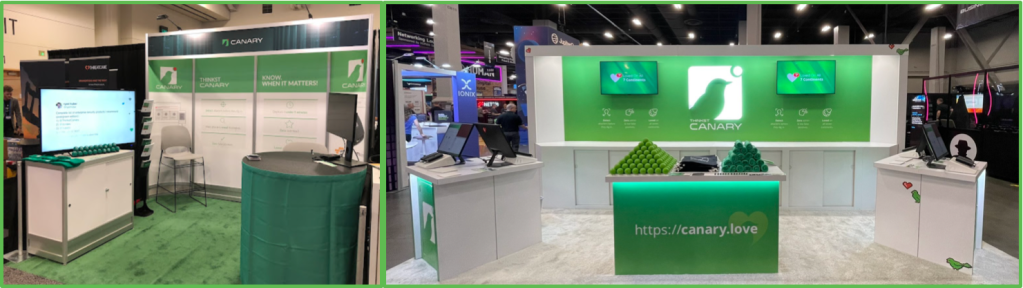
A few years back we wrote a post on running our first RSAC booth. We detailed all the costs involved, and though we’re a bunch of cynical, bootstrapped, technical founders, we reached the counter-intuitive conclusion that the booth actually worked out well for us. As a follow-up to that post, I wanted to share lessons we’ve learned since then.
We’ve strongly recommended booths to other security startups, with somewhat mixed results. This post explains what (we think) makes booths win for us (with some do’s and don’ts for friends).
Do: Meet your customers
As obvious as it sounds, the booth as a venue to meet customers is hugely valuable (and under-appreciated). We highlight 3 reasons why.
1) Customers want to meet you
This is by far the greatest benefit to having a booth. Our sales motion is extremely low touch. We’ve never actually met the majority of our customers in person. Most of them hear about Canary from someone they trust and try us out. (Admittedly, we get a hand here because they get to start at just $7.5k). Within a year, we typically catch their pen-testers (or actual attackers) and they reach out to grow their flock.
This means that we will have customers paying us hundreds of thousands of dollars a year that we’ve never actually met. A booth at a popular show, and they get to come over and hang out in person.
2) They will be your strongest sales-people if you let them
An ancillary benefit is that existing customers saying nice things about you at your booth in earshot of potential customers is amazing social proof, and leads to quick conversions. Customers who would never be able to authorize their logo in your marketing collateral, will happily stand at your booth and cheerlead for your product. They will wear their Fortune-100 name-tag while calling you the highest ROI tool they’ve bought. It’s so useful it feels like cheating. We get current customers jumping in on demos to prospects at the booth because they’re so excited about sharing their experience.
3) “There are no facts inside the building”
Years ago Steve Blank taught engineers to “get out of the building”. We are always surprised to discover that founders who religiously quote “Four Steps to the Epiphany” and “The Startup Owner’s Manual” ignore an opportunity to chat to several hundred customers in a day.
This brings us to our first booth requirement:
Staff your booth with your people: engineers, support, CS, execs, and founders.
It makes no sense to pack your booth with students and temp-booth-staff. If customers are coming by (and they do), then let them meet the customer support people they have probably dealt with. Let them discuss features with the engineers who built them. Let them discuss the product with the founders/execs who direct the product’s future.
This makes it worth your customers’ time to actually drop by. (1, 2 and 3 are why it’s worth it to you).
Don’t: The executive suite
It’s pretty common to see a split, where founders and senior company execs are up in a nearby hotel suite meeting investors, pitching large prospects, schmoozing large customers, and doing Serious Stuff (™️) while the booth is staffed by junior folks. This is stupid for multiple reasons, the simplest being you could probably just as easily schedule those meetings the following week if needed. You rarely get a clearer indicator of whether the senior people in the company care more about the product and customers, or care more about investors.
Pet peeve: a few years back we decided we had enough people in the company that it was probably worth standardizing on an EDR. Being a Mac shop, we knew some products would trail their Windows counterparts.. but “trail” was an understatement. A number of the products marketed features “presumably for competitor parity” that weren’t even in their shipping product. The booths were massive, they handed out expensive swag, but the product was clearly lacking. Complaining at the booth was pointless because.. well.. those were the booth people instead of the product people. I’m betting that product would have seen “parity” much sooner if the CEO/PM spent a few hours at the booth.
Arguably maybe this works for established vendors with a wide-range of customer sizes and lots of customers. But for start-ups who are spending a recent funding round on juicing sales with fancy stands. and not so much revenue to back it up… staying away from the booth is questionable.
Do: Demos
The cornerstone of our booths are demos. At a big show like RSAC or Blackhat, we do hundreds of them. We believe strongly in our product and love showing it off. Our demos convert, often on the floor itself. Taking up floorspace and failing to do live demos seems like a massively wasted opportunity.
A common response to this is that “your product demos easily but ours XYZ”. This is usually the result of having the wrong people at your booth. If your team built a great feature, I’d bet you anything they’d be able to build a great way to demo it.
I can’t count the number of times people come up to our booth merely because they saw an actual demonstration happening, without knowing anything about us. People are attracted to show-and-tells.
Don’t: Badge Scanning
We don’t make a big deal of scanning badges at any of our booths. Someone walking by who asks for a free t-shirt or stress ball sometimes offers up their badge in exchange for it, and they are often surprised when we demur.
The only time we scan a badge is if a prospect views a demo and specifically asks to be contacted. (The alternative is insane. Booths staff trick people walking by into stopping long enough to get their badge scanned, to build a list of people the company then has to reach out to multiple times who probably end up hating the vendor and the show. The staff are measured on number of badges scanned, leading to the expected outcome.) It’s like the canonical example of perverse incentives.
Do: Quality Gifts/Swag
We’ve written before about our attitude to company t-shirts and booth-swag. We think it’s amazing that someone would willingly wear our logo on their chests. We won’t take that lightly.
We make sure that the gear we hand out is stuff we are proud to put our names on. We spend time throughout the year choosing and designing new shirts. The stuff we hand out, is the stuff we wear all year round.
It might be tempting to go for cheap shirts that won’t last a single wash cycle, but then why do it at all? If someone is going to wear your gear, let them say that it’s amongst the nicest gear they’ve gotten.
We sweat all of our booth details, and to a man (and woman) we iterate over all the things. So our Canaries start on empty boxes and end with their own glorifiers. And our well sought after bouncy balls start on tables and end up on custom-adjustable-pyramid bases.
We keep iterating because that’s what we do, and because we believe that craft matters.
Hidden (lesser pondered) benefits of Boothing
Experiencing customer love in person
We make sure that we cycle everyone in the company through booth duty. Probably the biggest benefit to this, is having them experience customer love in person. It’s almost perfectly predictable to have engineers come back to the office and say:
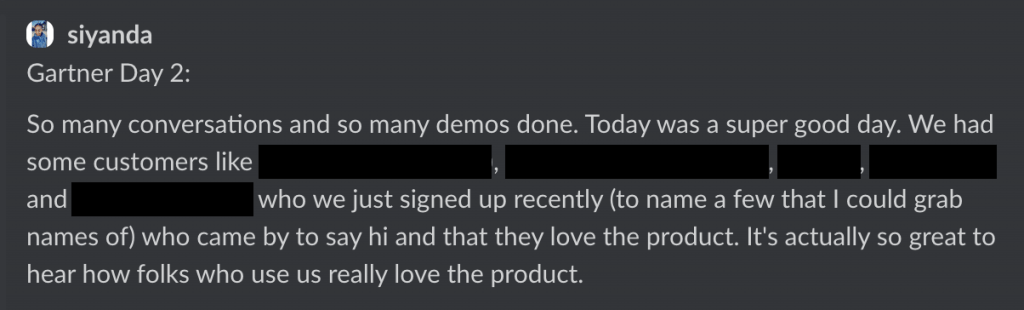
Everyone thinks they understand it. Everyone reads customer feedback on Slack but everyone comes back from a conference amped up. In person customer love is life changing.
How we roll
When all of the senior people in the org are cycling through booth duty, we get to show through action (instead of mission statements on the wall) what really matters to us. As a remote-first company, it becomes 2 full days of closely working with people in the company you probably wouldn’t work with normally.
Sure they say customers matter, but how do they react when a customer walks up to them at the end of a long day?
Do they truly look for opportunities to make the demos better, the booth better — pushing for craftsmanship?
Booths become an almost invaluable period to get a real feel for who we work with and what really matters to them, so quite unexpectedly, external booths become great for internal growth and collaboration.
Conclusion
Although 25-year-old-me hates to admit it, booths turn out to be super valuable. Shows like RSAC or BlackHat do a wonderful job of getting lots of interested people into a city, but infosec vendors appear to be in a desperate race to make the boothing experience so terrible that nobody will actually visit them.
They totally don’t have to be this bad. If you take good people, do demos and hand out quality gifts, you will be surprised how well they work out. They certainly do for us.