This episode of The Space Industry podcast by satsearch is a conversation with Laura Crabtree, CEO of Epsilon3, on how the company is approaching the adoption of AI to support process & resource management for complex space missions.
Epsilon3’s software platform manages complex operational procedures, saving operators time and reducing errors. The platform supports a majority of a project’s life cycle, from integration and testing through live operations.
In the episode, Laura speaks with satsearch COO Narayan Prasad Nagendra about a range of topics including:
- AI readiness and timing: the readiness of AI to handle process and resource management of complex space missions and whether this is the right time for AI adoption, despite the space industry’s traditionally complex and conservative nature.
- Safety and anomaly detection: making AI-driven anomaly detection for mission-critical systems simultaneously sensitive enough to catch real problems and robust enough to avoid excessive false alarms.
- Procedure correctness and vetting: ensuring that AI-generated or imported procedures meet the extremely high requirements for correctness, detail, and adherence to regulatory standards for spaceflight operations.
- Data security and customer trust: the specific architectural and security measures Epsilon3 is implementing to guarantee that sensitive, often classified, customer data is never exposed to external AI services, thus building trust with cautious space engineers.
- Immediate practical applications: the possibility of immediate and practical applications like dynamic AI scheduling or a recommender system, that could significantly reduce manual workload or human error for operations engineers in the next 12-18 months.
Find the episode now on your favorite podcast player! And please give us an honest rating and review to help us spread the word about all the important work going on in the space industry.
Related products
Products referenced in, or related to, the content in this podcast episode:

The Epsilon3 OS for Space Operations is a web-based, electronic procedures solution for operators who need to create, process, and track complex procedures. It is designed to streamline communication and help operators to reduce errors through intelligent error checking and automation. It also enables users to increase performance over time with detailed metrics and reports.

The Epsilon3 Plan tool is designed to visualize schedules, timelines, and dependencies to track the critical path in the space industry. It helps to easily plan and manage tasks by scheduling procedures, events, and operations in an interactive Gantt view with powerful filtering, organization, and editing capabilities. All while leveraging customers' existing procedures and operations.
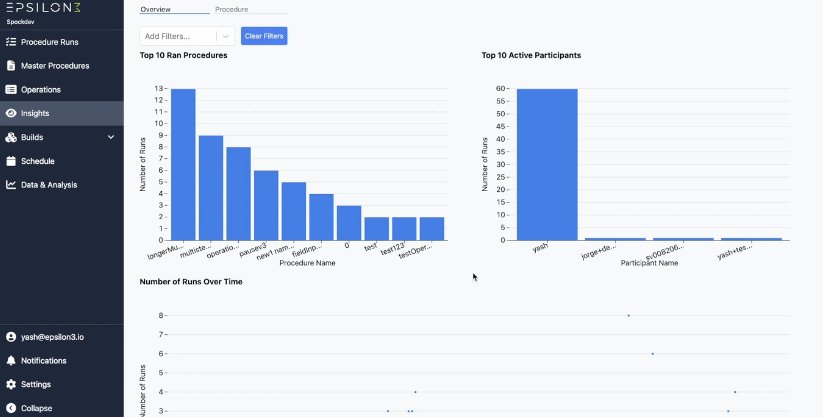
The Epsilon3 Discover tool is designed to access insights and increase efficiency to continuously improve performance. It helps discover key insights, trends, explore performance analytics, as well as share plots and analyses with other team members to quickly collaborate and troubleshoot anomalies or unexpected outcomes. This tool provides detailed analytics, dashboards, and reports of procedures.
Click here to view the full Epsilon3 offering on satsearch.
Transcript
Please note that this transcript is auto-generated and may contain errors and inconsistencies with the podcast audio and therefore we can accept no responsibility or liability relating to the content and accuracy of the text on this web page. The transcript should only be used to accompany the audio, and it is the audio of the podcast which should be referred to in order to confirm any of the information provided in the podcast.
Narayan (00:05)
Hi and welcome to The Space Industry podcast by satsearch. My name is Narayan, COO at satsearch, and I’ll be your host as we journey through the space industry. The space sector is going through some seismic changes, promising to generate significant impact for life on Earth and enable humans to sustain life elsewhere in the cosmos.
At satsearch, we work with buyers and suppliers across the global marketplace, helping to accelerate missions through our online platform. Based on our day-to-day work supporting commercial activity, my aim here during this podcast is to shed light on the boots-on-the-ground developments across the globe that are helping foster and drive technical and commercial innovation.
So come join me as we delve into a fascinating, challenging, and ultimately inspiring sector.
Narayan (00:54)
Hi, and welcome back to yet another episode of The Space Industry podcast. And today we have here again back at the podcast, Laura Crabtree, the CEO of Epsilon3, one of the satsearch trusted suppliers, talking about how ready is AI to power process and resource management for complex space missions. So welcome back again, Laura, and it’s great to have you here again.
Laura Crabtree (01:16)
Yeah, thanks for having me. Good to be here.
Narayan (01:19)
Great. You have ridden the whole space technology wave from the ops side, and now you’re looking at software as an adjacent area. And I guess you’ve ridden then two waves in your career, from the space mission side and now the AI side of it. One of the most interesting questions in this topic is obviously the question of “why now” when it comes to AI.
We’ve seen that a lot of the AI models really depend on—are depending on—large amounts of organized data to train themselves and then to then deliver services to certain problems. Can you describe why you believe that AI is ready now for the space industry in helping engineers dealing with process and resource management?
Laura Crabtree (01:59)
I’m not sure it’s completely ready, which is why we’re not totally getting distracted by the AI hype. But I do want to focus on practical applications that ensure our customers are able to do as much as they want to do, and potentially more, with fewer numbers of people. And so we are looking at ways we can enhance what people are currently doing with AI.
Previously, there was no discussion of what we could do with AI. And now it’s coming up more and more when we speak to our customers and prospective customers on what are we doing with AI. And I would turn it back to, you know, what do people need to do? And can it be solved with AI? Not “should we use AI for everything under the sun?”
If there’s a problem that can be solved without AI or without the use of Large Language Models (LLMs), I am certainly down with doing that. I just want to continue solving problems. And the availability of AI is a lot greater than it used to be. So I want to make sure that we’re staying ahead of what we can do to support our customers.
Narayan (03:04)
What you said is very apt in that sense. I’ll give you an example of what has recently happened with Google, for example. Google has started generating these AI snippets when you Google for something, right? I was just Googling, for example, “satsearch address” last week. And then Google threw out a snippet saying that satsearch belongs to a NASA office somewhere in Florida or whatever, and we are an office within that. And then it’s throwing out junk saying that we’re registered with NASA and we’ve been an entity within a NASA center. So I think if Google is making this mistake with the amount of money that they’re throwing at AI, it talks a lot about where the AI stands when it comes to accuracy of those models.
So the main theme of this discussion is also then around the whole idea around safety and anomaly detection. Obviously, that becomes very critical for space-related missions, right? One of the applications of AI is in generating insights and warnings when procedures look different from the past runs. So for space engineers dealing with mission-critical systems, what is the biggest technical hurdle Epsilon3 faces in this anomaly detection, both from a sense of dealing with sensitive data to flag real issues and then, robust enough, and for that to be robust enough so that you don’t have excessive alarms?
Laura Crabtree (04:25)
Yeah. So the first thing you have to do if you are going to use AI or machine learning in any way, shape or form is establish trust with the user base. And a lot of the reasons why our customer base is adverse to starting AI is because of things like what you mentioned. Google is outputting bad data. You get a Google search and maybe you search yourself and you’re seeing something that is completely and wildly untrue. So what we establish is: if we are going to use something like this, we are going to start small to establish trust within our customers. And so what we would want to do with anomalies is really make sure that we have enough of a dataset to be able to say, “this is something outside of the norm.”
And in that respect, it would be more on the machine learning side of things, which is: “Hey, I have this dataset and I have taken the same data a hundred times over again”, which is even a very small dataset. But in space flight, maybe you get—you only get—a hundred times to do something, or maybe you only get three times. And really writing down: what are the rules and the parameters by which you want the computer to help you analyze that data? And whether or not, again, whether or not it’s AI or machine learning or if you just write rules-based alarms, you can get the same type of data back. And so that you can then build trust and then build in more machine learning as you learn more about how the system performs.
Narayan (06:09)
For me, there are—there’s a three-way intersection here when it comes to what you guys do with respect to, for example, the whole thing around procedure generations and vetting, right? So the three intersections that I really see that need to work very well really here is maintaining a level of detail, and then obviously having a correctness to that, and then adhering to the regulatory requirements or standards that are there, right?
So you have this feature now where you can basically quickly import existing procedures and then generate new ones from a basic prompt, right. So given that there’s obviously very high stakes here when it comes to users and very rigorous testing needed for obviously space flight procedures, how do you at Epsilon3 ensure that the AI-generated insights or the procedures maintain the necessary level of detail, correctness, and adhere to regulatory or internal standards before they are put into use?
Laura Crabtree (07:06)
We believe that AI is not going to solve the entire problem right now for this type of workflow. What we want to do is basically unblock the user from their writer’s block. So you sit down in front of a blank page and you say, “man, I have to write a testing procedure on this subassembly. What do I start with?” And what we’ve done is we’ve trained a model that has been using publicly available data and you ask that model to build you the backbone of the procedure that you want to build. And the model will build you the building blocks, and you would then fill in the rest of the data.
So we’re never building something that’s already released and able to be run. We always build something with the intent that the human will verify and then modify and then release. So it is the first step, which is again what I talked about before, which is how we’re building trust that this is something that’s going to be useful for our customers going forward.
Narayan (08:28)
What you mentioned is again very interesting because obviously, I guess every customer that you have probably has some level of privacy that they need with respect to what they actually do, right? You cannot function the same way let’s say somebody who is doing cancer detection does, where basically you can have hundreds of hospitals sharing data so that people can improve cancer detection. Everybody’s in it for humanity to then get better in medicine. But here we’re dealing with a whole different sort of interest among users and organizations here, right?
So obviously in this sector, privacy is a key issue to deal with and is one of the fundamental aspects of actually building trust and commitment from customers and allowing also probably opt-outs and things like these features that people have now started building into these models, right?
So for engineers working on classified or highly sensitive satellite and launch systems, can you detail what are the specific aspects that you are dealing with or specific security measures that you have put in place to guarantee that the procedure data is never exposed to AI services? And how do you actually build trust with customers who are then inherently cautious about such tools?
Laura Crabtree (09:24)
Yeah. In this industry, everyone is and should be rightfully very inherently cautious of anyone who is storing their data. From the beginning, we’ve been very security conscious. We’ve been on the GovCloud since day one and recently deployed on FedRAMP services so that anybody supporting federal government can have the comfort level that they need that their data is private and secure. And in addition, each one of our customers has a completely different access level to Epsilon3. So customer number one will have a completely firewalled version from customer number two and customer number three. So there is no data shared across different customers’ versions of workspaces of Epsilon3.
In addition, when we talked about having a model that we trained, that model is not trained using any customer data. We don’t store any customer prompts or inputs, and we don’t store any customer data. The reason why it is currently working the way that it is, also part in fact because we are trying to be overly cautious about customer data and trying to tread lightly and learn from what customers want and need. And I see a path in the future where we will do a lot more for each customer or maybe train each customer’s model on their customer data. But we have not started that yet because we are still in the trust-building phase.
Narayan (11:07)
I just want to go a little bit detailed into that question, which is: who is really the stakeholder within your customer? Do you have a team of, I don’t know, like Chief Information Security Officers that you have to convince along with system engineers? And what do the stakeholders really look like when it comes to this?
Laura Crabtree (11:28)
Yeah, so it’s site reliability, it’s IT and security, it’s basically everyone. And depending on the size of customer, they will have a Chief Information Security Officer. They may have a bunch of IT security practices that we need to follow. And in order to be mindful of all of those, because of the varying size of each of our customers, we have to make sure that we’re fitting the needs for all of them.
Narayan (12:01)
The next theme that I really wanted to discuss: the future itself, how the future of operations looks, right? So if you take the long-term view or the long-term vision for how these kinds of dynamic systems would function, right? So they would obviously need to dynamically react to situations that are out there, right? So what is the most immediate and practical application of dynamic AI scheduling or AI-driven recommendation systems that you expect will significantly reduce manual workload or potential human error for an operations engineer in the next like 12 to 18 months?
Laura Crabtree (12:39)
We’re looking at ways we can optimize schedules using either rules, machine learning, or AI, depending on the different applications. So when you have a mission plan, the plan should be reworked automatically based on telemetry, based on failures, based on manual data entry, etc. And we are looking to expand a lot there. As well as when you have potentially telemetry that is not yet out of bounds but trending in that way, I would love to have more of an alert system telling the humans that this is going to happen or “I see a trend that the last time we had a failure of this part of the system, this is the same trend that I saw.” So maybe you can then train the system to take action before something is to go wrong.
And additionally, since we support now more than just operations, I’m thinking more in terms of: I have something I need to build and I don’t have the parts. I need to create a schedule to build this engine or this satellite. Do I have all the parts? And when do I need to order those parts? What tests do those parts need to undergo? Based on what’s written in my version of Epsilon3. So I would love to have a place where all of those things are automatically programmed and the humans who need to go and build, who need to go and test, they can focus all of their time on doing those things that will move the company forward, rather than coming in and saying, “please order me a hundred more bolts and three more motors for this build that I have upcoming in a month.” I’d like that version of reality to come to fruition. I think we’re close and I think we can get there within 12 to 18 months.
Narayan (14:24)
The other aspect of all of this is, that you mentioned, is about, obviously, you know, that the model is taking data from people who are then inputting all of this, right? So obviously the industry is spread across from people doing, I don’t know, like CubeSats to large micro-satellite constellations, to human spaceflight missions, to interplanetary missions and GEO spacecraft, and so many other things. Do you see adoption coming in from certain quarters to be faster because of the volume of missions that they are involved?
For example, I don’t know, I’m sure that somebody like a SpaceX who have whatever 5,000 spacecraft today would then look at all of this because they are repeating this so much often, that they would find more value because of the amount of repetition versus, I don’t know, one human spaceflight planned by the European Space Agency once a year? There is not a lot of data involved obviously, probably there in terms of probably the repetition and the volume. So where do you see this kind of adoption coming in?
Laura Crabtree (15:31)
If I was able to say I could save a month of time per person, or I could deliver a satellite a month earlier, whether it be a MEO or a GEO or a HEO or whatever it might be, I would absolutely see a huge impact to that. We’ll save you lots of money. But when it comes to the repetition, that’s where more of the machine learning and training the model would come in. The others is just rule-based calendar Gantt chart scheduling. And so it depends on which aspect you think is more beneficial. Each company will find different aspects of Epsilon3 more beneficial than others. So.
Narayan (16:20)
Finally, I think we should discuss a bit about one of the practical applications like versus the hype, and you discussed about, you made it very clear in the beginning that you guys are obviously not riding the hype and instead looking at really the practical side of applications at the end. And obviously here the AI is a tool in the toolset and not the end goal here, right? So obviously you’re looking at a problem-first approach here.
So can you share a specific problem or a bottleneck in the typical space mission life cycle, obviously it can be any part of the life cycle that you mentioned, and you did mention that Epsilon3 is going beyond operations there, where Epsilon3 can initially be considered as a solution and then you build upon further from there?
Laura Crabtree (16:52)
Yeah. I’m looking at it to learn about how my company, whatever my company would be if I’m a customer of Epsilon3, I would like to have the system learn the verbiage, learn how we talk, learn how we organize things, and utilize a system like Epsilon3 to help me organize all of my documentation. Because no matter what kind of program you have, you are definitely creating concept of operations documentation, design documentation, procedural documentation, and it needs to be standardized throughout the company. That’s the best way to not only bring people in and get them up to speed faster, but allow people to learn new systems and go from one group to another at a specific company to continue their growth potential for their careers.
So I would love for Epsilon3 to be the backbone of how we do this, utilizing some AI as necessary, and then utilizing really good configuration management. So they both go hand in hand. And I do believe that at some point most companies will be using some form of AI, but some might be later to adopt than others. So how do we best work with each of those customers to provide what makes them the most successful for what they’re comfortable with right now?
Narayan (18:11)
I just want to have one last final question, which is for me has been interesting with Epsilon3, which is the ROI mapping that you guys have done for customers both in terms of time and money, right? So I do know that you guys did this exercise and we actually talked about it sometime last year as a part of this podcast series. So I’m really curious to know if you have a sense of what is the impact on this ROI based on the AI models that you are going to impact? And if you have, I mean, I’m certain that maybe you are still very far away from probably measuring it very effectively, but I want to know as a CEO and somebody who’s leading the change here, if you have a gut instinct for it and what would that mean?
Laura Crabtree (18:47)
My instinct is that first draft of any documentation should be in the form of minutes, not hours and days. So if I was to give you back days of your life in writing prose for design documentation, you would be very happy with me. And that’s for each document. Right now, I can cut the composition time for a procedure roughly by 40%. And I can cut the revision history/release process down by approximately the same. And then execution between 20 and 40%, I can cut down the time. And then errors, I can’t correctly measure the errors or the reduction in errors, but I can tell you that our customers have been more successful in testing and repetitive testing in operations after using Epsilon3 than before. But I did not have correct error count/measurement count for what they were doing previously to really know the impact of the reduction in errors. But I can tell you that in the ability to communicate and reduce errors, that’s a huge factor in why people have onboarded and continued to utilize the product.
With AI, I’m hoping to cut all of those down by another order of magnitude, at least if not more. I think that people really want to reduce the amount of busy work that they have to do on a daily basis. But if we can do that the most intelligent and secure way possible, more people will be able to onboard with our products and be able to find a lot of benefit from them. So that is my hope for the future and what I strive to do here at Epsilon3 for our customers.
Narayan (20:37)
Great. So always a pleasure talking to you, Laura. And I want to reserve the conversation around the ROI, once you have run specific numbers on it and some specific use cases with customers, for next year.
Laura Crabtree (20:49)
Yeah, definitely. Talk about that next year.
Narayan (20:51)
Absolutely. So thank you so much again and I hope you have a great year ahead.
Laura Crabtree (20:55)
Yeah, thank you so much.
Narayan (20:57)
Thanks for joining me today for another exciting story from the space industry. If you have any comments, feedback or suggestions, please feel free to write to me at [email protected]. And if you’re looking to either speed up your space mission development or showcase your capabilities to a global audience, check out our marketplace at satsearch.com.
In the meantime, go daringly into the cosmos. Till the next time we meet.
Further reading
- Spotlight: The procedural debt in drafting work instructions that’s killing space missions – with Epsilon3
- Managing both AIT and TT&C workflows in a single integrated environment – with Epsilon3 (podcast)
- Spacecraft builds and MissionOps: a 2025 perspective with Epsilon3