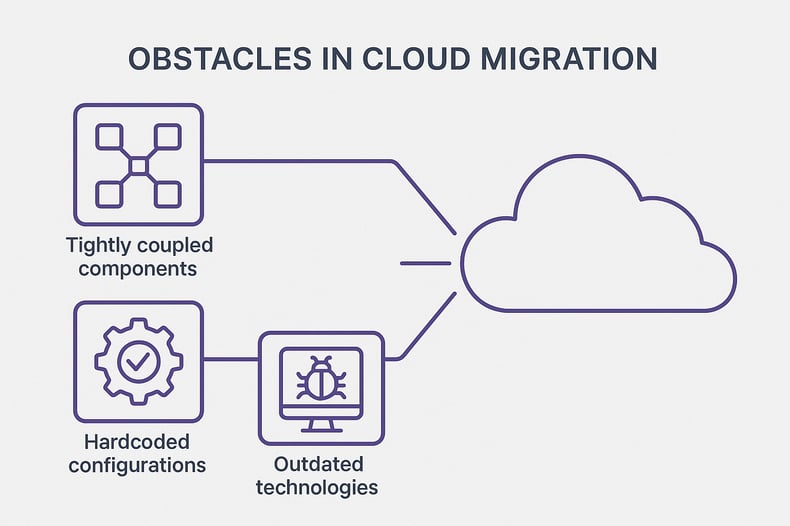
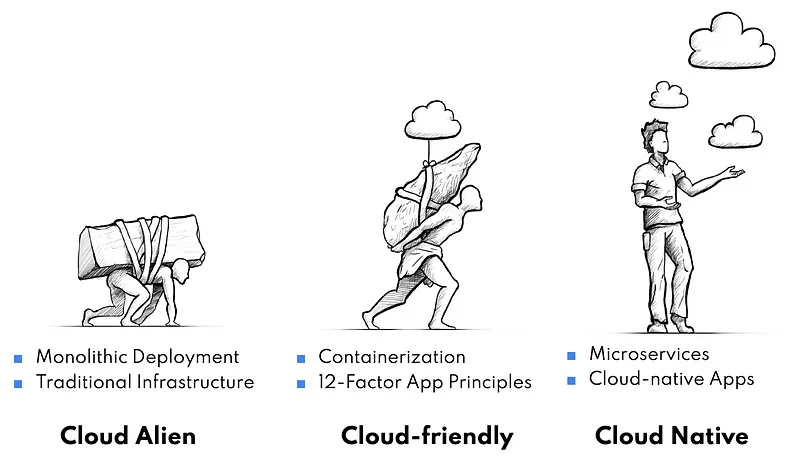
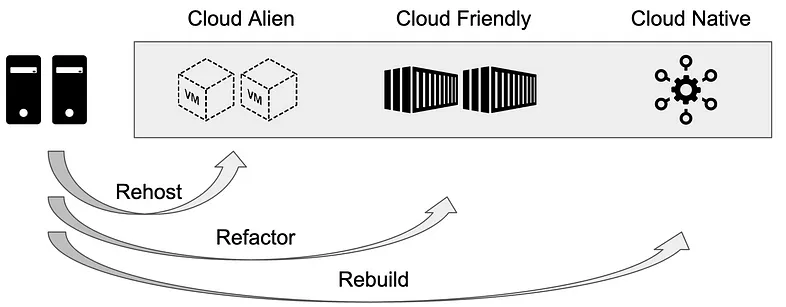
Migrating applications to the cloud is a complex endeavour with substantial technical and organisational implications. It requires assessing cloud readiness, selecting the right migration strategy, and adapting code where necessary. Automated tools now play a key role in streamlining both analysis and transformation. This article presents two open-source tools, the CNCF project Konveyor and OpenRewrite by Moderne, that aid in planning and executing Java-based enterprise application migrations. We cover both strategic considerations and technical workflows down to code-level adjustments. Cloud platforms promise scalability, resilience, automation, and cost control. Legacy systems, however, are often monolithic and tightly coupled to specific infrastructures. Successful migration demands tailored strategies; neither simple “lift and shift” nor full rewrites are always optimal. Effective projects balance cost, functionality, and modernisation. They rely on interdisciplinary teams, clear communication, and tools that deliver transparent analyses and reproducible changes. Konveyor helps evaluate migration needs, while OpenRewrite automates code updates—addressing common issues like classpath conflicts, logging frameworks, configuration, and legacy servlet containers. Cloud migration is not merely a technical exercise; it is an architectural decision with far-reaching consequences. It affects source code, build processes, infrastructure dependencies, deployment strategies, and security requirements. Common technical obstacles include: Typical obstacles in cloud migration. Image generated with ChatGPT. Another challenge is the lack of a consistent testing strategy. Applications without reproducible builds, automated tests, or Infrastructure-as-Code are difficult to integrate into automated CI/CD pipelines—yet such pipelines are essential for cloud-native operations. A central concept we use at QAware in cloud readiness assessments is categorising applications into three groups: Cloud Readiness Categories. Konveyor uses a similar classification that the analysis generates automatically and transparently. Key checks include: The Konveyor project has three key components: A CLI tool called Kantra that encapsulates the analysis capability into a standalone command-line interface. It analyses source code and dependencies, produces reports that highlight migration blockers and provides actionable insights. A new component to include AI capabilities called Konveyor AI. It is using the analysis results and provides automatic fixes using Generative AI. This component is still evolving, but it is promising. Konveyor’s analysis uses static code analysis and heuristics, detecting elements such as JDBC statements, web frameworks, hardcoded paths, or To analyze a Java application using the Konveyor CLI tool Kantra, you can follow these steps: Install the Kantra CLI by downloading it from the Kantra releases page. Kantra generates the report in HTML format inside the specified output directory ( Example report generated from the analysis. With the report you can assess the cloud readiness of your application, identify potential migration blockers, and provide actionable insights for refactoring or modernisation efforts. Based on the analysis results, teams can select a migration strategy that fits their application landscape and business goals. In practice, three core migration strategies have emerged, each with distinct goals, efforts, and risks. Cloud Migration Strategies. The developer of the application moves it to the cloud without modifications. This approach is fast and requires minimal development effort but delivers no structural improvements. It is often used for short-term capacity needs or infrastructure transitions (e.g., data center shutdowns). Technically, this can mean migrating VMs 1:1 to IaaS offerings like AWS EC2 or Azure VM, preserving most existing CI/CD pipelines. Downsides include limited scalability, restricted observability, and modest cost benefits—often leading to “Cloud in Name Only” scenarios. The developer adapts the application to cloud-native paradigms, typically involving: Refactoring is common for functionally stable but technically outdated applications. It enables debt reduction, observability (Prometheus, Grafana, OpenTelemetry), resilient Kubernetes deployments, and future-proof scaling. Tools like OpenRewrite facilitate this through rule-based, reproducible code changes. The developer performs a complete rewrite based on modern cloud architectures. A rewrite is necessary when: Typical technologies include microservices, serverless components (AWS Lambda, Azure Functions), and event-driven designs. Rebuilding is costly but forward-looking, with ROI tied to innovation potential. Most real-world migrations blend strategies, for example, refactoring the transactional core while rehosting auxiliary modules, combining quick ROI with long-term modernisation. Successful migration balances business continuity with technical renewal. While Konveyor focuses on analysis and strategy planning, OpenRewrite takes the next step: automated code modifications based on declarative rules. At its core, OpenRewrite parses code into a full Abstract Syntax Tree (AST), enabling semantically precise transformations. So-called recipes define the transformation logic as modular, reusable and versionable components. OpenRewrite provides a rich set of community recipes for common migration tasks, such as: Using Maven, it is easy to integrate OpenRewrite into your build process and apply a specific recipe. The following example demonstrates how to upgrade a Spring Boot application from version 2.x to 3.4, which includes significant changes such as Jakarta EE namespace migration. OpenRewrite lets you go beyond community rules by authoring your own recipes. You can do this declaratively with YAML (compose existing building blocks) or imperatively with Java (full control over AST‑level transformations). A pragmatic middle path is to start from Refaster‑style templates to scaffold simple Java recipes quickly. When to use: composition, quick wins, and centrally managed policy roll‑outs. Example Pros Cons When to use: complex, context‑aware refactorings that require AST access. Minimal Recipe Skeleton Pros Cons Use Refaster‑style before/after patterns to generate Java visitors. Example When to use Benefits With the rise of powerful Large Language Models (LLMs) like GPT‑5 or Claude 4, the question arises: how can these technologies contribute to cloud migration? Unlike rule‑based tools such as OpenRewrite, LLMs operate probabilistically—leveraging statistical language models trained on large code bases and text corpora. Promising use cases for LLMs in migration include: The strengths of LLMs lie in their: However, LLMs also have significant limitations: Combined with rule‑based tools like OpenRewrite and analysis frameworks like Konveyor, LLMs could serve as a “creative complement” for: A hybrid solution with reproducibility and contextual understanding emerges as a promising approach. Konveyor already explores this direction with its Konveyor AI component, which integrates LLM capabilities into the migration process. Migrating to the cloud demands strong architectural understanding, high code quality, and precise planning. It is rarely a linear process—instead, it is an iterative cycle of analysis, decision-making, adaptation, and validation. This is where open-source tools like Konveyor and OpenRewrite demonstrate their full value: Together, they form a complementary toolset: analysis and execution, strategy and implementation, transparency and automation. For organisations aiming to future-proof their software landscapes, these tools offer a scalable, open, and well-integrated path to the cloud. Free of black-box behaviour, but with clear rules, high reusability, and growing community support. However, the future lies in the combination: Konveyor and OpenRewrite for structured migration, LLMs for creative enhancements, embedded into DevOps processes and cloud-native principles. Migration thus becomes not a one-time effort, but a continuous modernisation process - scalable, traceable, and automated.Introduction - Navigating Cloud Migrations
Why It Matters
Keys to Success
Challenges – Making Complexity Visible
Assessing Cloud Readiness With Konveyor
Overview Of The Konveyor Project
sun.* classes. The output is available in HTML or JSON and can integrate directly into CI/CD pipelines.Example: Analysing A Java Application With The Konveyor CLI Kantra
kantra \
  analyze \
  -i /path/to/your/java/application \
  -o ../out \
  --mode source-only \
  --target cloud-readiness
../out in this example).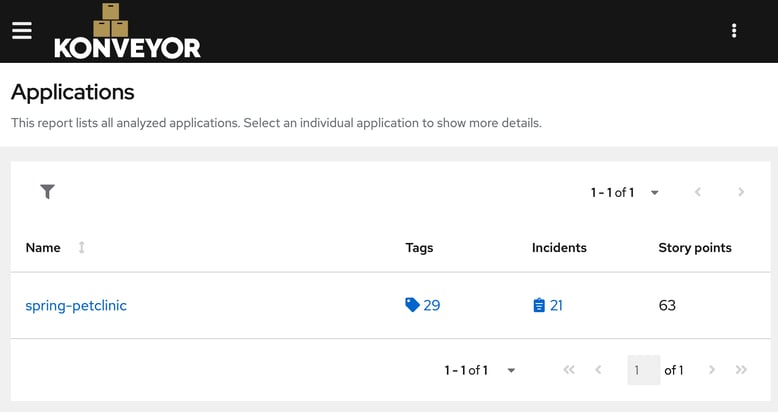
Migration Strategies – Three Paths To The Cloud
Rehosting (“Lift & Shift”)
Refactoring
Rebuilding
Hybrid Approaches
OpenRewrite – Automated Code Transformation
Common Transformation Recipes
Example: Upgrading Spring Boot From 2.X To 3.X
pom.xml under <plugins> <plugin>
<groupId>org.openrewrite.maven</groupId>
<artifactId>rewrite-maven-plugin</artifactId>
<version>6.15.0</version> <!-- Update to latest version -->
<configuration>
<activeRecipes>
<recipe>org.openrewrite.java.spring.boot3.UpgradeSpringBoot_3_4</recipe>
</activeRecipes>
<activeStyles>
<style>org.openrewrite.java.SpringFormat</style>
</activeStyles>
</configuration>
<dependencies>
<dependency>
<groupId>org.openrewrite.recipe</groupId>
<artifactId>rewrite-spring</artifactId>
<version>6.11.1</version> <!-- Update to latest version -->
</dependency>
</dependencies>
</plugin>
mvn rewrite:run
Creating Custom Rules
Extending OpenRewrite With Custom Recipes
Declarative (YAML)
# Compose existing recipes to roll out standards
name: com.company.platform.baseline
recipeList:
  - org.openrewrite.java.dependencies.UpgradeDependencyVersion:
      groupId: org.springframework.boot
      artifactId: spring-boot-starter
      newVersion: 3.3.x
  - org.openrewrite.java.RemoveUnusedImports
  - org.openrewrite.java.format.AutoFormat
Imperative (Java)
@DocumentExample
public class ReplaceSystemOutWithSlf4j extends Recipe {
  @Override public String getDisplayName() { return "Use SLF4J instead of System.out"; }
  @Override public TreeVisitor getVisitor() {
    return new JavaIsoVisitor<>() {
      @Override public J.MethodInvocation visitMethodInvocation(J.MethodInvocation m, ExecutionContext ctx) {
        m = super.visitMethodInvocation(m, ctx);
        if (m.getSimpleName().equals("println") &&
            TypeUtils.isOfClassType(m.getSelect().getType(), "java.io.PrintStream")) {
          return m.withName(m.getName().withSimpleName("info"))
                  .withSelect(JavaParser.parseExpression("logger"));
        }
        return m;
      }
    }; }
}
Refaster Templates (Middle Ground)
>
import com.google.errorprone.refaster.annotation.AfterTemplate;
import com.google.errorprone.refaster.annotation.BeforeTemplate;

@RecipeDescriptor(
    name = "Prefer StringIsEmpty",
    description = "Prefer String#isEmpty() over alternatives that check the string's length."
)
public class StringIsEmpty {
  @BeforeTemplate
  boolean equalsEmptyString(String string) {
    return string.equals("");
  }

  @BeforeTemplate
  boolean lengthEquals0(String string) {
    return string.length() == 0;
  }

  @AfterTemplate
  boolean optimizedMethod(String string) {
    return string.isEmpty();
  }
}
The Potential Of LLMs In Cloud Migrations: Complementary Intelligence
Potential Applications
Advantages
Limitations
Outlook
Conclusion: Automation As The Key To Scalable Migration