Update: after 10 weeks of processing my audiobook submission, Audible published the audiobook in its platform, on 13 February 2025. You can get the book here – though if you do not have a strong preference, I suggest buying the book either directly, or from any other audiobook platform that treats authors and publishers fairly. As you'll see below: Audible does not, but it has a de facto monopoly with audiobooks. Below is the article, as published on 10 Dec 2024.
Currently, Audible’s position is hurting audiobook authors. My audiobook w on Audible due to a mix of their monopolistic pricing practices, and the company’s own complacency in how long they take to approve new titles.
A year after The Software Engineer’s Guidebook was published, the audiobook version is here! The good news is it’s available on ALMOST all major audiobook platforms:
- Directly purchase the audiobook as mp3 files. You can upload these to any device or app you prefer to listen on. You can use apps like BookPlayer (iOS), Smart Audiobook player (Android) and many others to listen to the audiobook after downloading it.
- Spotify: a challenger audiobook platform that offers listening up to 10 hours of free audiobook listening per month in some countries, as part of its Premium plan.
- Apple Books
- Google Play
- Other audiobook platforms like Libro.fm, Barnes & Noble, Kobo, Audiobooks.com and Storytel
The very clearly missing platform is Audible.
Audible is a model example of a Big Tech company with an invisible de facto monopoly of a market. Customers are happy, but authors and publishers are not. I suddenly find myself directly impacted by such practices that go unchallenged, and which won’t change without competition or regulation. Now is a good time to talk about that.
So, why is the audiobook of The Software Engineer's Guidebook not on Audible?
Originally, I really wanted to avoid supporting a business that treats authors and publishers like only a monopolistic company can. But it’s clear that most of my readers prefer to listen on Audible. For this reason, I’ve made the book available on Audible, although I recommend purchasing it anywhere except there.
However, Audible’s unusually slow approval process means my audiobook isn’t even available on Amazon’s platform, yet. I submitted the book to Audible at the same time as I did for every other platform, six days ago. In a sign that Audible is way too comfortable in its position, they can take up to 25 days to approve new books in busy times like now – though the official estimate from Amazon is 14 business days (3 weeks). So, it will be on sale there when approval happens, likely either late 2024, or early 2025.
Audible’s domination
In 2008, Amazon acquired audiobook startup Audible for $300M, and kept it as a separate brand while integrating it nicely with Amazon’s books and e-books features. The strategy worked wonderfully: today, Audible is the clear market leader in audiobooks. In 2022, it had a dominant, 63.4% market share in the US, as per IbisShare.
I ran my own survey in November last year, asking people wanting to buy the audiobook version of this:
“Which platform would you be interested in getting this book on?”
Following 159 responses, the results illustrated Audible dominance – though one possibly challenged by Spotify:
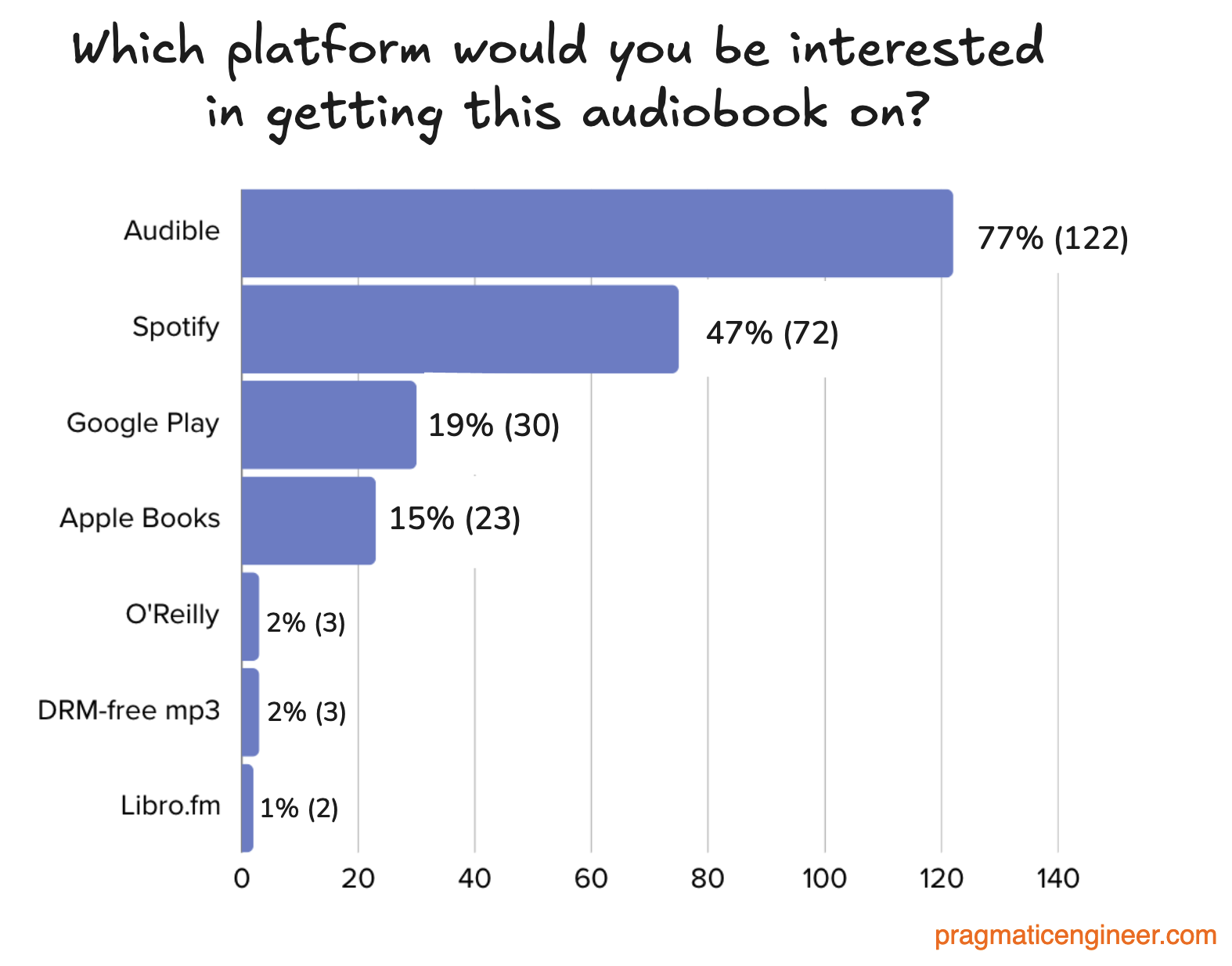
It’s clear most people would prefer to use Audible. I’m sorry that the book is not yet available – we’re getting into Audible contributing to this.
Amazon’s monopolistic pricing with Kindle and Audible
“Take rate” refers to the percentage of revenue a platform takes from merchants selling on it. Take rate examples:
- 2.9% + $0.30: the take rate Stripe charges per transaction
- 10%: the take rate that Substack charges (the newsletter platform this publication uses)
- 30%: the take rate Apple’s App Store and Google Play charges. This is the take rate that the EU is investigating, and which Epic Games has noisily contested.
- 30% + data transfer fees: the take rate Amazon Kindle charges for e-books priced at $9.99 or below. Data transfer fees refer to the cost of 3G or 4G connection to download the book – which fee is free for the customer, but is deducted from the publisher.
- 40%: the take rate Amazon.com charges for physical goods sold on their platform, such as books
- 50-60%: the take rate book stores typically charge when selling physical books
When it comes to audiobooks, Audible has alarmingly high take rates:
- 60%: take rate for audiobooks that are exclusively on Audible, meaning they cannot be sold anywhere else.
- 75%: the take rate for non-exclusive audiobooks.
A 75% take rate means authors need to sell 3x as much worth of revenue on Audible to make the same revenue as on any other platform. Let's take a specific example: my audiobook cost about $10,000 to produce (mostly in narrator costs). Selling it as $20, how many sales would it take on Audible – a platform with a 75% take rate – versus on Apple Books – one with a 30% take rate – to break even? The numbers:

Clearly, having a 75% take rate is booming business for Audible!
But how can Amazon command such sky-high take rates for what is effectively storing and streaming mp3 files, as well as building and maintaining the Audible app? It’s most likely because they dominate the market and can charge almost what they like because customers prefer Audible.
A take rate for digital goods that’s above 50% is something I associate with monopolistic pricing. Already on Amazon Kindle, Amazon sets a 65% take rate for any book priced at $10 or above. So, when buying the $25.99 ebook on Amazon, Amazon makes $16.90, and the publisher (me!) gets $9.
Monopolistic pricing is bad for consumers. Have you noticed there are few to no ebooks priced between $10 and $20? They are either $9.99, or start from $20-21 upwards.
Amazon’s Kindle pricing policy makes it illogical to price ebooks between the $10 and $20 range because books priced between this range result in less revenue for the publisher, than if they sold the book at $9.99:

This pricing policy most likely means e-books that would otherwise be listed in the $10-20 range, are sold to customers for $10 more.
Regarding Amazon’s Kindle hardware, two things can be argued as defences:
- Amazon does not “punish” books e-books sold outside of Amazon Kindle with a worse royalty rate
- Amazon created Kindle and its software ecosystem from scratch; a sizable investment. Without Amazon’s Kindle device, the market for e-books would likely be much smaller
Audible’s smart play to lock out competitors
Interestingly, Audible has a significantly higher take rate rate for audiobooks (60% or 75%) than Kindle has for e-books (30% or 65%), despite Audible not having created custom hardware for audiobooks. It has something just as valuable though: the largest exclusive collection of audiobooks!
Audible manages to maintain its lead in exclusivity by offering to lower its take rate for Audible-exclusive audiobooks. And if we assume that Audible, indeed, has 65% market share: then a publisher will probably make more money if it releases the audiobook exclusively on Audible, and gets paid 62% more per book (by being offered a 40% royalty, instead of a 25% one. Therefore, it makes $4 on a $10 audiobook, rather than $2.50).
Until Audible’s market share drops below 50%, it’s a financially bad decision to not sell audiobooks exclusively on Audible. With this tactic, Audible achieves two things at once:
- Maintain a very high 60% take rate by dominating the audiobooks market
- Strengthen its status by incentivizing audiobooks to be exclusive to Audible
In 2022, best-selling fantasy novel author, Brandon Sanderson, had concluded that the way Audible treats authors and publishers is unfair. He made the then unprecedented move of not releasing his latest audiobooks on Audible, at all; instead making them available for purchase directly, and putting them on Spotify. In his words:
“But Audible has grown to a place where it’s very bad for authors. It’s a good company doing bad things. (...)They treat authors very poorly. Particularly indie authors. The deal Audible demands of them is unconscionable, and I’m hoping that providing market forces (and talking about the issue with a megaphone) will encourage change in a positive direction. (...)
Each book you buy somewhere else [than Audible] helps break open this field. It will lead to lower prices, fewer subscription models, and better pay for authors. Plus, these partners I’ve gone to really deserve the support for being willing to try to change things.”
Sanderson’s effort to force Audible to treat authors more fairly seemed to work. A year later, Audible offered a much better financial deal for Sanderson, who took the deal, but only because Amazon said they’d roll out the same royalty structure to all authors. From Sanderson’s follow-up post:
“Audible has promised to release their new royalty system for all authors sometime in 2024, though I should be testing it in the next month or so.And…if you’ll allow me a moment, I’d like to say that this feels good. It isn’t what I wanted, but I’d begun to think that nothing would ever change–that even my voice, loud though it can be, wouldn’t be enough. Yet change IS possible.”
Audible drags its feet
In July, Audible announced a new royalty model with fairer rates for authors and publishers, is coming. However, the announcement lacks specifics, and the model doesn’t apply to authors like me.
Amazon encourages authors to reach out to Audible over an email “for more information.” I did this, asking how I can be part of the same royalty model that was promised for all authors to come in 2024. I received no meaningful answer.
Audible has no incentive to lower its take rates. The company would be giving up revenue, and unless there’s a competitor, or a regulator, forcing them to change course, it runs counter to the company’s interests.
I predict that eventually a regulator could launch a probe into potentially anti-competitive pricing practices by Audible. But if it happens, a resolution is years away. Meanwhile, customers will face higher audiobook prices, and authors and publishers on Audible will continue to de-prioritize audiobooks due to the relatively low earnings, compared to paperbacks and e-books.
If possible, avoid Audible for audiobooks
Audible is a fantastic product for customers, and Amazon has done a lot to make audiobooks more popular and widespread. Even so, it continues to treat authors and publishers poorly, offering pretty empty-looking commitments to improve things. Know that any time you purchase an audiobook on Audible, 60-75% goes directly to Amazon. On other platforms, this rate is never more than 30%. So, even if you spend the same amount on an audiobook outside of Audible, the author/publisher earns at least double.
I have no illusions about changing a Big Tech giant’s policy for audiobook authors. This is especially true after seeing what happened with Brandon Sanderson, who selflessly fought to secure a better deal for all authors, only for Amazon to not change anything for most of them.
If you would like to see more and better audiobooks at more competitive prices, then purchasing audiobooks anywhere except Audible is a small thing that can, over time, make a difference.
Spotify to challenge Audible?
The most straightforward way to make Audible offer fairer pricing to authors is if it faces a significant competitor which enables authors to deprioritize Audible.
Spotify is a product for which audiobooks are a pretty natural extension of its existing offering. Spotify has been aggressively investing in this area; it came up with the concept of 10 hours of free audiobooks for paying subscribers, while balancing royalties at a level well above Audible’s.
It’s strange to find myself rooting for an already giant company; Spotify is valued at $100B, in this potential audiobook battle between two titans. Still, it feels like Spotify operates with a startup mentality: they want to aggressively grow, and treat customers and authors alike as best they can. Currently, Audible is a cash cow product, where the likely business goal is to keep extracting revenue from the customer base, and to innovate as little as necessary, all while growing increasingly complacent.
A lack of “hustle” is visible in how Audible operates today. As a reminder, the primary reason why The Software Engineer’s Guidebook is not on Audible, but can be purchased on every other relevant marketplace, is that Audible takes 2-3x longer to approve and list an audiobook than any competitor.
Are market forces gathering which will force Audible to change its ways? While we wait to find out, you can get the new audiobook of my latest title on any of these platforms.
I hope you enjoy the audiobook of “The Software Engineer's Guidebook”. It has been a long process, but I’m really happy with how the spoken word version has turned out. There are many ways to purchase this title which support myself as an author/publisher. And who knows, it should be on Audible soon, too; as and when the world’s most important audiobook platform gets around to listing it.
If you're interested how I created the audiobook: I cover this in more detail in Creating the Audiobook.
Subscribe to my weekly newsletter to get articles like this in your inbox. It's a pretty good read - and the #1 tech newsletter on Substack.