In functional programming, the notion of dependencies must be rejected. Instead, applications should be composed from pure and impure functions.
This is the third article in a small article series called from dependency injection to dependency rejection. In the previous article in the series, you learned that dependency injection can't be functional, because it makes everything impure. In this article, you'll see what to do instead.
Indirect input and output #
One of the first concepts you learned when you learned to program was that units of operation (functions, methods, procedures) take input and produce output. Input is in the form of input parameters, and output is in the form of return values. (Sometimes, though, a method returns nothing, but we know from category theory that nothing is also a value (called unit).)
In addition to such input and output, a unit with dependencies also take indirect input, and produce indirect output:
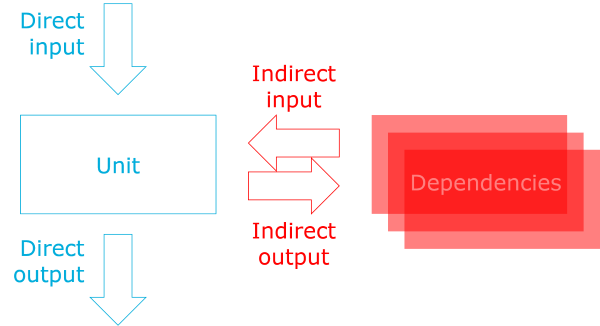
When a unit queries a dependency for data, the data returned from the dependency is indirect input. In the restaurant reservation example used in this article series, when tryAccept calls readReservations, the returned reservations are indirect input.
Likewise, when a unit invokes a dependency, all arguments passed to that dependency constitute indirect output. In the example, when tryAccept calls createReservation, the reservation value it uses as input argument to that function call becomes output. The intent, in this case, is to save the reservation in a database.
From indirect output to direct output #
Instead of producing indirect output, you can refactor functions to produce direct output.
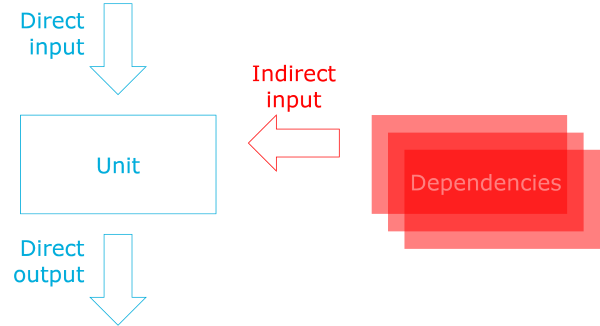
Such a refactoring is often problematic in mainstream object-oriented languages like C# and Java, because you wish to control the circumstances in which the indirect output must be produced. Indirect output often implies side-effects, but perhaps the side-effect must only happen when certain conditions are fulfilled. In the restaurant reservation example, the desired side-effect is to add a reservation to a database, but this must only happen when the restaurant has sufficient remaining capacity to serve the requested number of people. Since languages like C# and Java are statement-based, it can be difficult to separate the decision from the action.
In expression-based languages like F# and Haskell, it's trivial to decouple decisions from effects.
In the previous article, you saw a version of tryAccept with this signature:
// int -> (DateTimeOffset -> Reservation list) -> (Reservation -> int) -> Reservation
// -> int option
The second function argument, with the type Reservation -> int, produces indirect output. The Reservation value is the output. The function even violates Command Query Separation and returns the database ID of the added reservation, so that's additional indirect input. The overall function returns int option: the database ID if the reservation was added, and None if it wasn't.
Refactoring the indirect output to direct output is easy, then: just remove the createReservation function and return the Reservation value instead:
// int -> (DateTimeOffset -> Reservation list) -> Reservation -> Reservation option
let tryAccept capacity readReservations reservation =
    let reservedSeats =
        readReservations reservation.Date |> List.sumBy (fun x -> x.Quantity)
    if reservedSeats + reservation.Quantity <= capacity
    then { reservation with IsAccepted = true } |> Some
    else None
Notice that this refactored version of tryAccept returns a Reservation option value. The implication is that the reservation was accepted if the return value is a Some case, and rejected if the value is None. The decision is embedded in the value, but decoupled from the side-effect of writing to the database.
This function clearly never writes to the database, so at the boundary of your application, you'll have to connect the decision to the effect. To keep the example consistent with the previous article, you can do this in a tryAcceptComposition function, like this:
// Reservation -> int option
let tryAcceptComposition reservation =
    reservation
    |> tryAccept 10 (DB.readReservations connectionString)
    |> Option.map (DB.createReservation connectionString)
Notice that the type of tryAcceptComposition remains Reservation -> int option. This is a true refactoring. The overall API remains the same, as does the behaviour. The reservation is added to the database only if there's sufficient remaining capacity, and in that case, the ID of the reservation is returned.
From indirect input to direct input #
Just as you can refactor from indirect output to direct output can you refactor from indirect input to direct input.
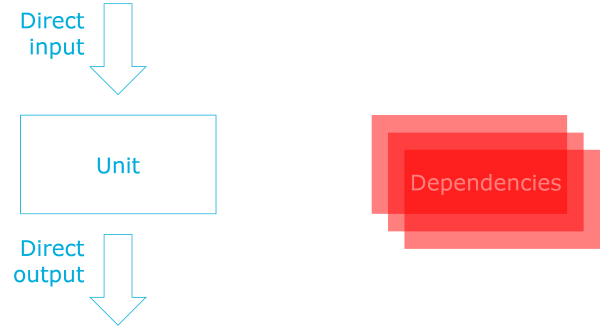
Again, in statement-based languages like C# and Java, this may be problematic, because you may wish to defer a query, or base it on a decision inside the unit. In expression-based languages you can decouple decisions from effects, and deferred execution can always be done by lazy evaluation, if that's required. In the case of the current example, however, the refactoring is easy:
// int -> Reservation list -> Reservation -> Reservation option
let tryAccept capacity reservations reservation =
    let reservedSeats = reservations |> List.sumBy (fun x -> x.Quantity)
    if reservedSeats + reservation.Quantity <= capacity
    then { reservation with IsAccepted = true } |> Some
    else None
Instead of calling a (potentially impure) function, this version of tryAccept takes a list of existing reservations as input. It still sums over all the quantities, and the rest of the code is the same as before.
Obviously, the list of existing reservations must come from somewhere, like a database, so tryAcceptComposition will still have to take care of that:
// ('a -> 'b -> 'c) -> 'b -> 'a -> 'c
let flip f x y = f y x

// Reservation -> int option
let tryAcceptComposition reservation =
    reservation.Date
    |> DB.readReservations connectionString
    |> flip (tryAccept 10) reservation
    |> Option.map (DB.createReservation connectionString)
The type and behaviour of this composition is still the same as before, but the data flow is different. First, the function queries the database, which is an impure operation. Then, it pipes the resulting list of reservations to tryAccept, which is now a pure function. It returns a Reservation option that's finally mapped to another impure operation, which writes the reservation to the database if the reservation was accepted.
You'll notice that I also added a flip function in order to make the composition more concise, but I could also have used a lambda expression when invoking tryAccept. The flip function is a part of Haskell's standard library, but isn't in F#'s core library. It's not crucial to the example, though.
Evaluation #
Did you notice that in the previous diagram, above, all arrows between the unit and its dependencies were gone? This means that the unit no longer has any dependencies:
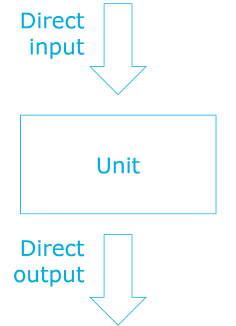
Dependencies are, by their nature, impure, and since pure functions can't call impure functions, functional programming must reject the notion of dependencies. Pure functions can't depend on impure functions.
Instead, pure functions must take direct input and produce direct output, and the impure boundary of an application must compose impure and pure functions together in order to achieve the desired behaviour.
In the previous article, you saw how Haskell can be used to evaluate whether or not an implementation is functional. You can port the above F# code to Haskell to verify that this is the case.
tryAccept :: Int -> [Reservation] -> Reservation -> Maybe Reservation
tryAccept capacity reservations reservation =
  let reservedSeats = sum $ map quantity reservations
  in  if reservedSeats + quantity reservation <= capacity
      then Just $ reservation { isAccepted = True }
      else Nothing
This version of tryAccept is pure, and compiles, but as you learned in the previous article, that's not the crucial question. The question is whether the composition compiles?
tryAcceptComposition :: Reservation -> IO (Maybe Int)
tryAcceptComposition reservation = runMaybeT $
  liftIO (DB.readReservations connectionString $ date reservation)
  >>= MaybeT . return . flip (tryAccept 10) reservation
  >>= liftIO . DB.createReservation connectionString
This version of tryAcceptComposition compiles, and works as desired. The code exhibits a common pattern for Haskell: First, gather data from impure sources. Second, pass pure data to pure functions. Third, take the pure output from the pure functions, and do something impure with it.
It's like a sandwich, with the best parts in the middle, and some necessary stuff surrounding it.
Summary #
Dependencies are, by nature, impure. They're either non-deterministic, have side-effects, or both. Pure functions can't call impure functions (because that would make them impure as well), so pure functions can't have dependencies. Functional programming must reject the notion of dependencies.
Obviously, software is only useful with impure behaviour, so instead of injecting dependencies, functional programs must be composed in impure contexts. Impure functions can call pure functions, so at the boundary, an application must gather impure data, and use it to call pure functions. This automatically leads to the ports and adapters architecture.
This style of programming is surprisingly often possible, but it's not a universal solution; other alternatives exist.