A fairness layer for CI that saves money by slowing you down just enough.
TL;DR
CI is too fast, engineers are too parallel, and cloud bills are too real.
The CI Arcade introduces a token-gated queue that meters the blast radius of human enthusiasm. One job at a time. Sometimes.
The Pitch
- Cut CI concurrency without saying “we cut CI concurrency”
- Align engineering behavior with finance targets using playful “game” mechanics
- Make throughput feel like a privilege you earn, not a utility you expect
Core Mechanics
You don’t run CI. You buy a turn.
Token lifecycle
- One active token per user. No token, no CI
- Tokens are consumed on job completion
- Forced issuance lets a user eject their currently running job to get a fresh token. Brutal but fair
Golden path flow
1. User requests token generation.
   - Check for existing active token.
     - If active token exists: Notify user (cannot generate new token).
     - If no active token: Generate new token and mark as active.

2. User requests forced token issuance.
   - Check for active job.
     - If job is running: Terminate job, mark existing token as invalid.
   - Generate new token and mark as active.

3. User provides active token to run CI job.
   - Check token status.
     - If valid: Run CI job, mark token as used upon completion.
     - If invalid: Notify user (token no longer valid).

4. Log CI job result and token used.
   - Provide feedback to user about job outcome.
Sequence diagram
sequenceDiagram actor Dev as Developer participant TA as Token API participant CQ as CI Queue participant ER as Executor Runner participant LG as Logger Dev->>TA: Request token TA-->>Dev: Token or "you already have one" Dev->>CQ: Submit job with token CQ->>TA: Validate token TA-->>CQ: Valid CQ->>ER: Start job ER-->>CQ: Job finished (success/fail) CQ->>TA: Mark token used CQ->>LG: Log job result + token id LG-->>Dev: Feedback summary
Token state machine
stateDiagram-v2 [*] --> None None --> Active: Generate Active --> Used: Job completes Active --> Invalid: Force issue (kill running job) Invalid --> Active: New token generated Used --> Active: New token generated
UI Concepts
Interface specifications. Lo-fi prototypes pending design review.
1) Home
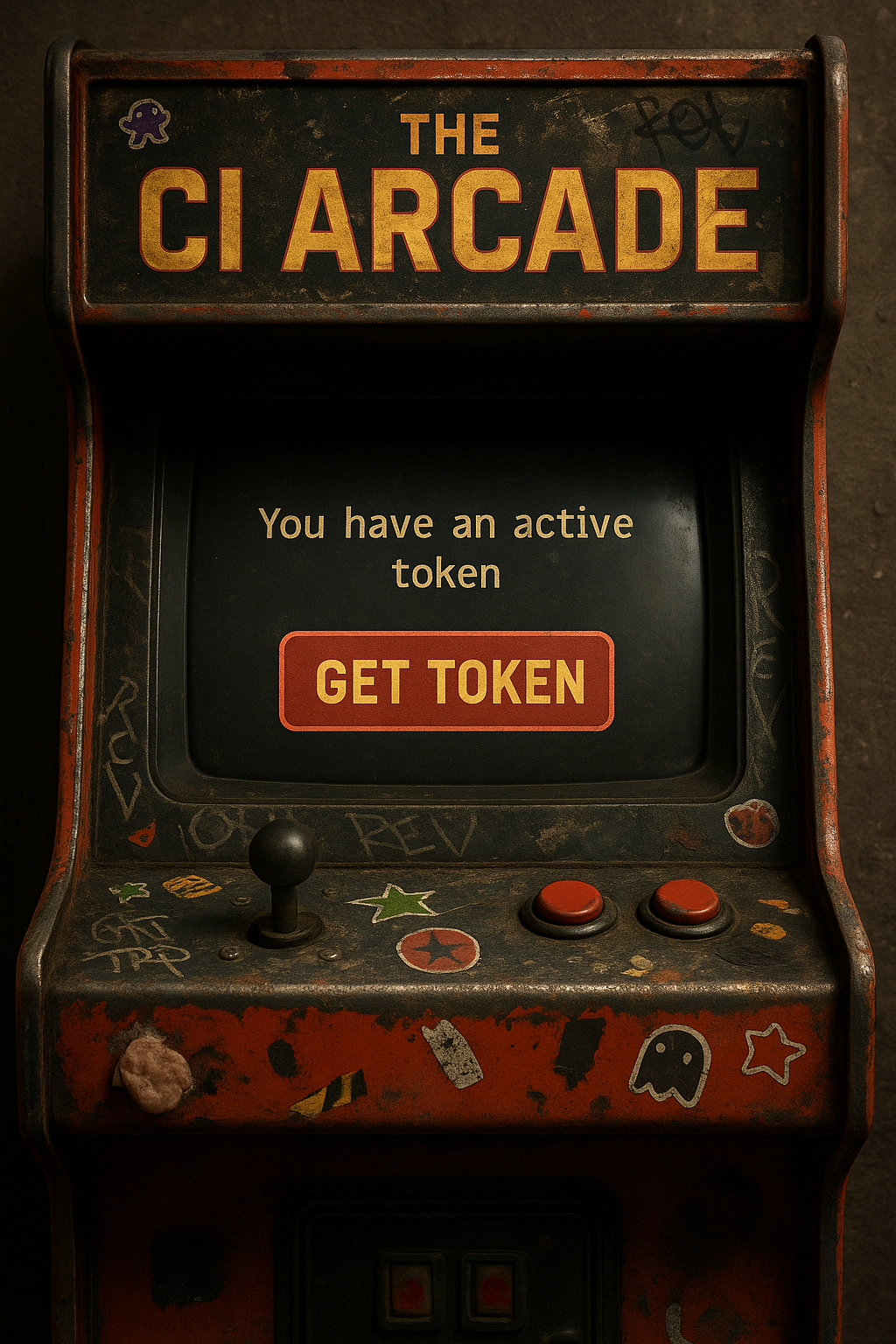
- Big “Get Token” button
- “You have an active token” banner with a sad timer that counts up, not down
2) Queue + Force Issue
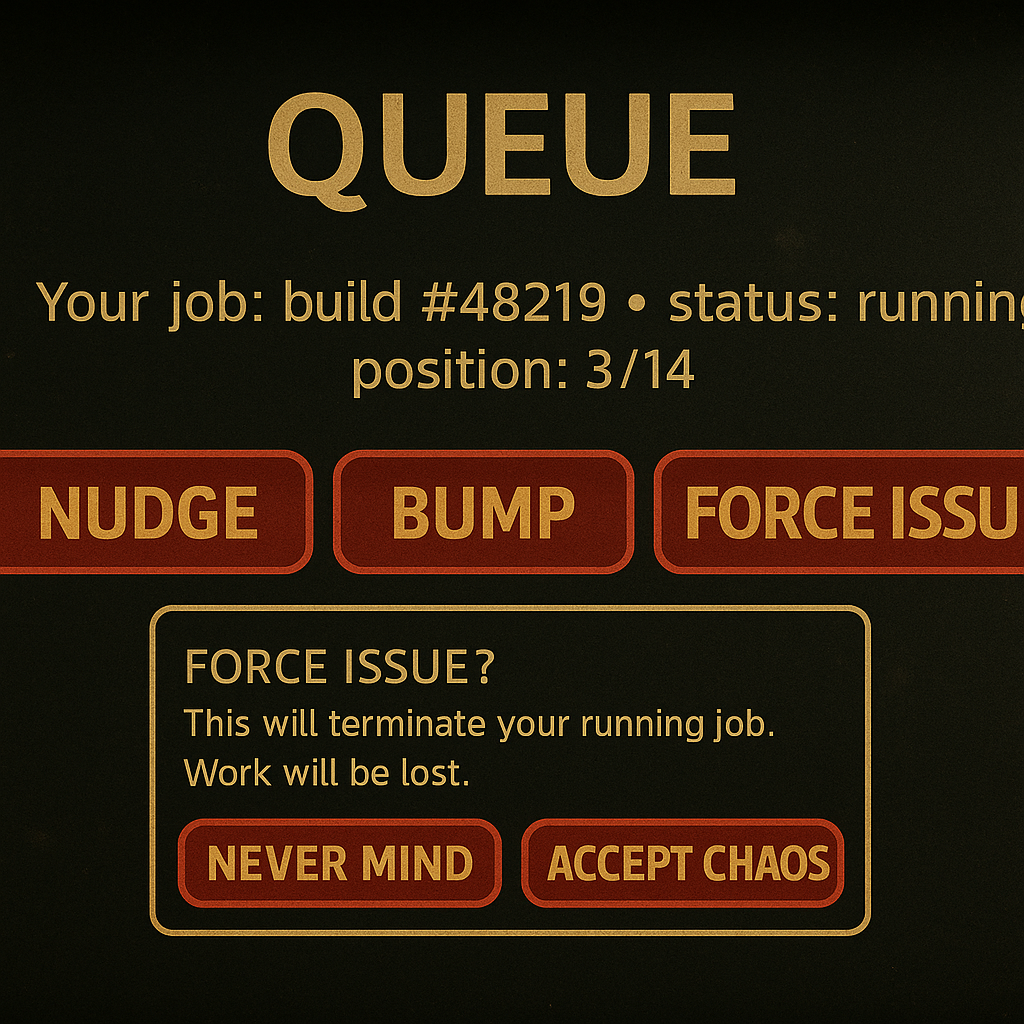
- Status + position in line
- Nudge/Bump controls
- Destructive Force Issue modal with “I accept the chaos”
3) Leaderboards + Finance
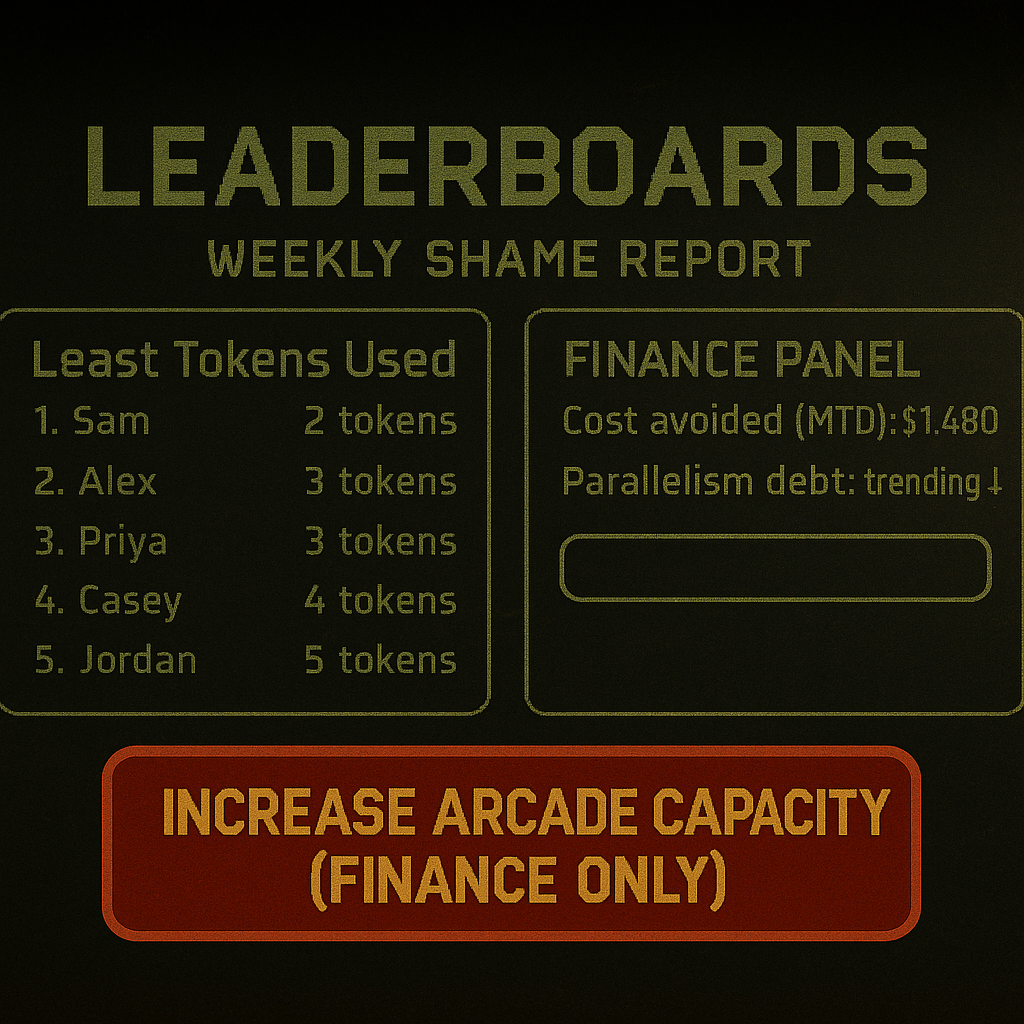
- Least Tokens Used (weekly)
- Finance panel with “Increase Arcade Capacity (Finance only)”
Workflows
“Happy” path
- Developer requests token
- Gets one
- Runs job
- Token is marked used when job completes
Result: Single-flight behavior. Cheap. Calm. Boring. Perfect.
“Panic refactor” path
- Developer spams commits
- Sees “active token exists”
- Tries Force Issue
- Running job is terminated, token invalidated, new token created
- Runs new job
Result: The Arcade discourages thrash with self-inflicted pain. Finance smiles.
“Oops stale token” path
- Developer tries to run a job with an invalid token
- Gets told it’s invalid
- Must request a new token like a normal human
Result: Order restored. Savings continue.
Pricing Theory
Free Soft concurrency caps. Leaderboard participation. Community norms.
Team — $8/seat/month Hard token enforcement. Audit logs. Manager dashboards. Monthly Arcade Health Report (PDF, branded).
Enterprise — Contact Sales
- Dedicated Arcade Success Manager
- Quarterly “Build Intentionality” workshops (CPD credits available in select regions)
- Custom Efficiency Score weighting aligned to your OKRs
- Concierge terminology review: all system strings audited for growth-positive language
- SLA: token issuance P99 < 45 s (intentional — supports deliberate commit practices)
- Joint “Capacity Planning” briefing with Finance, quarterly
SLOs
- Token issuance P50 under 200 ms
- Queue visibility P95 under 1 s
- Job kill-on-force-issue P99 under 3 s
- Monthly target: Arcade Efficiency Score ≥ 0.72 (see Appendix B for scoring model)
Governance and Compliance Theater
- Audit log stores:
- user_id
- token_id
- job_id
- action (issued, validated, consumed, invalidated, killed)
- timestamps
- reason (human text, e.g., “panic push”)
- Retention: 13 months so you can draw bad trend lines during budget season
- “Separation of duties”: only Finance can increase concurrency ceilings
Exemptions
- Staff+ engineers: token limits apply, but Force Issue is pre-authorized
- Incident responders: tokens auto-issued during active PagerDuty P0/P1 alerts
- Release managers during freeze windows: unlimited tokens, Finance-notified post-hoc
Change Management
| RFC | Title | Status | Owner |
|---|---|---|---|
| 000 | Rename “concurrency limit” to “Arcade Capacity” | Approved | Platform |
| 001 | Replace “job cancellation” with “graceful prize reclamation” | Approved | Comms |
| 002 | Happy Hour tokens (2–3 a.m. local) | Rejected — “encourages off-hours heroics” | Eng |
| 003 | Rebrand Force Issue as “Strategic Job Reconsideration” | In Review | Legal |
| 004 | Remove “chaos” from all user-facing strings | Approved | Brand |
Behavioral Design
- Commitment reinforcement: bonus token credits for users who maintain build frequency under 3/day. Encourages deliberate shipping.
- Community recognition: weekly digest highlights top contributors by Arcade Efficiency Score.
- Decision support: pre-confirmation modal on Force Issue surfaces estimated job completion percentage and time remaining. Users make informed choices.
FAQ
Isn’t this just a mutex for humans?
Yes. That’s the point.
Will engineers be slower? No. Engineers will be more intentional. Velocity is a measure of value delivered, not jobs launched. Internal pilots show a measurable reduction in context-switching overhead and a perceived throughput improvement of 12–18%. [n=14, 8 weeks, Platform team]
What about flaky tests?
Great news. You’ll notice them less often because you run fewer jobs.
How do I bypass this?
You don’t. Arcade Capacity is policy, not preference.
Launch Assets
flowchart LR A[Request Token] -->|Active exists| B[Notify: reuse it] A -->|No active| C[Generate Token] C --> D[Run Job with Token] D -->|Valid| E[Execute CI Job] D -->|Invalid| F[Notify: token invalid] E --> G[Mark Token Used] G --> H[Log: job + token + outcome]
Poster copy
- Headline: “Ship less. Save more.”
- Subhead: “Turns, not threads.”
- Footer: “The CI Arcade. One coin per run.”
Slack announcement
Arcade is live. You get one active token. Force Issue kills your job and gives you a new coin. Jobs without valid tokens are bounced. Leaderboards on Friday. Questions in #arcade-support.
How We “Measure Success”
- CI spend down 25–40%
- PRs linger longer but merges still happen
- Engineers report “less chaos” while privately seething
- Finance approves your next pet project because you “found savings”
Appendix: Mindful Builds Workshop Curriculum (90 min)
| # | Module | Duration |
|---|---|---|
| 1 | The Psychology of the Commit | 20 min |
| 2 | Token as Intention: Treating CI Resources as Finite | 25 min |
| 3 | Force Issue and the Ethics of Interruption | 15 min |
| 4 | Building a Personal Arcade Efficiency Practice | 20 min |
| 5 | Closing reflection + goal-setting | 10 min |
Facilitated by a certified Mindful Builds practitioner. CPD credits pending accreditation (expected Q2).
Appendix: Forced Issuance Flow
sequenceDiagram actor Dev as Developer participant TA as Token API participant CQ as CI Queue participant ER as Executor Runner Dev->>TA: Force issue request TA->>CQ: Is there a running job for this user/token? alt Yes CQ->>ER: Terminate job now ER-->>CQ: Job killed CQ->>TA: Mark token invalid else No TA-->>TA: Nothing to kill end TA-->>Dev: New active token issued