EIT Manufacturing just collapsed, leaving multiple startups without promised grants. EU funding’s structural failures go deeper than one fraud case. Read this before you apply for anything.
TL;DR: EIT Manufacturing, an EU-backed body that distributed grants of up to €500,000 to startups, filed for liquidation on March 25, 2026, leaving over 100 companies waiting for funds they were already promised. One Maltese startup spent €40,000 of its own money, was strung along with payment promises throughout 2025, and found out the truth when bankruptcy news hit the press. Then EITM’s CEO announced plans to set up a new legal entity and head back to Brussels for more public money. This is not a one-off fraud story. It is the latest symptom of a structural problem I have been writing about for years: the EU funding system is designed to protect itself, not the founders it claims to serve. You can still apply for EU grants. Just go in knowing the full picture.
Over 100 companies are sitting right now waiting for grant money that may never arrive. Some of them built their hiring plans around it. Some turned down other investors because they thought the EU grant was locked in. Many spent their own money first, because that is what the programme told them to do (which, by the way, is a disturbingly common practice with government funding, but this deserves its own piece).
If your organisation is owed money by EIT Manufacturing and you want to share your story, reach out.
The article is regularly updated as this is a developing story. Here are the most recent updates:
- The investigation by Follow the Money has been added (April 15, 2026)
- The story of Ioannis Kavazidis, startup founder and ex-employee of EIT Manufacturing (April 15, 2026)
- What to do if you are an entity that is owed money by EIT Manufacturing
- The liquidation process timeline and chances of success explained
- Response from an EIT Manufacturing representative who reached out to me (conversation ongoing, coming soon)
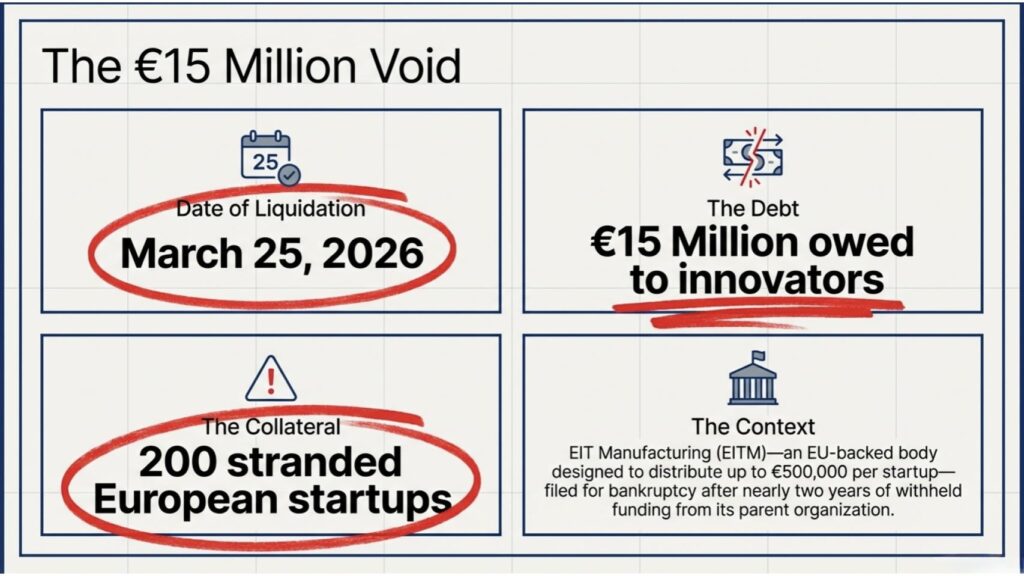
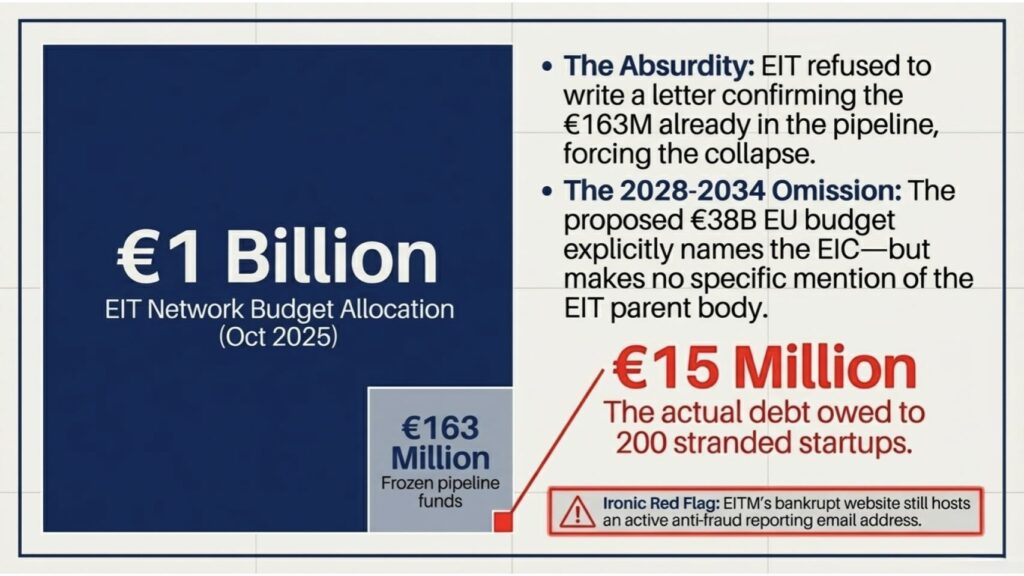
EIT Manufacturing, the EU-backed body tasked with digitising Europe’s industrial base, filed for liquidation in late March, 2026, after going almost two years without receiving funds from its parent organisation, the European Institute of Innovation and Technology (EIT). The total outstanding obligations sit at around €15 million owed to those 100+ beneficiaries.
None of that is on their official website. Or anywhere on their social media.
I read about this in a Sifted piece by Freya Pratty published on April 2, 2026. And it sent me straight back to my desk, because this story is one I have been watching build for a long time.
Let me tell you why this is bigger than one collapsed body.
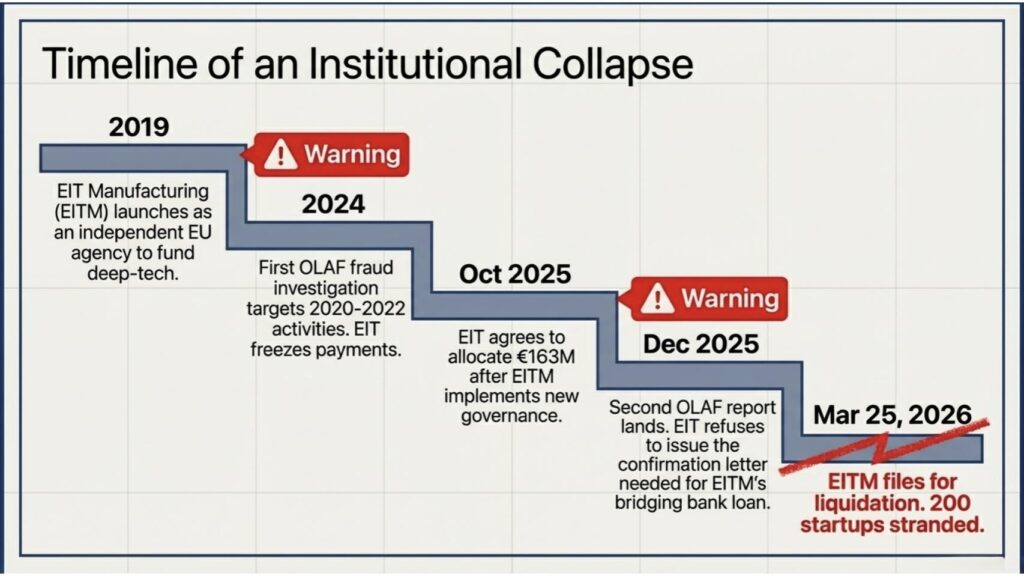
EIT Manufacturing Liquidation: The Full Timeline
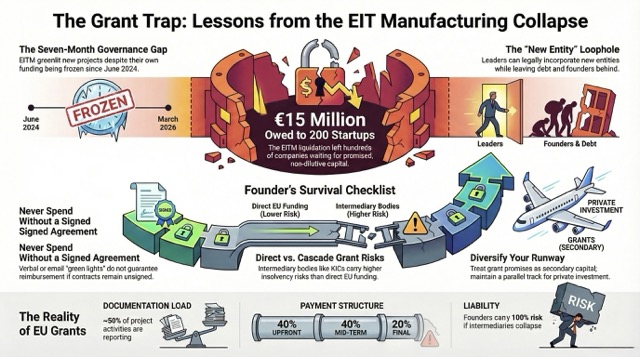
Here is every step, because it matters.
EIT Manufacturing (EITM) was launched in 2019 as one of nine Knowledge and Innovation Communities (KICs) funded through the EIT, an independent EU agency created to boost university-business collaboration. Through its Accelerate programme, EITM distributed grants ranging from €50,000 to €500,000 to manufacturing startups across Europe. The model was real and the money was real, until it was not.
In 2024, the European Anti-Fraud Office (OLAF) launched an investigation into EITM’s activities between 2020 and 2022. The EIT froze payments. The OLAF report, shared in September 2024, found “serious irregularities in the implementation of certain calls for proposals and selection of projects for funding,” according to EIT spokesman Balint Linder. EITM maintained that the investigation was about mismanagement of documentation, not mishandling of funds. That distinction matters legally. It does not matter to the founder staring at an unpaid invoice, but startups are at the bottom of the food chain, so it’s all fine.
In October 2025, after EITM implemented new governance structures and brought in new leadership, the EIT agreed to allocate €163 million. Founders waiting on payments probably exhaled.
Then in December 2025, a second OLAF report landed, finding that “irregularities went well beyond those identified initially.” EITM disputed this, saying the new instance also related to the 2020 to 2022 period already investigated under previous leadership.
The EIT refused to issue a letter confirming the €163 million was coming, which EITM needed to secure a bridging bank loan.
Without the letter, there was no loan. Without the loan, there was no runway. On March 25, EITM filed for liquidation. €15 million owed. More than 100 beneficiaries waiting. No clear path to payment.
EITM CEO Caroline Viarouge told Sifted: “EIT, as the grant authority, are the ones that need to step in and pay for these companies.”
The EIT said it would cooperate with the liquidator and was “particularly mindful of the impact on start-ups.” Some targeted payments to the most vulnerable beneficiaries were reportedly authorised. As of this writing, the situation for the majority of the waiting companies remains unresolved. NB. I am and will be in touch with some as I know them personally.
EIT Manufacturing Fraud Investigation: What the Official Statements Leave Out
There is one line from this story that I want you to read slowly.
Viarouge also told Sifted: “The KICs are put in a really unnecessarily fragile position in the current setup of the EIT framework. We really need to think of setting up a stable, transparent and simplified framework for them, with clear governance from the coordinating body at the commission. We truly need strong leadership in the coordinating body.”
She is the CEO of the organisation that just went bankrupt. She is not calling out fraud. She is calling out the structural setup that made the collapse possible.
And she is right.
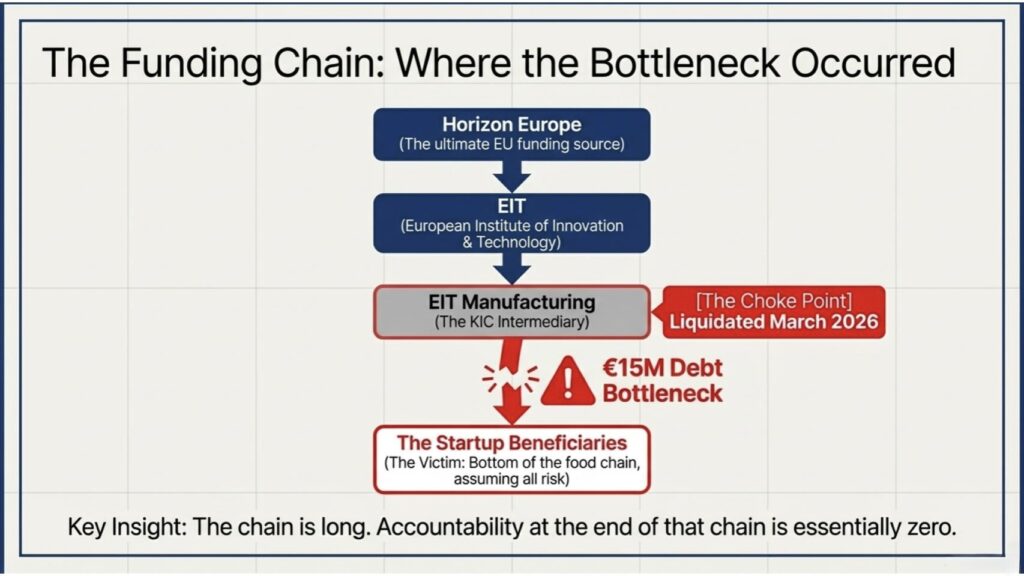
The KIC model groups large partnerships of universities, research centres, and private sector organisations into thematic areas: EIT Digital, EIT Health, EIT Manufacturing. Each receives funding from the EIT, which draws from the EU’s Horizon Europe programme. The chain is long. The accountability at the end of that chain, where the startup is, is essentially zero.
Jan Palmowski, secretary general of the Guild of European Research-Intensive Universities, told Times Higher Education that the collapse had raised serious questions about the EIT model itself.
The EIT’s official response was to call this a specific case, not representative of the broader model. “It is important to underline that this is a specific case concerning only one of the 10 Knowledge and Innovation Communities and does not affect the operations or financial stability of the other KICs,” the EIT spokesperson said.
This is the institutional reflex I have been writing about for years. One case. Not representative. Move along.
Except it’s not.
And I bet startups waiting for their money cannot move along.
EIT Manufacturing Scandal: One Founder Spent €40,000 of His Own Money and Was Told Nothing
Now let me show you what this actually looks like from the inside.
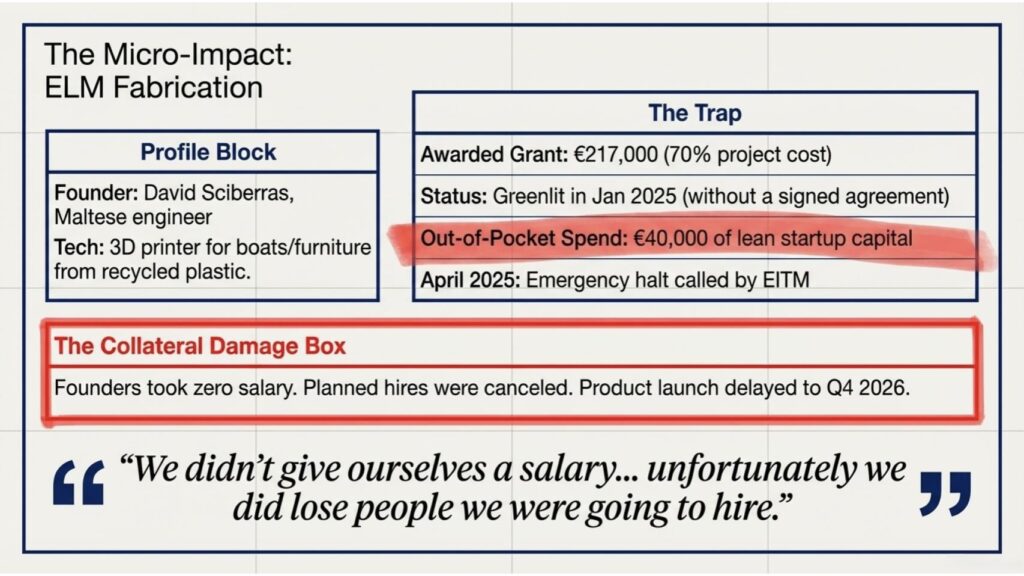
David Sciberras is a Maltese engineer and co-founder of ELM Fabrication Ltd, a startup that built a 2m x 2m x 6m 3D printer capable of printing boats and furniture from recycled plastic. It is exactly the kind of manufacturing deep-tech innovation that EITM existed to fund. ELM secured €217,000 from EITM, representing 70% of the project cost, to bring the technology to market.
EITM gave ELM the green light to start the project in January 2025.
The signed grant agreement never arrived.
In April 2025, EITM called an emergency meeting with ELM and instructed the startup to halt further spending. At EITM’s request, ELM submitted a cost breakdown of the work completed up to that point. The total was €40,000. EITM pledged to reimburse €28,000 of that in the first or second quarter of 2026. No specific timeline was ever confirmed.
Then David found out that EITM had filed for liquidation.
He told WhosWho.mt: “Many European startups in our cohort had to file for bankruptcy after counting on large sums of money that never arrived. However, we kept our operations lean. We didn’t give ourselves a salary or hire loads of people, although unfortunately we did lose people we were going to hire.”
Read that again. People they were going to hire. Gone. Because a EU-funded body told them the money was coming, kept them engaged in compliance work and reporting throughout 2025, and went bankrupt without warning.
I know how this feels. I have lived through something very similar.
ELM survived because Sciberras and his co-founder Nicholas Borg Calleja ran a tight ship, like a good startup would. They did not pay themselves (unlike the employees of EIT, I would presume). They did not scale headcount. They have now opened an equity round with 20% already subscribed, and moved their projected launch to Q4 2026.
They were lucky, if luck is even the right word, because they have been burnt before. Others in their cohort were not.
This is what the EIT spokesperson means by “particularly mindful of the impact on start-ups.” This is what that looks like in a real human life.
EIT Manufacturing Bankruptcy: The Hidden Cost Nobody Talks About
There is another dimension to this story that almost nobody is covering.
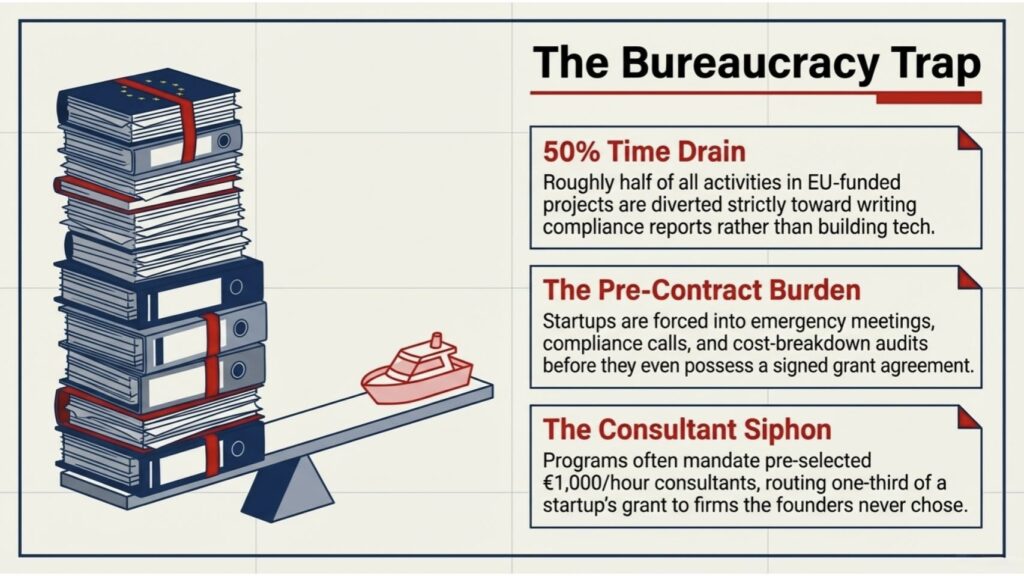
David and his team spent months working on the documentation required by EITM. EU grant paperwork is not a form. It is a full-time job. My team and I have spent entire sprints on single grant applications, and that was just the application stage. The reporting and compliance burden once a project is underway is many times heavier.
I wrote in my Sifted piece that roughly 50% of your activities in EU-funded projects go towards writing reports. ELM was not even at the reporting stage. They were still waiting on a signed grant agreement while preparing compliance cost breakdowns on request.
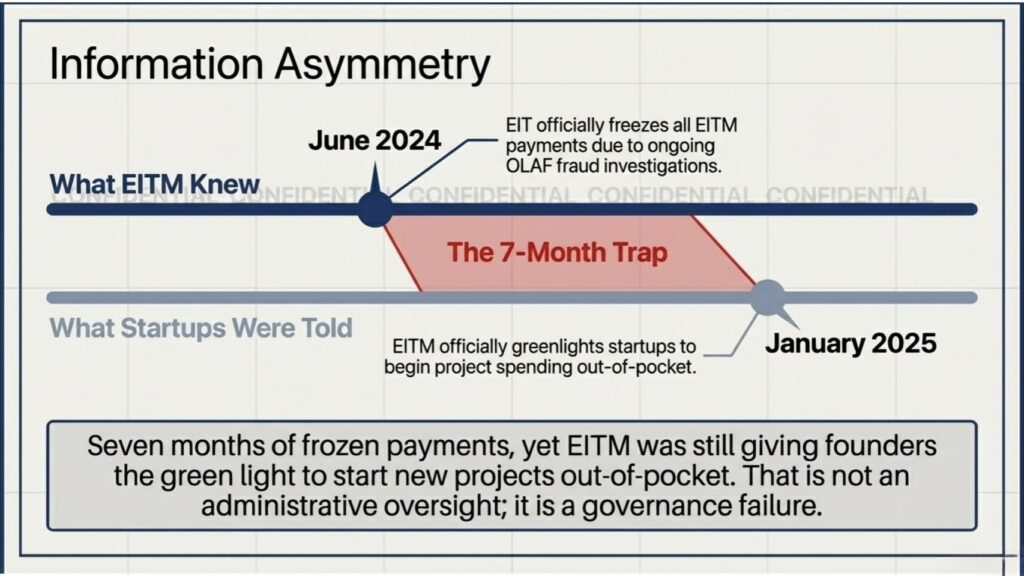
And all of this, the compliance calls, the cost breakdowns, the emergency meetings, the revised timelines, happened while EITM already knew it was in serious financial trouble. The EIT had frozen EITM’s payments since June 2024. That is seven months before EITM gave ELM the green light to start spending on the project in January 2025.
Seven months of frozen payments, and EITM was still greenlighting new project starts.
I am not going to speculate about intent. But I am going to name what it produced: founders who spent their own money and their own time on a project that the funding body already knew was at serious risk, and who found out the truth only when the liquidation news broke in the press.
That is not an administrative oversight. That is a governance failure with real human consequences attached to it.
And I know for a fact, that many startup founders in Europe have experienced some form of this government failure at some point.
I have been running the startup game for women for a while now and I hear stories. I hope one day these founders will be brave enough to publish these stories.
EIT Manufacturing Investigation: The New Legal Entity Play
Here is the part of this story that genuinely stopped me in my tracks.
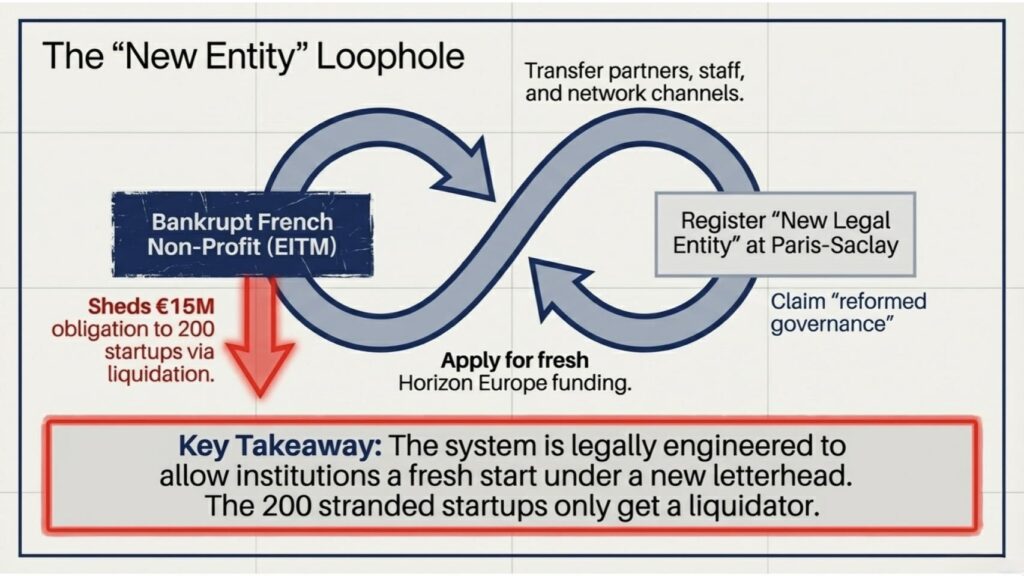
After filing for liquidation on March 25, and amid an active OLAF fraud investigation, EITM’s CEO Caroline Viarouge publicly announced that the organisation is looking to establish a new legal entity to continue supporting manufacturing innovation in Europe.
She told Science | Business: “We have some partners who are willing to take part of this endeavour. We have an opportunity to use this ecosystem in a new model, but we need to understand if the EIT is willing to support this new model.”
Let me make sure I have this right.
The organisation is under investigation for serious irregularities. It owes €15 million to 100+ beneficiaries. It just filed for liquidation. And the plan is to set up a new legal entity and return to Brussels to ask for more public funding? Did I get this right?
Here is how this works in practice. EITM was structured as a French non-for-profit association under French association law, registered at Paris-Saclay. When it files for liquidation, that legal entity winds down. A new association can be registered. Existing partners and staff can transfer across. The brand, the relationships, the access to EIT network channels, the institutional memory of how to write applications, all of that can potentially carry over under a new legal structure.
It is entirely legal. That is almost the most disturbing part.
The people who ran the programme that left more than 100 companies waiting for €15 million can, in principle, incorporate a successor entity, claim reformed governance, and apply for the next round of Horizon Europe money.
And Brussels might say yes. Because the alternative is losing Europe’s only dedicated manufacturing innovation community. Because the sector is strategic. Because the new governance structures are genuinely different from 2020 to 2022. Because the irregularities, by EITM’s own account, belong to a previous leadership era.
All of those arguments are available. Some of them are even reasonable on their face.
But from where I sit, watching a Maltese engineer explain that he lost team members he was going to hire because a EU-backed body kept him in a compliance loop while quietly heading towards bankruptcy, the logic of a fresh start under a new letterhead feels like something only the institution benefits from.
The companies waiting for €15 million do not get a new legal entity. They get a liquidator.
C’est la startup vie…
“No One Will Say Why”: The OLAF Reports Nobody Has Read
Follow the Money’s investigation into EIT Manufacturing’s collapse carries a headline that should unsettle anyone paying attention to EU accountability: EU-backed manufacturing body goes bust and no one will say why.
The reason nobody will say why is that the OLAF report has not been made public. A journalist at Follow the Money exercised their rights as an EU citizen and formally requested the OLAF report. The six-week deadline to reply passed. Still waiting.
This is worth sitting with. The European Anti-Fraud Office, which exists to investigate fraud and protect EU public funds, has produced at least two reports into EIT Manufacturing. The first, dated September 2024, found what EIT called “serious irregularities in the implementation of certain calls for proposals and selection of projects for funding.” The second, in December 2025, found that irregularities went well beyond what the first report had identified. EIT Manufacturing contested this, with CEO Caroline Viarouge telling Sifted that the second report still related to the 2020 to 2022 period under previous leadership.
But the actual reports remain confidential. No one outside a small circle has read them. No public summary has been released. And so what we are left with is an organisation that collapsed owing €15 million to 100+ beneficiaries, two fraud investigations, and an institutional silence that invites speculation precisely because it refuses to do otherwise.
What are they hiding? Nobody can answer that, because nobody has been allowed to ask the question with the documents in hand.
The Legal Architecture of Non-Responsibility
A pattern has been visible throughout this story, and the more people come forward, the easier it is to confirm the hypotheses.
When questions are raised about the many organisations owed money, EIT points to EIT Manufacturing’s legal independence as an ASBL registered under French law. When questions are raised about EIT Manufacturing’s management failures, the current leadership points to the 2020 to 2022 period and the previous leadership structure. When questions are raised about the OLAF reports, confidentiality protocols are cited.
The Times Higher Education coverage of this story included a quote from Jan Palmowski, Secretary General of the Guild of European Research-Intensive Universities, who said the EIT model itself had been called into question: “Such a KIC defaulting on its obligations obviously can never happen again, and it should never have happened. And that really raises the question whether the complex structure of the EIT is fit for purpose.“
That complexity is the point. The structure that makes EIT Manufacturing legally separate from EIT Budapest is the same structure that makes it possible for each to point at the other when accountability is demanded. It may or may not have been designed with that outcome in mind. But it functions that way.
And so we have: a beneficiary with documented proof of payment confirmation, a written admission that the funds were in the account, and a liquidation filing that prevented any disbursement. EIT says it cannot intervene in the French insolvency proceedings. EIT Manufacturing says it can no longer pay. And startups, who started their projects and earned their payment, are told to file as an unsecured creditor in a queue that will almost certainly return them nothing.
I Have Seen This Pattern Before
In 2023, I wrote a piece for Sifted asking why applying for EU funding is such a nightmare. That article focused on the absurdity of the application process: contradictory evaluation letters, redress channels that loop back to the same evaluators who rejected you, consortiums that are structurally closed to new entrants.
Then I wrote a follow-up for Mean CEO about how EU-funded projects, including the Epic-X Acceleration Programme, take public money to support female entrepreneurs, then ask other female entrepreneurs to deliver workshops for free while €1,000-per-hour consultants are pre-selected to receive one third of each startup’s grant.
Both pieces were about dysfunction in the system.
The EIT Manufacturing collapse is a different category. This is dysfunction that leaves founders unable to pay their bills.
And what makes it genuinely enraging is that the founders affected did nothing wrong. They applied. They were selected. They were told the money was coming. Some received partial payments in tranches. The 40% upfront, 40% mid-term, 20% on final report structure that is standard across EU programmes means some of them have already done the work and are sitting on an empty invoice.
The system failed them while asking them to trust it.
EIT Manufacturing Controversy: The Budget Context That Should Worry Every Founder
Let us look at the broader picture, because the numbers do not get more reassuring the further out you zoom.
In October 2025, the EIT was handed €1 billion to fund the organisations in its network. One billion euros, across nine KICs.
And yet the EIT could not provide a letter confirming €163 million to prevent EITM from collapsing. Not new money. A letter confirming that money already in the pipeline was on its way.
On top of that: in the proposed EU budget covering 2028 to 2034, there is no mention of any funds at all for the EIT as an institution. The €38 billion proposed for the European Innovation Council and “innovation ecosystems” in that same budget may functionally cover KIC activities, but the EIT parent body is not named.
So the institution that just allowed one of its bodies to collapse, leaving €15 million owed to founders, faces an uncertain future past 2027.
And the eight remaining KICs are now operating under a parent institution whose oversight model has been publicly questioned by academic leaders, whose name is attached to the word “fraud” in every major research/startup publication this week, and whose next multi-year budget allocation is not yet confirmed.
Also worth noting: EITM’s own website still carries an active anti-fraud reporting email address. You could, in theory, have reported suspected fraud to EITM while EITM itself was under a fraud investigation. The organisational irony there requires no further comment.
The Structural Incentive Problem
Here is the diagnosis I keep arriving at, no matter which part of EU funding I examine.
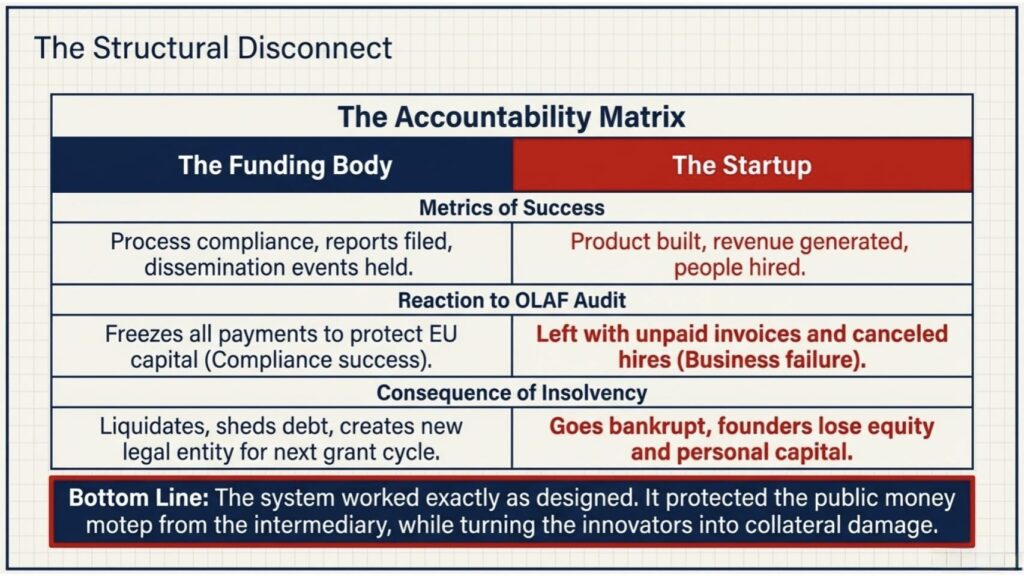
The organisations running EU-funded programmes are not evaluated on whether the founders they support actually succeed. They are evaluated on process compliance: reports filed, events held, funds disbursed, governance structures in place.
Go ahead and google “EU funding testimonials, reviews, feedback” and see what actually shows up and if any of that is from an entrepreneur and not the coerced grant receiver (yeah, been there, done that).
This means the path of least resistance is always to protect the institution, not the founder.
When OLAF flagged irregularities at EITM, the EIT’s job was to protect EU funds. It did that by freezing payments. Understandable from a compliance perspective. Devastating from a founder perspective. And the founders had no recourse, no appeal mechanism, no way to get their money from somewhere else. They just waited.
The same structural incentive runs through every layer of the system I have written about. The consortium trap I described in my Sifted piece locks startups out of large grants because eligibility rules require programme-specific experience that only existing members have. The Epic-X coaching budget pre-selects consultants that startups cannot choose, routing one third of each grant to firms the founders never agreed to work with. And here, the oversight mechanism designed to protect public money made it impossible for 100+ founders to access money that was already theirs.
The system protects itself at every level.
The people paying the price are always the ones who built something real.
A Checklist for Every Founder Reading This
I still believe European founders should try for EU grants. I said it in my Sifted piece and I stand by it. The runway matters. The non-dilutive capital matters. And for some programmes, the network and visibility genuinely add value.
But you need to apply with clear eyes. Here is what I would check before committing.
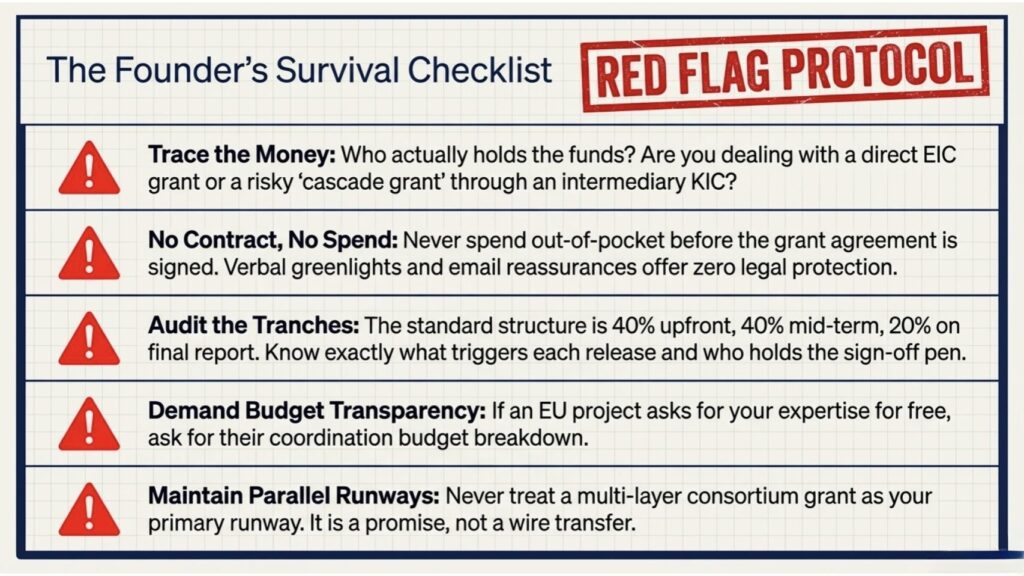
Who is actually holding the money? The EITM situation shows that the body handing you a promise is not always the body controlling the funds. Map the full chain: is there a parent institution with final say on whether the money flows, and what happens if that parent institution opens an investigation into the intermediary?
Do not start spending your own money before a signed grant agreement is in your hands. ELM’s €40,000 in unreimbursed costs came directly from starting a project on a green light before the contract was signed. No amount of verbal reassurance or email confirmation replaces a signed agreement.
What is the payment structure and what triggers each tranche? The standard EU model means you may be doing funded work before early payments arrive. If the funding body collapses mid-project, uncompensated work is the outcome.
Is this the only funding source in your plan? If yes, keep a parallel fundraising track open. A single grant from a multi-layer consortium arrangement is not a runway. It is a promise.
And if a EU-funded project is asking you to contribute your expertise, your time, or your content without paying you, ask for their full budget breakdown first. If they have public money for coordination and dissemination but cannot pay you, that tells you everything you need to know about where their priorities actually sit.
What Good EU Funding Infrastructure Would Look Like
I want to be clear: the EIT Manufacturing collapse was not caused by the founders. It was not caused by the startups waiting for their money. It was caused by governance failures in the 2020 to 2022 period, under previous leadership, in a model that concentrates too much financial control in too few institutions with too little direct accountability to the founders they serve.
Viarouge said it plainly: the KICs need a stable, transparent, and simplified framework with clear governance. She is right. The current model creates fragility at the level where it hurts most, at the point where the money was supposed to reach the companies building real things.
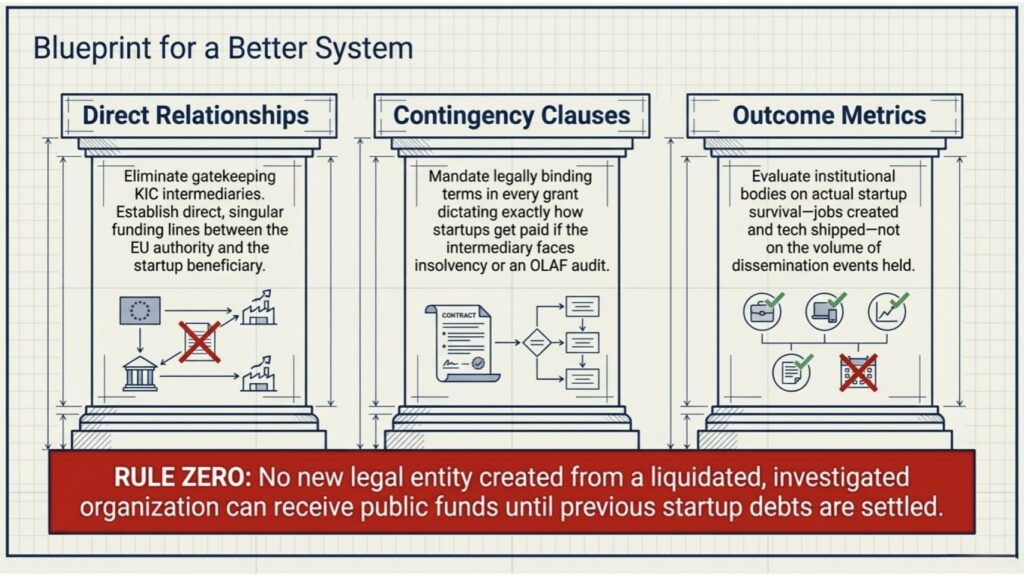
A better model would include direct relationships between the funding authority and the startup beneficiary, with the consortium in a coordination role rather than a gatekeeping one. A legally mandated contingency clause in every grant agreement, explaining what happens to promised payments if the intermediary body faces investigation or insolvency. A dedicated recovery fund for founders caught in institutional disputes they had no part in causing. And measuring KICs not on reports filed and events held, but on whether the companies they supported built something, hired people, and grew revenue.
And one more thing that apparently needs to be said explicitly: no new legal entity created from the wreckage of an organisation under active fraud investigation should be eligible for new public funding until all outstanding obligations from the previous entity are settled in full.
That should be obvious. The fact that it is not already a rule tells you a great deal about how the current system was built, and for whose benefit.
Next Steps
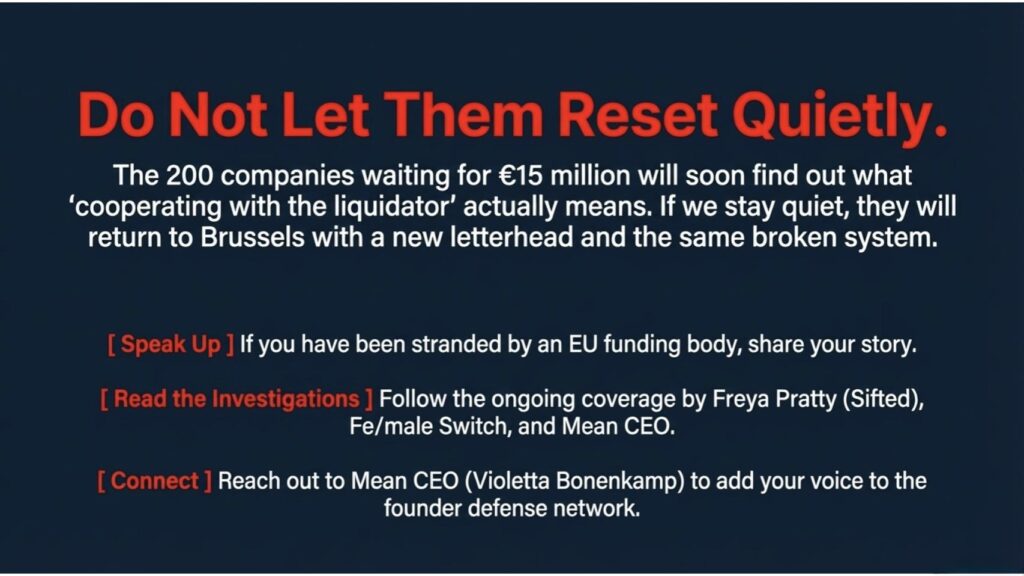
If you have been affected by the EITM collapse, or by any situation where a EU-funded body failed to pay promised grants, I want to hear from you. Find me on LinkedIn. The more founders talk about this publicly, the harder it becomes for institutions to quietly absorb the damage and return to Brussels with a new letterhead.
Also, if you are one of the organisations owed money by EIT Manufacturing, the most important immediate step is to register your creditor claim with the liquidator. Establishing yourself formally in the insolvency proceedings is the floor, not the ceiling, of your options.
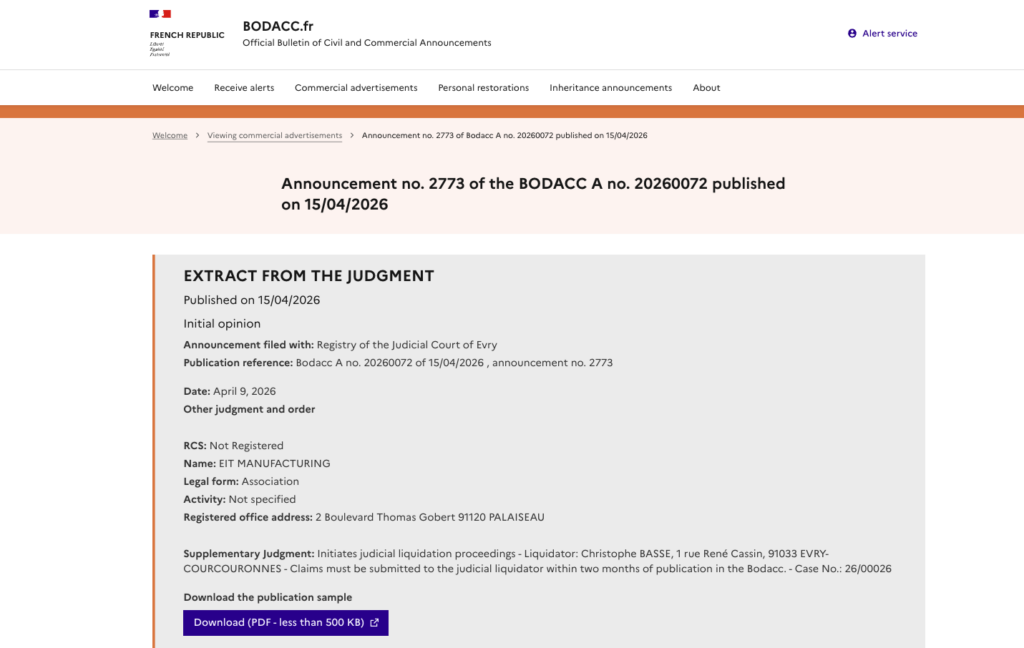
Today BODACC published the notice that EIT Manufacturing has entered insolvency proceedings (safeguard, restructuring, or liquidation), and any concerned startup, as a creditor, must formally declare its claim within a short, mandatory legal deadline or risk losing the right to be paid in the procedure.
What the notice is about
A publication in the BODACC (Bulletin officiel des annonces civiles et commerciales) makes official that a court has opened collective insolvency proceedings (sauvegarde, redressement judiciaire, or liquidation judiciaire) for the debtor company.
For these procedures, the notice generally includes the court decision, the identity of the debtor, and especially the identity and contact details of the mandataire judiciaire or liquidateur (the court‑appointed insolvency practitioner) to whom creditors must send their claims.
Deadlines to submit claims
Under French law, the standard deadline is 2 months from the date of publication of the opening judgment in the BODACC for creditors domiciled in metropolitan France.
For creditors domiciled outside mainland France, the deadline is extended to 4 months from the BODACC publication.
What “declaring a claim” actually involves
You must send a formal “déclaration de créance” to the mandataire judiciaire or liquidateur indicated in the BODACC notice, usually by registered mail with acknowledgment of receipt (LRAR) to prove you met the deadline.
The declaration must state at least: the identity of your startup, the amount of the claim as of the opening judgment date, the basis for the claim, any security or guarantees, and supporting documents.
Consequences if your startup misses the deadline
If you do not declare your claim within the 2‑month (or 4‑month) period, the claim is “forclose”: it is excluded from the insolvency procedure and you generally cannot obtain payment through that procedure.
There is a narrow escape route called “relevé de forclusion” (relief from forfeiture), but it is only possible if the delay was not your fault (for example, serious illness/hospitalization or the debtor failed to list you as a creditor), and you must apply to the judge‑commissaire within 6 months of the BODACC publication.
The Liquidation Process: A Timeline Built for Lawyers, Not Founders
Here is something a startup founder found out and shared with me. They contacted the court-appointed liquidator directly to ask a simple question: when will we see our money?
The process, they were told, will take more than two years. And if any funds remain after the liquidator works through the estate, creditors may begin to receive payouts at the end of that period.
Two years minimum.
The average European startup has somewhere between three and eighteen months of runway at any given time. Two years is a death sentence for most of the 100+ companies currently waiting for €15 million they already earned.
The French liquidation judiciaire is DEFINITELLY not a startup-friendly process. It was never designed to be. It is a court-supervised procedure built for the orderly dissolution of commercial entities, with a priority stack that puts employees, tax authorities, secured creditors, and court costs ahead of anyone else. Unsecured creditors, which is almost certainly what most of these startups are classified as, sit at the bottom of that stack and collect whatever is left, divided proportionally, which in most liquidations is very close to nothing.
Let me walk you through exactly what is happening, because you deserve to understand the machinery that is grinding through your money right now.
How the French Liquidation Process Actually Works (And Why It Was Not Designed With You in Mind)
Under French commercial law, liquidation judiciaire triggers an automatic stay on all payments to pre-existing creditors from the moment the court opens proceedings. Nobody gets paid anything while the liquidator works. The liquidator’s job is to identify all assets, verify all claims, sell whatever can be sold, and then distribute proceeds according to a legally mandated priority order.
The sequence, simplified, runs like this.
First come court costs and the liquidator’s fees. Then come post-judgment claims, meaning anyone who did business with the entity after the insolvency proceedings opened. Then come privileged creditors: employees (up to specific caps under French employment guarantee schemes), the French tax authority, social security bodies, and holders of specific secured interests.
Unsecured creditors come after all of the above. Startups owed grant money for completed projects (unless they successfully argue that the funds are ring-fenced fonds dédiés that never belonged to EITM at all, which is a legal argument we will return to) are almost certainly classified as unsecured creditors. That means they wait. And wait. And then receive a fraction of whatever is left.
The French system does not cap how long a liquidation can run. For complex cases involving disputes, contested claims, ongoing investigations, and international creditors spread across twenty-seven EU member states, two years is not a pessimistic estimate. It may be an optimistic one.
And By the time the liquidator closes the books and distributes whatever remains, most of the 200 companies waiting right now will no longer exist. Not because they failed to build something real. Because a two-year queue in a French insolvency proceeding is incompatible with the reality of a startup’s survival window.
The EU built an entire innovation ecosystem on top of a legal infrastructure that cannot move fast enough to save the companies it was supposed to serve.
What Startups Can Actually Do: A Brutally Honest Assessment
Step One: File Your Creditor Claim. Non-Negotiable.
This is the absolute floor. If you have not already registered your claim with the liquidator following the BODACC publication, do it immediately. Under French law, foreign creditors have four months from the date of the BODACC publication to file. Miss this deadline and your claim becomes legally unenforceable in the liquidation proceedings. There is a narrow relief mechanism called relevé de forclusion but it applies only in very limited circumstances, and “we did not know” is not one of them.
The declaration of claim (déclaration de créance) must go to the mandataire judiciaire or liquidateur listed in the BODACC notice, by registered post with proof of delivery. It must state your company’s identity, the exact amount owed as of the date proceedings opened, the legal basis for the claim, and supporting documentation: your Financial Support Agreement, all correspondence confirming project approval and payment commitments, cost breakdowns submitted on request, and any written payment confirmations you received.
Do not delegate this to someone who has never filed in a French insolvency proceeding. Get a French insolvency lawyer to handle it, even if it costs you €500 to €1,000. Missing the deadline costs you everything.
Step Two: Argue That the Money Is Not EITM’s to Distribute
This is the legal argument with the most structural merit, and it is the one that Ioannis Kavazidis and others have already begun to make.
The thesis is straightforward. The EU grant funds held in EITM’s bank account at the time of liquidation were not EITM’s money. They were EU public funds transferred by EIT Budapest to EITM for a specific purpose: disbursing them to approved beneficiaries for completed, audited, approved projects. Under French law, funds held for a designated purpose by an intermediary constitute fonds dédiés (dedicated funds) that are legally distinct from the general assets of the entity holding them. They should not form part of the insolvency estate at all.
If a French court accepts this argument, the funds in question would be extracted from the liquidation estate entirely and paid directly to the beneficiaries who earned them, bypassing the creditor queue. This would transform your position from “unsecured creditor hoping for pennies” to “rightful owner of ring-fenced funds.”
The challenge is that arguing this successfully requires legal representation in French insolvency proceedings, documentation proving the specific purpose for which each tranche was transferred, and the willingness of the liquidator, or the court, to accept the argument. Courts are not guaranteed to agree. EITM’s estate may also dispute it. And even if you win the argument, the process of having the funds separated and paid out takes time.
But it is the strongest argument available, and if there is enough collective weight behind it (i.e. multiple affected parties making the same argument, supported by documentation) the probability of it being taken seriously increases significantly.
Step Three: Pressure EIT Budapest Directly
EIT Budapest is the granting authority. Under Grant Agreement 101113078 and equivalent agreements across all affected cohorts, EIT Budapest authorised the projects, approved the beneficiaries, and channelled the funds to EITM for disbursement. The legal distance between EIT Budapest and the beneficiaries is real, but it is not absolute.
The European Ombudsman has jurisdiction over complaints of maladministration against EU institutions and bodies, including EIT Budapest. A maladministration complaint does not recover your money directly. But it does create a formal record of institutional failure, generates pressure on the EIT to consider direct intervention, and adds to the documented accountability trail that MEPs and the European Court of Auditors will eventually examine.
File with the Ombudsman. Contact members of the European Parliament’s ITRE (Industry, Research and Energy) committee and CONT (Budgetary Control) committee, both of which have direct oversight interests in this collapse. Write to the DG Research and Innovation and to the European Court of Auditors. Each of these actions alone does almost nothing. Collectively, and combined with press coverage, they create conditions under which EIT Budapest may find it less damaging to intervene directly than to continue citing legal separation.
The EIT has already authorised some targeted payments to the most vulnerable beneficiaries. That precedent matters. It means they accept, at least in practice, that they have some form of obligation. Push on that acknowledgement. Do not accept the legal separation argument as final.
Step Four: Consider a Criminal Complaint
If you received a written payment confirmation in the weeks before the liquidation filing, particularly if that confirmation arrived after June 2024, when the EIT had already frozen EITM’s payments, you may have grounds for a criminal complaint with the Parquet National Financier in Paris.
The legal concept is abus de biens sociaux or potentially escroquerie (fraud) if it can be shown that payment confirmations were issued with knowledge that payment was impossible. The faute de gestion standard under Article L651-2 of the French Commercial Code also allows a court to hold directors personally liable if their management decisions caused harm to creditors. A payment commitment made while the organisation demonstrably could not honour it is not a clerical oversight.
Filing a criminal complaint does not guarantee prosecution. French prosecutors have wide discretion. But it creates a formal legal record, may result in the liquidator being required to investigate management decisions more rigorously, and contributes to the broader accountability picture.
If you have documentary evidence, like written payment confirmations, emails from EITM staff confirming disbursement timelines, written green-lights to begin spending, preserve all of it. Timestamped originals. PDFs and physical copies. This is your evidence base for every avenue described above.
The Honest Assessment: Your Chances Are Poor, and the System Knows It
I want to be fair to you, which means I have to say something the institutional language will never say directly.
Most of you are not going to get paid. Not in full. Probably not at all.
Here is why. The €15 million owed sits inside a liquidation estate that first has to cover the liquidator’s fees, court costs, and employee claims. What remains gets divided proportionally among unsecured creditors. If the fonds dédiés argument fails (and it may, because French courts do not always accept it in cases like this) then the EU grant funds go into that general pool. If the argument succeeds, only the funds proven to be ring-fenced for specific projects would be separated out, and proving that on a per-project basis requires documentation that some affected parties may not have in the form French courts require.
Even in the best-case scenario, the process runs two or more years. During that time, your startup either survives on other sources of funding or it does not. If you close before the liquidation completes, you lose your ability to pursue your claim. And if you do not close, you spend two years of operational energy on a legal process whose outcome is uncertain.
The brutal irony is that the companies most likely to recover their money from this process are the ones who least need it: larger organisations with legal teams, balance sheets that can absorb the wait, and the administrative capacity to manage French insolvency proceedings from afar. The startups most harmed by the collapse are the ones least equipped to fight for restitution through a process that costs money, time, and attention they do not have.
This is what happens when a startup innovation ecosystem is built on a legal infrastructure designed for the structured dissolution of large commercial entities. The two things are fundamentally incompatible, and the people paying for that incompatibility are the ones who were supposed to benefit from the ecosystem in the first place.
If you have evidence of misconduct, consider the following:
The European Ombudsman handles complaints about EU institutions and bodies, including EIT Budapest, for maladministration.
The Parquet National Financier in Paris is the French prosecutor’s office with jurisdiction over financial crime involving French-registered entities.
The European Anti-Fraud Office (OLAF) accepts fraud reports from any person with information about irregularities affecting EU funds.
Members of the European Parliament’s ITRE (Industry, Research and Energy) and CONT (Budgetary Control) committees have direct oversight interests in this collapse and have been contactable throughout this process.
And if you were an employee of EIT Manufacturing terminated during your probationary period without proper notice, written grounds, or the prior interview required under French law, you may have grounds before the French labour courts (Conseil de Prud’hommes). The protections under Articles L1221-25 and L1332-1 of the Code du Travail do not disappear because the organisation that violated them is now in liquidation.
And on a more general note, if you are a founder considering EU grants in 2026, start by understanding which layer of the system you are actually dealing with. Is it a direct EIC or Horizon Europe application? Or is it a cascade grant through an intermediate body like a KIC or a consortium programme like Epic-X? The risk profile is completely different.
Read the payment structure before you build your cash flow plan around the grant. Know when each tranche arrives, what triggers the release of each tranche, and who has final sign-off authority on each payment.
The EIT Manufacturing story is still developing. The companies waiting for €15 million will find out over the coming months what “cooperate with the liquidator” actually means. Watch it closely.
Appendix: The EIT Manufacturing Startup Stories
Since this investigation began, founders, researchers, and project leads from across Europe have been sending their stories about the EIT Manufacturing liquidation and its aftermath. Each story adds a layer. Some add more than that.
I will try to add more stories as quickly as possible.
Let’s give startups a voice.
A Greek NGO, €90,000 in Limbo, and an Employment Termination That Raises Serious Legal Questions
Ioannis Kavazidis, founder of Reinvent Education AMKE, agreed to speak on the record. He can be reached at johnkavazidis@reinventeducation.gr. Documentation supporting this account, including the written payment confirmation of 3 March 2026, the Financial Support Agreement, and the EIT Legal Office complaint acknowledgement, is available for verification by journalists and investigators.
Ioannis is the founder of Reinvent Education AMKE, a small NGO based in Thessaloniki, Greece. His consortium, together with Finnish partner Avoin Ry, completed a fully audited and approved DTTI project called SDG Data Challenge (Project ID 700112, Grant Agreement 101113078). They certified over 1,000 learners in AI for sustainable development. Every contractual condition for payment was met. The audit was passed. The work was approved.
They are owed €90,000. Of course, they have not been paid.
But Ioannis Kavazidis also has a second story to tell. And that second story may be the more revealing one.
The 16-Day Payment Window That Never Opened
Here is the timeline that matters most.
On 3 March 2026, an EIT Manufacturing staff member sent Kavazidis a written email confirming that the payment was with the payments department and would be processed within the month. On 19 March 2026, EIT Manufacturing filed for liquidation. The gap between those two dates: sixteen days.
This was not a case of an organisation caught off guard. EIT Manufacturing had received no funding from EIT since June 2024, a period of 21 months. By early March 2026, the organisation had already been seeking an emergency bank loan it would never secure. They knew. And yet the written payment confirmation went out anyway.
Then, in EIT Manufacturing’s own liquidation notice to beneficiaries, the organisation stated that, while the DTTI funding remained in their bank account, they would no longer be permitted to pay it out.
The money was there. The obligation had been confirmed in writing. And no payment was made before the liquidation filing.
Under French insolvency law, this raises questions about what lawyers call faute de gestion, a concept referring to management misconduct that causes harm to creditors. A payment commitment made sixteen days before a liquidation filing, at a time when the organisation demonstrably could not honour it, is not a clerical oversight. It is a decision. Who made it, and why, remains unanswered.
NB. I have also briefly consulted a lawyer, but he’s not an expert in French labour law, so if there’s an inconsistency to this story, I’m happy to correct.
The Contract That Was Supposed to Protect Beneficiaries
Kavazidis has gone through the Financial Support Agreement carefully. Let’s break it down.
Under Article 7.4 of the FSA, payment was required within 30 days of fulfilment of all conditions. Those conditions were met. That deadline passed. No payment came.
Under Article 3.2.2.5, KIC LE (that is, EIT Manufacturing) holds the right to terminate the agreement if a recipient files for bankruptcy. There is no equivalent clause that permits EIT Manufacturing to exit its payment obligations in the event of its own insolvency. The protection in the agreement runs one way.
Under Article 3.3.1, financial obligations explicitly survive termination of the agreement. This matters because it means that even if the liquidation is treated as a termination event, the €90,000 remains legally owed.
Kavazidis also argues, with legal grounding, that the DTTI funds held in EIT Manufacturing’s bank account are not EIT Manufacturing’s money at all. Under Belgian law applicable to the agreement, EU grant funds received for specific approved projects constitute dedicated funds, known as fonds dédiés, that should be excluded from the general insolvency estate. EIT Manufacturing was the conduit, not the owner. The money was transferred to them for a specific purpose: paying Kavazidis and his consortium. It was never theirs to withhold.
He has filed a criminal report with the Parquet National Financier in Paris. He has filed a complaint with the European Ombudsman against EIT Budapest for maladministration. He has filed an OLAF fraud report. He has contacted MEPs on the ITRE and CONT committees. He has written to DG Research and Innovation and to the European Court of Auditors.
He received a template non-answer from EIT Budapest that addressed none of his six specific questions.
What a surprise, huh?
The Employment Story: A Separate Pattern, or the Same One?
This is where the story gains another dimension.
Kavazidis was not only a project beneficiary at EIT Manufacturing. He was also an employee. He was hired as an Education Funded Project Officer on a CDI (open-ended) contract starting 13 January 2025. On 12 May 2025, the final day of his probationary period, he was dismissed.
The dismissal came 30 minutes before the end of the working day. No prior warning had been given. No formal performance evaluation had taken place. No written explanation was provided. This is despite the fact that just four days earlier, on 8 May, his manager had explicitly confirmed in a meeting that he had successfully completed his probation. An HR representative had also confirmed this. No negative feedback had been delivered at any point during the trial period.
Here is why this matters legally.
Under French Labour Code Article L1221-25, employers must observe mandatory notice periods when terminating during probation. For someone employed more than three months, that notice period is one month. Kavazidis had been employed for approximately four months. A 30-minute verbal notification on the final day of his probationary period almost certainly did not satisfy this requirement.
Also, under Article L1332-1 of the Code du Travail, no disciplinary sanction may be imposed without the employee being informed in writing of the reasons and given an opportunity to respond. Termination without written grounds and without a prior meeting to discuss the reasons is not a procedural technicality: it is a breach of a fundamental right under French employment law.
There is a further legal wrinkle. French courts have held, including in a landmark Cour de Cassation decision in 2014, that if the notice period runs beyond the end of the probationary period, the contract becomes a permanent CDI. If EIT Manufacturing terminated Kavazidis on the last day of his probation without giving proper notice, and if the required notice period would have extended beyond that date, then under French case law, the employment may have converted to a permanent contract. That would mean the dismissal should have followed the full unfair dismissal procedure, complete with a prior interview (entretien préalable) and written reasoning, none of which happened.
Kavazidis filed a formal complaint with the EIT Legal Office on 13 May 2025. That complaint was registered with reference number 10/2025. He received an acknowledgement of receipt. He was told he would receive a reply “in due course.”
We all know what it means.
The Pattern That Connects Both Stories
In May 2025, EIT Manufacturing told Kavazidis he had successfully passed probation, then fired him without cause or process 30 minutes before the end of his last working day.
In March 2026, EIT Manufacturing sent Kavazidis a written payment confirmation, held €90,000 of designated EU public funds in their account, then filed for liquidation without disbursing any of it.
In both cases, a verbal or written confirmation was given. In both cases, the confirmation was followed by a decision that contradicted it entirely. And in both cases, the individual bearing the cost was left without recourse, explanation, or institutional accountability.
The Fe/male Switch analysis of the EITM collapse noted that governance failures originated in 2020 to 2022, under previous leadership. That framing absolves the most recent management from primary culpability for the structural fraud, and it may well be accurate. The OLAF reports, which nobody outside the institutional circle has read, apparently focus on that period.
But what happened to Kavazidis as an employee happened in May 2025, under current leadership. And the decision not to pay approved beneficiaries before filing for liquidation was made in March 2026, also under current leadership. “That was the previous leadership” does not cover everything.
Also on top of that: approximately 99% of the Greek employees at EIT Manufacturing were former employees of a single entity called LMS. Kavazidis flags this in his submission. The concentration of hiring from one source raises questions about recruitment integrity and governance that sit entirely outside the OLAF investigation’s stated scope of 2020 to 2022.
What Reinvent Education AMKE Is Asking For
The legal position Kavazidis takes is clear.
The €90,000 is not EIT Manufacturing’s money. It was EU public funding transferred specifically to be disbursed to an approved beneficiary for a completed approved project. EIT Manufacturing was the channel. The funds are fonds dédiés and should be excluded from the liquidation estate entirely.
EIT Budapest, as the granting authority under Grant Agreement 101113078, has both the legal standing and the obligation to intervene in the liquidation proceedings, recover those dedicated funds from the estate, and pay them to the 100+ organisations who earned them.
EIT has publicly committed to “continuity of EIT Community projects” and is already exploring continuing DTTI through another KIC, EIT Culture Creativity. That is fine as far as future cohorts are concerned. It does nothing for the 100+ organisations that built the DTTI programme, contributed to its headline milestone of one million trained talents, and remain unpaid.
Read More on the Topic
The EIT Manufacturing bankruptcy has sent shockwaves through the European startup ecosystem, and coverage of the fallout continues to grow.
For a deep dive into how over 100 companies ended up stranded without promised grants, read 200 Startups Are Waiting for Money That Will Never Come — a detailed breakdown of the full timeline, from the first OLAF audit to the March 2026 liquidation filing.
If you want to understand what the EIT Manufacturing liquidation means specifically for early-stage founders navigating EU funding, Fe/male Switch covers the structural risks that made this collapse possible — and why the CEO’s plans to launch a new entity and return to Brussels only deepened the EIT Manufacturing scandal.
The nonprofit arm of Fe/male Switch goes further, examining how the liquidation is hitting female entrepreneurs disproportionately hard.
For those tracking the legal and financial dimensions of the EIT Manufacturing fraud, Grant-Grants and CadChain both offer founder-focused perspectives on the ongoing EIT Manufacturing investigation and what it signals for EU grant reliability.
Finally, the Fe/male Switch build blog looks at what bootstrapping founders should take away from the EIT Manufacturing controversy when evaluating whether to pursue public funding at all — and Medium readers can follow the fraud investigation explainer for a concise summary of what this case means for startup grants across Europe.
FAQ
What is EIT Manufacturing and why did it collapse?
EIT Manufacturing (EITM) was a Knowledge and Innovation Community (KIC) launched in 2019 under the European Institute of Innovation and Technology (EIT), an EU agency created to support university-business collaboration in the manufacturing sector. EITM distributed grants ranging from approximately €50,000 to €500,000 to startups, universities, and NGOs across Europe. The collapse followed two investigations by the European Anti-Fraud Office (OLAF). The first, completed in September 2024, found serious irregularities in how funding calls were run and projects were selected, particularly in the 2020 to 2022 period. The second, completed in December 2025, found that the scope of those irregularities went further than the first report identified. After EIT froze payments in June 2024 and refused to issue a confirmation letter for a €163 million allocation that EITM needed to secure a bridging bank loan, EITM had no path forward and filed for liquidation on 19 March 2026. Outstanding obligations to 100+ beneficiaries total approximately €15 million.
What is the DTTI programme and who is owed money?
DTTI stands for Deep Tech Talent Initiative, a programme under EITM that funded education and training projects aimed at upskilling Europe’s manufacturing workforce. Beneficiaries included small NGOs, universities, startups, and other organisations that completed approved training projects and were awaiting payment under their Financial Support Agreements. Reinvent Education AMKE and Avoin Ry, for example, certified over 1,000 learners in AI for sustainable development under a project that was fully audited and approved, yet remain unpaid €90,000 as of April 2026. Across the programme, roughly 200 organisations are in similar positions.
Why did EIT Manufacturing send payment confirmations before filing for liquidation?
That is the central question. Documentary evidence shows that EIT Manufacturing staff sent written payment confirmations to at least some beneficiaries in the weeks before the liquidation filing on 19 March 2026. In the Kavazidis case, a written confirmation arrived on 3 March 2026, sixteen days before the filing. At that point, EITM had not received EIT funding since June 2024, had been seeking emergency financing, and demonstrably knew its financial position was untenable. Whether the payment confirmations were sent without full organisational awareness of the impending liquidation, or whether they were sent despite that awareness, is a question with significant legal implications. Under French insolvency law, the concept of faute de gestion covers management decisions made before liquidation that cause harm to creditors. These circumstances warrant examination by the Parquet National Financier, which has already received a formal complaint.
Are the OLAF reports about EIT Manufacturing public?
No. Despite two OLAF investigations resulting in reports that directly contributed to the collapse of a public institution and the loss of €15 million in EU funds to 100+ beneficiaries, the actual reports have not been released. Follow the Money’s investigative team formally requested the OLAF report under EU access-to-documents rights. The six-week statutory deadline passed without a response. This opacity is one of the most troubling aspects of the entire affair. Without access to the reports, neither affected beneficiaries nor the general public can assess what was found, who was implicated, or whether the institutional response was proportionate. The absence of transparency does not prove wrongdoing beyond what has already been confirmed. It does mean that nobody who was harmed by this collapse has been given a full accounting of why it happened.
Is EIT Budapest legally responsible for paying the 100+ beneficiaries?
This is genuinely contested. EIT points to EIT Manufacturing’s legal independence as a French non-profit (ASBL). EITM, as a separately registered entity, entered into its own Financial Support Agreements with beneficiaries and held the disbursement obligations. EIT’s position is that it cannot assume the contractual obligations of a separate legal entity now in liquidation. The counter-argument, advanced by Kavazidis and others, is that the funds involved are EU public money transferred by EIT specifically for disbursement to approved beneficiaries. They are not EITM’s general assets. They are dedicated funds, fonds dédiés, and should never have entered the insolvency estate at all. Under this reading, EIT has both the legal standing and the obligation to intervene in the liquidation proceedings to recover and redistribute those specific funds. The European Ombudsman complaint filed against EIT Budapest directly raises this question of maladministration.
What does French labour law say about probationary period terminations?
Under the French Labour Code, specifically Articles L1221-19 through L1221-26, the probationary period for a permanent CDI contract varies by employee classification: two months for workers and clerks, three months for supervisors and technicians, and four months for executives. Either party may terminate during probation without formal cause, but mandatory notice periods apply. For an employee who has been in post for more than three months, the employer must give at least one month’s notice under Article L1221-25. Additionally, under Article L1332-1, no disciplinary decision, including dismissal, may be made without informing the employee of the reasons in writing and allowing them the opportunity to respond. A purely verbal dismissal given 30 minutes before the end of the working day, on the last day of probation, with no prior meeting and no written grounds, potentially violates both of these requirements. French courts have also held that if the required notice period would extend beyond the probationary period end date, the employment converts to a permanent CDI, triggering full unfair dismissal protections.
What is faute de gestion and how does it apply here?
Faute de gestion is a concept in French company and insolvency law that refers to management misconduct which worsens a company’s financial position or causes harm to creditors. Under French law, specifically Article L651-2 of the Commercial Code, a court may hold directors or senior managers personally liable for a company’s debts if mismanagement contributed to the shortfall. A payment commitment made sixteen days before a liquidation filing, when the organisation had been insolvent in practice for months and was seeking emergency loans it could not secure, raises a reasonable question: was the failure to disburse already-designated EU grant funds to approved beneficiaries a product of mismanagement, or of a deliberate choice to preserve the organisation’s remaining liquidity for other purposes? The criminal complaint filed with the Parquet National Financier specifically raises this question in the context of potential misappropriation of EU public funds.
What are fonds dédiés and why do they matter for beneficiaries?
Fonds dédiés is a French legal concept referring to dedicated funds received for a specific purpose, which are legally distinct from the general assets of the organisation holding them. When EIT Budapest transferred money to EIT Manufacturing for disbursement to approved DTTI beneficiaries, the argument is that those funds did not become EIT Manufacturing’s money. They were held in trust, for a specific purpose, for specific recipients. Under this reading, a liquidator has no legal authority to treat them as part of the general insolvency estate, because they were never the debtor’s property in the first place. If this argument is accepted by a French court, it could mean that the funds owed to the 100+ beneficiaries should be ring-fenced and paid out ahead of other creditors, rather than diluted into a general distribution that returns pennies on the euro.
Why does it matter that 99% of Greek EIT Manufacturing employees came from one entity?
Recruitment concentration from a single external entity raises governance questions that regulators and investigators typically treat as red flags. If the majority of employees from one national cohort were drawn from a single organisation, this can indicate that hiring decisions bypassed open competition principles, that pre-existing relationships shaped staffing decisions, and that the governance independence the KIC structure is supposed to guarantee may have been compromised in practice. Whether this contributed to the irregularities identified by OLAF, or whether it is simply a separate governance concern, is not yet established. But in the context of an organisation under two OLAF investigations, whose reports remain confidential, every question about hiring, procurement, and partner selection carries more weight than it would under normal circumstances.
What should organisations do if they are owed money by EIT Manufacturing?
First, register your creditor claim formally with the liquidator appointed to handle EIT Manufacturing’s insolvency. Contact EIT Budapest directly to obtain the liquidator’s details if you have not already received them. Second, document everything: your Financial Support Agreement, all correspondence confirming project approval, payment confirmations, and the liquidation notice. Third, consider filing with the European Ombudsman if you believe EIT Budapest has failed in its obligations as the granting authority. Fourth, if you have evidence of wider irregularities, OLAF accepts formal fraud reports from any person with relevant information. If you were also an employee terminated without proper process, the French Conseil de Prud’hommes (labour court) has jurisdiction over claims arising from EIT Manufacturing’s employment practices, even during insolvency proceedings. Acting quickly matters: creditor claim deadlines in French insolvency proceedings are strict.

Violetta Bonenkamp, also known as Mean CEO, is a female entrepreneur and an experienced startup founder, bootstrapping her startups. She has an impressive educational background including an MBA and four other higher education degrees. She has over 20 years of work experience across multiple countries, including 10 years as a solopreneur and serial entrepreneur. Throughout her startup experience she has applied for multiple startup grants at the EU level, in the Netherlands and Malta, and her startups received quite a few of those. She’s been living, studying and working in many countries around the globe and her extensive multicultural experience has influenced her immensely. Constantly learning new things, like AI, SEO, zero code, code, etc. and scaling her businesses through smart systems.