Editor’s note: This article was last updated by Ikeh Akinyemi on 21 October 2024 to cover using infer in generic functions, the role infer plays with tuple types, arrays, and unions, plus some code corrections.

We’ve all been in situations where we used a library that had been typed sparingly. Take the following third-party function for example:
function describePerson(person: {
  name: string;
  age: number;
  hobbies: [string, string]; // tuple
}) {
  return `${person.name} is ${person.age} years old and loves ${person.hobbies.join(" and  ")}.`;
}
If the library doesn’t provide a standalone type for the person argument of describePerson, defining a variable beforehand as the person argument would not be inferred correctly by TypeScript:
const alex = {
  name: 'Alex',
  age: 20,
  hobbies: ['walking', 'cooking'] // type string[] != [string, string]
}

describePerson(alex) // Type string[] is not assignable to type [string, string]
TypeScript will infer the type of alex as { name: string; age: number; hobbies: string[] } and will not permit its use as an argument for describePerson.
It would be easy to think that the best approach to resolve the error is to hardcode-type the value of the hobbies field using as [string, string], but what happens if you have to use the alex object elsewhere in your code that expects string[]?
A more involved but efficient approach to easily have the proper type checking and auto-completion on the alex object would be to use TypeScript conditional typing. We’ll cover more of it later in this article, but let’s see it in action for now:
type GetFirstArgumentOfAnyFunction<T> = T extends (first: infer FirstArgument, ...args: any[]) => any
  ? FirstArgument
  : never;

const alex: GetFirstArgumentOfAnyFunction<typeof describePerson> = {
  name: "Alex",
  age: 20,
  hobbies: ["walking", "cooking"],
};

describePerson(alex); /* No TypeScript errors */
The conditional typing and infer keyword in TypeScript allow us to take a type and isolate any piece of it for later use.
🚀 Sign up for The Replay newsletter
The Replay is a weekly newsletter for dev and engineering leaders.
Delivered once a week, it's your curated guide to the most important conversations around frontend dev, emerging AI tools, and the state of modern software.
The no-value never type
In TypeScript, never is treated as the “no-value” type. You will often see it being used as a dead-end type and commonly used with conditional typing. A simple example of using never is in a union type such as string | never; in TypeScript, this will be evaluated to string, discarding never.
To understand that, you can think of string and never as mathematical sets where string is a set that holds all string values, and never is a set that holds no value (or an empty set, i.e., ∅ set). The union of such two sets is the former alone.
By contrast, the union string | any evaluates to any. Again, you can think of this as a union between the string set and the universal set (U) that holds all sets, which, to no one’s surprise, evaluates to itself.
This explains why never is used as an escape hatch because, combined with other types, it will disappear. On the other hand, any serves as a wildcard type that encompasses all possible types. In the following sections, we’ll see how both never and any are instrumental in conditional types.
Using conditional types in TypeScript
Conditional types modify a type based on whether or not it satisfies a certain constraint. It works similarly to ternaries in JavaScript.
The extends keyword
In TypeScript, constraints are expressed using the extends keyword. T extends K means that it’s safe to assume that a value of type T is also of type K, e.g., 0 extends number because var zero: number = 0 is type-compatible.
Thus, we can have a generic that checks whether a constraint is met and returns different types.
StringFromType returns a literal string based on the primitive type it receives:
type StringFromType<T> = T extends string ? 'string' : never

type lorem = StringFromType<'lorem ipsum'> // 'string'
type ten = StringFromType<10> // never
To cover more cases for our StringFromType generic, we can chain more conditions exactly like nesting ternary operators in JavaScript:
type StringFromType<T> = T extends string
  ? 'string'
  : T extends boolean
  ? 'boolean'
  : T extends Error
  ? 'error'
  : never

type lorem = StringFromType<'lorem ipsum'> // 'string'
type isActive = StringFromType<false> // 'boolean'
type unassignable = StringFromType<TypeError> // 'error'
Conditional types and unions
In the case of extending a union as a constraint, TypeScript will loop over each member of the union and return a union of its own:
type NullableString = string | null | undefined

type NonNullable<T> = T extends null | undefined ? never : T // Built-in type, FYI

type CondUnionType = NonNullable<NullableString> // evalutes to `string`
TypeScript will test the constraint T extends null | undefined by looping over our union, string | null | undefined, one type at a time.
You can think of it as the following illustrative code:
type stringLoop = string extends null | undefined ? never : string // string

type nullLoop = null extends null | undefined ? never : null // never

type undefinedLoop = undefined extends null | undefined ? never : undefined // never

type ReturnUnion = stringLoop | nullLoop | undefinedLoop // string
Because ReturnUnion is a union of string | never | never, it evaluates to string (see the explanation above).
You can see how abstracting the extended union into our generic allows us to create the built-in Extract and Exclude utility types in TypeScript:
type Extract<T, U> = T extends U ? T : never
type Exclude<T, U> = T extends U ? never : T
Using infer in TypeScript
The infer keyword compliments conditional types and cannot be used outside an extends clause. infer is used within conditional types to declare a type variable within our constraint to capture types dynamically within the extends clause of a conditional type.
Take the built-in TypeScript ReturnType utility, for example. It takes a function type and gives you its return type:
type a = ReturnType<() => void> // void
type b = ReturnType<() => string | number> // string | number
type c = ReturnType<() => any> // any
It does that by first checking whether your type argument (T) is a function, and in the process of checking, the return type is made into a variable, infer R, and returned if the check succeeds:
type ReturnType<T> = T extends (...args: any[]) => infer R ? R : any;
As previously mentioned, this is mainly useful for accessing and using types that are not available to us.
Infer keyword use cases
Using the infer keyword is often described as unwrapping a type. The following are some common use cases for the infer keyword.
Basic usage
Here’s a simple example:
type ExtractStringType<T> = T extends `${infer U}` ? U : never;
In this sample, if T is a string, the infer U statement will capture the actual string type within U. This allows us to work with the extracted string type.
Extracting types from unions
The infer keyword is particularly useful when working with union types:
type ExtractNumberType<T> = T extends `${infer U}` ? `${U}` extends `${number}` ? U : never : never;
In the above snippet, ExtractNumberType takes a union type T and extracts any numeric types from it. The infer U statement captures the individual types within the union, and the nested conditional type checks if each extracted type is a number type.
Extracting types from arrays
You can also use the infer keyword to extract types from arrays:
type ExtractArrayElementType<T extends readonly any[]> = T extends readonly (infer U)[] ? U : never;
In the above snippet, ExtractArrayElementType takes an array type T and extracts the element type of the array. The infer U statement captures the element type, and the conditional type checks if T is an array of U.
You can use infer in more complex recursive type operations, such as flattening nested arrays:
type Flatten<T> = T extends Array<infer U> ? Flatten<U> : T;

type NestedArray = number\[][\][];
type Flat = Flatten<NestedArray>;  // This will be 'number'
Here, we used Flatten<T> to recursively check if T is an array. Then, we used infer U to determine the type of the nested array’s elements. This continues to unwrap each level of nested arrays until it reaches a non-array type.
Extracting types from tuples
We can also extract and manipulate types from tuple types, including inferring the return type from a tuple parameter:
type TupleToUnion<T extends any[]> = T extends [infer U, ...infer Rest]
  ? U | TupleToUnion<Rest>
  : never;

function getTupleHead<T extends any[]>(tuple: [...T]): TupleToUnion<T> {
  return tuple[0];
}

const result1 = getTupleHead(["hello", 42]); // result1 is inferred as string | number
const result2 = getTupleHead([true, false, true]); // result2 is inferred as boolean
In the above sample, we defined a type TupleToUnion that takes a tuple type T and converts it into a union. We used the infer keyword to extract the first element from the tuple, infer U, and the remaining ones with infer Rest. Then, the union type was formed by applying TupleUnion recursively over what was left of the tuple.
The function getTupleHead receives a tuple as a parameter and returns its first element. We used […T] to create a tuple over T, and then the return type is inferred using the TupleToUnion, the result being a conversion of the tuple to a union type.
More great articles from LogRocket:
- Don't miss a moment with The Replay, a curated newsletter from LogRocket
- Learn how LogRocket's Galileo AI watches sessions for you and proactively surfaces the highest-impact things you should work on
- Use React's useEffect to optimize your application's performance
- Switch between multiple versions of Node
- Discover how to use the React children prop with TypeScript
- Explore creating a custom mouse cursor with CSS
- Advisory boards aren’t just for executives. Join LogRocket’s Content Advisory Board. You’ll help inform the type of content we create and get access to exclusive meetups, social accreditation, and swag
React prop types
In React, we often need to access prop types. React offers the utility type, ComponentProps, for accessing prop types powered by the infer keyword:
type ComponentProps<
  T extends keyof JSX.IntrinsicElements | JSXElementConstructor<any>
> = T extends JSXElementConstructor<infer P>
  ? P
  : T extends keyof JSX.IntrinsicElements
  ? JSX.IntrinsicElements[T]
  : {}
After checking that our type argument is a React component, it infers its props and returns them. If that fails, it checks that the type argument belongs to IntrinsicElements (div, button, etc.) and returns its props. If all fails, it returns {} which, in TypeScript, means “any non-null value.”
Using infer in generic functions
You can define types for your function’s parameters and return types based on the inferred types from the function arguments or return values.
Let’s start by inferring the parameter types:
function makeArray<T extends unknown[]>(...args: T): T {
  return args;
}

const numberArray = makeArray(1, 2, 3); // numberArray is inferred as number[]
const stringArray = makeArray('a', 'b', 'c'); // stringArray is inferred as string[]
The infer keyword is not explicitly used here, but TypeScript infers the type of T based on the arguments passed to the function.
Next, let’s infer the return types:
function getFirst<T extends unknown[]>(arr: T): T extends [infer U, ...unknown[]] ? U : never {
    return arr[0] as T extends [infer U, ...unknown[]] ? U : never;
}

const firstNumber = getFirst([1, 2, 3]); // firstNumber is inferred as number
const firstString = getFirst(['a', 'b', 'c']); // firstString is inferred as string
Here, the generic type T is constrained to be an array type (T extends unknown[]).
The conditional type T is an array with at least one element. If so, it infers the type of the first element using infer U. The return type is then set to U if the condition is met, or never otherwise. The type assertion in the return statement helps TypeScript correctly infer the return type. This allows the function to work with arrays of any type, correctly inferring the type of the first element.
Next, let’s see how we can use a functional interface together with infer to extract and use type information from the function parameters and return types. This way, we can define more generic and reusable types that can adapt to different input and output types:
interface Mapper<T, U> {
  (input: T): U;
}

type MapArray<T, U> = {
  mapArray: <V extends Array<T>>(arr: V, fn: Mapper<T, U>) => Array<U>;
};

const mapObjectsImplementation: MapArray<{ id: string }, string> = {
  mapArray: (arr, fn) => arr.map(obj => fn(obj)),
};

const result = mapObjectsImplementation.mapArray(
  [{ id: "1" }, { id: "2" }],
  obj => obj.id
);
// result is inferred as string[]
Here, we have a functional interface Mapper<T, U>, which represents a function that will take an input of type T and return a value of type U. We also defined the type MapArray<T, U>, which has a mapArray property, a function that will take an array of type V (where V is constrained to be an array of T), and a Mapper<T, U> function. Then, the mapArray function takes the provided Mapper function, applies it to each element in the array, and returns a new array of type U.
In our implementation of mapObjectsImplementation, we specify the types { id: string } and string for T and U, respectively. This way, TypeScript can correctly infer the types for the mapArray function and its arguments.
Keep in mind that the infer keyword has its restrictions when inferring generic type parameters reliant on other type parameters. TypeScript’s inference method primarily depends on the types of function arguments and their return values to infer types, without restricting the generic type parameters during the inference process. That is why there are times when TypeScript cannot correctly infer dependent types automatically.
Conclusion
The infer keyword in TypeScript is useful for manipulating or extracting types because it lets you write expressive code that is safe when it comes to types. This is especially useful when dealing with generic types, complex type operations, or third-party code because it can capture types and save them on the fly.
Throughout the article, we covered various use cases of infer, which include basic type extractions and advanced scenarios involving unions, arrays, tuples, and functional interfaces. We also looked at the complexities of conditional types using the extends keyword and the never type to create powerful type utilities.
The infer keyword is a vital component of any TypeScript developer’s toolkit, and hopefully, you have learned how to use it to craft expressive third-party libraries.
LogRocket understands everything users do in your web and mobile apps.
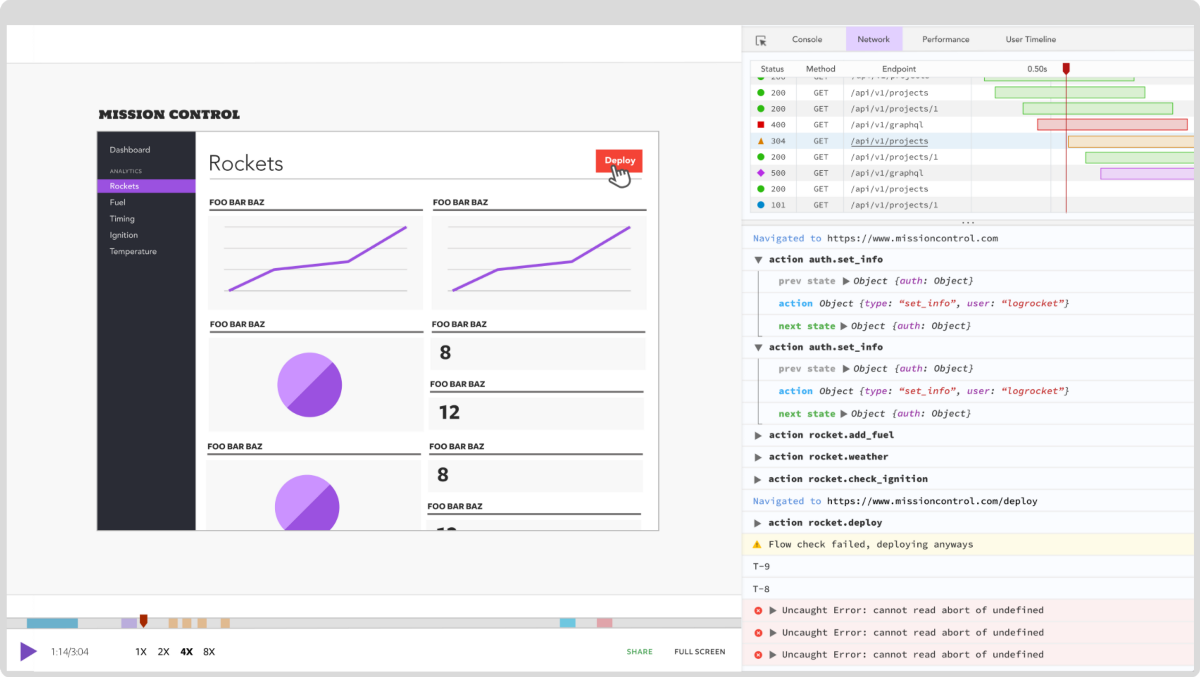
LogRocket lets you replay user sessions, eliminating guesswork by showing exactly what users experienced. It captures console logs, errors, network requests, and pixel-perfect DOM recordings — compatible with all frameworks, and with plugins to log additional context from Redux, Vuex, and @ngrx/store.
With Galileo AI, you can instantly identify and explain user struggles with automated monitoring of your entire product experience.
Modernize how you understand your web and mobile apps — start monitoring for free.