Podcasts and audiobooks are growing in popularity. Recent studies show that spoken-word audio now makes up 25% of daily listening in the US. And not only are more people listening, but the average time they spend listening is also increasing. Beating out radio for the first time this year, podcasts and mobile devices are now the primary way people listen.
A few years ago the Spoken Word Audio Report asked respondents why they listen. The top answer was multitasking. Two listeners described it like this:
Rick: …I do everything while listening. Working out, working, cleaning. …it takes my mind off of what I'm doing at the moment.
Anahi: …I used to have more time to read actual books page by page and have more time to watch TV, documentaries and all that stuff. But with kids, I feel like I have to squeeze it into my life one way or the other.
All this suggests that there is real value in offering your work in audio form. So why aren’t more journalists, bloggers, and newsletter writers doing it?
Until recently, producing good quality narration meant using a voice actor. It was slow, expensive, and out of reach for most creators. Large publishers would partner with companies like Audm to produce professional readings of their content. Even then they had to be selective, as it was a costly and time-consuming process.
The alternative was using text-to-speech tools that sounded robotic and were painful to listen to.
But recent advances in AI voice models have changed that. You can now produce audio that’s almost indistinguishable from a professional reading, in minutes. And if you spot mistakes and have to update your text later, the audio can be re-generated just as quickly.
That’s why we built Voxi.fm. To make it quick, easy and inexpensive to add natural-sounding narration to your articles.
It's worth acknowledging that AI aversion exists. People are tired of reading low-effort AI-generated content that’s flooding the internet.
But the public is rightly more wary of content authored by AI than of AI being used instrumentally. Reading a human-authored text aloud falls into the second category. You’ll notice that large publications like the New York Times and Inc.com, which are now adding AI-voiced narration on their articles, refrain from using the ‘AI’ label, opting for ‘automated voice’ instead.
There is also aversion to AI because of the potential job losses, including for human narrators. Given the choice, I think people would prefer human narration, especially on longer-form content like audiobooks. I certainly would.1
But it’s also true that for many writers and smaller publishers, human narration is simply not an option. So if AI-voiced narration is a viable alternative, why not offer it to readers who'd rather listen.
The easy creation of narrated versions of your written work also opens up a new opportunity: to distribute your content as a podcast.
Doing so will make your work discoverable for new audiences on Spotify, Apple Podcasts, and other podcast platforms. Each new article becomes a new podcast 'episode’. It also gives your existing audience the option to get updates and listen to your new articles when they are published.
This works with Substack today (see our Substack Voiceover guide), and we’ll soon support platforms that don’t produce their own podcast feeds.
No.
We’ve noticed that when we mention AI and podcast creation in the same breath, people imagine Google’s NotebookLM. But what we’re discussing here is not that.
For the unfamiliar: NotebookLM’s Audio Overview generates an artificial conversation between two AI speakers, in the style of an American podcast, about whatever text you give it. What’s read aloud isn’t your text. It’s a script Google’s AI writes around your text, performed as if two people were discussing it.
Such audio can be useful for personal learning. But when you're publishing to an audience, having AI write the script as well as read it is a step too far.
Voxi.fm uses AI only to read the text aloud, the way an audiobook narrator would, without generating a pretend conversation around it.
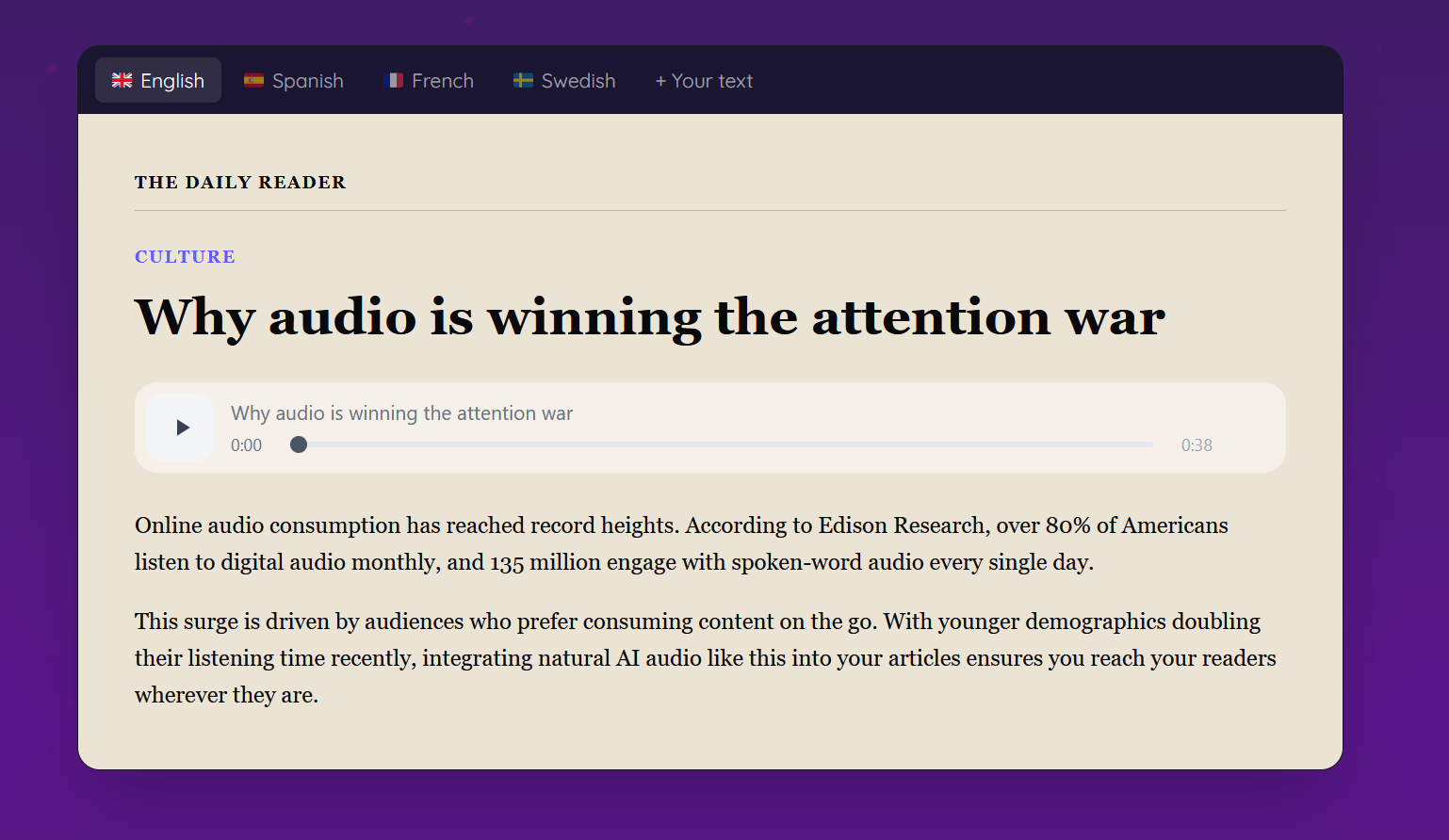
The Voxi player is embedded on recent Media Lens articles, and new articles also appear as podcast episodes.
Adding audio to an article takes a few minutes. For readers who'd rather listen, it makes a big difference. If you’d like to add audio to your own content, try it out or get in touch. We’re especially keen to work with smaller publishers, independent journalists, and non-profit media groups.