This is a follow-up to my last post AI detectors are a bad idea.
In 2024, OpenAI had already built a working text watermarking system. But they found that bad actors could trivially circumvent it and worried that using it would unfairly stigmatise non-native English speakers.
Then the EU AI Act’s marking obligations went into effect on August 2, 2026. Nine days later, Anthropic announced it would be watermarking everything Claude writes. OpenAI has also signed the EU’s Code of Practice on transparency, alongside most of the major labs, committing to marking AI-generated text.
While roughly half of Europeans and Americans have used AI, there is a vast disconnect between people who use it as part of producing real work and casual users who have only fired off a few prompts or use it as an easier, smarter Google.
Without experiencing how AI can help you produce real work, it’s easy to treat all AI output the same: someone else’s work. This can make criticism of AI detectors and watermarking difficult, as many will immediately interpret it as coming from someone who wants to pass off someone else’s work as their own.
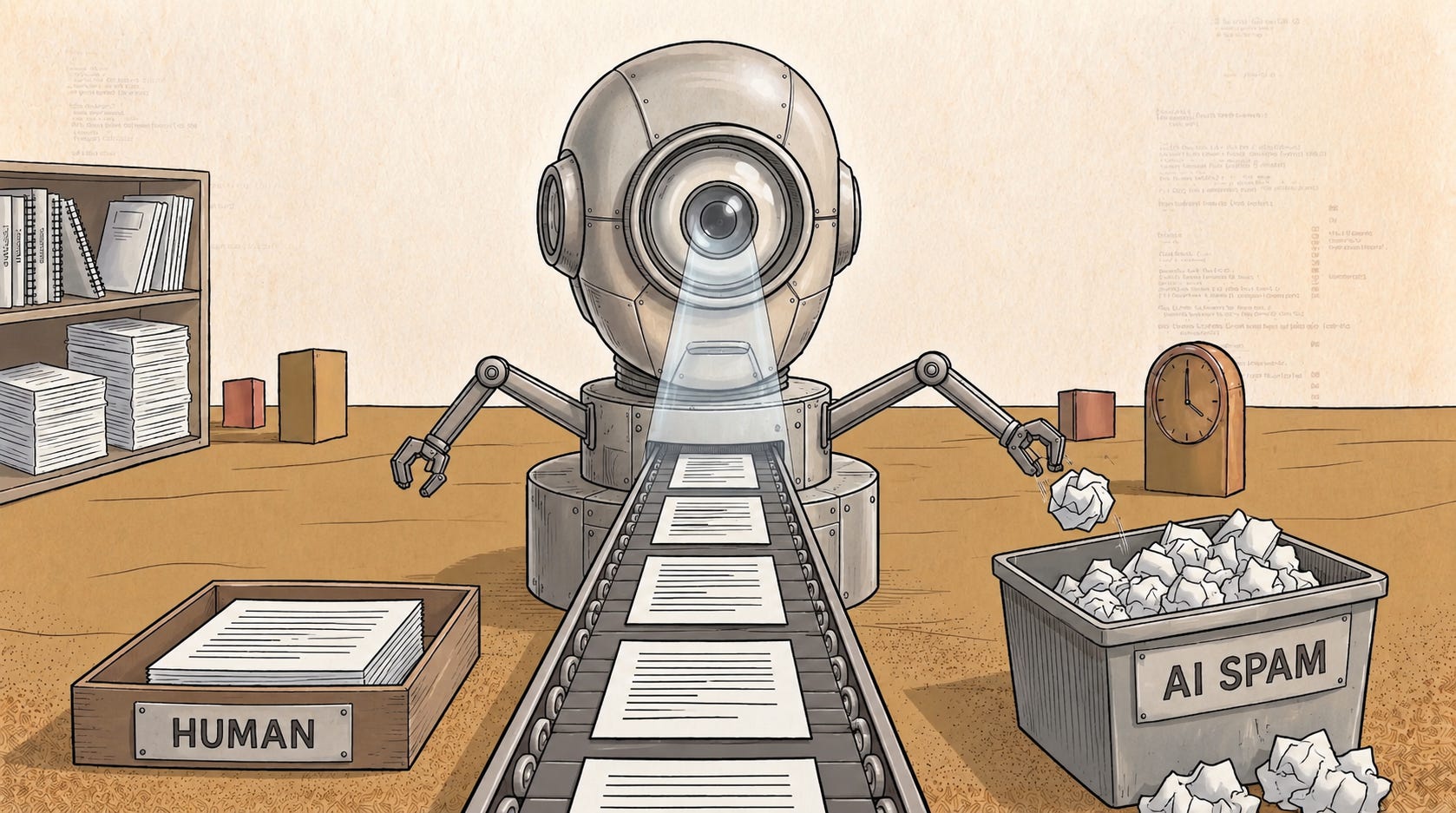
Many see anything produced by AI that they didn’t prompt themselves as slop and a signal of inauthenticity. And AI detectors are being used like spam filters. You can see, then, why there’s so much stigma associated with AI use. It changes how your work is perceived, and whether it gets read or not.
I wanted to share some examples of AI use that I consider useful and democratising, but which risk being dismissed as slop once detectors and watermarks label them as AI.
Many will argue that disclosure is the right thing to do, and it will not affect how the work itself is perceived. But this is not true. A recent study showed a ‘disclosure paradox’:
while participants hold a normative belief that disclosure is important and predict that such disclosure will not negatively bias them, they nevertheless exhibit negative evaluative attitudes when AI use is actually disclosed. These findings are also supported by research in different contexts. In the context of crowdfunding campaigns, the disclosure of AI use resulted in donors having significantly less cognitive and affective trust
The authors conclude that:
…a communicator’s capacity as a knower is unfairly diminished because they used, or are believed to have used, an AI tool. Furthermore, this AI penalty may be even more unfair to those who might benefit the most from the use of AI to overcome accessibility or linguistic barriers, such as non-native speakers
AI models often do a much better job at translation than previous online tools like Google Translate. The EU, in its final transparency guidelines published last month, goes so far as to exempt translation from watermarking.
But detectors like Pangram only look at the surface text. And Anthropic, perhaps worried about accidentally exempting the unexemptable, announced it will be watermarking everything, translation or not.
If I write an argument in English and ask an AI to translate it into some other language, every word in the output will have been selected by the model, and a detector will flag it as AI. But the argument is still mine.
Here’s an example of how this plays out in real life. A Korean user, Selta, posts on X, critiquing Anthropic’s text watermarking move, after translating their thoughts to English with AI. Another user invokes Pangram’s X bot to scan the user’s post for signs of AI. Pangram loudly declares, “We believe this entire text is AI,” alongside a large “100%” graphic.
Selta replies: “Thank you for proving my point. This is exactly how human authorship gets erased.”


The biggest challenge, in my mind, is convincing people that labels produced by detectors, like ‘100% AI’ or ‘50% AI, 50% human’, are meaningless if they’re only based on the final text. And the final text is all that these systems look at.
This becomes obvious in two examples:
Brief throwaway prompt → AI generates article → AI detector: 100% AI
Weeks of work → Written draft → AI rewrite → AI detector: 100% AI
Clearly, the human contribution in these two examples is very different, but to an AI detector they look the same. That classification then invites us to draw conclusions about authorship.
We now have tools that make it easier for journalists to go independent without worrying about losing access to editors. AI tools can help them produce the final copy and free them up to spend time investigating and researching.
A Wired piece compared tech reporter Alex Heath's use of Claude to write to the traditional newspaper rewrite desk:
Several longtime journalists remarked to me that Heath’s workflow feels like a modern version of a long-standing institution: the rewrite desk. In the days before laptops and smartphones, reporters in the field would call in stories to a newsroom, where writers behind a desk would quickly weave those reported details into articles they could print for the next day’s paper. This allowed some reporters to spend their days covering events and talking to sources. In a way, Claude is now Heath’s rewrite desk.
Even within newsrooms, some have adopted the AI rewrite desk to free up their journalists’ time. And as with the traditional rewrite desk, the reporter keeps the byline.
To me, this is a good example of AI’s democratising potential. Some will argue that writing is a critical part of the intellectual work and shouldn’t be delegated. I think that’s true for some work, but not all. Journalism had already separated reporting from final prose through the use of rewrite desks.
And not all journalists consider writing to be the most important part of their work. A Finnish study looking at journalists’ “professional identity” grouped them into “artisans” for whom the craft of writing was very important, and “advocates” who found the societal role and impact more important.
OpenAI had already found in 2024 that its text watermarks could be easily circumvented through “translation systems, rewording with another generative model, or asking the model to insert a special character in between every word and then deleting that character.”
Now with text watermarking being rolled out by the AI labs, everyone doing AI-assisted work will have to worry even more about the social stigma it carries. Many will be unaware that even existing AI-assisted work can be easily checked against classifier-based detectors like Pangram for signs of AI output.
But circumventing watermarks and evading detectors are still trivial for those determined to do it, such as those who want to defraud people or spread disinformation - precisely the groups the EU Act is supposedly trying to stop.
The result is that people who genuinely benefit from the technology are put in a much worse position, while the people it’s supposed to stop face only the flimsiest of hurdles.
For a very funny and dystopian take on an AI editor, but one which I think anticipates a frightening and very plausible use of AI in propaganda and journalism, I can highly recommend the book The Man With No Face by David Edwards of Media Lens.
Articles and papers I found interesting researching this post:
The AI penalty and disclosure paradox: Trust, authenticity and knowledge uptake in AI-mediated communication By Siavosh Sahebi, Paul Formosa, Sarah Bankins, May 2026
Authorship After Generative AI: Distributed Creativity and Relational Responsibility by Michael Uebel & Bilal Hamamra, August 2026
Artisan, Advocate, Steward: A Narrative Exploration of Professional Identity and Meaningful Work in Journalism by Minna Koivula, Tiina Saari, Pinja Päivänen, and Mikko Villi, February 2026
Differentiation by Disruption: Gatekeeper Perspectives on “AI-Aided Writing” in Three Academic Disciplines by Isak Ladegaard, March 2025
Understanding the source of what we see and hear online by OpenAI, May 2024
Sharpening the Pencil, Not Replacing the Hand: De‐Stigmatising AI Use in Research Writing by Aaron Opdyke, March 2026
Evidence of a social evaluation penalty for using AI by Jessica A Reif, Richard P Larrick, Jack B Soll, May 2025