Authors: Mart Krupovic, Eugene V. Koonin
Paper: https://arxiv.org/abs/2602.23268
Code: N/A
Data: N/A
Tool/Model: N/A
WHAT was done? This perspective paper introduces a theoretical framework that recasts the ribosome not merely as the cell’s passive translation machinery, but as a “selfish” biological entity that drove cellular evolution to ensure its own continual replication.
WHY it matters? By inverting the organism-centric view of evolution, this framework provides a novel lens for understanding the extreme thermodynamic costs of translation, the architectural constraints on cell growth, and the foundational basis of virus-host conflicts.
WHO should read this? Essential reading for evolutionary and computational biologists focused on early life, translation dynamics, and host-pathogen co-evolution; skip if you require purely empirical datasets or algorithmic methodologies.
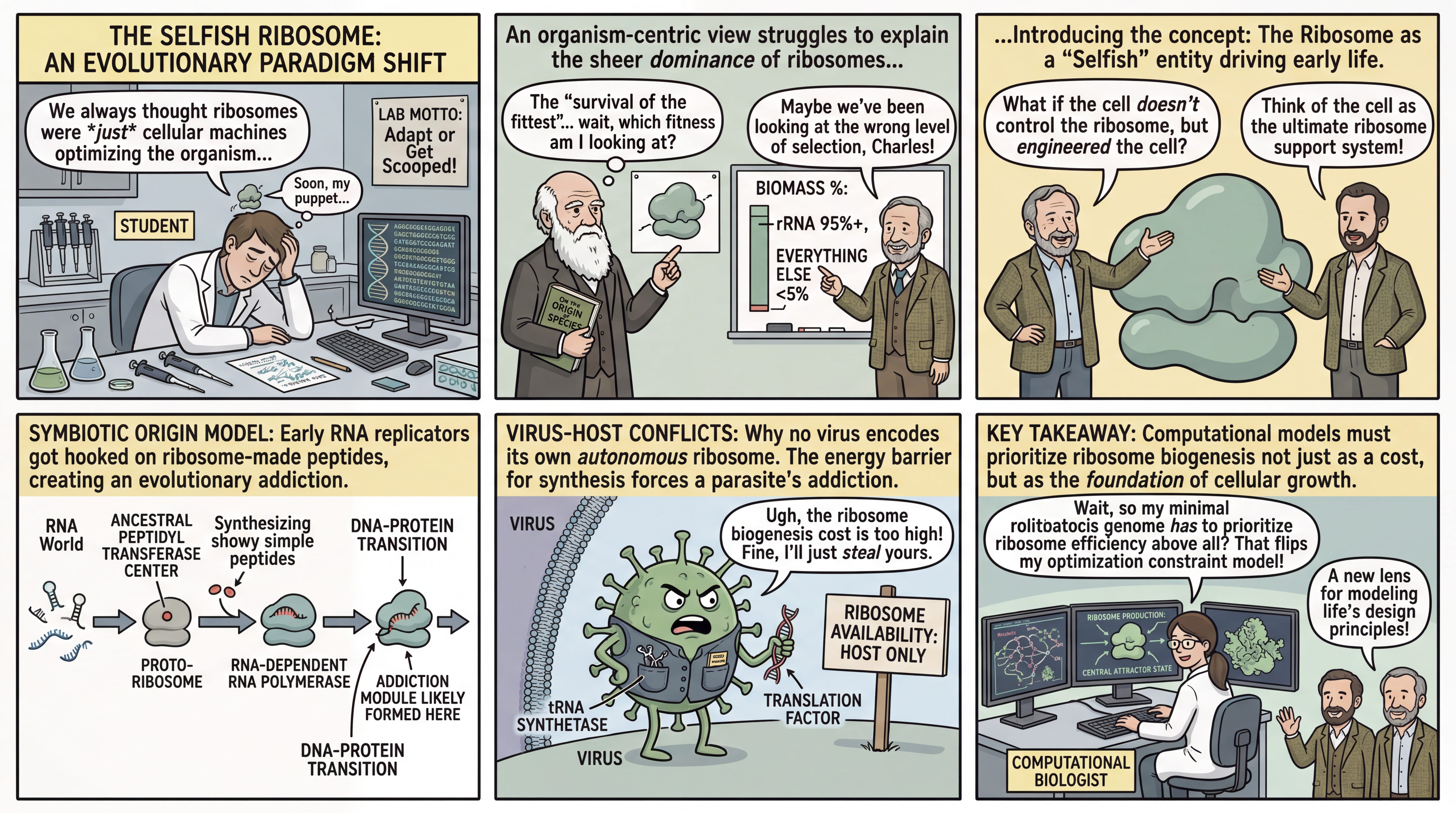
The origin of life debate typically oscillates between “metabolism-first” and “replication-first” scenarios. In both classical models, the emergence of the translation machinery is treated as a relatively late, albeit essential, evolutionary invention that facilitated the transition from the RNA world to protein-driven life. Consequently, the ribosome is widely viewed through an organism-centric lens as an adaptive workhorse—a complex machine optimized by natural selection to serve the fitness of the cell. However, this perspective struggles to intuitively explain the overwhelming energetic dominance the ribosome commands over all other cellular processes. The authors of this paper identify a conceptual gap in our understanding of early evolution and propose a radical paradigm shift, suggesting that the architecture of modern life is actually a byproduct of the ribosome’s own evolutionary self-interest.
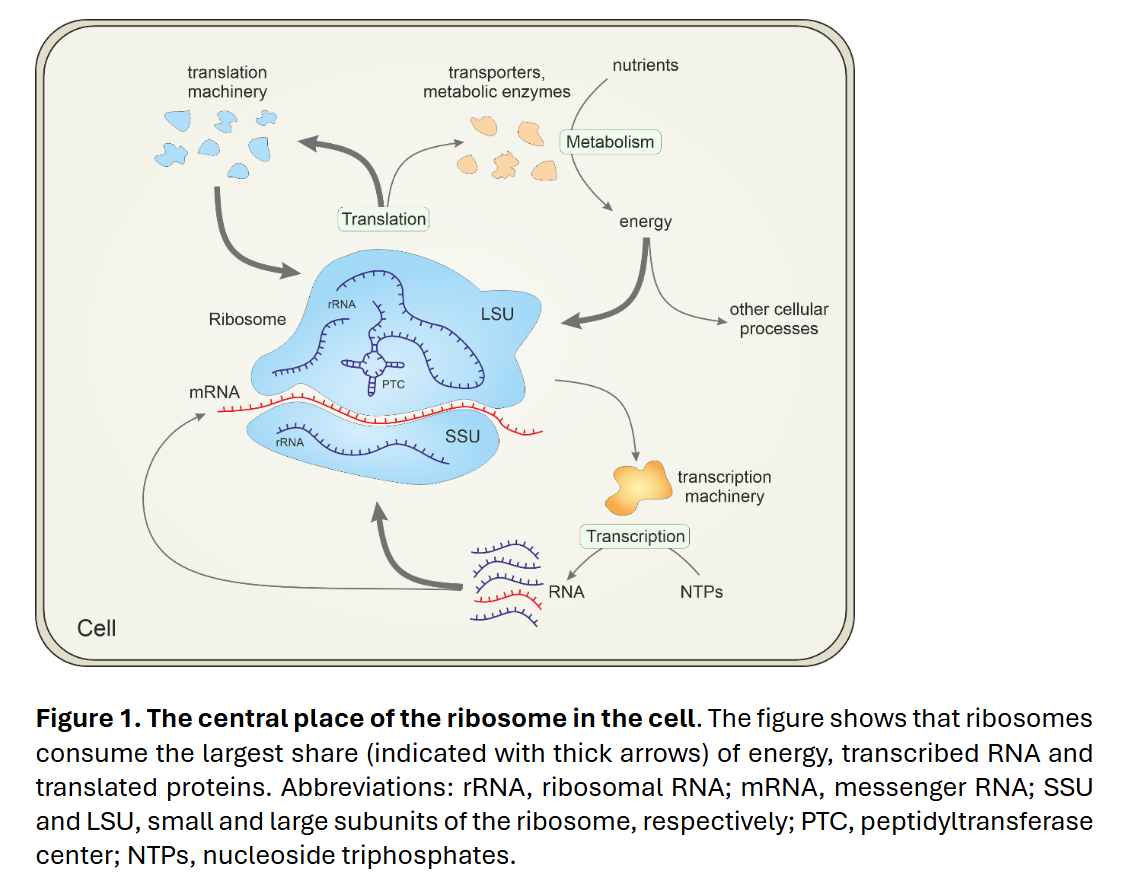
To build their case, the authors leverage established quantitative data regarding cellular resource allocation. In actively growing prokaryotes, ribosomal RNA (rRNA) constitutes an astonishing 95% to 98% of total cellular RNA. Furthermore, translation is the largest energy sink in the cell, accounting for at least 50% of the energy expenditure in fast-growing bacteria. The cellular concentration of ribosomes increases linearly with the growth rate, and the physical space required to house them—alongside the roughly seven minutes required to synthesize a single bacterial ribosome—sets a hard thermodynamic and physical limit on bacterial division, known as the “ribosome catastrophe.” As illustrated in Figure 1, the authors argue that the entire metabolic and structural componentry of the cell functions primarily to funnel energy and nutrients toward ribosome production. In this framework, the cell is effectively an elaborate support system designed to maximize the propagation of the ribosome, operating much like a selfish genetic element but on the scale of a massive macromolecular complex.
The paper presents a mechanistic timeline for how this ribosomal takeover occurred during the transition from the RNA world. As detailed in Figure 2, the authors propose a symbiotic origin model.
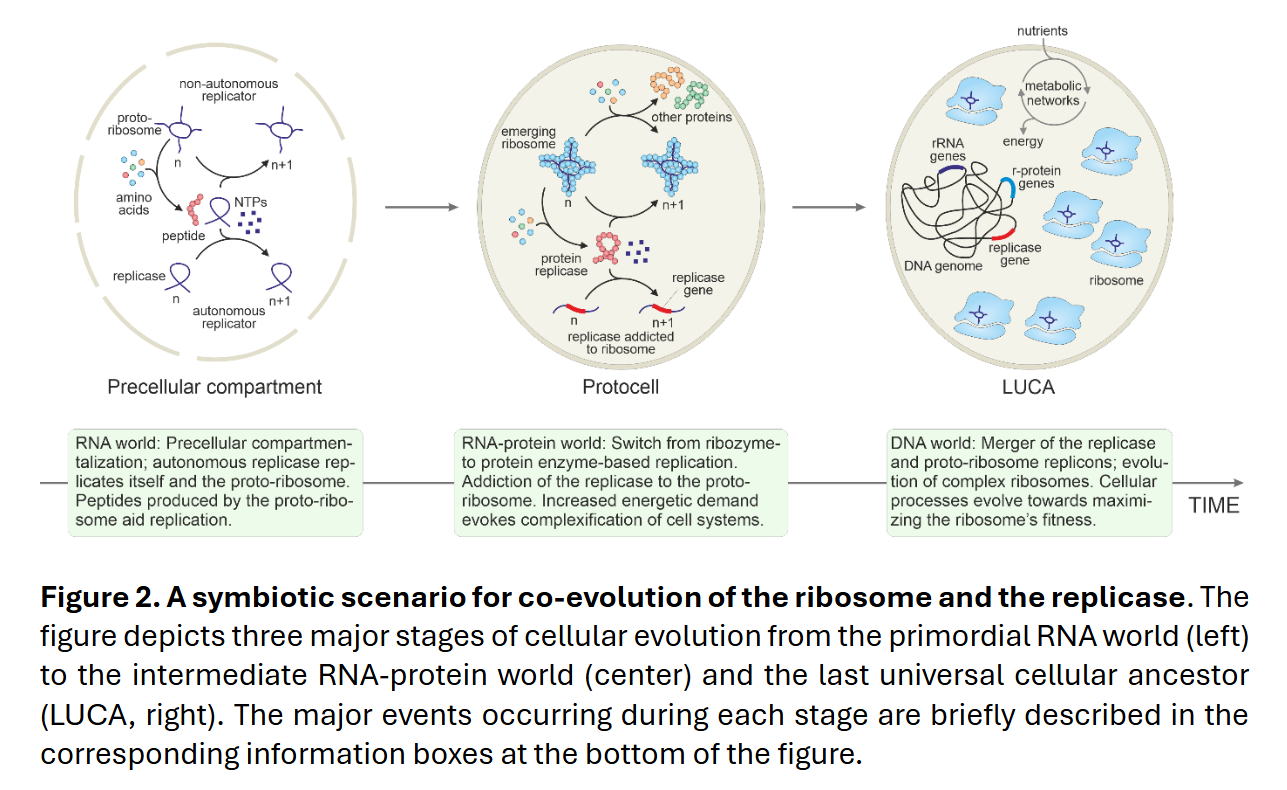
The earliest proto-ribosome—likely a small ribozyme capable of non-templated peptide bond formation, akin to the ancestral Peptidyl Transferase Center—produced random peptides. Some of these peptides happened to stabilize or enhance the activity of distinct, co-evolving RNA-dependent RNA polymerases, or replicases. In return, these replicases copied the proto-rRNA. As evolution progressed and protein-based enzymes outcompeted ribozymes, autonomous replicators became entirely dependent on the proto-ribosome for survival. This irreversible evolutionary lock-in meant that replicators were forced into an addiction module. To sustain the heavy metabolic cost of the growing ribosome, replicators had to evolve increasingly sophisticated metabolic networks, eventually coalescing into the large DNA genomes characteristic of the Last Universal Cellular Ancestor.
Beyond early evolution, the selfish ribosome concept provides a compelling explanatory framework for extant biological conflicts, particularly between cells and viruses. Despite encoding vast repertoires of translation factors, tRNA synthetases, and occasionally ribosomal proteins, no known virus encodes a complete, autonomous ribosome. The authors posit that the energetic and temporal costs of de novo ribosome synthesis are simply too prohibitive for efficient viral propagation. Consequently, viruses—which are essentially autonomous selfish replicators—remain fundamentally addicted to the host’s translation machinery. This obligate reliance explains why the ribosome is the ultimate battleground in inter- and intra-cellular conflicts. It is the primary target for viral subversion mechanisms, as well as the focal point for host antiviral defenses, such as abortive infection via toxin-antitoxin systems, and ecological warfare via antibiotics.
While intellectually stimulating, biology audiences must evaluate this work with specific caveats in mind. Primarily, this is a conceptual synthesis and not an empirical study. There are no new retrospective benchmarkings, novel experimental assays, or mathematical models provided to test the boundaries of this hypothesis. Distinguishing the selfish ribosome model from standard adaptive complexification remains experimentally challenging, as it relies on reinterpreting existing metabolic data through a philosophical, multi-level selection lens. Additionally, testing evolutionary dynamics that occurred over four billion years ago relies heavily on reconstructing ancestral sequences, but the paper does not offer computational phylogenetic simulations to validate the proposed symbiotic trajectories between early RNA replicases and the proto-ribosome. Without predictive mathematical modeling—such as evolutionary game theory simulations demonstrating the exact conditions under which a selfish proto-ribosome would subjugate a host replicator—the framework remains a descriptive narrative rather than a quantitative tool.
Despite the lack of testable code or new datasets, this perspective holds strategic value for computational biologists and systems modelers. For researchers designing synthetic cells or modeling minimal genomes, this paper underscores a critical design principle: algorithms optimizing cellular functionality must heavily weight ribosomal biogenesis and translation efficiency, not just as a metabolic cost, but as the central attractor state of cellular growth. By reframing the ribosome as the primary unit of selection at the dawn of life, this work challenges researchers to look at cellular resource allocation models from the inside out, potentially inspiring new approaches to studying host-pathogen co-evolution and the basic thermodynamic limits of life.