When children behave badly, their parents often take their toys away from them. But when Massachusetts State Police screw up, they get blank checks to purchase new toys for big boys.
For a decade, the Boston Institute for Nonprofit Journalism has tracked unwieldy spending by the troubled law enforcement agency. Unmonitored security and weapons purchases have been a persistent problem, even landing the former head of the state police union in prison earlier this month.
Yet the money keeps on flowing. According to requests for proposals analyzed by BINJ, MSP are on a spending spree, and are now madly shopping for new drone equipment and accessories like contestants on Supermarket Sweep.
Drone detection and mitigation
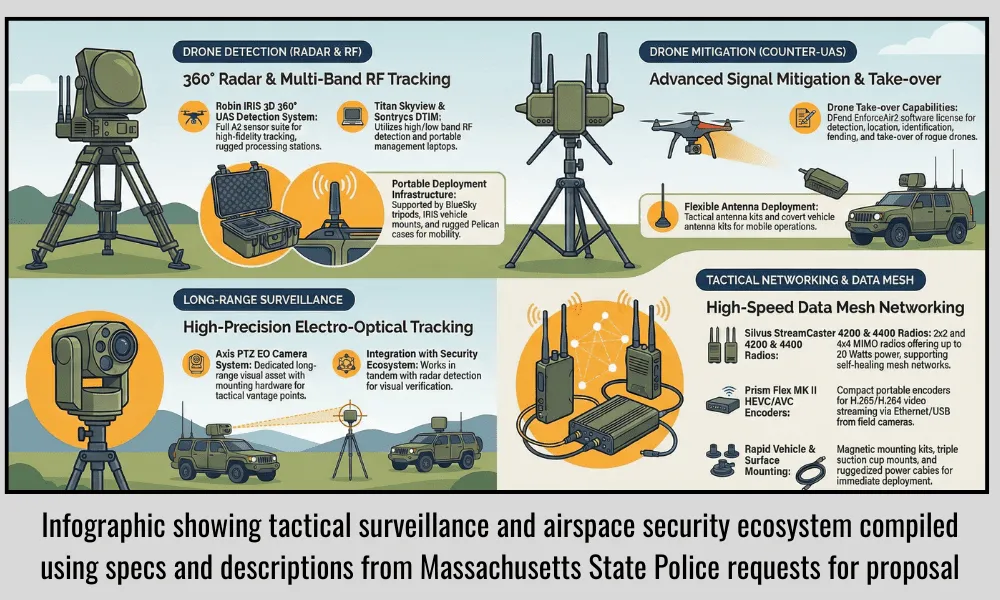
A major component of these requests involves securing airspace against unauthorized Unmanned Aerial Systems (UAS). MSP is seeking systems to provide a layered defense from detection to intervention. Specifically, equipment like the Robin IRIS 3D system uses 360-degree radar to provide three-dimensional tracking of drones. While the Sentrycs DTIM and Titan-SV Skyview units act as sensors to monitor the presence of drones within a specific area.
There are no specific usage needs cited in the request for proposal, but these systems could be deployed around a stadium or a large public gathering—say, for example, the upcoming FIFA World Cup games in Foxborough—to create a “digital dome.” If a drone is detected entering the restricted airspace, security teams would receive an immediate alert with its precise location and flight path.
Authorities will also be prepared to commandeer civilian UAS. Unlike traditional jammers, the takeover software MSP seeks is designed to identify and hijack a flight. If a drone is identified as a threat near a critical bridge or a sensitive government building, a state operator could use this technology to force it to land safely in a designated zone.
Beefing up the systems
These are mostly upgrades to existing equipment. As BINJ previously reported, in 2024, according to the Mass Office of Grants and Research, state police paid Dedrone, which is owned by Taser and body camera maker Axon, $85,000 for a year-long renewal of service for 11 antennas. Per the DHS grant program’s state share application, the funding runs through this June. Grant funding for a similar program was secured by MSP in 2023 to the tune of $60,000.
According to the application filed by the state police director of billing and grants, the system they acquired can detect a drone’s position and the location of the operator, as well as the spot where the drone was initially launched from.
“This grant will continue to provide the MSP and our partners with detecting drone operations in and around restricted airspace as well as areas of high security concern such as airports, stadiums, prisons and large open-air venues,” the MSP director said at the time. Think the Boston Marathon, July 4th celebrations, MLB games, and concerts at Fenway Park.
As BINJ reported back in 2024, the state police also have a cell-site simulator, commonly known as a Stingray, after one popular brand name. Installed in the bed of a Chevrolet Silverado, the controversial device allows the authorities to collect cell information from thousands of people as they drive through crowded areas. It works by fooling phones into connecting with it instead of a cell tower; once those phones are connected, police collect International Mobile Subscriber Identifiers from SIM cards.
Long-range surveillance
There’s no use in controlling the skies unless you also have the most powerful watch over them. To that end, MSP are also bolstering the department’s visual monitoring capabilities. The department has requested an axis long-range electro-optical camera with pan-tilt-zoom, which allows for high-precision remote zooming.
On a clear day, these cameras could be used for maritime security or search-and-rescue operations. On a less clear day, they could be watching you undress because you’re having an affair with the spouse of a trooper who has access to the drone.
To ensure that all the data from these cameras and sensors can be shared instantly, the state is building a high-speed self-healing network. Unlike standard wi-fi, this network becomes stronger as more radios are added and can work off the grid. As a kicker, state police are also shopping for encoders that can compress high-quality video feeds so they can be streamed smoothly over that network.
Most of these requests have a proposal deadline of March 6. All procurement documents require that the equipment be delivered before May 31, 2026.