
There is a lot of discussion recently about whether AI reached bubble territories. Nvidia a month ago touched the $5T valuation. I still remember when Apple became the first company with a $1T market cap not a long time ago, in 2018. At the time it felt like a generational milestone, but now we are way past that and $1T is merely a CEO compensation.
Signs that the narrative switched to a bubble vibe started a few months ago. In September Mark Zuckerberg on the Access podcast said that “if we end up misspending a couple of hundred billion dollars, it’s going to be very unfortunate, but the risk is higher on the other side if you build too slowly”. One month later, Jeff Bezos said that AI is a bubble, but a good one, and “when the dust settles and you see who are the winners, society benefits from those inventions”. For example we got to use all the fiber optic cables that have been laid out during the internet bubble of the early 2000s, although the companies that laid out those cables went out of business. More recently, Michael Burry came back to Twitter to hint that he was taking bear positions in the AI space, which was later discovered were puts against Nvidia and Palantir. The tweet came out around the time Nvidia and Palantir hit their all time high market price, and both stocks dropped since then.
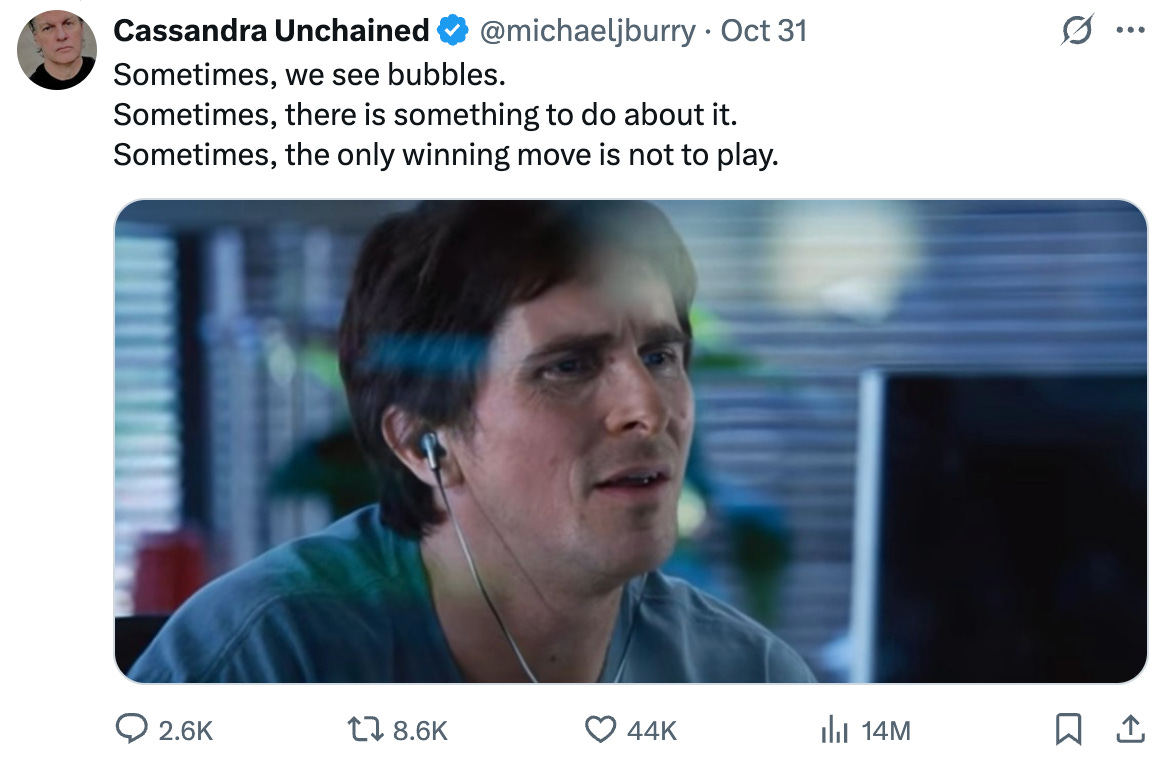
So is the AI industry a bubble? Of course it is, but the main question is what kind of bubble and when it will pop.
I do not care about the timing component of the bubble because I think it is basically impossible to predict. Markets can stay irrational for a long time, even if all the metrics indicate that the level of euphoria is not sustainable. Often the pin that pops the bubble is an external one-off event, impossible to predict1.
The more interesting question is about what kind of bubble it is. Is it going to be an industrial bubble, like railways, telecommunication or dotcom, or a financial one like housing in 2008?
Industrial bubbles are more benign and have smaller impact on the broader economy. Industrial bubbles are caused by the difference between the pace of the investment and the pace of the return on those investments. Basically, investments are getting too far ahead of the returns, too much capacity is built in a short time, but the return and the revenue from those investments do not materialize fast enough. When this realization becomes apparent among investors, investment stops abruptly and idle capacity is left as a result. However, typically industrial bubbles produce infrastructure that eventually becomes useful and generates those returns, although it is possible that the original companies that built that infrastructure are now out of business and other companies benefit from the fruits of the investment.
The difference between an industrial bubble and a financial bubble is how it is financed. Industrial bubbles are financed by the free cash flow or the reserves of the company making the investment. A financial bubble is when debt is involved. Financial bubbles are way more harmful for the broader economy because they have banks and credit markets involved, which tend to propagate the effect of the bubble in a broader swath of the economy.
The great financial crisis of 2008 is the prime example because it did not stay restricted to the real estate sector, where it originated. With banks involved in the financing and the repackaging of the mortgages into financial products, they brought the nefarious effect of the bubble everywhere.
In the case of AI, it does not seem that banks are heavily involved in the financing of the infrastructure buildup. Many of the hyperscalers building data center capacity have a lot of free cash flow and reserves to fund these investments. Amazon recently announced Project Rainier, one of the world’s largest AI compute clusters, and the largest that AWS ever built. Its capacity is 70% larger than any AI cluster AWS history, and yet a single AI company, Anthropic, is going to use all of it to train its next generation of models. Project Rainier price tag is $11B, but Amazon has cash reserves for $93B and free cash flow of $32B (after deducting current data center investments). Other hyperscalers like Google and Microsoft are healthy companies generating a lot of free cash flow from business divisions unrelated to AI.
So overall, there are signs that indicate that AI is more an industrial bubble, and when it pops it should not have devastating effects like 2008. There are, however, some differences compared to other industrial bubbles like railways and telecommunications.
First of all, there are some financial institutions involved in the financing of the infrastructure buildup: private credit funds. Private credit is the equivalent of private equity for debt. While private equity funds buy companies to generate returns, private credit funds are companies that gather investments and borrow money to then lend that money out in private markets. It’s not clear how private credit funds are insulated from banks. Bank lending to private credit funds might pose a systemic risk to the banking system, making the AI bubble more financial and less industrial.
Secondly, the useful life of an AI data center is much shorter than railway tracks. Hyperscalers typically depreciate GPUs on a five-year cycle due to the rapid innovation in the space and new, faster, better GPUs coming out from Nvidia and others. Five years is an incredibly short time. If you build an excess of data centers for which you do not have demand, if they sit idle for five years they will become useless.
Finally, AI-related technology stocks have been responsible for the vast majority of the US stock market’s growth. According to JP Morgan, AI-related stocks were responsible for 75% of S&P 500 returns, 80% of earnings growth and 90% of capital spending growth since ChatGPT launched in November 2022. If the AI bubble pops and tech stock valuations drop significantly, the overall US stock market will drop too, with the corresponding negative wealth effect, which will reduce consumption and cause problems to the broader economy.
Do you like this post? Of course you do. Share it on Twitter/X, LinkedIn and HackerNews