Wikipedia's article on "Acquired Homosexuality" begins:
Acquired homosexuality is the discredited idea that homosexuality can be spread, either through sexual "seduction" or "recruitment" by homosexuals or through exposure to media depictions.
Au contraire! As I explain in my book on human genetics, twin and adoption researchers have long credited some version of this “discredited” idea. While almost all studies find that genetics matters, virtually none asserts that the heritability of sexual orientation is even close to 100%. Ergo, homosexuality must, to some extent, be “acquired.” While that hardly implies that any specific mechanism - such "recruitment" or "media depictions" - works, the idea that homosexuality can be spread is the unheralded scientific consensus.
Recently, however, the evidence in favor of acquired homosexuality has become overwhelming. Check out the results of the latest Gallup poll on LGBT orientation.
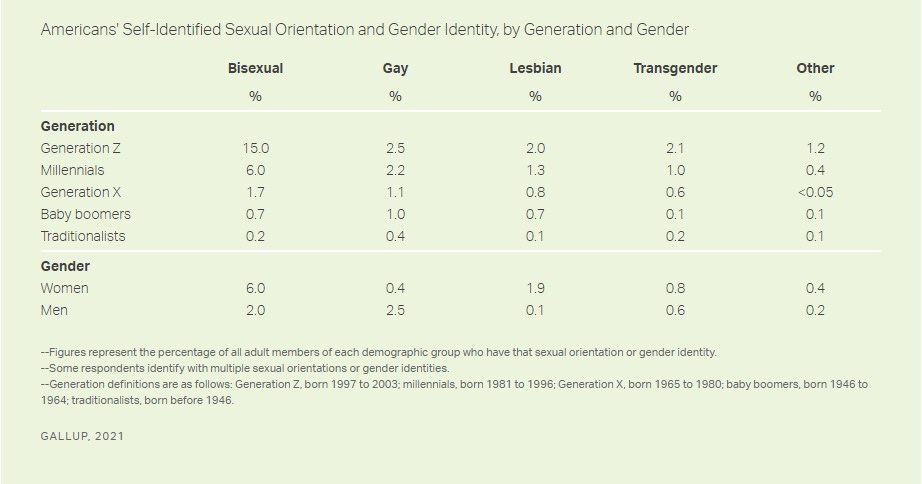
The numbers for bisexuality are especially shocking. Over the course of five generations, bisexual identity has multiplied by a factor of 75! Lesbian identity has multiplied twenty-fold, transgender identity ten-fold. Even gay identity is six times as common in Generation Z as among traditionalists.
What's going on? The answer is clearly not, “Gay genes exploded in the population.” Gays have far fewer biological children than straights. Fertility was conceivably equal back when almost all gays lived in the closet, but there can be little doubt that during the last fifty years, gay genes have become less prevalent.
Could the rising LGBT share merely reflect the decline of closeting? In part. Still, if that’s the whole story, why is there such a massive generational pattern? Why would older LGBTs stay in the closet as the stigma plummets?
You could appeal to age-segregated social circles. Octogenarians fret more about the intolerance of fellow octogenarians, and draw little comfort from the tolerance of today's teen-agers. But the elderly plainly care about the opinions of close family members - and the older you get, the more likely your close family members are to be markedly younger than you are. Nevertheless, Traditionalists' total LGBT share still sums to just 1%.
The evidential elephant in the room is the massive shift from Gen X to Gen Z. Being part of Gen X, I confidently assert that we were far less intolerant than earlier generations. Yet our self-reported LGBT share stayed under 5%. Even if later generations turned the intolerance dial down to zero, why would this relatively minor change multiply Gen Z's numbers more than four-fold?
Another weakness of the closeting story is that mainstream stigma against bisexuals was always milder than against any of the other groups. Yet it is bisexuality that has exploded.
You could argue that stigma has actually reversed, leading young straights to closet as LGBT. This might be true in rare social bubbles, but it's still hard to believe this is common. Even if your parents are officially gay-positive, mild parental dismay when you come out is probably the norm.
What’s really going on? The best stories are the very mechanisms that Wikipedia dismisses: recruitment and the media.
Let’s start with “recruitment.” On reflection, this is just a slightly conspiratorial synonym for socializing. When the Mormons next door invite you to come to their church, you could call it “recruitment,” “outreach,” or “just being neighborly.” Tomato, tomahto. Whatever you call it, this is a good way to make more Mormons.
Similarly, the more openly LGBT people you socialize with, the more likely you are to consider giving their lifestyle a try - especially if the costs of trying are low. When stigma falls, this doesn’t merely lead confirmed LGBTs to come out of the closet; it also means that lots of straight-by-default people start socializing with LGBTs. Which is a good way to make more LGBTs.
Don’t misunderstand me. Some people won’t become gay, no matter how many gays they know, just as some people won’t become Mormon, no matter how many Mormons they know. None of that changes the obvious fact that hanging out with Group X causally raises the chance that you become an X. And one strong predictor of hanging out with Group X is outreach by Group X.
This is especially clear for the orientation with off-the-charts growth: bisexuality. The current cost of "trying" bisexuality is low. You barely have to act on it. Even today, self-identified bisexuals rarely marry - or even co-habit - with same-sex partners. So why adopt the label? To live in communion with LGBT friends… even if you live a nearly-straight lifestyle.
Much the same goes for the “media” channel. As Michael Chwe might observe, positive media depictions of LGBTs create common knowledge that (a) LGBTs exist, and (b) prestigious people like them. Both of these, at minimum, lead to “questioning”; and once many people question their straight identity, at least a modest share will reach an LGBT answer.
Lurking in the background is a deeper force than either recruitment or the media: human conformity. Human beings naturally want to “fit in” with other people around them. Implication: Small behavioral changes readily snowball over time. Being the first person to call yourself an X is terrifying. Being the tenth person to call yourself an X is daunting. As the number of self-identified X’s grows, however, the fear falls. Once you reach critical mass, people may call themselves an X first, and ask questions later.
You might think that sexual identity is too ingrained to change. The Gallup poll says that for the elderly, that’s basically true. Younger people’s identities, however, have turned out to be much more flexible than I ever would have imagined back in the 1980s. Though granted, the identity that has grown the most is the identity that asks the least.
Behavioral geneticists have long emphasized that heritability estimates are relative to your sample. If you collect all your data in a given year, genes will explain almost all the variation in height. If you collect height data for a full century, however, you’ll discover big environmental effects. The same holds even more strongly for the genetics of sexuality. At any given point in time, genes are important, but are far from the whole story. Yet over time, the LGBT phenotype is exploding while the LGBT genotype is imploding. However you evaluate these changes, that’s the world we live in.