R. A. Lafferty (1914–2002) is an unusual SF writer in many ways. First of all, he was forty-five years old before he began to seriously pursue writing as a career. Moreover, he did not set out initially to become a professional science-fiction writer. In fact, he readily admitted in interviews that growing up, he was not a fan of SF and that his ending up publishing most of his work in that genre turned out to be a largely accidental happenstance.
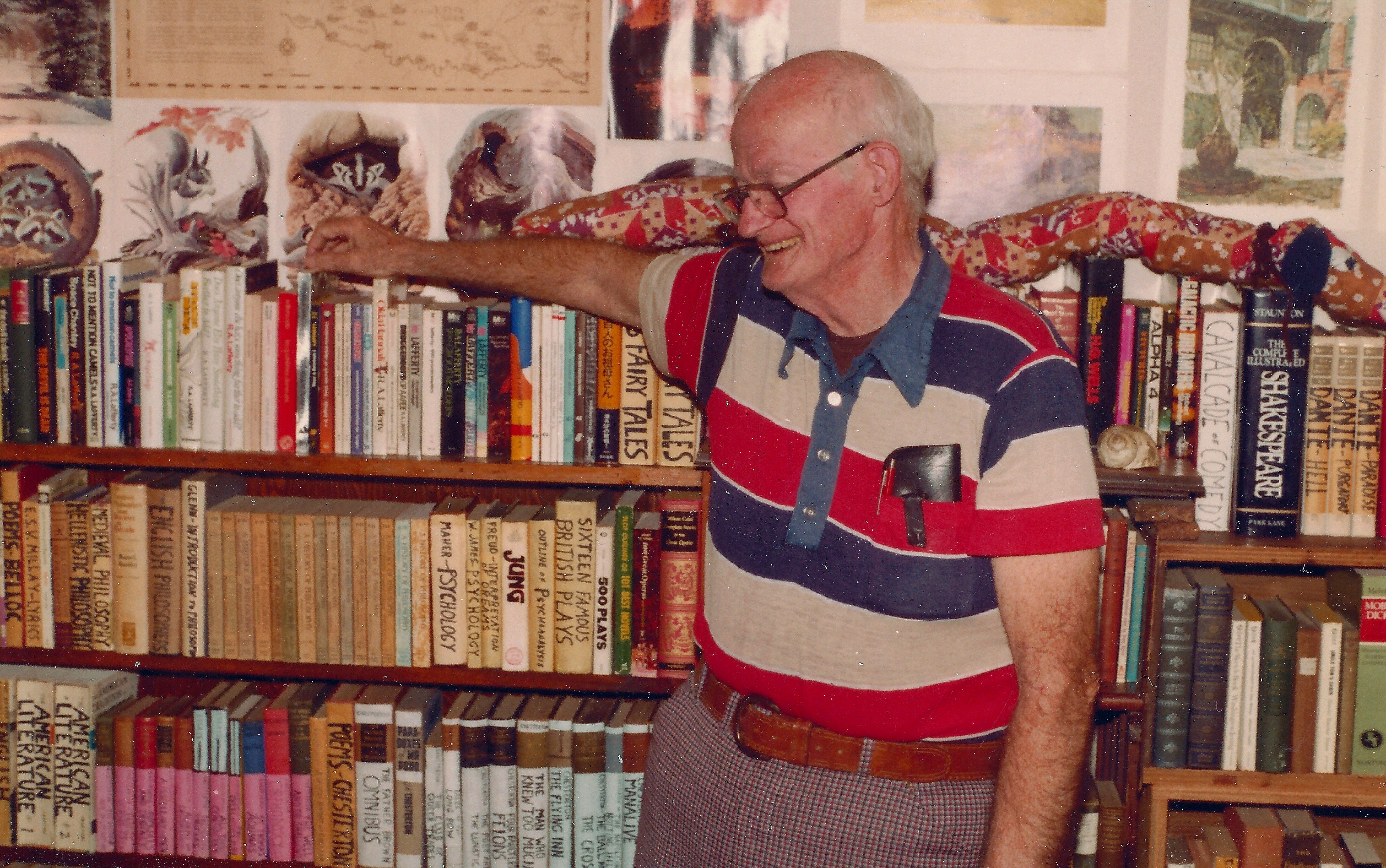
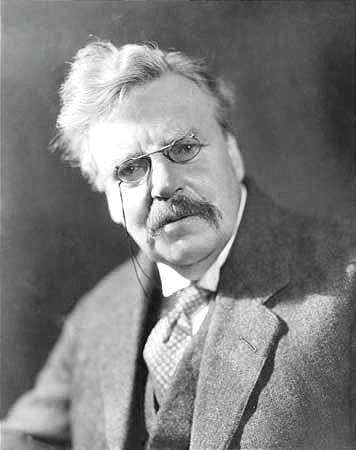
Lafferty was a voracious reader from his earliest years and had even written a historical novel set in Renaissance Italy when he was in his early twenties. Still, when he first began to produce short stories in the late 1950s, he was unsure where to find a market for his unique narratives. One of Lafferty’s most formative influences was the work of the English writer G. K. Chesterton, an author with a style at once both witty and paradoxical. Chesterton often utilized linguistic and narrational riddles in his work in order to explore more profound puzzles about the nature of the human condition, truth, and the meaning of existence, perhaps most notably in his surrealistic detective novel The Man Who Was Thursday (1908). It is perhaps not surprising, then, that Lafferty’s earliest unpublished fiction frequently displays a characteristically Chestertonian predilection for puzzling paradoxes, nor that many of them fit (somewhat uneasily) within the mystery and crime genres. Indeed, the key to understanding and appreciating Lafferty could very well hinge on a recognition of the prevalence of Chesterton in much of his work.
These nascent efforts at mystery and crime-detective writing met with meager success, so the undaunted Lafferty soon moved on to other genres, eventually arriving at science fiction. As already mentioned, Lafferty had very little exposure to pulp SF, so he began buying the numerous magazines published at the time (Astounding, The Magazine of Fantasy & Science Fiction, Galaxy, If, Fantastic, Amazing Stories, and many others) to familiarize himself with the predominant themes and literary conventions of this potential new market for his fiction.
It is fair to say that Lafferty was not overly impressed with many of the customary themes he encountered in these genre publications or the conventional manner in which they were frequently conveyed. Robots, alien invasion, planetary exploration, time travel—all these, and more, would eventually feature in Lafferty’s SF work, but always done with a certain whimsical, oftentimes satirical, even critical point of view that would come to be uniquely identified with him. Two early stories illustrate Lafferty’s burgeoning attempts at employing familiar SF tropes to explore ideas of central importance to his own creative imagination.
The first story, “Through Other Eyes,” written in 1958 and published in Future Science Fiction in February 1960, opens with what appears to be a conventional SF triumph: the successful invention of a “Recapitulation Correlator,” essentially a time machine. Yet Lafferty immediately undercuts the familiar promise of such a device. Instead of granting privileged access to greatness, the machine reveals the banality, discomfort, and petty obsessions of history’s most celebrated figures. Witnessing the Battle of Hastings turns out to involve years of mud and rain for an event lasting less than twenty minutes; Sappho can speak of nothing but the spaying of her cat; Aristotle bores his audience with metaphysical beard theory. The comic effect is unmistakable, but the deeper implication is sobering: even perfect historical access fails to yield meaning when perspective itself remains unchanged.
With this comic prelude concluded, Lafferty turns to his true theme: the development of the “Cerebral Scanner,” a mechanism that allows the amplification of brain impulses so completely “that one man might for an instant see with the eyes of another — also see inwardly with that man’s eyes, have the same imaginings and daydreams, perceive the same universe as the other perceived.” What is discovered, however, is not merely new information but entirely different worlds. As Cogsworth observes while inhabiting another man’s consciousness, “Who would have thought of giving such a color to grass, if it is grass? It is what he calls grass, but it is not what I call grass.”
In Charles Dickens: A Critical Study (1906), G. K. Chesterton relates a curious incident from Dickens’s childhood in which the young writer, sitting in a coffee shop, sees the words COFFEE ROOM rendered backward on the glass door as MOOR EEFFOC. Chesterton famously claims that this moment reveals the essence of Dickens’s genius: the capacity to see the familiar world as strange and newly revealed. “That wild word, ‘Moor Eeffoc,’” Chesterton writes, “is the motto of all effective realism… the principle that the most fantastic thing of all is often the precise fact.”
“Through Other Eyes” is almost a textbook example of the Mooreeffoc effect in action. The Cerebral Scanner is, in essence, a Mooreeffoc machine, designed to produce a radical defamiliarization of reality. This defamiliarization reaches its most extreme and disturbing expression when Cogsworth views the world through the eyes of Valery Mok. What he encounters is a universe of violent sensuality in which every aspect of reality seems grotesquely alive: “Every tree has a strong smell in her world… the grass itself is like clumps of snakes, and the world itself is flesh.” The shock nearly breaks him, not because the vision is false, but because it reveals how partial and anesthetized his own perception has always been. Here, Lafferty pushes Chesterton’s principle to its limit, showing that sudden, total understanding of another consciousness may be psychologically shattering rather than ennobling.
This Mooreeffoc technique of portraying familiarity as estrangement by dramatically shifting narrative point of view is even more pronounced in the second story reprinted in this issue, “The Weirdest World,” written in 1958 and published in Galaxy in June 1961. As the title gradually reveals, the “weirdest world” is our own planet, rendered alien by being perceived through the eyes of a marooned extraterrestrial. Early in the narrative, the protagonist encounters what he calls “giant grubs”—unfinished, cocooned bipeds who crawl out from under rocks and walk “upside down with their heads in the air.” Only gradually does it become clear that these grotesque beings are simply human beings, seen through a radically estranged lens. Clothing becomes an unshed cocoon, upright posture a biological absurdity, and human behavior an expression of arrested development. As the narrator reflects, these creatures are “doomed in their apparent adult state to carry their cocoons with them.”
The story follows a familiar rags-to-riches arc as the alien narrator achieves wealth, fame, and social acceptance through his superior abilities, only to be stripped of everything when a legal ruling declares that a “blob may not own property in Florida.” The narrator’s fall is swift and merciless: friends abandon him, and even the woman who professed love leaves once his wealth vanishes. “By definition I am an animal of indeterminate origin,” he records, “and my property is being completely stripped from me.” Seen through this alien perspective, human legal and social categories appear arbitrary, predatory, and cruel, revealing a society whose moral claims collapse under even the slightest shift in viewpoint.
These two early tales demonstrate an innate feature of Lafferty’s creative worldview that would become even more pronounced in his later, more extravagant novels, with their convoluted plots and odd permutations of widely accepted genre conventions. Behind such unconventionality lies a steadfast adherence to the clarifying, and often disquieting, benefits of the Mooreeffoc effect. Lafferty’s brief period of popularity in the late 1960s and early 1970s can perhaps be attributed to a fortuitous convergence of New Wave sensibilities and the psychedelic interests of younger readers, who were themselves captivated by defamiliarized modes of perception. For a brief moment, the devout traditionalist Catholic Lafferty and his countercultural audience were united by a shared fascination with the strange vistas revealed when one peers at the world through the interior of a London coffee shop.
Many contemporary SF and fantasy readers, removed from both the New Wave ethos and Lafferty’s Chestertonian aesthetic, continue to find his fiction perplexing or even off-putting. Yet readers willing to take a gander through Lafferty’s Mooreeffoc lens may discover that reality itself—seen truly and from the right angle—is far stranger, richer, and more unsettling than they had ever imagined.