On June 1, 2009, Air France flight 447 fell out of the sky over the middle of the Atlantic with three trained pilots in the cockpit and nothing mechanically wrong with the start-of-the-art Airbus A330 aircraft. The autopilot had been doing the work, as it almost always does, and when a set of iced-over sensors briefly fed it bad airspeed data, it did the sensible thing and handed control back to the humans. That was the moment everything came apart. The pilots in the seats had spent years supervising a machine that flew better than they did, and somewhere in those years, their flying skills had quietly atrophied. Handed a startled airplane in the dark, the pilots held the nose up and stalled it all the way down to the water.
The automation was so good, for so long, that it eroded the very capability it existed to support.¹ The better the machine got at the routine, the less prepared its humans were for the rare moment the machine couldn’t handle — which was the only reason the human was still there for.
There is a name for this, and it predates the crash by a quarter century. In 1983 the researcher Lisanne Bainbridge published a short paper called “Ironies of Automation.”² When you automate the easy parts of a job and leave a person to cover the hard parts, you’ve done two things at once: 1) handed the human the most demanding work — the exceptions, the emergencies — and 2) removed the daily practice that kept them sharp enough to do it. The job ends up depending most on human judgment at exactly the moments it has done the most to degrade it.
Fast forward to today, and to agentic AI in marketing — and in consulting, law, and every other white-collar forums. We’re about to run Bainbridge’s experiment across a whole generation of office workers, and almost nobody is talking about the irony of it.
Today, agentic AI is genuinely good at the work that used to belong to the most junior people on the team. Pulling the campaign data together. Draft the first version of the copy. Cleaning the spreadsheet. Building the deck. Chasing down the numbers. Nobody loved this work. The case for handing it to a machine is real, and anyone holding a budget or a stopwatch can tell you why it makes sense to do this.
But that work was doing a second job that never appeared on any invoice. It was how a twenty-three-year-old with a good degree and no judgment evolved into a thirty-five-year-old you’d trust with a client, a crisis, or a decision the data couldn’t make. The grunt work was learning by repetition, and the repetition was a big part of how a person became worth promoting. We’re now removing the repetition and keeping the expectation that experienced people will keep appearing, as if they arrive fully formed from somewhere else.
Chip Conley put the distinction even better. In Wisdom @ Work, taking on Peter Drucker’s idea of the “knowledge worker,” he argues that we’re drowning in knowledge and starving for wisdom — and that wisdom, unlike knowledge, can’t be automated.³ When the founders of Airbnb brought him in, they told him they’d hired him for his knowledge, but what they got was his wisdom. Take a pause there and think for a moment about new hires you’ve brought in for their experience in other industries — what did their real value end up being? Knowledge is the thing a machine now hands you instantly and for free. Wisdom is knowledge that has been paid for — in repetition, in failure, in the slow accumulation of having seen this before. And the price is paid in precisely the entry-level work we’re automating away.
So the proposition of this essay is simple to state and hard to shake. The work we’re handing to the machine is the work that makes people experts — so the better the machine gets, the faster we starve ourselves of the judgment we will need to oversee it.
The junior-level job was a cross-subsidy. When a firm paid a entry-level or junior-level analyst a modest salary to do modest work, it bought two things in one transaction and only ever noticed one of them. It noticed the output — the cleaned data, the reviewed contract, the finished slides — and it paid for that. Riding along inside the same transaction, unpriced and unremarked, was the second product: a person becoming an expert. The firm got its work done. The economy got its next generation of senior people. The training was a byproduct of the work, so nobody had to fund it deliberately, and nobody did.
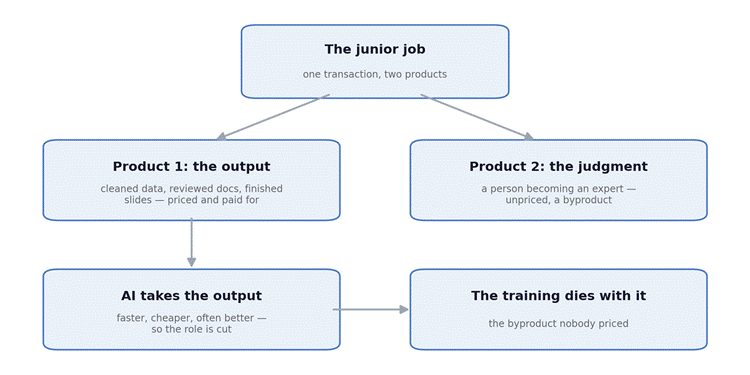
One transaction, two products — and only one of them was ever on the invoice.
AI severs the two. It does the output better and at a fraction of the cost, so the rational firm stops buying the junior employee’s output — and the training bundled inside that output dies as collateral. Not because anyone decided the next generation didn’t matter. Because the thing that manufactured the next generation was never a line item anyone chose to protect. It was a side effect, and you don’t defend a side effect in a budget meeting.
The natural hope is that this is fine — that we’ll simply start people higher up, at the judgment layer, and skip the boring years. Four of the most durable ideas in how humans acquire and hold skill say it isn’t that easy. If you ever had to make this case to a room, these are the four principles to explain.
1. The knowledge that matters can’t be downloaded (Polanyi).
In 1966 Michael Polanyi compressed a lifetime of thinking into one sentence: we know more than we can tell.⁴ The deepest expertise is tacit — it lives in the expert’s instincts and can’t be fully written down, because the expert themselves can’t fully articulate it. The explicit, codified kind of knowledge is exactly what an AI holds in abundance and hands to anyone. The tacit kind — the read on a room, the sense that a deal is going sideways, the feel for which number in the model is lying — transfers only by doing the work under the eye of someone who already has it. That transfer was the apprenticeship. Remove the doing, and the tacit knowledge has no way to move.
2. There’s no express elevator to expertise (Dreyfus).
Hubert and Stuart Dreyfus spent the 1980s mapping how a person travels from novice to expert, and found five stages — novice, advanced beginner, competent, proficient, expert — that run in order and can’t be leapt.⁵ More pointedly, they argued that genuine expertise doesn’t work by following rules faster; the expert has stopped consulting rules and simply sees what the situation requires. That intuitive seeing is the summit, and it’s built only by climbing through the earlier stages one repetition at a time. The machine can follow rules better than any novice; it can’t hand anyone the seeing, and it can’t make the stages go faster.
3. Automation erodes the judgment it depends on (Bainbridge).
This is the pivot, and it’s why the problem runs deeper than a hiring pipeline. It would be bad enough if the only issue were that no new experts are coming through. Bainbridge’s irony says the damage runs in both directions at once. Automate the routine work and you also decay the experts you already have. Senior judgment isn’t a trophy earned once and kept forever; it’s a muscle, kept in tune by contact with the actual work. Hand all of that contact to the machine — the analysis, the drafting, the first pass on everything — and the senior’s own fluency withers, exactly as the pilots’ manual-flying did behind the autopilot. And here’s the cruel timing: the whole justification for keeping the human in the loop is that they’ll catch what the machine gets wrong. Catching it requires the sharpness that only comes from doing the work the machine has taken. Dependence on judgment goes up as the supply of judgment goes down. That is not a bug in the deployment. That is the shape of the trap.
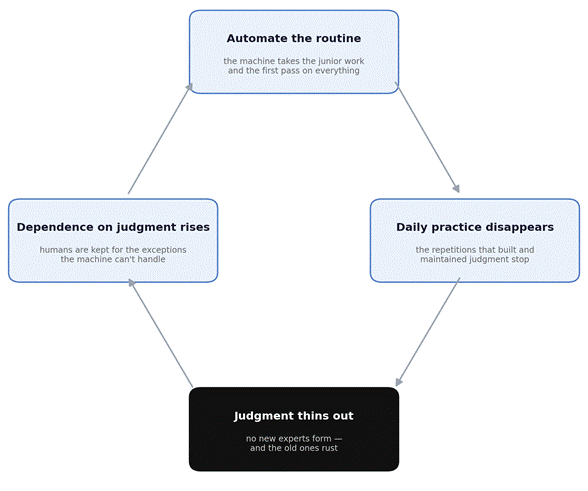
Bainbridge’s loop: the pipeline empties and the existing experts rust — at the same time, for the same reason.
4. The market won’t fix this on its own (Becker).
The comforting reply is that if firms genuinely need experienced people, they’ll invest in producing them. Gary Becker explained sixty years ago why that fails for exactly this kind of training.⁶ His Human Capital drew a line between two kinds of skill. Firm-specific skill — how this company does things — a firm will happily fund, because it captures the return. General skill — transferable judgment a person could take to any competitor — a firm is loath to fund, because the moment the worker is valuable they can leave, and a rival that spent nothing on training simply hires them away. Firms therefore systematically underinvest in portable expertise. The only reason it got produced at all was the cross-subsidy: the training came free, bundled inside junior-level labor the firm wanted anyway. Break the bundle and you’re left with a form of human capital every firm needs, no firm will pay to create, and every firm would rather poach than build.
That’s a textbook collective-action failure, and it resolves the way they always do. Each firm’s saving is immediate, legible, and lands in this year’s numbers. The cost — a hollowed-out generation of experienced people — lands a decade out, is diffuse, and belongs to no one. No executive is ever fired for it. Everyone poaches; no one trains; the shared pool everyone drinks from slowly empties, because nobody’s job was to refill it.
The one place that solved this didn’t do it through the market. The German and Swiss dual apprenticeship systems produce transferable expertise at scale precisely because the cost is shared — firms, industry chambers, and the state co-fund the training, so no company carries a burden a rival can free-ride on.⁷ White-collar work never built anything like that, because it never had to; the junior-level job did it for free. It’s worth noticing that the blue-collar trades kept their apprenticeship ladder — formal, funded, and deliberate. An electrician still becomes an electrician the slow way. It may turn out the knowledge workers are the ones who let their apprenticeship rot, precisely because theirs was invisible and unpaid and easy to lose without noticing.
First, the good news: the apocalyptic framing — the warning that AI could erase half of all entry-level white-collar jobs within a few years — hasn’t shown up in the aggregate data.⁸ White-collar employment has grown. There are more software developers than in 2022, more radiologists, and, tellingly, more paralegals — the professions everyone nominated for extinction.⁹ If you’re looking for a collapse, it isn’t in the totals.
What’s happening is subtler, and worse in a way that trips no alarms: the damage is landing specifically on the on-ramp. A Harvard working paper analyzing résumé and job-posting data across tens of millions of workers found that at firms actively adopting AI, junior-level hiring has fallen sharply since 2023 — entry-level employment down roughly nine percent within six quarters of adoption, relative to firms that didn’t adopt — while senior headcount at the same firms kept growing.¹⁰ A Stanford analysis of payroll records found a roughly sixteen percent relative decline in early-career employment in the most AI-exposed occupations since late 2022, concentrated in the fields — software, customer service — that used to absorb armies of junior-level hires.¹¹ Economists at Indeed have a name for the milder version: “experience creep,” employers demanding more experience for the jobs that used to provide it.¹² The perverse endpoint is a market where landing your first job requires proof that you’ve already had one.
The on-ramp, by the numbers
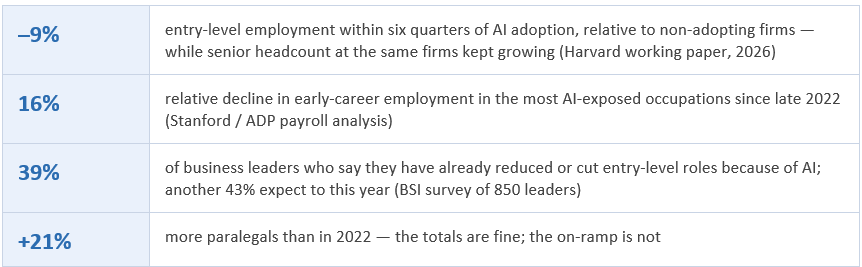
And leaders are choosing this on purpose — the survey numbers above aren’t a side effect; they’re policy.¹³ You can watch it most clearly where white-collar apprenticeship was most formalized: consulting. The firms’ own AI tools now do most of the junior-analyst research and slide-building that used to be a first-year’s entire existence, and some firms have hired former consultants specifically to train the machine on entry-level work.¹⁴ The pyramid is being sawn off at the base by the people who climbed it. Where the future partners come from is a question the deck doesn’t answer.
Three good logical objections to my point-of-view do deserve exploration.
1. This is an old panic in new dress. Socrates thought writing would destroy memory. Every generation is sure the new tool will produce a soft generation, and every generation turns out mostly fine — it just develops skills its parents didn’t value. Maybe “wisdom” gets redefined, and what we’re mourning is one flavor of it.
2. Maybe the ladder doesn’t break; it compresses. This is the strongest objection, and the one I’d bet on shaping the good outcomes. Maybe the new junior-level colleague starts at the judgment layer on day one, with AI doing the floor, and — supervised well — accumulates the repetitions that matter faster than we did, because the machine has cleared the drudgery from the calendar. The flight simulator is the encouraging precedent: it didn’t deskill pilots, it became the fastest way ever invented to build the skill, letting a trainee live through a hundred emergencies that reality serves up once a career. AI could be that — a sparring partner that manufactures repetition on demand — rather than the autopilot that quietly removes it. Which of the two it becomes isn’t a property of the technology. It’s a choice about deployment.
3. A lot of the grunt work was just grunt work — it built tolerance for tedium, not judgment, and good riddance to it. True. But that’s a reason to be more deliberate, not less: if the accidental training is gone and only some of it mattered, keeping the part that mattered now has to be done on purpose, by someone, or it won’t happen at all.
Even if all three are true, the problem doesn’t go away. The industrial machine that used to manufacture judgment is being switched off on cost grounds, and nobody is deciding what replaces it. That’s the worry — not that we chose wrong, but that we didn’t choose.
1. Treat apprenticeship as a system you design, not a byproduct you assume. For a century the junior-level job trained the person for free. It won’t anymore. If you want experienced people in ten years, someone has to build the thing that makes them — the rotations, the exposure to real judgment calls, the repetition against hard problems — on purpose, and fund it as what it is: an investment, not an overhead line to trim.
2. Move your junior people up the ladder, not out of the building. The firms that will look smart in a decade aren’t the ones cutting early-career hiring hardest; they’re the ones putting young people on real judgment work sooner, with AI doing the floor beneath them. Several large employers have already reversed course and gone back to hiring new graduates aggressively, reasoning that a company that stops taking in young talent is, in one firm’s own phrase, starving itself of its future.¹⁵
3. Measure the pipeline, not just the savings. The money you save by cutting a junior-level program shows up this quarter; the capability gap it opens is invisible and years away, so it never makes the dashboard. Put it on the dashboard. If the only things you can point to are dollars saved and assets produced, you haven’t built a leaner organization. You’ve quietly borrowed against your own future and called it efficiency.
4. Give the talent pipeline a real owner with real authority. A training system that everyone is responsible for is one that no one defends when budget pressure arrives. Name the person. Give them the standing to protect early-career development against the reasonable, relentless pressure to cut it. Without that authority, every good intention here is a suggestion.
5. Treat this as bigger than your own firm. Becker’s logic is brutal and correct: no single company can afford to be the one that trains the whole industry’s talent for its competitors to poach. The real fix is partly collective — the unglamorous machinery of shared standards, funded apprenticeships, and industry-level commitment that the trades never abandoned and the professions never built. That isn’t a memo you can write alone. But it starts with leaders willing to say the quiet part: the market, left alone, won’t produce the experienced people the market is about to need.
The pilots of that Airbus weren’t stupid, and they weren’t lazy. They were failed by a system that had let a skill atrophy and then demanded it back in an instant, at the one moment it was gone. That’s the shape of the thing I’m afraid of, scaled up from a cockpit to a generation. Not a dramatic collapse — the totals will look fine for years, the dashboards will stay green — but a slow, invisible thinning of the one capability everything else now rests on, discovered only when we reach for the experienced colleague and find we stopped making them somewhere back down the line.
The repetition is still available. The young people are still willing. Knowledge is cheaper and more abundant than at any point in human history. The only thing genuinely at risk is the wisdom — the part you can’t download, that has to be earned one step at a time. It’s at risk not because AI is too powerful, but because we’re too content to let AI do the very work that used to make us worth having. The ladder is still standing. Someone has to decide, on purpose and against the arithmetic, to keep sending people up it.
A note on how this was written
The argument here is mine: that entry-level work has a hidden cross-subsidy that produces the next generation of experienced people as a free byproduct; that automating it severs the training from the work and leaves no means to replace it; that Bainbridge’s irony guarantees the damage runs in both directions, hollowing out the pipeline and decaying the experts we already have; and that Becker’s economics make this a structural certainty rather than a choice any single firm can reverse. I worked through it in conversation with Claude, Anthropic’s AI, using it to connect the case to the underlying theory and to find and check the industry data and sources. The judgments are my own, and the factual claims are checked against the reporting cited below. The knowledge came from the machine, easily and for free. Whether any of this adds up to wisdom is the one thing the machine couldn’t tell me, and the one thing worth arguing about ;)
Notes
1. Air France Flight 447, 1 June 2009; BEA (Bureau d’Enquêtes et d’Analyses) final report, 2012. The accident was multi-causal; the automation-dependency and skill-erosion thread is one prominent strand of the analysis, not the sole cause. As a business case: Nick Oliver, Thomas Calvard, and Kristina Potočnik, “Cognition, Technology, and Organizational Limits: Lessons from the Air France 447 Disaster,” Organization Science, 2017, summarized in Harvard Business Review, September 2017 (“The Tragic Crash of Flight AF447 Shows the Unlikely but Catastrophic Consequences of Automation”); and Jamie O’Brien, “Mystery over the Atlantic: The Tragic Fate of Air France Flight 447,” The CASE Journal, Vol. 15, No. 1, 2019.
2. Lisanne Bainbridge, “Ironies of Automation,” Automatica, Vol. 19, No. 6, 1983. The foundational statement that automating routine tasks both burdens operators with the hardest work and strips them of the practice needed to do it.
3. Chip Conley, Wisdom @ Work: The Making of a Modern Elder, Currency, 2018. On the distinction between knowledge and wisdom and the claim that wisdom cannot be automated; builds on Peter Drucker’s coinage of the “knowledge worker” in Landmarks of Tomorrow, 1959. The “hired me for my knowledge … got my wisdom” line is Conley’s account of the Airbnb founders.
4. Michael Polanyi, The Tacit Dimension, 1966 (and Personal Knowledge, 1958). “We know more than we can tell” — the argument that the deepest expertise is tacit and cannot be fully codified.
5. Hubert L. Dreyfus and Stuart E. Dreyfus, Mind Over Machine, Free Press, 1986, building on their five-stage model of skill acquisition (1980). On the developmental, unskippable progression from novice to expert and the non-rule-based character of expert intuition.
6. Gary S. Becker, Human Capital, Columbia University Press for the NBER, 1964. On the distinction between general and firm-specific human capital and why firms underinvest in transferable skill.
7. On the German and Swiss dual apprenticeship systems: the vocational-training model in which firms, industry chambers, and the state co-fund transferable skill, structurally solving the free-rider problem Becker’s analysis predicts.
8. The “half of entry-level white-collar jobs” warning is Anthropic CEO Dario Amodei, first widely reported in May 2025 and subsequently softened by Amodei and other AI-company leaders.
9. On aggregate white-collar growth (roughly three million white-collar jobs added since 2022; 7% more software developers, 10% more radiologists, 21% more paralegals): Washington Monthly, May 2026.
10. Seyed Hosseini and Guy Lichtinger (Harvard), working paper, 2026, analyzing résumé and job-posting data covering 66 million workers across more than 280,000 U.S. firms, 2015–2025: at AI-adopting firms, entry-level employment fell roughly 9% within six quarters of adoption relative to non-adopters, while senior employment continued to grow; junior-level hiring declined sharply from 2023. Reported in Forbes, May 2026.
11. Erik Brynjolfsson, Bharat Chandar, and Ruyu Chen, “Canaries in the Coal Mine? Six Facts about the Recent Employment Effects of Artificial Intelligence,” Stanford Digital Economy Lab, November 13, 2025. Analysis of ADP payroll records: a ~16% relative decline in employment among early-career workers in the most AI-exposed occupations since late 2022, concentrated in software development and customer service.
12. Laura Ullrich, lead economist at Indeed, on “experience creep,” via Washington Monthly, May 2026.
13. British Standards Institution survey of 850 business leaders across seven countries, via Fast Company, May 2026: 39% had already reduced or cut entry-level roles due to AI; 43% expected to in 2026.
14. On consulting: futureofconsulting.ai (January 2026) on in-house tools (e.g., McKinsey’s Lilli, BCG’s Deckster) performing the bulk of junior-analyst research and slide work; TheStreet (May 2026) on roughly 150 former consultants hired to train AI on entry-level tasks.
15. On employers reversing course (IBM, Reddit, Dropbox, Cloudflare, LinkedIn expanding early-career hiring; PwC recommitting and warning that cutting it risks “starving your organization of its future”): Fast Company, May 2026.