Here are some things you can buy right now:

There are many things I do not know how to do, but I do know how to exchange money for goods and services. Many of my problems have been fixed by this superpower.
From a young age my Dad tried to instruct me in the wisdom of buying things; he would hire a handyman to repair something and tell me a parable about comparative advantage. As an eight year old with like, $30 stored in a box with a hidden compartment, these lessons were not immediately actionable.
Now, I try to remember that I should see if my problems can be solved with money. While spiritual and mental growth is good, it’s sometimes nice to skip that step entirely and just have Amazon Prime deliver the solution next day.
The current meme of “You Can Just Do Things” over emphasizes the “you doing” part; comparative advantage is really important! And I, and many others, fail to internalize the potential of applying the world’s most advanced supply chains and markets to our problems.
The mental algorithm to run:
Notice you have a problem.
Figure out what about it is a problem.
Search for a product or service to solve the problem.
Try it out and return it if it doesn’t solve the problem.
For example five days ago I noticed that, while I like waking up early and writing on my patio, after fifteen minutes my WPM dropped precipitously because my hands were cold. I looked on Amazon for gloves, found the fingerless gloves linked above, and purchased them; they arrived same day and I’ve worn them every day since.

Despite how general purpose and functional the consumerism algorithm is, I and others often run into similar bottlenecks when using it:
Having enough money
Uncertainty on how much money to use to solve a problem
Noticing the problem at all
I’m not sure how to have enough money, if you have ideas on how to earn money fast please post in the comments.1
It’s worth reflecting if having enough money is the actual constraint, or if you’re just uncertain about the amount of money that is ‘right’ to spend to solve a problem.
There’s some kind of rough internal policy I’m normally checking a purchase against to decide if it’s worth it. Sometimes it’s obvious and you can make a quick decision, other times it’s unclear what to do.
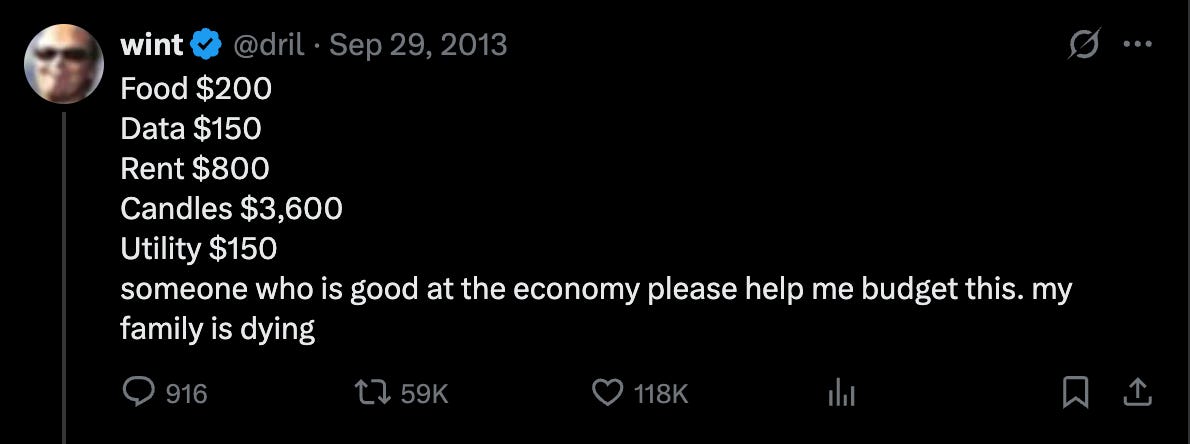
I like doing quick and dirty back of the envelope calculation (BOTEC) to establish a price range, which often transmutes the vague uncertainty into something I can get a handle on, and then trying out different representations and units of exchange. For instance $3,600 is three round trip flights or 2,400 lightbulbs - I can then check against my gut intuition if I’d be happy paying that.
There’s lots of ways to practice BOTECs (also known as Fermi Estimates) but I’d recommend just asking an LLM to help, while validating it’s assumptions against your own priors.
Recently I made a BOTEC to decide whether to hire an interior designer. After getting a potential quote, I estimated the total price would be somewhere between $5,000 - $12,000; refactoring it into approx. an extra $600/mo in rent for a year gave me an intuitive feel for the cost that my gut could interface with. Looking at other options for that price I decided I’d just put all that money into buying an insane number of house plants.
And if I buy them through Amazon and don’t like them, I can return it easily. Optionality!
To run the algorithm at all you’ve got to notice the opportunity to apply it, which is frequently the hardest problem. Gwern describes this as the Ur Bias:
How had I run out of socks?…At no point did I ever deliberately try to economize on socks or go without socks or explicitly think that it wasn’t worth the bother of picking up some socks next time I was in a clothing store or doing an Amazon order—it just happened on its own.
Many human cognitive biases can be considered as reflections of a single ur-cognitive bias, a failure to activate difficult, deliberate, explicit System II thinking when appropriate, ‘waking up’ from the usual fast frugal System I thinking, perhaps from time to time just to re-evaluate things.
Many of the best anti-bias mechanisms or ‘life hacks’ or ‘habits’ are about strategic application of our limited System II resources, often employing external systems to fight starvation.
I frequently fail to notice that I could make my life better by ordering {X} or hiring {Y}. But some useful strategies I’ve found:
Make it a free action to purchase small goods. Ex. If I am out of socks, I can immediately pull out my phone to purchase more through yes-I-promise-I’m-not-getting-paid-for-this-post Amazon App.
Set aside regular times to reflect on whether I can solve more of my life problems with Capital. I often use the regular cadence of my monthly Links collection newsletter as the time for to look back and look forward.
Talk to friends who share, or are even more willing, to turn money into happiness.
The strategies either reduce the amount of System II strategic thinking needed, or create contexts where System II thinking is more available. Warning: people or companies might adversarially attempt to hijack those moments to get you to make bad-purchases.
I hope this provides all the help needed to start being a better consumer. Bonus: I looked through my recent purchases and here are endorsed selections that made my life better: