There was some moment that passed by, largely unnoticed, where widespread use of drugs for cosmetic and performance reasons became mainstream in the US.
GLP-1s: About 1 in 5 (18%) adults in the United States has used a GLP-1 drug like Ozempic or Mounjaro at some point, and 12% are actively on it. GLP-1s went from 1% of all prescriptions at the start of 2021 to 5.4% of all prescriptions in September 2024.
Plastic Surgery: The U.S. performed over 6.1 million cosmetic procedures in 2024 (it was 1 million in the 90s). Botox procedures increased roughly 10x from 2000 to 2024, from under 800,000 to somewhere between 4.7 and 9.5 million annually.
Testosterone: Conservative estimates, which don’t include gray or black market sourcing, have 11 million prescriptions in the US for Testosterone Replacement Therapy (TRT) - depending on average refill frequency, that’s about 2-4 million patients. One meta-analysis of a collection of surveys put general steroid use at 6.4% among gym-going men (though this seems high to me and I haven’t looked through the studies).
Stimulants: 16 million US adults take stimulant medications like Adderall. Prescriptions for the 31-40 age group in particular increased 240% since 2012, which is a strong indicator of performance enhancement use.
Antidepressants: While blurring the personal improvement and clinical line, about 1 in 8 American adults takes an antidepressant. Over 60% of users have been on medication for more than two years.
If we create a model where every prescription is a unique user, we get an upper bound of something like 85.3 million Americans (approximately 31.5% of the US adult population) currently using at least one of GLP-1s, TRT, stimulants, or antidepressants.
Of course it is far more likely that the people injecting peptides are also into adderall. Assuming substantial overlap between these groups1, we might get a rough estimate of 61.5 million Americans (roughly 23% of adults). Excluding anti-depressants, perhaps 45 million Americans (17% of adults).
When we add plastic surgery to the mix - which likely shares a heavy overlap with the other categories - I’d guess the total reaches 65 million.
That suggests nearly one in four American adults is currently modifying their biology or morphology via significant pharmaceutical or surgical intervention.
There’s something antimemetic about this. I can look at the stats, think about what they imply, and then it just seems to slip out of my head. It’s like a localized version of Gell-Mann amnesia - America just doesn’t feel like a place where one in four adults are enhanced.
Cremieux had a tweet that pointed out that, while everyone knows about veganism, in fact vegans are a very small minority in the US; there are more than twice as many gambling addicts as there are vegans.
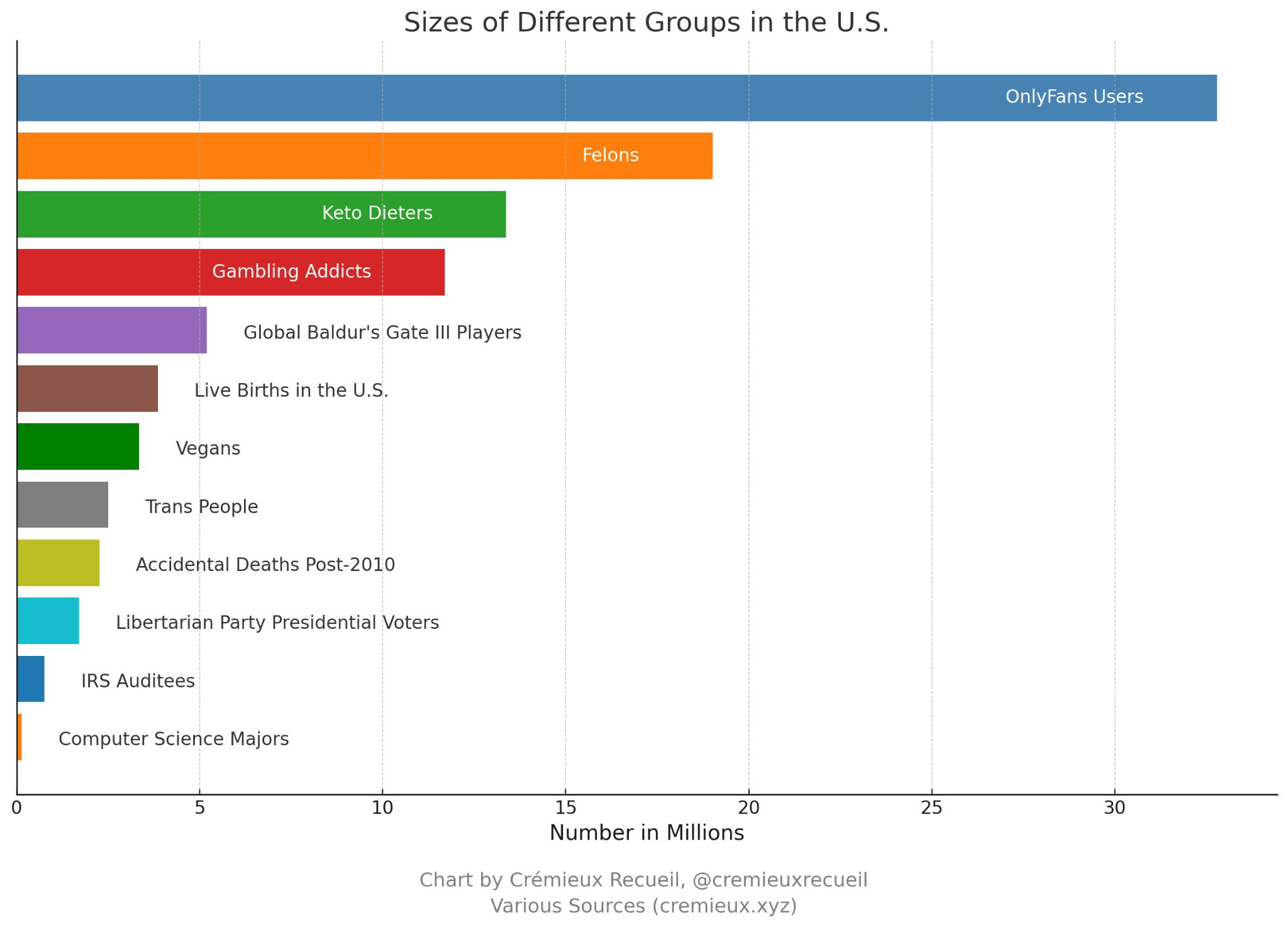
Adding in our estimates for chemical or surgical enhancement makes for an interesting comparison. There’s more than 15x times the number of people on GLP1s than voted Libertarian.

For context there are about 37 million registered republicans and 45 million registered democrats. Perhaps the next president will rally a Stimulants + Botox + OnlyFans coalition.
In the 2000s there were bioconservatives with real clout—Leon Kass chaired a presidential council, and warned about ‘chemical happiness’ and ‘factitious moods.’ They predicted widespread enhancement would force a civilizational reckoning.
I think we got the widespread enhancement without the reckoning; there was never any moment where the culture acknowledged the shift.
I mean the discourse exists, kind of. Joe Rogan and Bryan Johnson are major cultural influencers, and even the NY Times is writing about women experimenting with microdosing testosterone. In the more experimental, freer parts of the media landscape, you can find real cultural pioneers - my friend Richard, who has cultivated an e s o t e r i c tiktok algorithm, receives schizo bodybuilder steroid media:


And there is the MAHA movement, which, while focused on seed oils and food additives, seems cool with peptides.
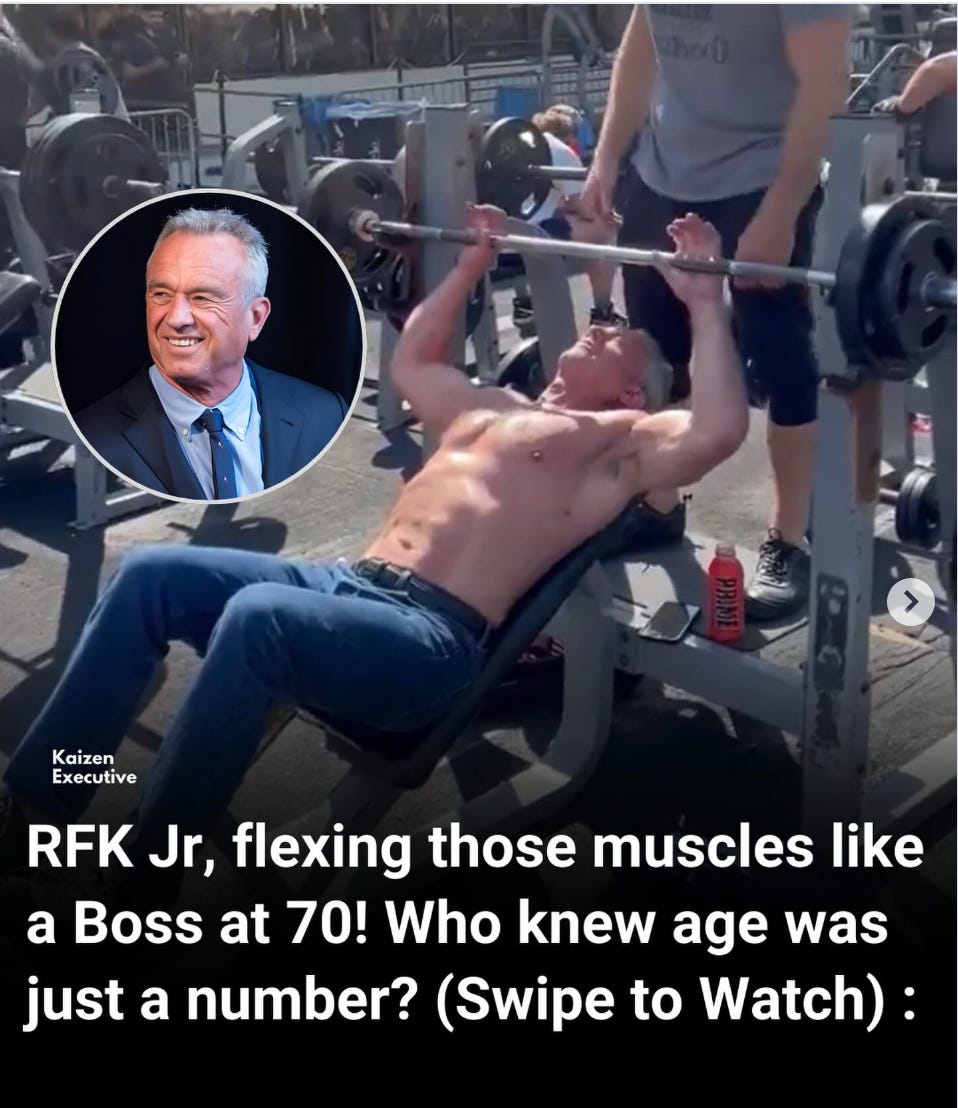
Also RFK Jr. is clearly juicing:
Trying to opine about what everyone else knows about what everyone else knows is a mug’s game... but I’ll stand by that this isn’t what I would expect the cultural discourse of better living through chemistry to feel like. It feels ripe for some kind of preference cascade.
There are cultures with more explicit acknowledgment of enhancement norms. In South Korea one in five women have had plastic surgery; in Brazil, the government subsidizes nearly half a million plastic surgeries annually under a principle that citizens have a “right to beauty.“ Maybe we end up looking like that, but we include a more American principle of the right to amphetamine levels of productivity.
This kind of cultural acknowledgment might not be good. There’s probably hidden wisdom in discretion—like how it’s wise not to discuss salaries with your neighbor. Making competition and comparison too legible can be corrosive.
But there’s also too much potential energy here, too much latent demand for suprahuman living, for the current equilibrium to hold. At some point it becomes common knowledge that no one’s natty anymore.
Disclaimer: This post was written under the influence of stale whole foods coffee, half a nicotine lozenge I bummed from a friend, and a Troja track.