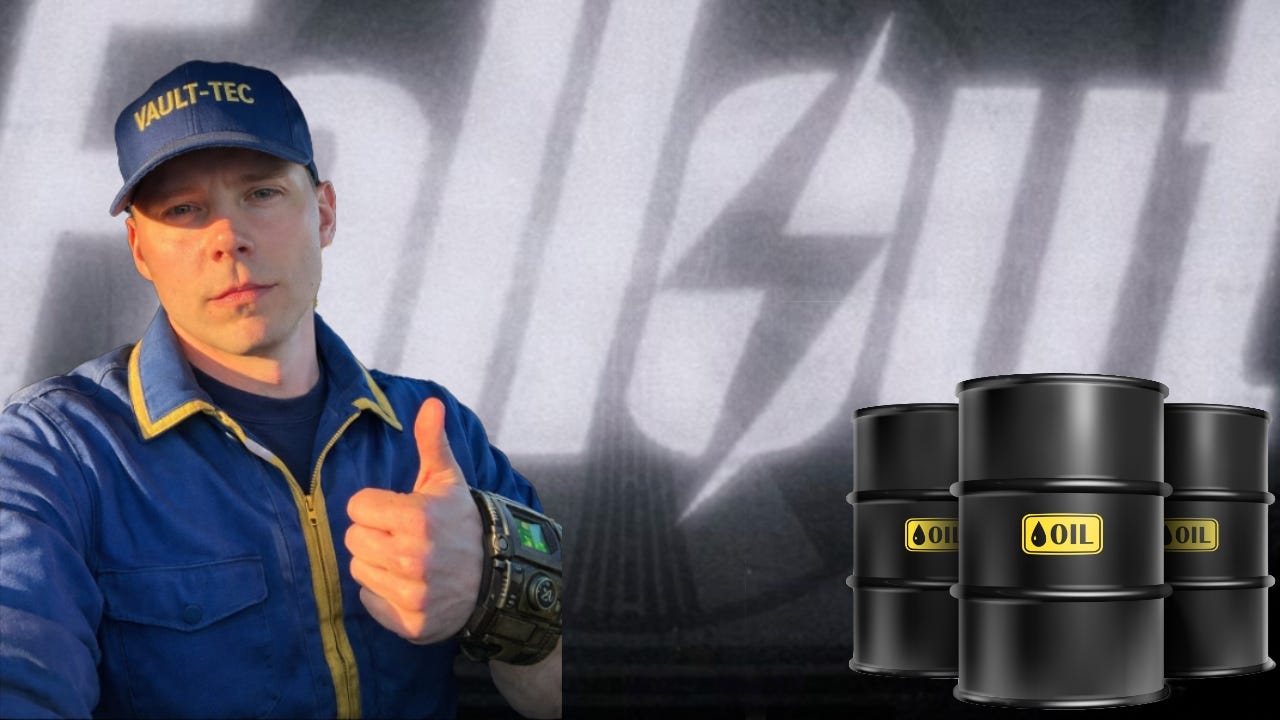
I don’t watch much TV, and I haven’t seriously played a video game in about a decade. But somehow Fallout got me to do both.
Writing code and managing AI agents takes a surprising amount of mental energy. Unless you deliberately break up your days, you can start to feel like you are frying your brain. I was learning that the hard way, so I started looking for something, anything, that would interrupt the cycle.
That is how I ended up watching Fallout.
The show actually exceeded my expectations. It is not perfect, but for a Hollywood adaptation of a video game, it is far better than I expected. And after finishing it, I did something that would have sounded absurd to anyone who knows me personally: I bought Fallout 4 on Steam.
I am generally awful at video games. But I wanted more. Not particularly more combat or more loot, but more about pre-war America. I wanted to know what kind of world produces the Fallout universe.
Because to me, the strongest parts of Fallout aren’t the explosions, mutants, or power armor. They are the glimpses of the world before the bombs.
That is where the real horror is.
Lucy’s journey through the wasteland is fun. Norm’s storyline, slowly uncovering what Vault-Tec really is, adds a mystery-thriller aspect, a David Lynch-like quality to it. There are moments in the show that genuinely work. Justin Theroux’s performance as Robert House is especially good.


But the show also feels like it is trying to cover too much ground too quickly. It jumps between factions, lore, and set pieces without spending enough time on the thing I found most compelling: the slow decay of pre-war civilization.
We hear the phrase “resource war,” but only in broad strokes. Which resources? When did the crisis begin? What did scarcity actually look like in daily life? How did normal people experience it?
The games are not perfect on this point either, but they are at least a little more coherent. In the game world, the crisis reads less like a generic war over “resources” and more like a civilizational crisis brought on by overconsumption, scarcity, and energy limits.
And that is where something clicked for me.
To understand pre-war America in Fallout, I think you have to understand a real-world idea that barely gets mentioned anymore: peak oil.
Peak oil theory, most closely associated with geologist M. King Hubbert, is often misunderstood.
The crude version is: oil is finite, therefore one day we run out.
But the more interesting version is not about whether there is oil somewhere in the ground. It is about whether the energy and cost required to extract it still make sense. A resource can exist in abundance and still become economically or energetically useless if it takes too much effort to harvest it.
That is where concepts like EROI, or energy return on investment, matter.
If extracting a barrel of oil takes the energy equivalent of a barrel of oil, or more, then you have a problem. Not because the oil is physically gone, but because the system built around it starts becoming dysfunctional.
That distinction matters.
Peak oil was always less about “the last drop” and more about the end of cheap, easy, society-shaping energy.
And once you start thinking in those terms, Fallout starts making a lot more sense.
Peak oil was never just a technical question. It also invited a certain kind of political imagination: if resources are tightening, then perhaps society must be managed more aggressively from the top down. Enter, the technocrats.
Hubbert himself sometimes sounded less like a geologist issuing a warning and more like a man imagining a radically reorganized society. At one point, he described an authoritarian configuration that would “operate the entire physical equipment of the North American Continent.” Elsewhere, he said he favored an overhaul of the country so sweeping that the plans of socialists and communists would “look cheap by comparison.”
“I am for the overhaul of this country from top to bottom so thorough that the plans of the socialists and communists will look cheap by comparison.” - M. King Hubbert
That is part of what makes the pre-war world of Fallout so interesting to think about. Scarcity does not just produce hardship. It also invites grand schemes, emergency powers, technocratic crackdowns, and systems of control that promise stability while making ordinary life feel even less free.
To its credit, the show does explore the concept of technocracy and freedom, something I was pleasantly surprised by, particularly in Cooper Howard’s scene, “No dogs in the vault,” and in Barbara Howard’s scene, “War Never Changes.”
In our timeline, conventional oil production appears to have peaked years ago. And yet the world did not collapse into nuclear war. So was peak oil simply wrong?
Not exactly.
What peak oil advocates underestimated was the degree to which technology could change the equation. Hydraulic fracturing, horizontal drilling, shale extraction, improved efficiency, electrification, and other innovations bought modern society more time. They did not abolish limits, they changed the way those limits show up.
That is an important distinction.
The failure of old predictions does not necessarily mean the underlying observations were foolish. It often means reality responded in more complicated ways than the model allowed for.
Our society did not solve resource constraints in some final sense. We adapted around them. We shifted burdens. We found new methods. We became more efficient in some places and more fragile in others.
That is why I find Fallout so capitvating.
Its timeline seems to imagine a civilization with advanced nuclear technology, but without enough of the efficiency gains, substitutions, and adaptations that softened the blow in ours. In other words, Fallout is not a world where people were simply stupid. It is a world where a high-energy civilization failed to transition gracefully.
And that is much more believable than people think.
When most people think of Fallout, they think of the bombs.
I increasingly think the bombs are almost beside the point.
The more horrifying possibility is that much of the visible decay in the Fallout world may have begun before the war ever went nuclear. The rot would not have arrived all at once. It would have seeped into ordinary life first.
Imagine the character Claudia and what her life might have been like in pre-war America.
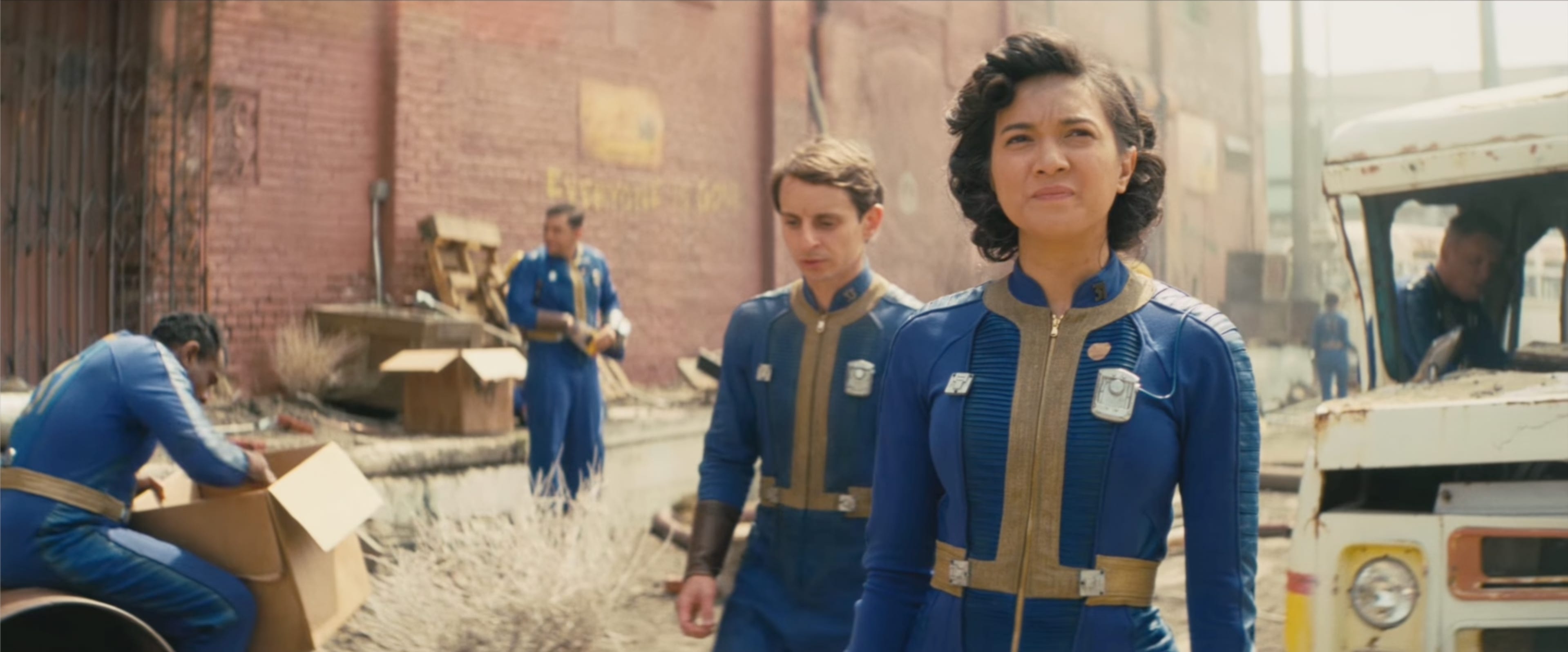
She wakes up and checks her rationing app on her PipBoy. She is allowed three gallons of fuel this week.
She drives past strip malls with more empty storefronts than open ones. Roads are still there, but they feel underused, tired, abandoned in spirit before they are abandoned in fact.
The grocery store is farther away now. Food distribution has become less reliable. Fresh produce only arrives on certain days. The prices have jumped again.
The news ticker flashes something about fighting in Alaska. There are whispers about shortages, unrest, sabotage, military deployments, emergency authorities.
That night the power browns out.
Her neighbors have quietly started planting food in their backyard.
That is the kind of apocalypse Fallout only hints at, but it is the one I find most convincing: not the flash, but the long dimming.
Energy is not some abstract policy category. It is the substrate of civilization.
Energy means food production. Clean water. Heating and cooling. Manufacturing. Transportation. Defense. Communications. Entertainment. Every comfort of modern life rests on abundant energy, whether directly or indirectly.
So what happens when a society begins to lose that abundance?
You do not just get inconvenience. You get cascading institutional failure.
Debt becomes harder to service. Economic growth stalls. Jobs disappear. Supply chains fray. Trade contracts. Investment dries up. Political conflict intensifies. Trust collapses. And because modern systems are interdependent, each failure amplifies the others.
In that kind of environment, scarcity does not remain technical for very long. It becomes moral, political, and psychological.
People stop believing the future will be better than the past.
That may be the single most dangerous threshold any civilization can cross.
What separates our timeline from Fallout’s is not that we are virtuous and they were foolish. It is that we found ways, however imperfect, expensive, and temporary, to offset some of the consequences of energy constraints.
We got more efficient. We changed extraction methods. We substituted technologies. We reorganized parts of the economy.
The Fallout timeline seems to suggest a civilization that remained spectacularly advanced in some respects, while becoming brittle and decadent in others. That tension is what makes its world so compelling.
It is retro-futurism, yes. But underneath that aesthetic is a familiar warning: a society can look technologically impressive right up until the moment it stops functioning.
That is one reason the pre-war scenes land so hard. They are not showing us prosperity. They are showing us a civilization trying to maintain the appearance of prosperity while deeper conditions are deteriorating.
That feels uncomfortably contemporary.
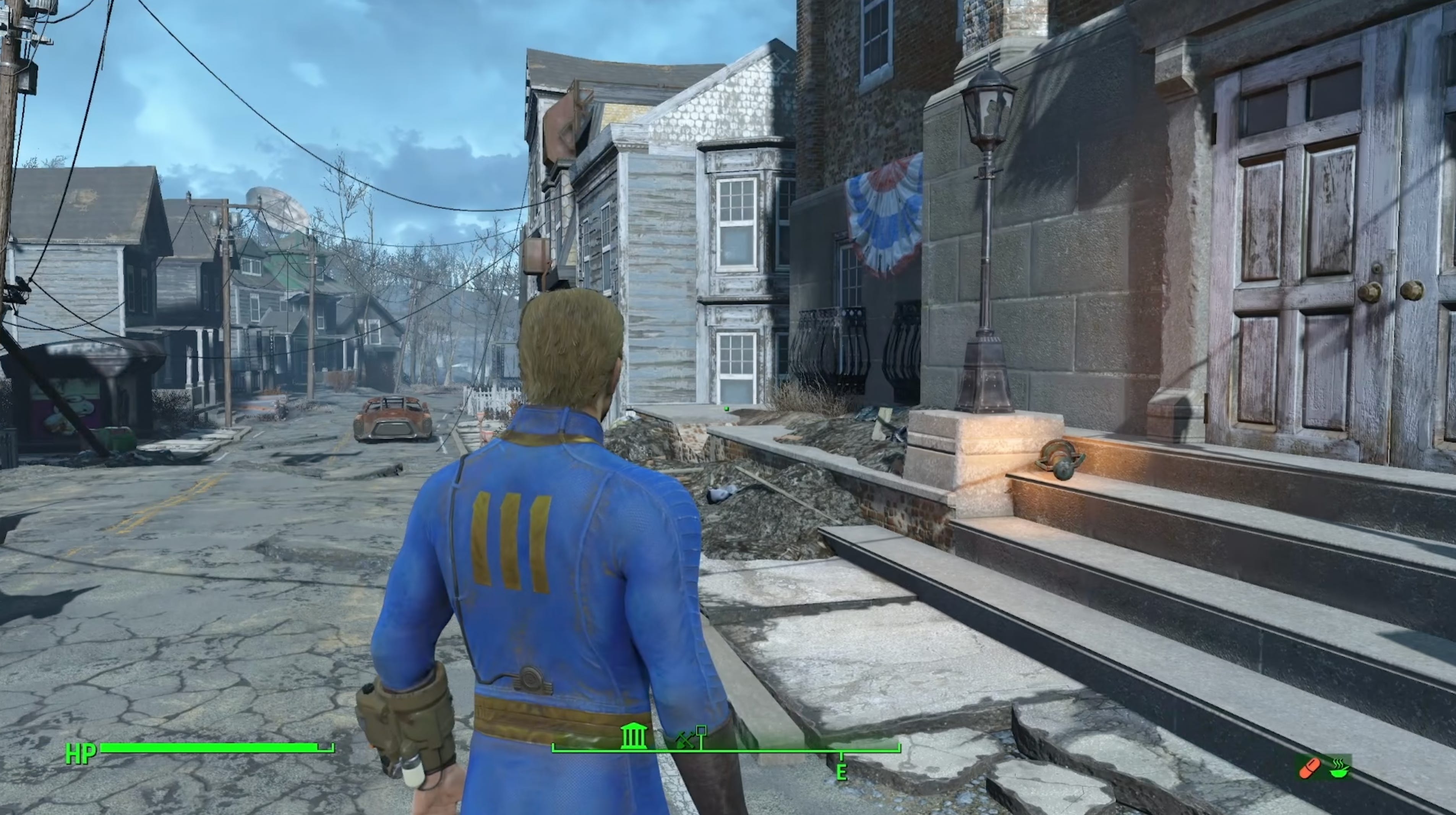
At one point, while playing the game and thinking through all of this, I had a thought that genuinely unsettled me:
We are already living in Fallout.
Not literally, of course. I do not mean nuclear wastelands, vaults, or power armor.
I mean that we already live in a society wrestling with fragility, institutional mistrust, energy dependence, financial abstraction, and a constant struggle to preserve normalcy. We are not standing outside history, safely analyzing collapse from a distance. We are living inside a civilization that assumes continuity while quietly testing its own limits.
That is why Fallout resonates.
The setting is absurd on the surface, but emotionally it is not absurd at all.
It captures the feeling that collapse does not begin with a mushroom cloud. It begins when systems stop delivering what people assumed they always would.
There are two common ways people respond to questions like this.
One is the Malthusian response: we are doomed because resources are finite and humanity always overshoots.
The other is the cornucopian response: human ingenuity will solve everything, so none of this matters.
I do not fully believe either.
What has always made America distinct, at its best, is not blind optimism or fatalism. It is the combination of ingenuity, dissent, decentralization, experimentation, and a stubborn refusal to let one orthodoxy settle every question forever.
That matters.
It means we can take warnings seriously without surrendering to despair. We can acknowledge constraints without adopting a philosophy of collapse. We can remain alert to fragility while still believing that free people, working within imperfect institutions, can adapt.
There are no guarantees. Civilizations fail. Systems become brittle. Abundance can narrow faster than people expect.
But the answer is not to panic, and it is not to sleepwalk.
It is to think clearly. To stay skeptical of grand narratives. To preserve the social habits and freedoms that make adaptation possible in the first place.
That, more than anything, may be the real lesson hiding underneath Fallout.
The bombs are not the whole story.
The story is what happens to a society before the bombs ever fall.