2026-07-21
 Let's dive into The Wizard's
Castle (source code)!
Let's dive into The Wizard's
Castle (source code)!
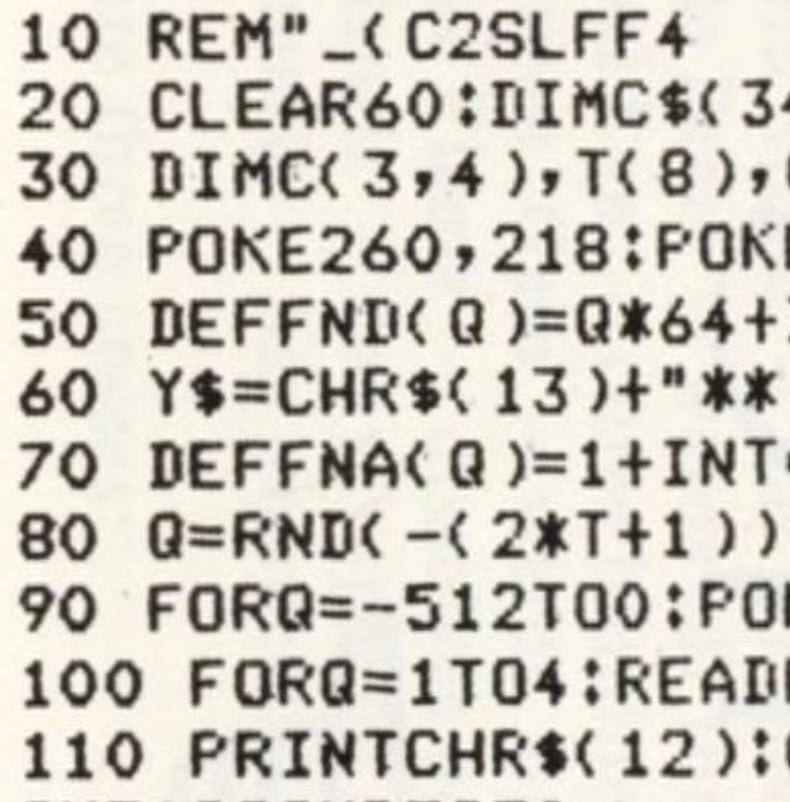
10 REM"_(C2SLFF4
That is the first line of the 80s microcomputer BASIC game The Wizard's Castle initially written for the Exidy Sorcerer platform.
It's a REMark statement, a comment in that particular language. 10
is the line number, if you're unfamiliar with languages that had such
things.
But the interesting part was this "_(C2SLFF4 mess. A typo or garbage?
No. It appears verbatim in the source code as originally published in
the July, 1980 issue of Recreational
Computing.
What the heck is it?
Note: I'm going to jump back and forth between decimal (which is
BASIC-friendly) and hex (which is programmer-friendly). Hex will be
prefixed with 0x, suffixed with h, or will obviously have digits A-F
in it.
Note: Thanks to Josh and Chris, my hacking buddies, for doing tons of the emulator and research work on this. It took hours, but they were good hours. It would have taken me 10x as long without their help.
Suspicions
Here's more of the source in context, but with irrelevant pieces removed and some spaces added:
10 REM"_(C2SLFF4
40 POKE 260,218: POKE 261,1: T = USR(0): T = PEEK(-2049)
80 Q = RND(-(2*T+1))
In BASIC, a : is a command separator. POKE writes a byte value to
the specified memory location. PEEK reads from one. Sorcerer BASIC
used signed 16-bit numbers, apparently, so address -2049 is 65536-2049
or 0xF7FF in hex. We'll revisit that address later.
Calling the pseudo-random number generator (PRNG) RND() with a
negative number seeds it.
Old PRNGs liked to be seeded with odd numbers, thus the 2*T+1
expression forcing it odd.
And the USR() function calls a machine code routine.
And line 80 is the first use of T after it is initialized from the
PEEK().
The proximity of these things makes it seem like they're all related to
seeding the PRNG. Sorcerer BASIC didn't have a RANDOMIZE command, so
the only options of the day were:
- Ask the user to enter a random seed.
- Run an increment loop until the user hits a key (or some user-driven thing like that) and use that for the seed.
- Get the seed for some kind of randomish-thing from the existing software and/or hardware.
Wizard's Castle didn't do the first two. So it must be the last one.
Could it be that the REM statement has machine code that happens to
encode to ASCII text? The Sorcerer did use ASCII encoding.
But it seems nuts that you could get useful Z80 machine code just from ASCII characters. Right?
Nevertheless, this seemed like a reasonable-enough crazy assumption to run with and see what we could find.
The USR() Function
The USR() call is interesting—this calls a machine code function, but
the details are system-dependent. But luckily the Internet has tons of
technical manuals
in various places and we were
able to figure it out.
Address 259 has a JP instruction (unconditional jump) to a 16-bit
little-endian absolute address.
And the POKEs were for addresses 260 and 261. This was the
trampoline
for the USR() function. You POKE the address of the start of your
machine code into addresses 260 and 261, and then run USR() to call
it.
40 POKE 260,218: POKE 261,1: T = USR(0): T = PEEK(-2049)
Reversing them for little-endian, this means we're looking at address
(1 << 8) | 218 which is 474. When we run USR(0), it jumps to the
machine code at address 474 that should end in a RET instruction.
The argument for
USR()(the0) is stored as a 4-byte float elsewhere in RAM so the machine code can look at it if it needs to. It turns out not to be relevant for this use case. Also we're assigning the return value fromUSR()intoT, but it's unclear to me what this return value is. However, it is irrelevant as we immediately overwriteTwith the next assignment.
So... What's at address 474?
BASIC RAM
When you enter a line of Sorcerer BASIC, the interpreter
tokenizes
it and replaces commands like PRINT with single byte values:
PRINTis tokenized to 0x97REMis tokenized to 0xC3- etc.
And then it is stored like a linked list in memory where each row is a "node".
The node format is:
- 2 bytes of "next" pointer
- 2 bytes for the line number
- Bytes representing the tokenized line of code
- 1 byte of null terminator (a 0x00 byte)
And the start of this linked list in RAM is at address 469 on the Sorcerer.
Let's see the mystery line again:
10 REM"_(C2SLFF4
That means the node for that line consists of the following addresses and bytes:
469  Low byte of the next pointer
470  High byte of the next pointer
471  Low byte of the line number
472  High byte of the line number
473  `REM` token (0xc3)
474  First byte of REM text, the `"` character!!
and 474 is where the USR() function gets us! It is literally calling
the text of the REM statement as Z80 machine code!
Disassembly, Attempt One
Could it be true? Let's try it out!
Here are the hex values for the ASCII characters:
"  22
_  5F
(  28
C  43
2  32
S  53
L  4C
F  46
F  46
4  34
There's the 0x00 terminator at the end, but that's just a NOP in Z80,
so we'll ignore it.
Disassembling, we get:
22 5F 28   LD   (285Fh),HL  ; " _ (
43         LD   B,E         ; C
32 53 4C   LD   (4C53h),A   ; 2 S L
46         LD   B,(HL)      ; F
46         LD   B,(HL)      ; F
34         INC  (HL)        ; 4
Now, I don't want to get into the details of Z80 assembly here, but take
my word for it that this code makes no sense. The addresses don't seem
to point to anything in particular, who knows what HL has in it at the
beginning, B is never read, the duplicated LD B is pointless, and
there's no RET to get us back to BASIC.
It's garbage. And running it in an emulator results in Weird Things happening (like soft resets), as expected.
This was a dead-end for the time being. We speculated that maybe it was a printing error, that the printer didn't have the glyphs for the actual bytes, so it substituted other ones. But that wasn't super-satisfying.
The PEEK(-2049)
Let's switch gears, then, and continue on to the PEEK:
40 POKE 260,218: POKE 261,1: T = USR(0): T = PEEK(-2049)
What's at address -2049? Unsigning this makes it equivalent to 0xF7FF. According to the docs, this is the last byte of memory-mapped screen text, representing the current character in the lower right of the screen.
We then immediately use this value to seed the PRNG:
40 [ ... ] T = PEEK(-2049)
80 Q = RND(-(2*T+1))
I'm going to use my magical powers now to look at one of your open terminal windows and read the character in the lower right of the screen. It's fuzzy, but if I concentrate... it's... yes, it's a space character, isn't it!
Am I right? That'll be $200.
Now, the space is 32, so seeding the PRNG with -(2*32+1) every game
would make for bad replayability in this randomly-generated dungeon, so
the USR() function must have something to do with it. Like it puts
something on the screen at address 0xF7FF and then the PEEK() reads
it. The screen is cleared not-long thereafter, so the player might not
notice the blip of a character temporarily placed in the lower right.
RTFM
 The source code
in its original dot-matrix glory
The source code
in its original dot-matrix glory
So we had strong suspicions that all this was part of the PRNG seed process. If only there were some way to prove it!
It was at this point that Josh noticed this line in the magazine where the program was published: "The first remark is a machine language routine to simulate the RANDOM function."
Sheesh. That'll teach me not to read things.
In BASIC, RND(), not RANDOM, is the random function, used with a
negative argument to seed the PRNG, and a positive argument to get the
next random number, which was historically a random floating point
result between 0 and 1.
So what the author probably meant was RANDOMIZE which was popular in
Microsoft BASIC for setting the random number seed to a specific value
or prompting the user to enter one.
In short, it was supposed to be doing what we thought, but the machine code didn't seem to be doing that at all.
A Breakthrough
Josh and I had been running Sorcerer emulators in MAME (thanks to Josh for sharing the ROMs with me to get going) and Chris had another Java-based one that he'd gotten working.
In MAME, we'd entered the REM statement and looked in memory, and it
had the nonsensical bytes and machine code as disassembled, above. And
it didn't run properly.
But Chris found a tape image of the game and loaded that up in his emulator. And the first two lines of source looked like this:
10 REM"_(C2SLFF4F4F4
15 REM ED 5F 28 FC 32 FF F7 C9 (in O1DA)
WOW! Another(?) author has annotated the source with the hex of the
machine code! Not only does it end in 0xC9 which is Z80 RET, but it
has that lower-right screen corner address 0xF7FF right there!
How on Earth does the REM text map to that? Things like 0xED are
clearly non-ASCII. But wait, some of the characters are, and their
positions match what we see in the REM!
   "
5F _
28 (
   C
32 2
   S
   L
   F
What actual values are there? Chris loaded the program and looked:
FOR I=474 TO 489: PRINT PEEK(I): NEXT I
 237
 95
 40
 252
 50
 255
 247
 201
 70
 52
 70
 52
 32
 0
 18
 2
READY
You can see the 0x00 null terminator down there. And a hidden space at the end of the line. And 237 is 0xED, and 95 is 0x5F... it matches the line 15 comment!
Let's get ready to disassembbbllllllllllleeee! I'll convert the numbers to hex and go for it.
ed 5f     LD A,R         " _
28 fc     JR Z,-4        ( C
32 ff f7  LD (F7FF),A    2 S L
c9        RET            F
46        LD B,(HL)      F
34        INC (HL)       4
46        LD B,(HL)      F
34        INC (HL)       4
20 00     JR NZ,0        space null
Later, I'll find out that the part after the RET is disassembled
incorrectly and that my annotation of which REM characters mapped to
which hex values was wrong, but who cares for now! Everything is over at
the RET anyway.
And the code is exactly what we were looking for! Let's look at the first assembly instructions:
LD A,R       ; copy R register to accumulator
JR Z,-4      ; if result is 0, jump back to previous instruction
LD (F7FF),A  ; copy accumulator into address F7FFh
RET          ; return
What's it do? The R register is interesting on the Z80 in that it is
incremented every instruction fetch. Maybe? Depends on which resource
you ask. In any case, it is incremented very, very frequently relative
to human timescales. And the Sorcerer
busy-waits for input, so
when you finally run the game, it effectively has a random-ish value in
it.
But seeding many lesser PRNGs with 0 is a bad idea (they tend to just
produce 0 after that), so the code retries if it happens to get a 0
in R. But if it is non-zero, it stores that value in address 0xF7FF,
the lower right corner of the screen! And then the PEEK() picks it up
and uses it to seed the PRNG!
The R register only increments the low 7 bits, though, meaning it can
only be 128 different values. And we discard 0, so really this means
on the Sorcerer, there were only 127 different randomly-generated
dungeons that you could play. Bummer!
So the glyphs we see simply aren't ASCII. Our first disassembly was
doomed to fail because the REM violates the assumption that all
listing text was ASCII.
For verification, I made a new program that was just a REM followed by
a bunch of spaces (to give me room to work before the null terminator).
Then I POKEd in the right values and got a listing.
10 REM
POKE 474,237
READY
POKE 475,95
READY
POKE 476,40
READY
LIST

10 REM"_(
READY
It worked! Those values gave me the "_( glyphs that were in the
original source listing!
Could You Type It In?
The whole idea in the 80s with magazines like this was that you'd get it in the mail or from the newsstand and you'd painstakingly spend hours typing them in and getting them right.
It wasn't easy. Here's another excerpt from The Wizard's Castle:
1070 IFFL=0THENPRINT:PRINT"** HEY BRIGHT ONE, YOU'RE OUT OF FLARES":GOTO620
1080 PRINT:PRINT:FL=FL-1:A=X:B=Y:FORQ1=A-1TOA+1:X=FNB(Q1):FORQ2=B-1TOB+1:Y=FNB(Q2)
1090 Q=FNE(PEEK(FND(Z))):POKEFND(Z),Q:PRINTI$(Q);"  ";:NEXTQ2:PRINT:PRINT:NEXTQ1:X=A:Y=B
1100 GOSUB 3400:GOTO620
1110 IFLF=0THENPRINT:PRINT"** YOU DON'T HAVE A LAMP, ";R$(RC):GOTO620
1120 PRINT:PRINT"WHERE DO YOU SHINE THE LAMP (N,S,E, OR W) ";:GOSUB3290
1130 A=X:B=Y:X=FNB(X+(O$="N")-(O$="S")):Y=FNB(Y+(O$="W")-(O$="E"))
1140 IFA-X+B-Y=0THENPRINT:PRINT"** TURKEY! THAT'S NOT A DIRECTION":GOTO620
Just pure codevomit. But those of us who typed this stuff in were pretty practiced at getting it right. So when we saw something like this:
10 REM"_(C2SLFF4
you can bet we typed it in exactly.
But now we know this wouldn't have worked if you assumed those were ASCII-encoded glyphs.
Perhaps there was some lore well-known to Sorcerer programmers where they knew the magic incantations to make it go.
Or maybe he just wrote this to get some space to work:
10 REMF4F4F4F4F4
And then manually POKEd the machine code in like I did, above, to get
this:
10 REM"_(C2SLFF4
And then never mentioned how to do it, forgot about it in the excitement of getting it published, and out the door it went.
But what is the deal with that F4 thing? It's really bugging me.
The F4s
 An F-4 Phantom. It's an
aviation/programming pun. I hereby indemnify myself against lawsuits.
An F-4 Phantom. It's an
aviation/programming pun. I hereby indemnify myself against lawsuits.
In my version, we had:
10 REM"_(C2SLFF4
Chris's version had some extra F4s:
10 REM"_(C2SLFF4F4F4
And we did a memory dump of Chris's version and got the following:
237
95
40
252
50
255
247
201
70
52
70
52
32
0
18
2
Notice anything weird? About the F4s? I didn't either. There are
three of them in the REM, but only two of them in the memory dump
(the 70,52 pairs)!
And that's not all—where's the L? Something's wrong. Earlier, I'd
tried a sanity check by POKEing in the first three characters by hand,
but let's try the others.
I'm going to recreate the entire machine code here and see what pops up.
10 REMXXXXXXXXXXXXXX
20 FOR I=474 TO 481: READ X: POKE I,X: NEXT I
30 DATA 237, 95, 40, 252, 50, 255, 247, 201
Then I run that, and list it. I get:
10 REM"_(C2SLFF4XXXXXX
20 FOR I=474 TO 481: READ X: POKE I,X: NEXT I
30 DATA 237, 95, 40, 252, 50, 255, 247, 201
Wait! My Xs shifted right by two characters! What's up with that? You
can't just insert characters like that. It's like there are two extra
characters in the output. I poked eight values, but there are 10
characters printed before the Xs!
Let's dump RAM and see what's there. I'm going to annotate the output, but—spoilers—my annotation is wrong:
237    "
95     _
40     (
252    C
50     2
255    S
247    L
201    F
88     X ← No additional Fs or 4s!
88     X
88     X
88     X
No Fs or 4s. It goes directly from my last 201 (in the DATA)
straight to a bunch of Xs (the 88s). So why do I see them in the
listing?
Let's get specific. I'm going to manually plug in the 255, the 247, and
the 201 in the REM and see what we get out of it.
10 REMX
POKE 474,255
LIST

10 REMS
Okay, it's the S, as expected.
POKE 474,247
LIST

10 REMLF
Whoa—what? LF? Two characters? And suspiciously like "linefeed", but
who knows. But that matches the REM!
POKE 474,201
LIST

10 REMF4
And there's the F4. So the last two bytes are being printed as LFF4.
That's where the extra two characters are coming from in the output.
So fixing my memory dump annotation, it would look like this:
237    "
95     _
40     (
252    C
50     2
255    S
247    LF
201    F4
88     X
88     X
88     X
88     X
And now that's matching what we're seeing in the listing:
10 REM"_(C2SLFF4XXXXXX
But that's not all. The bytes with values 128 and just over actually map to BASIC keywords! Check this out:
POKE 474,137
LIST

10 REMGOTO
When BASIC is printing its lines, we speculate that if the high bit is set, it looks up the symbol name and prints that instead. The weird symbol names we get up higher (random-seeming) might be (again, we speculate) mapping into garbage past the end of that table.
But wait just a second. In Chris's memory dump, there were bona fide
ASCII Fs and 4s in there
237   "
95    _
40    (
252   C
50    2
255   S
247   LF
201   F4  ← RET
70    F   ← what's all this, then?
52    4
70    F
52    4
32
0
18
2
Why were they added when they have no effect on the machine code? I think we'll just have to let that one go as being lost to the mists of time. Or maybe you can try gazing into an orb until you find the answer. Just don't overdo it.
Wrap Up
The only point of all this, since I basically knew up front it was seeding the PRNG, was to feed hacker curiosity. What a luxury!
What did we learn?
- You can cram machine code into a
REMstatement on the Exidy Sorcerer, but don't expect a sensible print-out. - The code when typed in from the magazine probably didn't work.
- The author likely
POKEd the machine code in directly, or perhaps the Sorcerer had some kind of graphics shift key that would let those characters be typed. - We now know, with more certainty than was ever required, the answer to that age old question, "What the frick is that comment doing at the beginning of The Wizard's Castle?"
How much money did we make?
- $zero!
Would this work on other platforms, I wonder? Or would they just freak out? Someone else can give it a try on the Commodore 64 or something. Edit: according to multiple people on Hacker News, yes, it was totally done on a variety of different computers back then.
If you want to know more about The Wizard's Castle and even play this bit of history, I have a collection of documents and information on GitHub.
Bonus Follow-up Information
User nneonneo on Hacker News had some great additional info, quoted here with permission.
Hmm, based on the (handwritten!) notes on Table F-2 in http://bitsavers.informatik.uni-stuttgart.de/pdf/exidy/DP500..., it looks like pressing Graphic+key would allow you to enter BASIC tokens from 0x80 to 0xBF, while pressing Graphic+Shift+key would allow you to access 0xC0 to 0xC6. By inference, it seems like Graphic+Shift+key should allow access to the entire 0xC0 to 0xFF space, but most of those keys are undocumented.
Based on this, I wonder if it's worth trying the following:
10 REM [Graphic+Shift+=] [_] [(] [Graphic+Shift+NumpadPlus] [2] [Graphic+Shift+NumpadEquals] [Graphic+Shift+Numpad6] [Graphic+Shift+0]Note that you'll probably need an emulator with accurate keyboard emulation - or a real device - in order to type these in. However, with the emulator from http://www.liaquay.co.uk/sorcerer, I was able to confirm that Graphic+Shift+0 produced 201 (rendered as F4), and Graphic+Shift+= produced 255 (rendered as S), so I think this approach will work.
Bonus: Here's what all of the tokens >= 0x80 render as, including the corrupt ones:
128 0x80 b'END'
129 0x81 b'FOR'
130 0x82 b'NEXT'
131 0x83 b'DATA'
132 0x84 b'BYE'
133 0x85 b'INPUT'
134 0x86 b'DIM'
135 0x87 b'READ'
136 0x88 b'LET'
137 0x89 b'GOTO'
138 0x8a b'RUN'
139 0x8b b'IF'
140 0x8c b'RESTORE'
141 0x8d b'GOSUB'
142 0x8e b'RETURN'
143 0x8f b'REM'
144 0x90 b'STOP'
145 0x91 b'OUT'
146 0x92 b'ON'
147 0x93 b'NULL'
148 0x94 b'WAIT'
149 0x95 b'DEF'
150 0x96 b'POKE'
151 0x97 b'PRINT'
152 0x98 b'CONT'
153 0x99 b'LIST'
154 0x9a b'CLEAR'
155 0x9b b'CLOAD'
156 0x9c b'CSAVE'
157 0x9d b'NEW'
158 0x9e b'TAB('
159 0x9f b'TO'
160 0xa0 b'FN'
161 0xa1 b'SPC('
162 0xa2 b'THEN'
163 0xa3 b'NOT'
164 0xa4 b'STEP'
165 0xa5 b'+'
166 0xa6 b'-'
167 0xa7 b'*'
168 0xa8 b'/'
169 0xa9 b'^'
170 0xaa b'AND'
171 0xab b'OR'
172 0xac b'>'
173 0xad b'='
174 0xae b'<'
175 0xaf b'SGN'
176 0xb0 b'INT'
177 0xb1 b'ABS'
178 0xb2 b'USR'
179 0xb3 b'FRE'
180 0xb4 b'INP'
181 0xb5 b'POS'
182 0xb6 b'SQR'
183 0xb7 b'RND'
184 0xb8 b'LOG'
185 0xb9 b'EXP'
186 0xba b'COS'
187 0xbb b'SIN'
188 0xbc b'TAN'
189 0xbd b'ATN'
190 0xbe b'PEEK'
191 0xbf b'LEN'
192 0xc0 b'STR$'
193 0xc1 b'VAL'
194 0xc2 b'ASC'
195 0xc3 b'CHR$'
196 0xc4 b'LEFT$'
197 0xc5 b'RIGHT$'
198 0xc6 b'MID$'
199 0xc7 b'\x00\t'
200 0xc8 b'G.'
201 0xc9 b'F4'
202 0xca b'K'
203 0xcb b'5'
204 0xcc b'H\x03'
205 0xcd b'`C'
206 0xce b'JO'
207 0xcf b'Mr'
208 0xd0 b'J'
209 0xd1 b'L'
210 0xd2 b'Hr'
211 0xd3 b'HU'
212 0xd4 b'HD'
213 0xd5 b'I'
214 0xd6 b']'
215 0xd7 b'Fa'
216 0xd8 b'H'
217 0xd9 b'\x10'
218 0xda b'H'
219 0xdb b'7'
220 0xdc b'H\x07'
221 0xdd b'GV'
222 0xde b'R&'
223 0xdf b'IH'
224 0xe0 b'G\\'
225 0xe1 b'R\x1f'
226 0xe2 b'O\x05'
227 0xe3 b'Wh'
228 0xe4 b'I5'
229 0xe5 b'G'
230 0xe6 b'F'
231 0xe7 b'E\x0f'
232 0xe8 b'HA'
233 0xe9 b'S'
234 0xea b'I'
235 0xeb b'R\x1a'
236 0xec b'Dy'
237 0xed b'"'
238 0xee b'Wy'
239 0xef b'*'
240 0xf0 b'S|'
241 0xf1 b'j'
242 0xf2 b'T|K'
243 0xf3 b'U\x7f'
244 0xf4 b'C'
245 0xf5 b'XP'
246 0xf6 b'('
247 0xf7 b'LF'
248 0xf8 b"'"
249 0xf9 b'LNFSNRGODFCOVOMULBSDD/0IDTMOSLSSTCNUFMO'
250 0xfa b'Ck'
251 0xfb b'@'
252 0xfc b'C'
253 0xfd b'e'
254 0xfe b'G'
255 0xff b'S\x00'
This is based on a simple decoding of the token table starting at 0xf6 in the BASIC ROM; it matches the observed output for 201, 247, 252, and 255 so I expect that it is generally correct. Indeed, with
10 REMX; POKE 474, 249; LISTin the emulator, I get10 REMLNFSNRGODFCOVOMULBSDD/0IDTMOSLSSTCNUFMOprinted out, which further confirms this decoding.Here's the decode script I used to produce the table above:
rom = open('exsb1.dat', 'rb').read()
ptr =  0xf6
for i in range(128, 256):
    out = bytearray([rom[ptr] - 0x80])
    while rom[ptr+1] < 0x80:
        out.append(rom[ptr+1])
        ptr += 1
    ptr += 1
    print(i, hex(i), bytes(out))
The format of the tokens packed into the BASIC ROM is quite simple: the first byte in each token is ORed with 0x80 and the tokens are concatenated without any other separators. Tokens end when the next byte has 0x80 set (indicating the start of the next token).