hCaptcha is a reCAPTCHA clone that has been growing in popularity over 2020 and 2021, in particular due to Cloudflare’s conversion of their nag screens from Google’s reCAPTCHA to hCaptcha. Although hCaptcha advertises itself as being a privacy-conscious alternative to reCAPTCHA, there’s also an incentive for websites to switch over: hCaptcha will pay websites each time one of their users completes a hCaptcha challenge.
Now the question is: how does you completing a captcha earn anyone money? Of course, hCaptcha is a VC-funded business, so it can afford to burn money in the pursuit of market share; nonetheless there needs to be a plausible business model there, and it’s not obvious at first sight.
If you read the hCaptcha website, they suggest that AI startups will pay them to label their images for them. 1 Labelling images is a labour-intensive task and required for some current-generation machine learning approaches. AI startups are well-funded and have money to spend on labelling, so this sounds like a reasonable case of selling shovels during a gold rush. But the output from solving CAPTCHAs isn’t obviously isomorphic to the type of labelling required for machine learning, which is often quite specific and requires a very low error rate.
Complex CAPTCHA challenges are not possible, as web users turn out to be drunk, blind, 3 years old, or just randomly clicking buttons to get this infernal thing to go away. Accordingly, hCaptcha challenges are simple: select the images that match a simple 1-3 word prompt from a 3x3 grid. This is fortunately easy for most real people. 2 3
The most common prompts seem to be selecting buses, trucks, boats or trains out of the grid.4 The market demand for this sort of simple labelling must be rather limited, even if challenges have to be repeated many times and cross-checked to get an acceptable error rate.
So far, a little inscrutable but all seems sensible enough. But then it all gets interesting when you actually take a look at the images in a little more detail:

Starting from the top left and going right, we have:
- A boat that appears to have been painted by Dalí, with a mast drooping like a wet noodle.
- A plane with tricycle landing gear, except it’s got two sets of wheels at the front and one at the back. That’s not normal!
- A normal looking plane with some odd-looking clouds above.
- A bus with an axle in front of the door, and another behind it, and another at the back. Hmm
- A boat in a marina made of splodges.
- A normal-looking boat on a normal-looking sea, except - look at that horizon! How did that happen.
- A single-decker london bus with a ghost of it’s double-decker cousin above. And a giant moth perched on it at the back.
- Another ghostly upper deck on a regional bus.
- A sailing boat with some oddly stylised “alien” writing on the sail.
These images are obviously AI-generated. They have all the hallmarks of GAN output, with typical artifacts and oddities. Have some more and see if you can spot the same things in these other challenges - it’s not hard at all, is it!

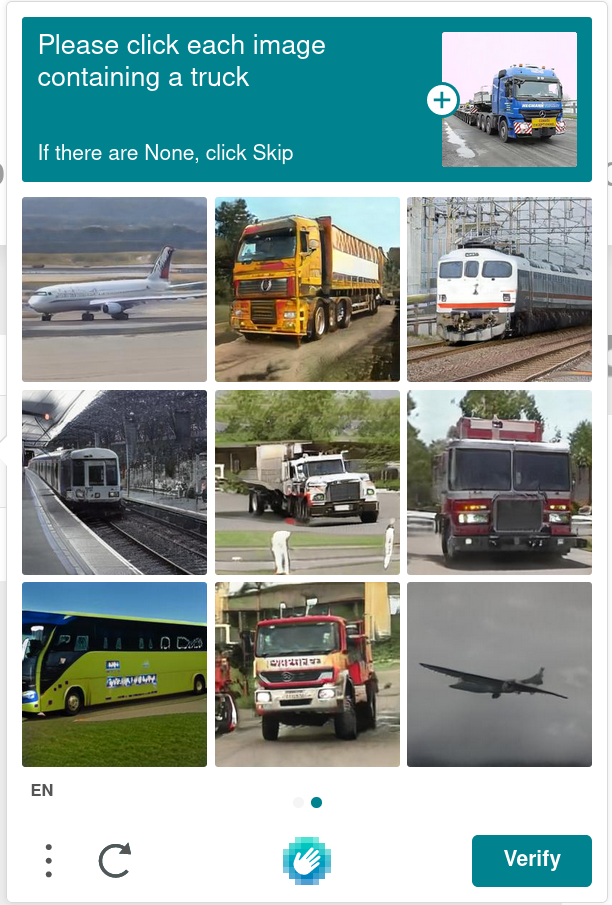
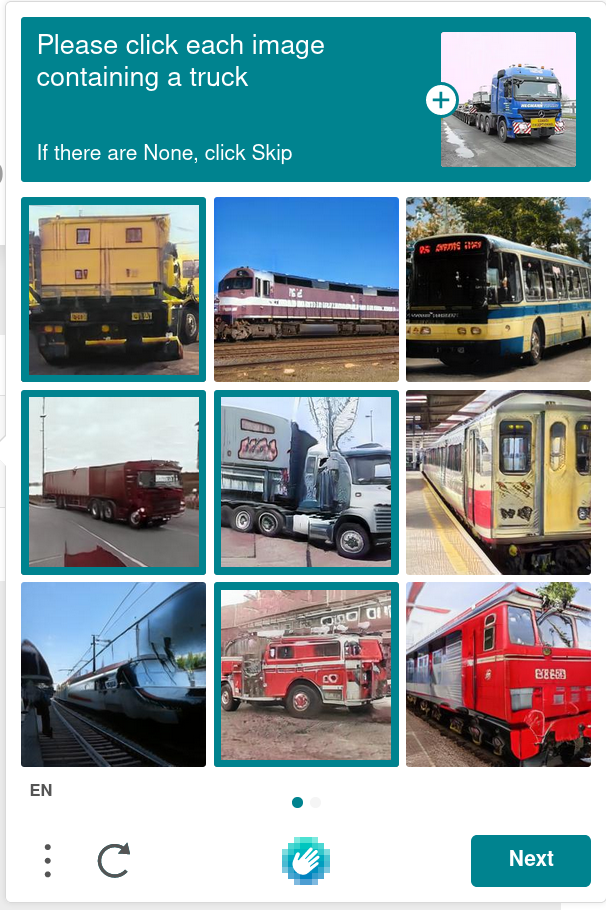
The question then is why? Why would hCaptcha be generating these challenges - aren’t they supposed to be labelling real life, not some AI mirages? You know the labels before you generate them, what’s the point in using humans to re-label them again… And why are the results so bad - these are definitely not state of the art!
The only explanation that makes sense is that hCaptcha is not really doing this whole AI-labelling business at all, or if they are it’s only in very limited fashion. Most of the time they’re just using a GAN to generate images that defeat the bots’ image recognition AI. And the GAN isn’t trained to optimise human recognition, rather to confound the bots in an arms race, leading to the bad image quality.
If you have any better ideas I’d be glad to hear them because this whole thing doesn’t really make much sense.
Footnotes:
Comments
No comments yet!
To leave a comment, please send it via email here. Comments are licensed CC-BY as with the rest of the site. Your sender name and email address will be published along with the comment, unless you tell me not to.
Articles from other blogs I follow
Giant mud doughnut lands at the Barbican — and yes, it’s art
A giant muddy doughnut has arrived in the middle of the Barbican, and of course, it’s art.Read more ›
via ianVisits May 15, 2026
UK Government Kicks Out Palantir
The UK Government, for all its faults, is pretty good at publishing contracts it has awarded. That's why I get depressed when I see rage-bait nonsense about how companies have been award "Top Secret" deals. Right now you can go to https://www…
via Terence Eden’s Blog May 15, 2026
banning all Anthropic employees
Per my policies, I need to ban every employee and contractor of Anthropic Inc from ever contributing code to any of my projects. Anyone have a list? Any project that requires a Developer Certificate of Origin or similar should be doing this, because Anthropic…
via see shy jo April 1, 2026
Generated by openring