(In this 2,700-word deep dive, I’m diving into RTO in BigLaw – and the data that suggests that it may have unpleasant consequences for firms.)
The office market still hasn’t fully recovered since COVID – and what signs of recovery there are have been uneven. Large law firms, however, remain a tried and true friend to office owners and operators – keeping up (and, in some cases, expanding) their commitments to office leasing.
Word on the street is that this is all part of a bid to attract and retain talent – meaning “lawyers.” But if we include support staff in “talent,” then the data suggest that this may backfire.

As someone who used to practice law, I always hesitate to call lawyers “happy” – but the law-practice industry has certainly been perky the past couple of years. Throughout 2025 (including as recently as November), a bevy of reports crowed of huge profits and growth for law firms.
All that growth is translating to more office leases.
Savills’s recent US Law Firm Activity Reports show as much for law-firm leases over 20,000 square feet. The company’s Q2 report from 2025 shows that law-firm leasing volume has, on average, exceeded pre-pandemic levels over for the past two years. Quarter for quarter in 2024, law-firm leasing volume consistently topped 2019 year over year; ditto for the first half of 2025 compared to 2024. According to their 2025 Q3 report, leasing volume slowed quarter over quarter in Q3, but still showed substantial year-over-year growth.
“Through the first half of 2025, quarterly leasing volume has averaged 3.0 msf – double the pace recorded between 2020 and 2023,” reads the Savills Q2 report. “This sustained momentum reflects renewed confidence in long-term office commitments and underscores the legal sector’s steady reengagement with the workplace.”
This reengagement isn’t exactly a glow up, to be clear; in 25H1, 58.8% of leases were renewals – and of those who moved, at least 94.66% relocated “to similar or older buildings.”
The percentage of renewing and relocating firms expanding their footprint has risen year-over-year in 2025, while the percentage of firms downsizing has dropped – and expansions in Q3 outnumbered downsizes (37.3% vs. 32.4%). Still, the net footprint of renewals and relocations hasn’t changed much quarter-over-quarter – growing only 0.4% in Q3 after shrinking 1.1% in the first half of the year.
In other words: New leases are driving the crazy-high growth here.
There are a few possible interpretations of this, so I arranged a call with Zoë Paige, the senior research analyst at Savills who co-authored both reports. In our conversation, she underscored a factor universal to law firms – and business at large: return-to-office mandates.
“In 2024 and 2025, a lot of [law firms] started making announcements saying, ‘Hey, we’re coming in the office more,’” Paige told me. “They sometimes check how many people attend nowadays – and that sometimes affects their bonuses.”
The irony is that, according to Paige, the law-firm sector is exhibiting heightened demand for office-space amenities (mostly external, locational ones) in a bid to attract or retain talent.
The upshot: if workers don’t come in to the office to enjoy those amenities, their compensation is on the line.
For years, BigHand has been issuing reports warning of law firms facing serious support-staff attrition issues. (Their surveys include UK firms along with US firms, but in my experience their UK-only and US-only results have rarely substantially differed.)
Here are some of BigHand’s findings from a 2025 survey of law firms with 50+ lawyers, as reported in its 2025 Legal Workflow Leadership Report.
The workforce is aging out. 54% of firms expect to lose somewhere between 21% and 50% of their support staff to retirement by Q1 2030. An additional 4% expect to lose more than 50% of their support staff to retirement by then.
Workers are demanding more flexibility. Two of the top three reasons support staff are quitting are work/life imbalance (22% of firms) and in-office work requirements (20% of firms).
They’re also demanding more money. The other top reason support staffers have quit? Salary (20% of firms).
More findings from the report related to in-office requirements specifically:
84% of firms changed office attendance requirements in the prior year.
Of those, 53% began requiring support staff to spend more days in the office – compared to 39% loosening up in-office attendance requirements.
Meanwhile, only 29% of those firms’ attorneys were required to come to the office more; 56% relaxed in-office requirements for attorneys.
In fairness, I do wonder if the reason so few firms increased attorney in-office days is that they were already requiring attorneys to come in most of the week. Nonetheless, these numbers paint a picture of promoting the officers while firing at the front line. It all still amounts to a plurality of firms making support staff come in more and letting lawyers come in less.
The optics are terrible – and support staffers are taking notice.
Practically speaking, not all law-firm work can be done remotely. Sometimes there is no getting around working with paper documents (especially in jurisdictions that don’t support e-filing). It’s also nice to have someone to bring you coffee – and, if you’re a Boomer, print your emails for you – while you’re pulling a late night on M&A due diligence or trial prep or what-have-you. Moreover, certain support-staff professions, like knowledge management and IT, often inherently require having someone onsite at least time to time.
But there are reasons why work-from-home has stuck around since the end of the COVID pandemic.
It’s more cost-effective for both workers and employers.
Despite all the rhetoric espousing the collaborative benefits of in-office, research shows that remote workers are overall more productive than their onsite counterparts.
It gives employers access to a broader range of talent.
When employers require in-office days, even on a “hybrid” schedule, they necessarily require that employees live relatively nearby (so-called “super-commuters” notwithstanding) – limiting themselves to the local talent pool. And while a company may be willing to foot the bill for relocation for a highly paid executive (or, in the case of a law firm, a lateral attorney hire), that’s less likely to be the case for an admin.
These considerations lead us to look at some economic data. The National Housing Conference has a database called “Paycheck to Paycheck” that tracks housing affordability across US metros by occupation. I used it to compare the ability of law-firm support staff to afford housing in 12 major legal markets – i.e., the kind that routinely rent out more than 20,000 square feet to law firms full of junior associates working on doc review and senior partners working on their short games (no hate; we all know golf is important for biz dev):
San Francisco-Oakland-Fremont, CA
New York-Newark-Jersey City, NY-NJ
Boston-Cambridge-Newton, MA-NH
Washington-Arlington-Alexandria, DC-VA-MD-WV
Los Angeles-Long Beach-Anaheim, CA
Miami-Fort Lauderdale-West Palm Beach, FL
Atlanta-Sandy Springs-Roswell, GA
Nashville-Davidson-Murfreesboro-Franklin, TN
Dallas-Fort Worth-Arlington, TX
Chicago-Naperville-Elgin, IL-IN
Philadelpha-Camden-Wilmington, PA-NJ-DE-MD
Houston-Pasadena-The Woodlands, TX
(In our talk, Paige pointed to growth in the Miami market, identifying the region as a developing core metro for law firms – so I included it here. I also included Nashville, though it is not typically thought of as a BigLaw epicenter, for two reasons: (1) Savills reports that the city was home to the country’s second-largest law-firm relocation in 25Q2 – a 141,447-sf lease to Holland & Knight. (2) It is also home to at least one big AmLaw firm’s centralized support offices; you’ll see why that’s relevant later on.)
Understanding that large law firms rely on many kinds of support staff, for these purposes I stuck to two occupational categories:
Paralegals and Legal Assistants (“Paralegals”)
Legal Secretaries and Administrative Assistants (“Legal Admin”)
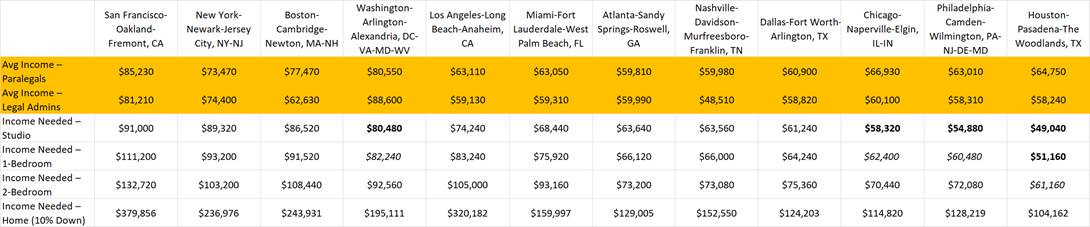
Dollar figures in bold indicate affordability for both Paralegals and Legal Admins; dollar figures in italics indicate affordability for only one or the other.
In 7 of these 12 markets, the average legal support professional cannot afford an average studio apartment. Paralegals can’t afford a one-bedroom in 8 out of 12, while Legal Admins can’t afford a one-bedroom in 9 out of 12. Houston represents the only metro area here in which Paralegals (but not Legal Admins) can afford a two-bedroom. And if a legal support professional wants to buy a house someday, in most markets their best strategy is to marry an associate at their firm (and in California, not a junior associate).
By the way, more than two thirds of firms in the BigHand survey reported intending to keep raises for support staff to no more than 10%.
This next table shows the average raise Paralegals and Legal Admins would have to get, respectively, in each market to afford a home.

So, okay, great news for those support staff at more generous firms (outside the NYC and LA metros): if they couldn’t already, they might be able to afford a studio apartment on their own in 2026. Maybe even a one-bedroom if they live in the South or Midwest (discounting Miami). A two-bed remains unlikely except in a handful of markets/circumstances.
(Note to self: Invest in a roommate-matching company.)
To be fair, giving substantial raises to support staff across the board is an expensive proposition. You know what’s cheaper? Renting more office space.
So the legal industry took a look at this problem and asked: What if we opened a dedicated support-staff office in a cheaper city?
This is called centralization, and it’s a hot trend in several industries right now. The theory driving centralization is that you can take your essential but “non-value-added” workers and throw them all in a big regional center in a smaller market. From there, you have them service multiple sites at once – increasing efficiency and agility while reducing cost.
In practice, in my personal opinion, I’m not so sure that centralization is as great as advertised on the tin. But that’s a letter for another day. For our immediate purposes, let’s assume arguendo that centralization works exactly like it’s supposed to. After all, 90% of respondents to the BigHand survey reported using at least some level of centralization.
(Know someone else who’d like B2BS? Pass it on.)
It would be tedious to examine housing affordability data for every US metro below a certain median income – and unnecessary, I like to think. Let’s get naughty with some ipse dixit and assert that housing costs throughout the US have gotten high.
But one metro bears a callout. The Tampa area in particular seems to be on its way to becoming a centralization hub for law practice; without naming names, a few AmLaw 100 firms have opened operations centers there. The neat thing about this is that, in a recent report referencing its “Paycheck to Paycheck” data, the National Housing Conference specifically cited the example of Tampa legal professionals. And – surprise, surprise – the picture looks no different in Tampa than it does in “core legal markets”.
Per the report (numbered bullets added for clarity):
“In Tampa, Florida, a law firm might include
Lawyers;
Human Resources Managers;
Human Resources Specialists;
Paralegals and Legal Assistants;
Bookkeeping, Accounting, and Auditing Clerks;
File Clerks;
Human Resources Assistants;
Information and Record Clerks; and
Legal Secretaries and Administrative Assistants.
“Renting a one-bedroom apartment became unaffordable for six of those [categories of] workers over the course of five years – including Paralegals and Legal Assistants making $62,420 a year in 2024. The same group was priced out of renting two-bedroom apartments in 2023 after just one year of affordability in 2022. Human Resources Specialists then lost the ability to afford two-bedrooms in 2023… In this law firm, just two [categories of] employees out of nine, Human Resources Managers and Lawyers, are able to afford housing payments without being cost-burdened.”
Centralization moves the support work farther away from the attorneys who rely on it. Therefore, if it’s an efficiency play, it should at least solve the affordability problem for support staffers. But without remote work, it probably doesn’t. The risks of attrition and talent shortages remain.
It seems we cannot escape the facts that, as a whole, the law-practice sector is:
Doubling down on its real-estate footprint
Letting lawyers stay home more
Requiring support staff to come in more
Not increasing support-staff compensation enough to keep up with rising cost-of-living expenses
Trying to solve the problem with centralization – which is a bit like moving turds around in a litterbox and hoping they go away on their own.
The resulting reality: Increasingly, legal support staff cannot afford their careers.
I used to have a solo law practice in Boston. Now’s a good time to tell you the story of the first time I saw how appellate practice worked in the BigLaw context.
It was my first time appearing in appellate court, and it wasn’t clear when my case would be called. I sat and watched several other cases over the few hours before opposing counsel and I had our turn.
In the Massachusetts Appeals Court, each side gets 15 minutes for oral arguments. If one side has multiple lawyers, they may split their time between them – e.g., “I’ll be taking nine minutes to address the statutory and Due Process Clause issues, and Attorney Smith will then take six minutes to address the Equal Protection Clause issue.”
Many of the cases that day had at least one side represented by a BigLaw™ firm – household names in the legal industry. And in these instances, there would always – always – be an army of attorneys representing the single party.
It looked damned impressive. Until the lead attorney would stand up and say something like this:
“May it please the Court, I’ll be reserving five minutes to address the breach-of-contract claims, Attorney Brown will take three minutes to address the fraud claims, Attorney Clark will take three minutes to address the promissory-estoppel claim, Attorney Davis will take two minutes to address the tortious-interference claim, Attorney Evans will take one minute to address the unjust-enrichment claim, and Attorney Flores will take one minute to address personal jurisdiction.”
This is not an exaggeration. They would actually do this. They would actually take turns like this, splitting up their allotted time between all of them in this way.
And it would be a disaster – a hurried, disjointed jumble of merely cursory treatments of big issues.
In the cases where both parties were represented by top AmLaw firms, it was downright comical.
The first thought I had was about what a joke these white-shoe stuffed suits seemed to be. Today, I’m old enough and wise enough to suspect (suspect, mind you; I daren’t outright accuse a bunch of white-shoe lawyers of anything without the hardest of proof) that this tactic was less about the success of the case and more about the success of the matter. These heavyweight firms were in a position to bill several hundred dollars an hour for each warm body who prepared for and attended court that day.
(Commonly, the last-most attorneys wouldn’t even get a chance to present to the panel because their peers who went before them would take up more than their share of time, making their attendance at court that day largely useless – except for RevenueOps, assuming those attorneys’ time didn’t get written off.)
Revenue optimization (and the ethical implications thereof) aside, this practice is bad lawyering. This gets me to the second thought I had back then – that if they really wanted to split their time up in this way, then all these attorneys should have gotten together in a room for a couple of hours to semi-script/choreograph the thing. True, you can only script so far for oral arguments because you’re subject to interruptions and questions from the panel of justices – but you can outline, plan for contingencies, and turn courtroom prep into a tabletop exercise. And it’s all billable.
This is the kind of scenario you probably need people in the office for.
You know what you don’t need people in the office for? Email. Meetings. Creating and working with documents and data. Reviewing dashboards. In other words, the vast majority of support-staff tasks.
BigLaw has it backwards with their RTO policies – and they might not like the downstream effects.
Managing partners: pls fix.
Know someone who would appreciate this? Pass it on.