^ this post will almost certainly colour your interpretation of the graphic novel, Logicomix. if you’re planning to read the book (which you should!!), please feel free to read this post later!
I have been meaning to sit down and reflect about everything I have learnt in the last six months. I did get started with a list, and it was by large, a rundown of technical stuff. But I chanced upon quite the brazen book a few days ago; it held up a mirror to my face and challenged me and my list. All thanks to Logicomix by Apostolos Doxiadis and Christos Papadimitriou, my list won’t reach my five wonderful Substack readers in the near future. To me, the yardstick for a good book is 2-dimensional. The two dimensions are: how much fun I have while reading it, and how much it challenges my worldview. Logicomix has somehow performed extremely well in both dimensions. It was both absolutely delightful and hauntingly beautiful. At the origin is one question: What can we know to be objectively true? Something that is absolutely true, set in stone, something no one can rationally contradict?
Is it perhaps Mathematics? 1 + 1 is 2, this fact cannot be false, right? But what does 1 actually mean? In the world of mathematics, there are constructs that do not occur in the natural world, does 1 exist? what does it mean when a number is infinitesimally small? isn’t that a circular definition in itself? what even is infinity? an axiom is defined as “a fundamental statement or assumption accepted as true without the need for proof”, what if a number of these axioms we believe to be true are actually false? we build so many probabilistic models, but is it even possible to ascertain the probability of any material event in the real world? Is Mathematics still the objective truth? Or is it rather the product of years of rote calculation and assumptions that have somehow transcended time?
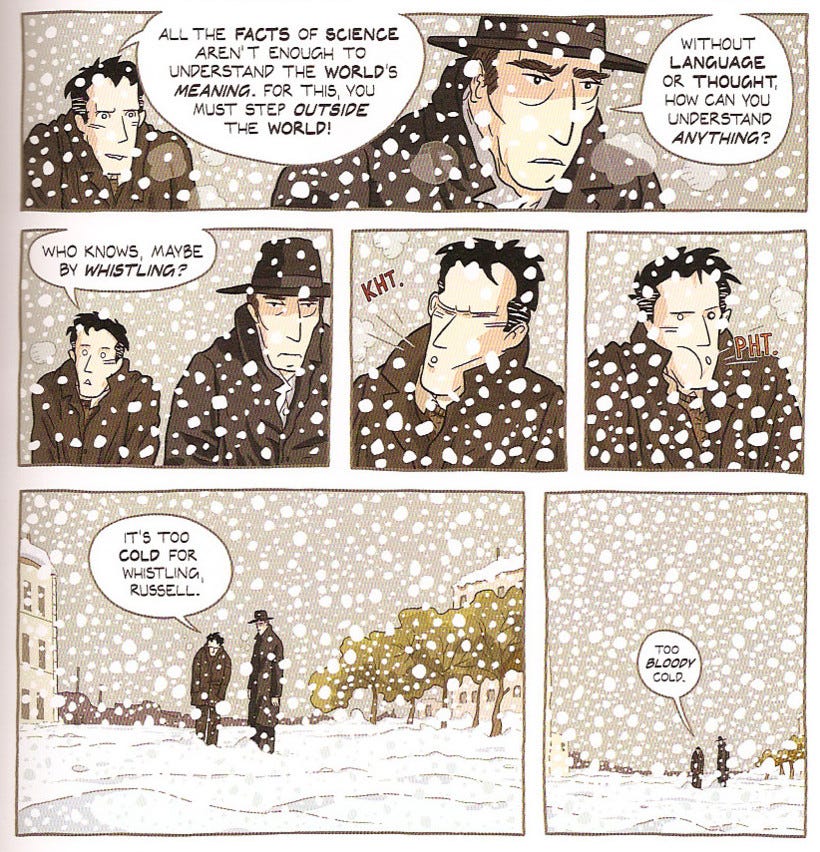
Enter Bertrand Russell, our protagonist, a mathematician and philosopher. In the present timeline of the story, Professor Russell is scheduled to deliver a lecture, but is disrupted by a group of isolationists who believe that the US must stay out of WW2. Russell is asked to take a stance on this situation: does he think the US must participate or not? what is the rational, logical choice? is there a logical choice? Through the rest of the book, we follow his answer to this question: his life’s journey as a logician, his struggles to discover the true foundations of mathematics.
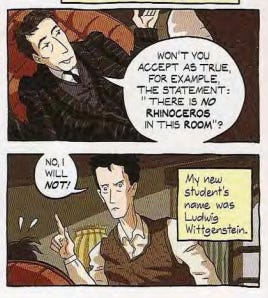
Russell believes that every axiom must be proven, every assumption clearly stated and objectively true. In his life’s magnum opus, Principia Mathematica, Russell famously proves 1+1 equals 2 in 162 pages - his predicates first define ‘1’, ‘+’ and ‘=’ from first principles, building upward from a minimal set of explicit logical axioms. We encounter anecdotes, arguments and discussions with several mathematicians, Hilbert, Frege, Cantor, Whitehead, the charming Wittgenstein, and finally we see the end to this battle for certainty, in the form of Godel’s incompleteness theorem. Mathematics ends up proving that there is indeed ignorabimus (i.e., what we cannot know). The authors themselves are mathematicians, and concepts like Hilbert’s Infinite Hotel, Russell’s Paradox, and even Godel’s theorem are explained with such lucidity that any curious person will understand them. To me however what impressed me the most wasn’t the theorems or the explanations, but rather, the human component in the story.
The authors make the following argument: what drove these mathematicians to Logic is their fear of uncertainty and ambiguity. We see how passion and obssession can actually drive a person to madness. Most media we see these days has this habit of depicting passionate people with a revered, feverish glow that ultimately ends in success; we do not usually see the other side of this coin.
In these logicians’ fear of uncertainty, and pursuits for exactitude, I saw.. more than a glimpse of myself. Godel’s theorem was as much a blow to me as it was to them: if the perfectly formulated problems of Maths themselves cannot be proven to be right or wrong, what hope do we have for the problems of our real world? can one even make a genuinely rational or right decision? even more concerning, is there such a thing as a right decision?
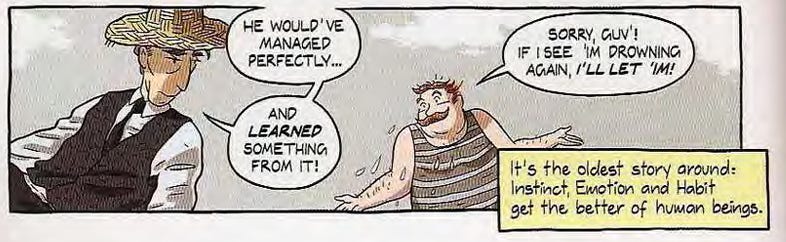
I know for a fact that my kryptonite is my indecisiveness; when faced with a difficult decision, I often tend to go in circles, analyzing pros and cons, pitting one against another on imaginary weighing scales. Reading Logicomix made me realize the source of this indecisiveness. I seem to have internalized the idea that my decisions must be “right“ decisions, and not necessarily what I actually want to do. So whenever one of the choices isn’t objectively “the right thing to do”, I end up confused. Logicomix solved this ~10 year problem for me with merely three words: Instinct, Emotion and Habit.
Tying together Logicomix and what I learnt in the last six months, is the other theme of the book: Fear of Uncertainty. We see mathematicians driven to Logic merely because they are incapable of accepting ambiguity. If you’ve been in a propositional logic class in a CS degree, you’re sure to have wondered, what the damn point of “Every man is mortal“ and “Socrates is a man“ is! After reading this book, I thought about how I was dealing with uncertainty in my own life lately.
Prior to this job, I worked in Software Engineering. Currently, I dabble in equal parts: Software Engineering as well as Finance. There is almost a striking difference in the way these two fields handle uncertainty. Computer Science is a career of perfection, there is no room for ambiguity whatsoever. We tell computers exactly what to do, how to do it and when to do it. We think of edge cases and handle them all, everything that can possibly happen is handled. Infinity is 2^16 - 1 on a 16 bit computer, and 2^32 - 1 on a 32 bit computer. Hilbert would be pleased to know that if his infinite hotel was run on a computer, and he moves his guests, the hotel will end up having 0 rooms. Even software engineering as a discipline is done with painstaking efforts to ensure certainty. How much work can you get done in a week? put that down as a number. How much can this team get done this quarter? we shall always plan ahead. How did you perform this quarter? There are three possible answers to that question: “EP“, “SP“ and “IP“, no excuses, no in-betweens. This person is about to resign? Create a REQ. How dare you write “int x = 576“ in the code? That is blasphemy, this might change in the future, and our system has to be correct even then! In fact, if our users interact with our software applications in ways we did not foresee, we call it a bug, and make the application behave as it was perfectly supposed to.
Finance, on the other hand, is entirely a machine of uncertainty. It capitalizes people’s fear of uncertainty: you want to buy next month at today’s price? Buy a future. What if the market moves in your favour, you ask? buy an option. You’re afraid something might happen to you? Buy life insurance. What is the price of this stock? 358.73, factoring in all known cash flows and the behavioual quirks of all people involved. We know this price is probably wrong, but we’re willing to try anyway. In fact, the very act of buying something implicates holding it to sell it at a higher price that may or may not come. We shall try to measure our Value at Risk, our Delta, our Gamma, but we know this might be wrong too. One thing that really caught me by surprise in a project I’m currently working on is this: when the system was tasked with making a certain kind of decision, it was making them randomly. I asked, “won’t this make the behaviour non-deterministic?“ The response was this: “that random choice is better than any deterministic choice we can make.“ The other side of this sword however is that payoffs vary, and sooner than later, uncertainty will see you crying at your desk, looking in awe, at a fat tail event, you never thought was possible. But, on the next trading day, you try yet again, you cannot not try.
So thank you Logicomix for making me realize that the biggest takeaway from the last six months isn’t something technical, but rather it is this strange acceptance of uncertainty and it is this understanding that I cannot control everything based on my actions. Uncertainty and ambiguity are okay. And it is what is uncertain that makes life a worthwhile adventure to look forward to.