minRLM: A Token-Efficient
Recursive Language Model Implementation and Benchmark
Abstract
minRLM is a token and latency efficient implementation of Recursive Language Models, benchmarked across 12 tasks against a vanilla LLM and the reference implementation. On GPT-5-mini it scores 72.7% (vs 69.7% official, 69.5% vanilla) using 3.6× fewer tokens. On GPT-5.2 the gap grows to +30pp over vanilla, winning 11 of 12 tasks. The data never enters the prompt. The cost stays roughly flat regardless of context size. Every intermediate step is Python code you can read, rerun, and debug.
12 tasks · 1,800 evaluations · 3 runners
| Accuracy | Tokens/query | Cost | |
|---|---|---|---|
| minRLM | 72.7% | 8,151 | $2.86 |
| vanilla | 69.5% | 20,967 | $4.74 |
| official RLM | 69.7% | 29,327 | $7.92 |
minRLM wins overall: +3.2pp accuracy, 2.6× fewer tokens than vanilla, 3.6× fewer than official.
12 tasks · 1,200 evaluations · 2 runners
| Accuracy | Tokens/query | Cost | |
|---|---|---|---|
| minRLM | 78.2% | 8,095 | $18.93 |
| vanilla | 48.2% | 14,196 | $16.50 |
Largest gap: +30pp accuracy. minRLM wins 11 of 12 tasks. AIME: 96% vs 0%. Vanilla is a plain API call (no chain-of-thought) - the REPL compensates by computing via code.
12 tasks · 1,800 evaluations · 3 runners
| Accuracy | Tokens/query | Cost | |
|---|---|---|---|
| minRLM | 53.7% | 13,810 | $0.74 |
| vanilla | 63.2% | 18,136 | $1.16 |
| official RLM | 43.3% | 27,174 | $2.68 |
Vanilla wins on accuracy, but minRLM still beats official by +10.4pp at 3.6× lower cost. Small models struggle to generate correct REPL code for code-heavy tasks.
Background
In December 2025, Zhang, Kraska, and Khattab proposed Recursive Language Models (RLMs): store input data as a variable in a Python REPL rather than pasting it into the context window. The model writes code to query the data; attention runs only on the results - search hits, filtered rows, extracted snippets. A 7M-character document becomes as accessible as a 7K one, navigated through code rather than read wholesale.
┌──────────────────────────────────────────────────────────┐ │ Standard LLM │ │ │ │ [System prompt] │ │ [500,000 tokens of raw context] ← you pay for all of it │ [Question] │ │ → Answer (maybe right, maybe not) │ └──────────────────────────────────────────────────────────┘ ┌──────────────────────────────────────────────────────────┐ │ Recursive LLM (RLM) │ │ │ │ input_0 = "<500k chars stored in REPL>" ← never in prompt │ Task: "Count errors in last hour" │ ├──────────────────────────────────────────────────────────┤ │ LLM writes: │ │ │ │ errors = re.findall(r'\[ERROR\].*', input_0) │ │ cutoff = datetime.now() - timedelta(hours=1) │ │ FINAL(len([e for e in errors if parse_time(e) > cutoff])) │ │ │ → Code runs, answer returned. ~4k tokens total. │ └──────────────────────────────────────────────────────────┘
The original paper validated this on a few tasks. This post extends the evaluation to 12 tasks across 3 model sizes, describes a leaner inference loop, and reports accuracy, token usage, latency, and cost per query for everything. Code is open-source.
If you're already familiar with RLMs as a concept, feel free to skip to the implementation.
Using code execution instead of pure token generation for LLM reasoning has come up independently in several places.
Code-as-action agents
smolagents (Hugging Face, 2024) proposed agents that write Python code at each step instead of selecting from a fixed tool schema. Both smolagents and RLMs treat the Python runtime as the model's interface. The difference: smolagents targets multi-tool orchestration; RLMs focus on a single REPL with data already loaded.
Production systems using code-based retrieval
Anthropic's improved web search (2026) uses the same pattern in production: Claude writes and executes code to filter search results before presenting them - the same tradeoff RLMs make for local data, deployed at scale in a commercial product.
The Model Context Protocol (MCP) and the Universal Tool Calling Protocol standardize how models access code execution across providers, lowering the barrier to deploying RLM-style patterns in production.
Context window limitations
Luo et al. (2025) show that LLM accuracy degrades as context length increases (context window rot) even when the answer is right there. Anyone who's used AI coding agents has seen this. Hennie de Harder (2025) has a good walkthrough of applying RLMs to work around it. RLMs sidestep this by design: the model never attends over the raw input.
How is this different from ReAct?
ReAct (Yao et al., 2022) interleaves reasoning and action steps: think, act, observe, repeat. Each step appends to the conversation, so context grows linearly. The model picks from a fixed tool schema at each step. RLMs are narrower and cheaper: the data lives in a REPL variable, the model writes one block of Python code (not a multi-turn chain), and the result comes back in 1-2 iterations. No tool selection, no observation parsing, no growing context. ReAct is a general agent loop; an RLM is a single code-generation call with a sandbox.
RLM implementations and extensions
Prime Intellect independently scaled RLMs and saw similar token efficiency gains on long-context tasks. @realmcore_ built an RLM specifically for coding tasks, showing the pattern works beyond the retrieval and analytics tasks in the original paper.
minRLM Implementation
The reference implementation appends code and output to the conversation each iteration, so context grows with every step. minRLM does it differently:
- Entropy profiling - before the model sees anything, we compute a compression-based
entropy map of the input using
zlib. The context is split into 20 sections, each scored by compression ratio at 500-char resolution. Sections with high entropy (unique, diverse content) get flagged as spikes. This map is injected into the system prompt so the model knows where to search before writing a single line of code. A needle in a 7MB haystack shows up as an entropy spike - the model can skip straight to it. - Context preview - a head/mid/tail sample (400+300+500 chars) gives the model the data's structure and format without dumping the full input. Combined with the entropy map, this replaces the reference implementation's approach of feeding raw context into the prompt.
- Flat token cost - one structured system prompt with typed code patterns. The model picks the pattern and usually finishes in 1-2 iterations. Context never enters the conversation - only the entropy map and preview do.
- Task routing - Step 0 in every prompt: detect whether the task is structured data,
MCQ, code retrieval, code generation, creative writing, math, or search & extract.
Each type has a specialized code pattern. If none match, the model classifies via
sub_llmand falls back to the closest pattern. - Two-pass search - for needle-in-haystack tasks, if the first search pass returns "unknown" or "insufficient", a second pass automatically runs with new keywords extracted from the first-pass evidence. This catches cases where the answer requires following a chain of references.
- Reasoning-first -
# REASONING:comment before code generation. Helps on tasks that need planning (multi-hop retrieval, complex codebases).from minrlm import RLMgives you the reasoning variant by default. - Sub-LLM delegation - for MCQ and extraction tasks, the outer model gathers
targeted evidence via
search(), then passes it to a focusedsub_llm(task, evidence)call. The sub-LLM reasons over a small, relevant context instead of the full input. For structured data, regex counting replaces LLM "reading" entirely. - DockerREPL - every execution runs in a fresh container with a seccomp profile
blocking network and filesystem syscalls. Stdlib only (Python 3.14). The reference uses local
execby default.
from minrlm import RLM

client = RLM(model="gpt-5-mini")
answer = client.completion(
    task="Which user had the most errors in the last 7 days?",
    context=open("huge_log_file.txt").read()  # can be 10MB+
)
# Data never enters the prompt. Token cost stays flat regardless of context size.
Instead of attending over 400K characters, the model reads the entropy map ("section 14 has a spike"),
checks the preview for format, and writes targeted search() calls. For structured data,
it auto-detects the delimiter and counts with regex - no hallucinations, no substring traps.
The full input never enters the prompt at any point.
Experimental Setup
The eval framework (eval/ in the repo) runs any RLM strategy against 12 tasks
and records accuracy, token count, latency, and cost per query. Any runner implementing the
interface can be plugged in. Primary benchmark: gpt-5-mini, three runners,
50 queries per task (1,800 evaluations). Cross-model results in
Model Scaling.
| Runner | Accuracy | Avg Tokens | Avg Latency | Total Cost (50/task) |
|---|---|---|---|---|
| minRLM | 72.7% | 8,151 | 25.8s | $2.86 |
| Vanilla | 69.5% | 20,967 | 24.2s | $4.74 |
| Official RLM | 69.7% | 29,327 | 60.9s | $7.92 |
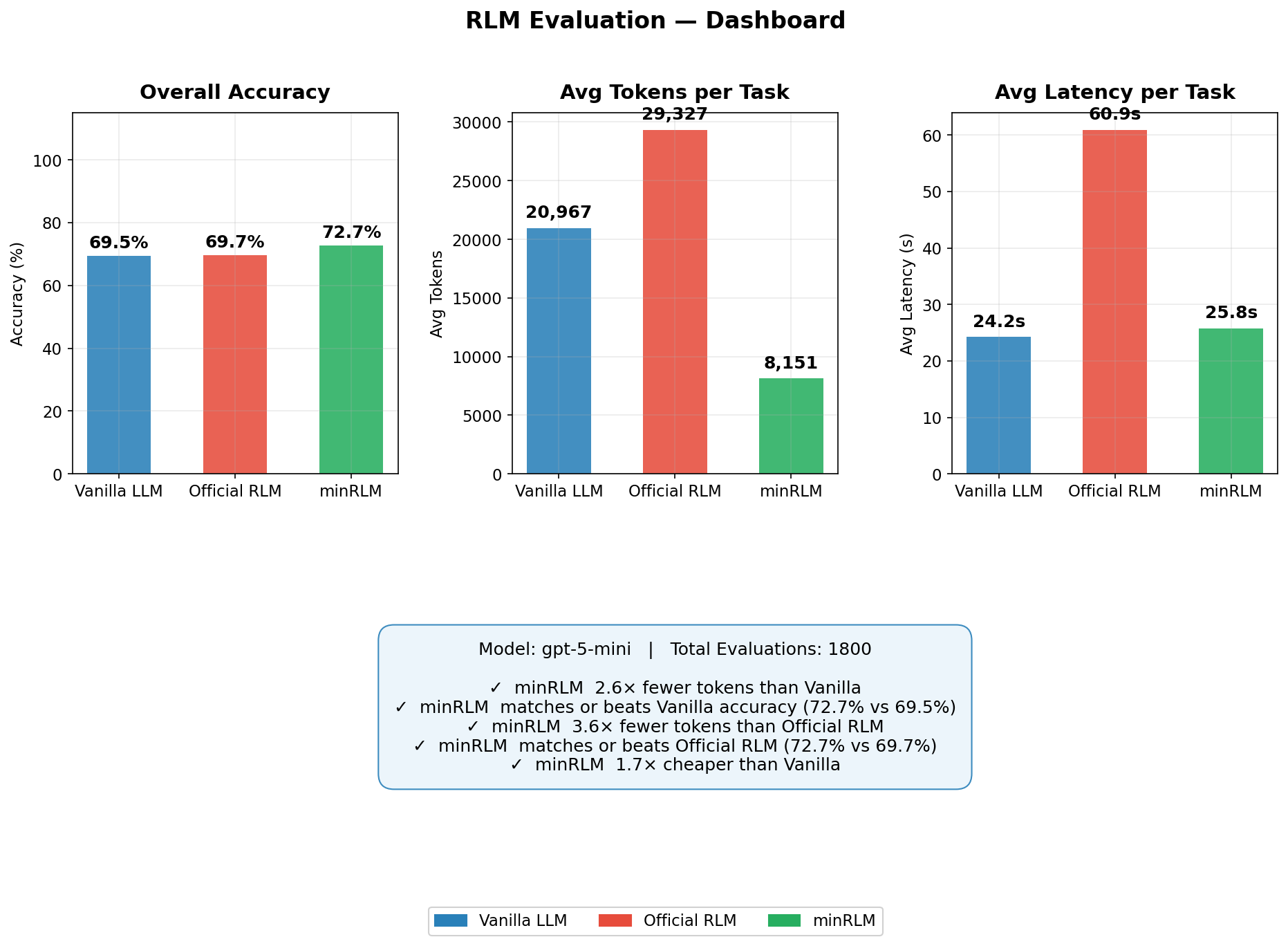
GPT-5-mini summary: accuracy, token usage, and latency across all 12 tasks.
Tasks & Results GPT-5-mini · click to expand
All results in this section use GPT-5-mini. Each task shows the actual code generated and an honest look at where the approach works and where it doesn't. For GPT-5-nano and GPT-5.2 results, see Model Scaling.
Large-context retrieval
Task 1 BrowseComp - Needle in a 7MB Haystack
Find one specific entity - a name, institution, place - inside a multi-document corpus up to 7MB. One correct answer, hidden somewhere in millions of characters. Vanilla can't even load the context. The query fails before it starts. ↗ Tevatron/browsecomp-plus
"Please tell me the name of the learning institution that fits the following criteria:
A. In 2002, it held a three-day event from Thursday to Saturday…
B. In 2003, it held its graduation ceremony on the fourth Sunday…"
Context: 7,726,462 characters
minRLM's code
# REASONING: Search the 7MB document for keywords from the criteria,
# gather snippets, and ask sub_llm to extract the institution name.
import re, json, datetime, collections

head = input_0[:500]
tail = input_0[-1000:]
kws = re.findall(r'\b[a-z]{4,}\b', (head + tail + task_0).lower())
kws = list(dict.fromkeys(kws))[:20]

snippets = []
for kw in kws:
    for match, before, after in search(input_0, kw):
        snippets.append(before + match + after)
    if len(snippets) >= 10: break

combined = "\n---\n".join(snippets[:10])
answer = sub_llm(task_0, combined)
FINAL(answer)
Result: "Queen Arwa University" ✓ 3,679 tokens total.
| Runner | Accuracy | Avg Tokens | Notes |
|---|---|---|---|
| minRLM | 62% | 10,740 | Navigates 7MB via search() |
| Vanilla | 16% | 34,084 | Context overflow on most queries |
| Official RLM | 66% | 68,354 | Best accuracy, 6.4x more tokens |
Vanilla can't even load most of these documents. minRLM navigates 7MB with targeted search() calls.
Task 2 SNIAH - Single Needle-in-a-Haystack
A specific value planted inside a long synthetic document (~14K chars of densely packed records). Retrieve it exactly - one wrong field selection fails the task. ↗ tonychenxyz/ruler-full
"Answer the final question in the text. Return ONLY the answer."
Context: ~13,800 characters of structured professional records
minRLM's code
# REASONING: Extract keywords from head/tail of input_0, gather search snippets,
# look for numeric values, otherwise delegate to sub_llm on focused evidence.
import re, json, datetime, collections

head = input_0[:500]
tail = input_0[-1000:]
kws = re.findall(r'\b[a-z]{4,}\b', (head + tail + task_0).lower())
kws = list(dict.fromkeys(kws))[:20]

snippets = []
for kw in kws:
    for match, before, after in search(input_0, kw):
        snippets.append(before + match + after)
    if len(snippets) >= 10: break

combined = "\n---\n".join(snippets[:10])
nums = re.findall(r'\b(\d{4,})\b', combined)
if nums:
    FINAL(nums[0])
answer = sub_llm(task_0, combined)
FINAL(answer)
Result: 8231838 ✓ 3,390 tokens total.
| Runner | Accuracy | Avg Tokens | Notes |
|---|---|---|---|
| minRLM | 94% | 6,328 | Near-perfect |
| Vanilla | 100% | 3,758 | Context fits in prompt |
| Official RLM | 76% | 16,283 | 2.6x more tokens, lower accuracy |
Task 3 RepoQA - Code Retrieval from Large Codebases
Given a codebase dump and a natural-language description, return the exact function. Up to 500K+ chars. ↗ evalplus/repoqa_release
"Return the exact function that creates an error object specifically for operations that have been
canceled, providing a standardized error handling mechanism. It accepts three optional parameters:
a message string, an optional code, and an optional config."
Context: 732 chars (axios codebase index)
minRLM's code
# REASONING: Scan all function definitions, ask sub_llm to identify the right one,
# then extract and return its full source context.
import re, json, datetime, collections

is_code_task = any(k in task_0.lower() for k in ["codebase", "exact function", "code snippet"])

# Scan for all function definitions across Python, JS, TS, Java
all_funcs  = re.findall(r'^\s*def (\w+)\(', input_0, re.MULTILINE)
all_funcs += re.findall(r'\bfunction\s+(\w+)\s*\(', input_0)
all_funcs += re.findall(r'\b(\w+)\s*[=:]\s*(?:async\s+)?function\s*\(', input_0)
unique = list(dict.fromkeys(all_funcs))

# Build signature list for sub_llm to pick from
sigs = []
for nm in unique[:80]:
    sm = re.search(r'^\s*(def ' + re.escape(nm) + r'\([^)]*\).*?:)', input_0, re.MULTILINE)
    if sm: sigs.append(sm.group(1).strip())

func = sub_llm(f"{task_0}\nAll functions:\n{chr(10).join(sigs)}\nReply ONLY the function name.",
               input_0[:10000]).strip()
func = re.sub(r'[^a-zA-Z0-9_]', '', func)

r = search(input_0, "function " + func)
if r:
    m, b, a = r[0]
    FINAL(func + "||" + b[-800:] + m + a[:5000])
Result: CanceledError + full class source extracted from lib/cancel/CanceledError.js ✓ 3,879 tokens.
| Runner | Accuracy | Avg Tokens | Notes |
|---|---|---|---|
| minRLM | 62% | 8,026 | Struggles with function selection |
| Vanilla | 98% | 3,958 | Context fits - fastest path wins |
| Official RLM | 96% | 17,944 | Near-perfect |
Vanilla and Official both win here. minRLM's code retrieval pattern sometimes generates code instead of extracting it, or selects a similar but wrong function. This is the biggest gap to close.
Long-document MCQ & structured data
Task 4 LongBench V2 - Long-Document MCQ
MCQ over long documents (novels, papers, manuals). 50K-600K+ characters, four statements, one true. ↗ zai-org/LongBench-v2
"In Agatha Christie's 'The Murder on the Links,' which statement is true?
A) Eloise Renauld did not grieve upon hearing of her husband's death because she no longer loved him.
B) The overcoat that Paul Renauld was wearing when he died did not fit him because he'd put on the vagrant's overcoat.
C) Bella Duveen killed Paul Renauld.
D) Madame Daubreuil overheard Paul Renauld's plan of feigning death, and took action."
Context: 329,526 characters (full novel)
minRLM's code (large MCQ path)
# REASONING: Use MCQ pattern - gather evidence snippets from the 330K char novel,
# then call sub_llm on curated evidence instead of the full text.
import re, json, datetime, collections

sz = len(input_0)   # 329,526 - triggers "large" path

# Extract terms from both question and answer options
opts = re.findall(r'[A-D]\)\s*(.+?)(?=\s*[A-D]\)|$)', task_0, re.DOTALL)
opt_terms = re.findall(r'\b[A-Z][a-z]{3,}\b|\b[a-z]{5,}\b', " ".join(opts))[:15]
q_terms   = re.findall(r'\b[A-Z][a-z]{3,}\b|\b[a-z]{5,}\b', task_0)[:10]
terms = list(dict.fromkeys(q_terms + opt_terms))[:25]

# Search for each term, deduplicate by page position
snips, seen = [], set()
for t in terms:
    for m,b,a in search(input_0, t)[:4]:
        pk = len(b)//2000
        if pk not in seen:
            snips.append(b[-2000:] + m + a[:2000]); seen.add(pk)

evidence = input_0[:3000] + "\n...\n" + "\n---\n".join(snips[:30])
answer = sub_llm(task_0, evidence[:50000])
answer = (answer or "A").strip().upper()
FINAL(answer)
Result: "A" ✓ 3,917 tokens - vs 65,917 tokens for vanilla on the same question.
| Runner | Accuracy | Avg Tokens | Notes |
|---|---|---|---|
| minRLM | 46% | 10,767 | 8x fewer tokens than vanilla |
| Vanilla | 56% | 87,813 | Full context dump |
| Official RLM | 48% | 83,807 | 7.8x more tokens than minRLM |
All runners struggle here. minRLM's search-based evidence gathering misses passages that full-context attention catches - but uses 8x fewer tokens trying.
Task 5 CodeQA - Deep Codebase Reasoning (MCQ)
MCQ about real codebases (100K-600K characters). Questions about architecture, not keyword lookup. ↗ zai-org/LongBench-v2 (code subset)
"The DynamiCrafter code base includes a complex training pipeline for a video diffusion model…
Which combination of class methods and processing steps is most critical for ensuring motion
smoothness and temporal coherence during long video generation?"
Context: 395,334 characters (full codebase)
minRLM's code (large MCQ evidence path)
# REASONING: Large codebase MCQ - gather evidence by searching for terms from
# both the question and answer choices, then call sub_llm on curated snippets.
import re, json, datetime, collections

opts = re.findall(r'[A-D]\)\s*(.+?)(?=\s*[A-D]\)|$)', task_0, re.DOTALL)
opt_terms = re.findall(r'\b[A-Z][a-z]{3,}\b|\b[a-z]{5,}\b', " ".join(opts))[:15]
q_terms   = re.findall(r'\b[A-Z][a-z]{3,}\b|\b[a-z]{5,}\b', task_0)[:10]
terms = list(dict.fromkeys(q_terms + opt_terms))[:25]

snips, seen = [], set()
for t in terms:
    for m,b,a in search(input_0, t)[:4]:
        pk = len(b)//2000
        if pk not in seen: snips.append(b[-2000:]+m+a[:2000]); seen.add(pk)

# Include README/docs for architectural context
for doc_kw in ["README", "Abstract", "Introduction"]:
    for m,b,a in search(input_0, doc_kw)[:1]:
        snips.append(b[-1000:]+m+a[:3000])

evidence = input_0[:3000] + "\n...\n" + "\n---\n".join(snips[:30])
answer = sub_llm(task_0, evidence[:50000])
FINAL(answer.strip().upper())
Result: "D" ✓ 3,988 tokens - vs 89,960 tokens for vanilla on the same codebase.
| Runner | Accuracy | Avg Tokens | Notes |
|---|---|---|---|
| minRLM | 40% | 9,724 | 9.8x fewer tokens than vanilla |
| Vanilla | 46% | 95,332 | Full codebase dump |
| Official RLM | 38% | 78,232 | Most tokens, lowest accuracy |
Task 6 OOLONG - Structured Data Analytics
Pipe-delimited records (Field: Value || Field: Value), questions about frequency, counts,
and comparisons. The classic trap: "incorrect" contains "correct".
A vanilla LLM can stumble on this; re.findall(r'\bTrue\b', ...) can't.
↗ oolongbench/oolong-synth
"In the above data, is label 'False' more common, less common, or the same frequency as label 'True'?
Give your final answer in the form 'Answer: False is [X] True'."
Context: ~6,260 characters of pipe-delimited records
minRLM's code
# REASONING: Count exact whole-word occurrences of "True" and "False" in input_0.
import re, json, datetime, collections

# STRUCTURED DATA pattern - auto-detect delimiter from data
sample = input_0[:5000]
if "||" in sample: delim = "||"
elif "\t" in sample: delim = "\t"
elif "|" in sample: delim = "|"
else: delim = ","

false_count = len(re.findall(r'\bFalse\b', input_0))
true_count  = len(re.findall(r'\bTrue\b',  input_0))

if   false_count > true_count: relation = "more common than"
elif false_count < true_count: relation = "less common than"
else:                          relation = "same frequency as"

FINAL(f"Answer: False is {relation} True")
Result: "Answer: False is more common than True" ✓ 3,430 tokens. Deterministic, zero hallucination risk.
| Runner | Accuracy | Avg Tokens | Notes |
|---|---|---|---|
| minRLM | 92% | 6,184 | Exact regex counting |
| Vanilla | 78% | 12,196 | Misled by substring matches |
| Official RLM | 80% | 14,373 | 2.3x more tokens |
Reasoning & open-ended
Task 7 AIME 2025 - Competition Math via Code
AMC/AIME competition math. No context - pure reasoning. When the domain is bounded, a REPL turns "prove it algebraically" into "just enumerate it" - exact arithmetic, no edge cases. On GPT-5-mini, vanilla wins (88% vs 74%). On GPT-5.2 it flips: minRLM 96%, vanilla 0% (vanilla outputs a bare guess with no reasoning; the REPL forces actual computation). ↗ MathArena/aime_2025
"Find the number of ordered pairs (x,y), where both x and y are integers between −100 and 100, inclusive, such that 12x²−xy−6y²=0."
minRLM's code
# REASONING: Brute-force enumerate all (x,y) pairs in range and count solutions.
import re, json, datetime, collections

count = 0
for x in range(-100, 101):
    for y in range(-100, 101):
        if 12*x*x - x*y - 6*y*y == 0:
            count += 1

FINAL(str(count))
Result: 117 ✓ 7,015 tokens total. Executes in milliseconds.
| Runner | Accuracy | Avg Tokens | Notes |
|---|---|---|---|
| minRLM | 74% | 7,951 | Exact enumeration |
| Vanilla | 88% | 3,965 | No REPL overhead needed |
| Official RLM | 84% | 11,300 | More tokens, less accurate |
On GPT-5-mini, vanilla wins - no data to retrieve means the REPL is overhead. On GPT-5.2 this flips completely. See scaling results.
Task 8 GDP Val - Open-Ended Professional Tasks
Open-ended professional tasks - financial models, training programs, legal analysis. No single correct answer; scored by rubric keyword matching. ↗ openai/gdpval
"You are a Quantitative Researcher at a proprietary trading firm expanding into single-name options. Develop a comprehensive American option pricing framework in a Python notebook. Implement and compare multiple methodologies (binomial trees, finite differences, Monte Carlo)."
minRLM's code (excerpt)
# REASONING: Implement CRR binomial tree, explicit finite differences,
# and Longstaff-Schwartz Monte Carlo in pure Python. Benchmark convergence.
import re, json, datetime, collections, math, random, time, statistics

def crr_binomial_american(S, K, r, q, sigma, T, N, option_type='put'):
    dt = T / N
    u  = math.exp(sigma * math.sqrt(dt))
    d  = 1 / u
    p  = (math.exp((r-q)*dt) - d) / (u - d)
    disc = math.exp(-r * dt)
    # Build price tree and work backwards with early exercise
    prices = [S * (u**j) * (d**(N-j)) for j in range(N+1)]
    values = [max(K - st, 0) if option_type=='put' else max(st - K, 0) for st in prices]
    for i in range(N-1, -1, -1):
        prices = [S * (u**j) * (d**(i-j)) for j in range(i+1)]
        cont   = [disc*(p*values[j+1] + (1-p)*values[j]) for j in range(i+1)]
        ex     = [max(K-st, 0) if option_type=='put' else max(st-K,0) for st in prices]
        values = [max(c, e) for c, e in zip(cont, ex)]
    return values[0]

# ... Finite differences and Longstaff-Schwartz MC follow ...
FINAL("american_option_notebook_generated")| Runner | Accuracy | Avg Tokens | Notes |
|---|---|---|---|
| minRLM | 86% | 12,007 | Builds content as Python strings |
| Vanilla | 54% | 4,236 | Misses rubric terms |
| Official RLM | 50% | 20,458 | Struggles with open-ended generation |
An early bug: sub_llm() refused tasks mentioning "attached files" that don't exist.
Fix: build document content directly as Python strings from task_0.
Task 9 GPQA Diamond - Graduate-Level Science MCQ
Graduate-level science MCQ (physics, chemistry, biology). No context - pure domain reasoning. ↗ Idavidrein/gpqa
"An electron is in the spin state... Which of the following is the probability
of getting +ℏ/2 in the measurement of the z-component of the spin?"
No context (pure reasoning)
minRLM's code
# REASONING: MCQ with no context - delegate to sub_llm for domain reasoning.
import re

# Extract valid answer letters from the question
valid = [c for c in "ABCD" if f"{c})" in task_0]

# No context - call sub_llm directly on the question
answer = sub_llm(task_0, "")
answer = (answer or valid[0]).strip().upper()

# Sanitize to a valid letter
if answer not in set(valid):
    m = re.search(r'\b([A-D])\b', answer)
    answer = m.group(1) if m else valid[0]
FINAL(answer)
Result: "A" ✓ 6,220 tokens total.
| Runner | Accuracy | Avg Tokens | Notes |
|---|---|---|---|
| minRLM | 70% | 6,679 | Systematic elimination via computation |
| Vanilla | 66% | 2,140 | Cheapest path |
| Official RLM | 74% | 14,272 | Best accuracy, 2.1x more tokens |
Task 10 MMLU Pro - Broad Knowledge MCQ
Broad-knowledge MCQ (STEM, humanities, social sciences). No context, ten answer choices. ↗ TIGER-Lab/MMLU-Pro
"A house, valued at $10,000 and insured for $7,000 with an 80% coinsurance clause,
is damaged by fire to the extent of $8,500. How much will the insurance company pay?"
No context (pure knowledge, 10 answer choices A–J)
minRLM's code
# REASONING: MCQ with no context and 10 choices - delegate to sub_llm.
import re

valid = [c for c in "ABCDEFGHIJ" if f"{c})" in task_0]

# No context to search - pure knowledge question
answer = sub_llm(task_0, "")
answer = (answer or valid[0]).strip().upper()

if answer not in set(valid):
    m = re.search(r'\b([A-J])\b', answer)
    answer = m.group(1) if m else valid[0]
FINAL(answer)
Result: "J" ($7,437.50) ✓ 5,607 tokens total.
| Runner | Accuracy | Avg Tokens | Notes |
|---|---|---|---|
| minRLM | 82% | 6,341 | REPL overhead, no benefit |
| Vanilla | 90% | 885 | Cheapest and most accurate |
| Official RLM | 86% | 8,461 | More tokens, less accurate |
Pure knowledge recall - the REPL adds overhead for no benefit on GPT-5-mini. On GPT-5.2 the story changes. See scaling results.
Task 11 IFEval - Instruction Following
Precise instruction following: format constraints, word counts, inclusion/exclusion rules. ↗ google/IFEval
"Brainstorm a name for a company that collects and analyzes public transportation fares. The response should be in English, and in all capital letters."
minRLM's code
# REASONING: Generate company names and enforce the ALL CAPS constraint
# programmatically - verify before submitting.
import re

# Build creative names directly as Python strings (ALL CAPS)
names = [
    "FAREFLOW ANALYTICS",
    "FAREWISE LABS",
    "TRANSFARE INSIGHTS",
    "FAREMETRICS",
    "ROUTEFARE INTELLIGENCE",
    "FARETRACKER SOLUTIONS",
    "TRANSIT FARELOGIC",
    "FAREVISION ANALYTICS",
    "COMMUTER FARELAB",
    "FAREDATA SYSTEMS",
    "FAREMAP ANALYTICS",
]

# Verify ALL CAPS constraint before submitting
output = "\n".join(names)
assert output == output.upper(), "Not all caps!"
FINAL(output)
Result: 11 company names, all caps verified ✓ 5,527 tokens total.
| Runner | Accuracy | Avg Tokens | Notes |
|---|---|---|---|
| minRLM | 84% | 5,963 | Enforces constraints programmatically |
| Vanilla | 78% | 1,360 | Can't verify its own output |
| Official RLM | 78% | 9,316 | Same accuracy, higher cost |
The REPL checks constraints programmatically before submitting. If the output violates a rule, the code catches it.
Task 12 LiveCodeBench - Code Generation
Competitive programming. The REPL lets the model test its solution before submitting. ↗ livecodebench.github.io
"There is a glass and a mug with capacities G and M ml. Perform K operations: if the glass is full, discard all water; if the mug is empty, fill it; otherwise transfer water from the mug to the glass until one is full/empty. Output the final amounts." (G=5, M=17, K=4)
minRLM's code
# REASONING: Implement straightforward simulation of the K operations
code = r'''
import sys
def main():
    data = sys.stdin.read().strip().split()
    K, G, M = map(int, data)
    glass = 0
    mug = 0
    for _ in range(K):
        if glass == G:
            glass = 0
        elif mug == 0:
            mug = M
        else:
            transfer = min(G - glass, mug)
            glass += transfer
            mug -= transfer
    print(glass, mug)
'''
FINAL(code.strip())
Result: correct simulation outputting "5 12" ✓ 4,832 tokens total.
| Runner | Accuracy | Avg Tokens | Notes |
|---|---|---|---|
| minRLM | 80% | 7,106 | Tests before submitting |
| Vanilla | 64% | 1,877 | Can't test its own code |
| Official RLM | 60% | 9,128 | More rounds, same problem |
The model writes code, runs it, sees if it works, and fixes it before calling FINAL().
Full Results GPT-5-mini
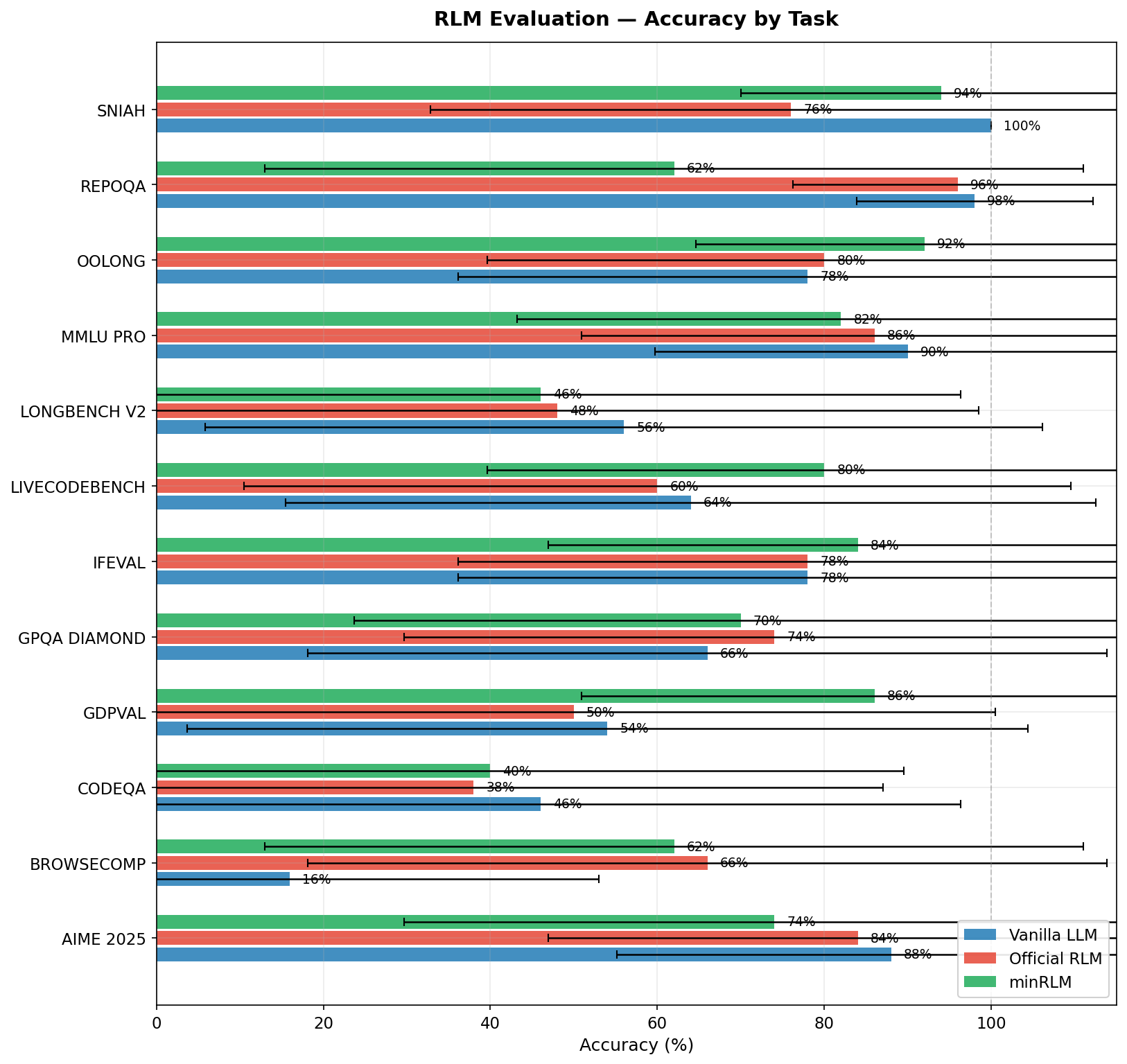
Per-task accuracy across all three runners.
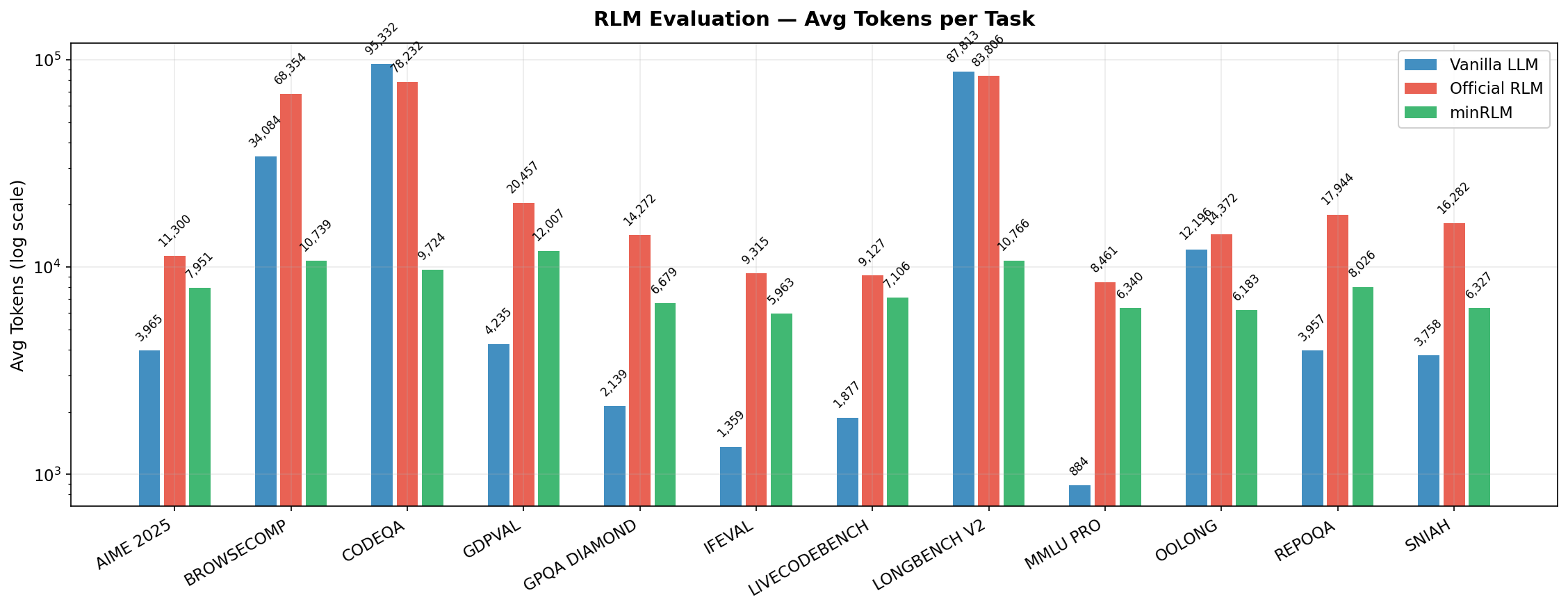
Average tokens per query per task. Vanilla returns 0 on BrowseComp (context overflow - query fails entirely).
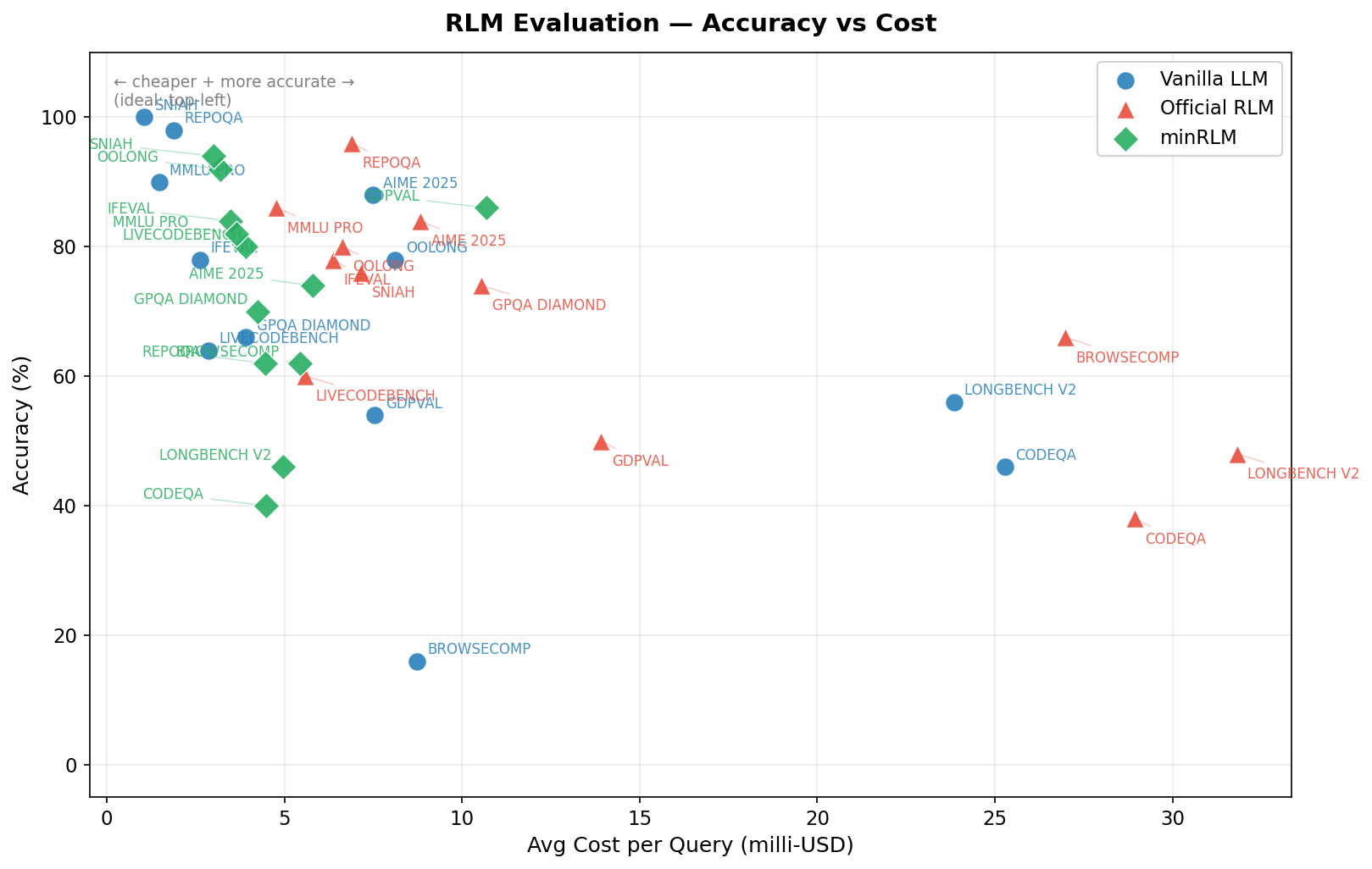
Efficiency frontier: accuracy vs. cost per query. Top-left is ideal.
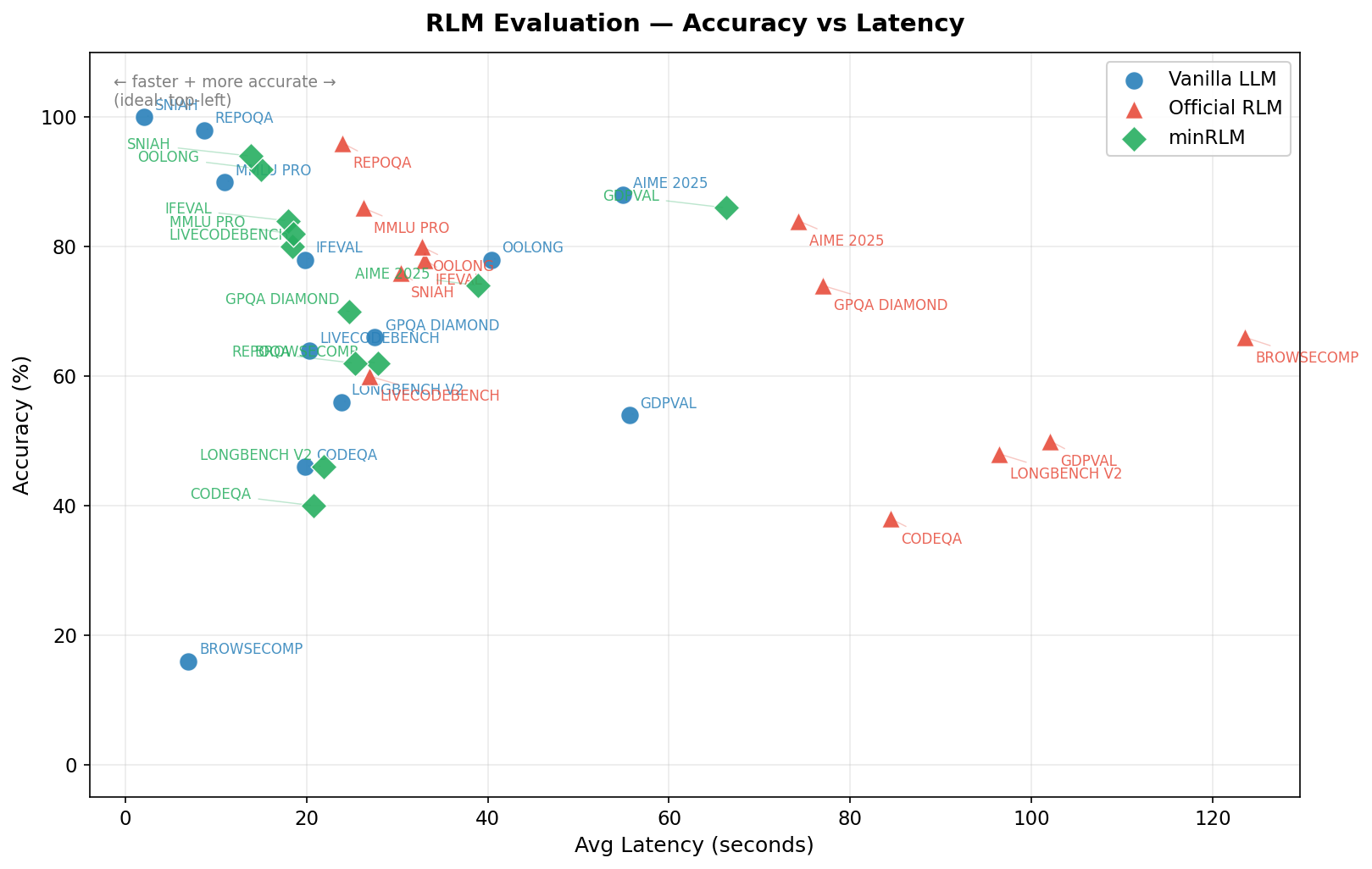
Speed vs. quality. minRLM is faster than Official RLM on all 12 tasks (avg 26s vs 61s).

Average cost per query per task. minRLM's flat token budget makes large-context tasks cost the same as small ones.
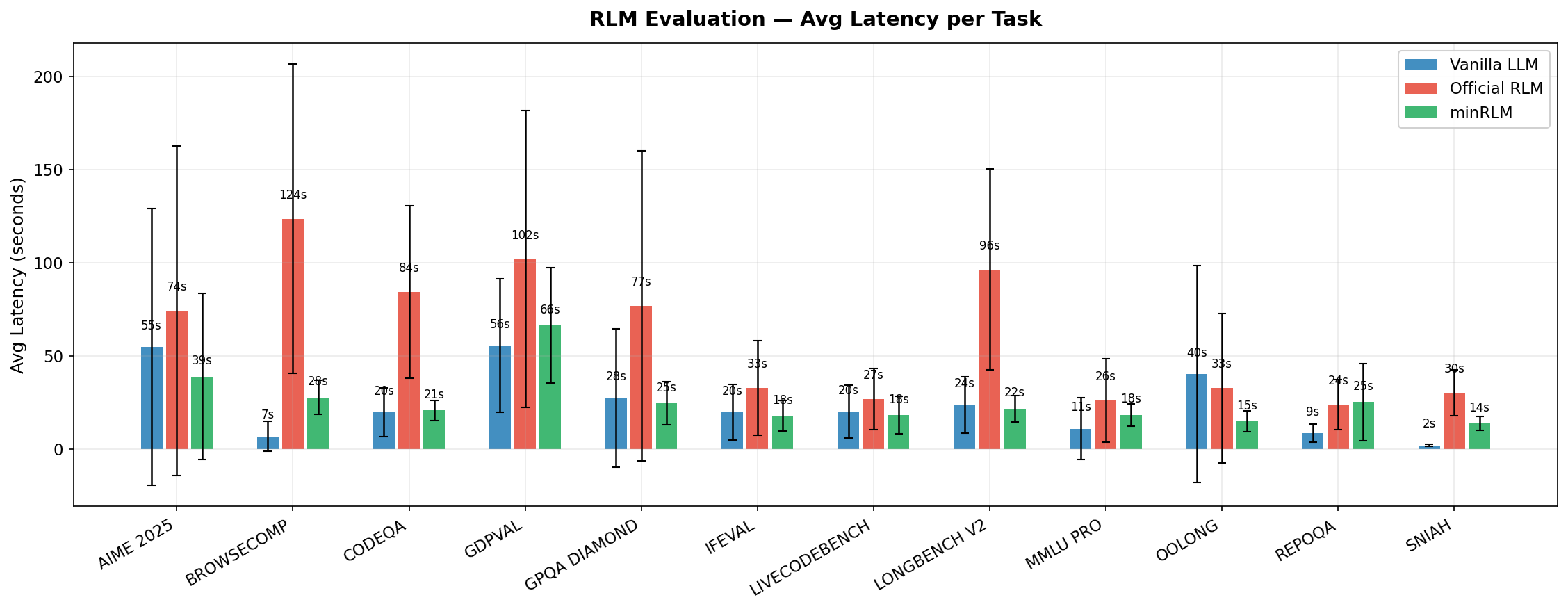
Average latency. Official RLM's multi-round prompt accumulation adds 3× overhead vs minRLM.
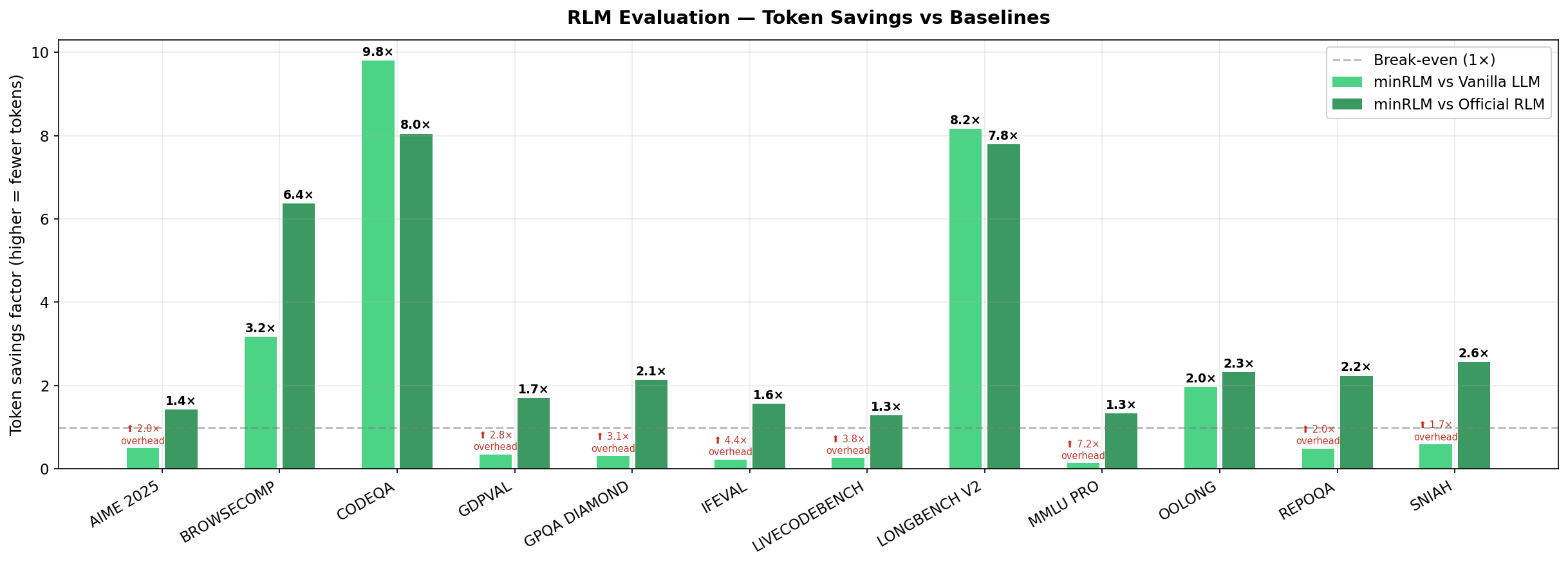
Token savings factor of minRLM vs Vanilla and Official. Higher is better. Negative means minRLM uses more tokens (GDP Val, AIME).
| Task | minRLM | Vanilla | Official | Tokens vs Vanilla | Tokens vs Official |
|---|---|---|---|---|---|
| BrowseComp | 62% | 16% | 66% | 3.2× fewer | 6.4× fewer |
| SNIAH | 94% | 100% | 76% | minRLM uses ~1.7× more | 2.6× fewer |
| RepoQA | 62% | 98% | 96% | minRLM uses ~2× more | 2.2× fewer |
| LongBench V2 | 46% | 56% | 48% | 8.2× fewer | 7.8× fewer |
| CodeQA | 40% | 46% | 38% | 9.8× fewer | 8.0× fewer |
| OOLONG | 92% | 78% | 80% | 2.0× fewer | 2.3× fewer |
| GDP Val | 86% | 54% | 50% | minRLM uses ~2.8× more | 1.7× fewer |
| AIME 2025 | 74% | 88% | 84% | minRLM uses ~2× more | 1.4× fewer |
| GPQA Diamond | 70% | 66% | 74% | minRLM uses ~3.1× more | 2.1× fewer |
| MMLU Pro | 82% | 90% | 86% | minRLM uses ~7.2× more | 1.3× fewer |
| IFEval | 84% | 78% | 78% | minRLM uses ~4.4× more | 1.6× fewer |
| LiveCodeBench | 80% | 64% | 60% | minRLM uses ~3.8× more | 1.3× fewer |
| Overall | 72.7% | 69.5% | 69.7% | 2.6× fewer | 3.6× fewer |
50 runs per task per runner (1,800 evaluations total). GPT-5-nano and GPT-5.2 results below.
Model Scaling GPT-5-nano & GPT-5.2
Same 12 tasks, same prompts, different models. The advantage grows with capability - but not uniformly.
Scaling trend
| Model | minRLM | Vanilla | Δ | Tasks won by minRLM |
|---|---|---|---|---|
| GPT-5-nano (small) | 53.7% | 63.2% | −9.5 | 4 of 12 |
| GPT-5-mini (mid) | 72.7% | 69.5% | +3.2 | 7 of 12 |
| GPT-5.2 (frontier) | 78.2% | 48.2% | +30.0 | 11 of 12 |
The REPL isn't a crutch for weak models - it's a lever that better models pull harder.
GPT-5-nano (small model)
1,800 evaluations (50 per task × 12 tasks × 3 runners).
| Runner | Accuracy | Avg Tokens | Cost | Cost Efficiency |
|---|---|---|---|---|
| minRLM (reasoning) | 53.7% | 13,810 | $0.74 | 1.56× |
| vanilla GPT-5-nano | 63.2% | 18,136 | $1.16 | 1.00× |
| official RLM | 43.3% | 27,174 | $2.68 | 0.43× |
Vanilla wins overall, but the per-task breakdown shows where RLM helps a smaller model most:
Where RLM helps nano
| Task | minRLM | Vanilla | Δ |
|---|---|---|---|
| GDP Val (open-ended) | 82% | 60% | +22 |
| BrowseComp (multi-hop) | 36% | 14% | +22 |
| CodeQA (code reasoning) | 38% | 28% | +10 |
| OOLONG (structured data) | 76% | 70% | +6 |
Where vanilla nano wins
| Task | minRLM | Vanilla | Δ |
|---|---|---|---|
| RepoQA (code retrieval) | 14% | 96% | −82 |
| LiveCodeBench (code gen) | 2% | 36% | −34 |
| SNIAH (needle-in-haystack) | 90% | 100% | −10 |
| AIME 2025 (math) | 76% | 86% | −10 |
| MMLU Pro (knowledge) | 80% | 92% | −12 |
Takeaway: RLM helps small models on structured decomposition (BrowseComp, GDP Val, CodeQA, OOLONG). But nano can't write correct Python for code-heavy tasks, so the REPL hurts there. Still beats official scaffolding at 3.6× lower cost.
GPT-5.2 (frontier model)
1,200 evaluations (50 per task × 12 tasks × 2 runners).
| Runner | Accuracy | Avg Tokens | Avg Latency | Total Cost |
|---|---|---|---|---|
| minRLM | 78.2% | 8,095 | 20.4s | $18.93 |
| vanilla GPT-5.2 | 48.2% | 14,196 | 8.0s | $16.50 |
Per-task breakdown:
Per-task: minRLM vs vanilla on GPT-5.2
| Task | minRLM | Vanilla | Δ |
|---|---|---|---|
| AIME 2025 (math) | 96% | 0% | +96 |
| BrowseComp (multi-hop) | 72% | 14% | +58 |
| CodeQA (code reasoning) | 56% | 20% | +36 |
| OOLONG (structured data) | 96% | 64% | +32 |
| GPQA Diamond (science MCQ) | 76% | 46% | +30 |
| LiveCodeBench (code gen) | 66% | 42% | +24 |
| GDP Val (open-ended) | 74% | 50% | +24 |
| LongBench V2 (long doc) | 44% | 26% | +18 |
| MMLU Pro (knowledge) | 92% | 76% | +16 |
| IFEval (instruction) | 82% | 76% | +6 |
| SNIAH (needle) | 100% | 100% | 0 |
Where vanilla GPT-5.2 wins
| Task | minRLM | Vanilla | Δ |
|---|---|---|---|
| RepoQA (code retrieval) | 84% | 98% | −14 |
Takeaway: The AIME result is wild - vanilla scores 0% while minRLM scores 96%. Why? The vanilla runner is a plain API call with no chain-of-thought prompting. GPT-5.2 outputs 4 tokens (just a number) and moves on - no reasoning, just a guess. The REPL forces the model to actually compute the answer via code instead. RepoQA remains the one consistent weak spot across all models.
Limitations & When Not to Use It
- Pure reasoning with no data - model-dependent. On smaller models, the REPL adds overhead on tasks like AIME and MMLU Pro. On larger models this flips - the REPL becomes a calculator, not just a retriever. When in doubt, skip the REPL for pure-reasoning tasks on smaller models.
- Short contexts (<8K tokens) - if everything fits in the prompt, a direct call is simpler and about as good. The advantage grows with context size.
- Code retrieval (RepoQA) - the one task where vanilla wins across all model sizes. The model sometimes generates code instead of extracting it. Biggest gap to close.
- Stdlib-only sandbox - Python 3.14, no third-party packages.
math,itertools,statistics,collections- but nonumpy,pandas, orrequests.
Discussion
Fewer tokens means lower cost, lower latency, and higher throughput. Because minRLM's token cost is roughly flat - independent of input size - a 10MB document costs about the same as a 10KB one to process.
The failures matter as much as the wins. RepoQA is the one task where vanilla wins on every model size I tested - the model sometimes generates code instead of extracting it. Pure-reasoning tasks (AIME, MMLU Pro) hurt on small models but flip on larger ones. The pattern is consistent: stronger models use the REPL to compute, not just retrieve.
Right now, most companies optimize for making AI work at all cost. Saturate the context window, throw compute at it until accuracy clears a threshold. That works for demos. It doesn't work when you're paying per token at scale and your p99 latency is blowing SLAs. I think this will shift - not because people suddenly care about efficiency, but because the economics will force it. It's already starting: Anthropic's web search tool writes code to filter results, MCP standardizes code execution access, smolagents and @realmcore_'s work go further. They all converge on the same idea: let the model use code to work with data instead of attending to all of it.
Architectures are getting more efficient too - hybrid models like NVIDIA's Nemotron mix SSM layers with attention. But even with better architectures, most input tokens are irrelevant to the query. RLMs work at a different level: reduce what any architecture has to process. Feed the model only the relevant part.
Conclusion
The results speak for themselves - check the tables above. What I find more interesting than the numbers: every intermediate step is Python code, not hidden attention patterns. When a query fails, I can read the generated code and see exactly which search missed, which filter was too strict, which assumption was wrong. That's something you can't do with a vanilla LLM call. It's not full explainability - but it's a real step toward it. RLM outputs are Software 1.0: deterministic, testable, reproducible.
Context window rot is real (Liu et al., 2024) - model accuracy degrades as input grows, even when the answer is right there. Bigger windows aren't the fix. Less input, better targeted is. This is open-source because I think it should be. I welcome everyone to contribute and adopt this where it makes sense. Our goal is to help enable efficient AI adoption at scale - memory and compute friendly, on the tasks that matter.
Future work
- More models - Claude Opus 4.6, Gemini 2.5, open-weight models. I want to see if the scaling trend holds across providers, not just OpenAI.
- Agentic pipelines - using the RLM pattern as a retrieval step inside multi-step agent workflows.
- More tasks - expanding the benchmark to stress-test edge cases and domains where the approach might break.
Code & Reproduction
CLI (zero-install)
# Just a task - no context needed
uvx minrlm "What is the sum of the first 100 primes?"

# Task + file as context
uvx minrlm "How many ERROR lines in the last hour?" ./server.log

# Pipe context from stdin
cat huge_dataset.csv | uvx minrlm "Which product had the highest return rate?"

# Show generated code (-s) and token stats (-v)
uvx minrlm -sv "Return the sum of all primes up to 1,000,000."
# -> Sieve of Eratosthenes in 6,215 tokens, 1 iteration
# -> Answer: 37550402023

uvx minrlm -sv "Return all primes up to 1,000,000, reversed. Return a list of numbers."
# -> 999983, 999979, 999961, 999959, 999953, ...
# -> Tokens: 6,258 | Output: 616,964 chars (~154K tokens) | 25x savings
Python
from minrlm import RLM

client = RLM(model="gpt-5-mini")

answer = client.completion(
    task="Which product had the highest return rate in Q3?",
    context=open("q3_returns.csv").read()  # could be 50MB
)

answer = client.completion(
    task="Find all race conditions in this codebase",
    context=codebase_str
)
Visualizer
# Interactive side-by-side comparison UI (minRLM vs vanilla)
git clone https://github.com/avilum/minrlm && cd minrlm
uv sync --extra visualizer
uv run python examples/visualizer.py  # http://localhost:7860
Reproduce the benchmark
uv sync --extra eval
export OPENAI_API_KEY="sk-..."

# All 12 tasks, all 3 runners, 50 runs
uv run python eval/run.py \
  --tasks all \
  --runners minrlm-reasoning,vanilla,official \
  --runs 50 --parallel 12 --task-parallel 12 \
  --output-dir ./my_results
Client, benchmark framework, and all evaluation data: github.com/avilum/minrlm
Primary benchmark on GPT-5-mini; cross-model results on GPT-5-nano and GPT-5.2. Code samples lightly abridged; full source at github.com/avilum/minrlm.
References
- minRLM - Lumelsky, A. (2026). minRLM: A Token-Efficient Recursive Language Model Implementation and Benchmark. github.com/avilum/minrlm
- Zhang, A., Kraska, T., & Khattab, O. (2025). Recursive Language Models. arXiv:2512.24601
- Zhang, A. (2025). RLM - Reference Implementation. github.com/alexzhang13/rlm
- Hugging Face (2024). smolagents - Code-as-Action Agents. huggingface.co/blog/smolagents
- Anthropic (2026). Improved Web Search with Dynamic Filtering. claude.com/blog/improved-web-search-with-dynamic-filtering
- Reddit/ClaudeAI (2025). Claude Web Search Now Writes & Executes Code. reddit.com/r/ClaudeAI/comments/1r7xawn
- Willison, S. (2025). Code Execution with MCP. simonwillison.net/2025/Nov/4/code-execution-with-mcp
- Universal Tool Calling Protocol. github.com/universal-tool-calling-protocol
- Luo, H. et al. (2025). Context Window Rot in Long-Context LLMs. arXiv:2509.21361
- Liu, N. F. et al. (2024). Lost in the Middle: How Language Models Use Long Contexts. arXiv:2404.02060
- Reddit/LocalLLaMA (2025). Why AI Coding Agents Waste Half Their Context. reddit.com/r/LocalLLaMA/comments/1rr5fo5
- de Harder, H. (2025). Going Beyond the Context Window: Recursive Language Models in Action. towardsdatascience.com
- Prime Intellect (2025). Scaling Recursive Language Models. primeintellect.ai/blog/rlm
- @realmcore_ (2025). Building an RLM for Coding Tasks. x.com/realmcore_
- NVIDIA (2026). Nemotron-3-Super-120B-A12B. huggingface.co/nvidia/NVIDIA-Nemotron-3-Super-120B-A12B-NVFP4
- Model Context Protocol. modelcontextprotocol.io
- Yao, S. et al. (2022). ReAct: Synergizing Reasoning and Acting in Language Models. arXiv:2210.03629
Datasets
- BrowseComp-Plus. Tevatron/browsecomp-plus
- RULER (SNIAH). tonychenxyz/ruler-full
- RepoQA. evalplus/repoqa_release
- LongBench V2. zai-org/LongBench-v2
- OOLONG. oolongbench/oolong-synth
- AIME 2025. MathArena/aime_2025
- GDP Val. openai/gdpval
- GPQA Diamond. Idavidrein/gpqa
- MMLU Pro. TIGER-Lab/MMLU-Pro
- IFEval. google/IFEval
- LiveCodeBench. livecodebench.github.io