


Call it organics’ dirty little secret. Most consumers would probably assume that if a wine – like fruit or vegetables – is certified organic, that means the grapes in it are grown without synthetic chemicals. Yet organic and biodynamic grape growers are allowed to spray copper sulphate and sulphur on their grapes to protect again fungal diseases. This bothers some growers, organic and otherwise – especially the copper, a heavy metal. But what to do about it? The common European vine, Vitis vinifera, is particular prone to powdery and downy mildew and to botrytis. And without any treatment, growers risking losing most or all of their crop.
Enter the new breed of supergrapes, or “PiWi” varieties as they are known (from the German Pilzwiderstandsfähig, “fungus-resistant”). These are hybrid grapes with selective breeding to incorporate resistance genes found in American, non-vinifera grapes into European Vitis vinifera vines. The breakthroughs of the past 20 years, mostly in Germany and Switzerland, have been especially in creating vines with resistance to fungal diseases. It is a long process that can take 15 years or more.
The new grapes also often have higher yields and ripen earlier – or, for instance, have better resistance to cold. Doug Wregg, of leading natural wine importer Les Caves de Pyrene, sells some wines made in Vermont by cult producer La Garagista from PiWi grapes developed to resist the cold of the American North. Meanwhile in Europe, hardy PiWi grapes can be planted in places such as Scandinavia or damper parts of England. Thus Solaris, one of the first white PiWis, has become a mainstay of the fledgling Danish and Swedish wine industries over the past 20 years. And over 3,500 hectares of PiWi varieties are planted in Germany – around 3.5 per cent of German vineyards.
But why stop with plantings in cool and wet climates? Fungal diseases affect vines across the world. So organic-certified winemaker Vincent Pugibet has for almost 20 years now been planting PiWi grapes at Domaine La Colombette, near Béziers, in the Languedoc. He was first grower to plant them in France, in 2007, and today has the country’s largest such plantings, at 170ha – more than two thirds of his vineyards. He says that most of the 40-odd PiWi varieties he has planted need spraying only two to three times a year to protect against mildew, and that he has not sprayed his Souvignier Gris vines for 15 years.
“For me, selection for resistance is working very well,” says Pugibet, the fifth generation of his family to make wine on this domaine. “We can’t imagine planting Chardonnay and the rest now – it’s not the future.” Chardonnay is particularly prone to mildew. Pugibet also thinks it’s better to have different grapes ripening at different times, part of a strategy aimed at growing a greater diversity of grapes as a way of dealing with climate change. Other growers appear to agree: “I don’t know one winemaker around me who doesn’t have at least some Piwi plantings,” adds Pugibet.
At Le Carezze, a winery in Italy’s Veneto region, Alihan Eksel reports similar changes. At this organic-certified vineyard they first planted PiWi grapes in 2017 and now have six hectares. “Our use of fungicides has been drastically reduced, allowing for a vineyard management approach that is almost entirely free from chemical treatments,” says Eksel.
“The main nurseries supplying them can’t keep up with demand,” says wine journalist and viticulture expert Jamie Goode. ““I think they have a really bright future. Their environmental credentials are unquestioned.” This is because while the pesticide savings implied by PiWi grapes are hard to quantify, they are certainly large. For a start, fungicides amount to around 90 per cent of all the pesticides used in vineyards. In France alone, vignerons spray an estimated 12,000 tonnes of pesticides each year, a disproportionate fifth or so or the total used by all French farmers (even though vineyards make up only about three per cent of French agricultural land).
And in damp, rainy years like 2024 in Northern France and England, mildews run wild – requiring even more spray treatments. In a normal, dry year in the Languedoc, growers might get away with half a dozen sprayings. In 2024 in Burgundy or Sussex, that’s more like 15 or 16: because copper and sulphur are “contact” chemicals, they just stay on the leaves and are washed off the next time it rains.
“These wet summers [like 2024] make it very challenging,” Simon Roberts, winemaker at Ridgeview in Sussex, told me last year. “It’s difficult spraying every two weeks when the ground is so wet.” It’s also damaging to the land: every pass made by a tractor further compacts the soil.
So PiWi grapes might sound like a no-brainer – except it’s more complicated than that. For a start, in France especially there are strict rules around which grapes can be grown in which appellations. White PiWi variety Voltis has been approved for experimental use in Champagne, one of the heaviest French regional users of fungicides. But as yet, growers can plant no more than five per cent of their vineyards with the grape: nearly nine hectares were harvested in total last year. Some are planted in fields next to residential areas, where pesticide spray drift can be a controversial issue.
In the local Languedoc appellations, says Pugibet, PiWis are permitted in a number of IGP designations (previously known as Vin de Pays ). Wine there can be labelled Chardonnay if it is made up of at least 85 per cent of the grape, while the balance can be PiWis. “We’re working to change the regulations,” he says. “Not everyone is happy, but it’s moving along.”
The other sticking point with PiWi grapes is, simply, quality: is the wine any good? “In terms of quality, so far the jury is out,” says Wregg, “but the Vermont wines are something special.” The ones that I’ve tried have been mixed, though even in the past year or so, the standard seems to be improving. I have found the white PiWi grape Voltis especially promising.
Even with decent quality wines, winemakers still have the challenge of persuading consumers to switch to unfamiliar new grapes. Some get around this by using blends of conventional grapes and PiWis labelled, say, “Grenache et cépages résistants”. “The market is evolving,” says Le Carezze’s Eksel. “Consumers are increasingly open to and appreciative of these wines.”
“The market isn’t completely ready but we can move the market,” argues Pugibet. The wines’ sustainability credentials should be an advantage – though he admits that it can be tricky explaining the difference between organic and PiWi to consumers, since they assume that organic wine doesn’t involve chemicals.
But as with wine packaging, it’s also a question of horses for courses. For a fresh, easy-drinking wine, a bottle – or box – or Voltis or Vidoc will do the trick for many consumers. They’re not particularly complex and certainly not made for ageing – but they’re pleasant and, given that over 90 per cent of wine sold in the UK is consumed within 48 hours of purchase, ageability isn’t an issue for most drinkers anyway.
And as PiWis advance, the wines may well improve. “I think they are perfect for more commercial, easy-drinking wines, but they do have the potential to make fine wines,” says Goode. “I’ve tried some very interesting examples that are a bit more ambitious. Give them a bit of vine age and some more care in terms of viticulture and winemaking, and we might be in for some surprises.”
Les Malandes “Victorious” 2024, Vin de France – made from organic Voltis grapes, this is the first wine made from this variety to be sold in the UK. Crisp, fresh, bright and fruity with a slightly spicy edge – very enjoyable (Laithwaites, £16.99).
La Colombette Cabernet Blanc 2024, Vin de France – made by Vincent Pugibet from organic grapes, this is crisp and bright with more roundness to it and slightly sweeter fruit than the Voltis. Pleasant. The same producer’s Cabernet Noir 2023 red isn’t at all bad either: fresh, notes of green pepper and vanilla (both Vintage Roots, £13.75 and £13.99 respectively).
Tesco Finest Floreal 2023, Vin de France – launched last year, this was the first wine from a PiWi grape in a major UK store. Made from grapes grown in the Languedoc and the Loire, which reportedly needed 90 per cent fewer fungal treatments than conventional grapes. Fresh, bright apple and citrus fruit, and only 11 per cent alcohol. Pleasant enough although I got a slight vegetal note (Tesco, £8).
Waitrose Vidoc 2023, IGP Atlantique – from the Tutiac co-op in Bordeaux’s Côtes de Bourg, this is a convincing claret: fresh, plummy fruit and soft tannins. Very decent (Waitrose, £9.50).
My new book with Jane Masters MW, Rooted in Change: The Stories Behind Sustainable Wine, explores pesticide use and the alternatives to it in winemaking in greater detail.

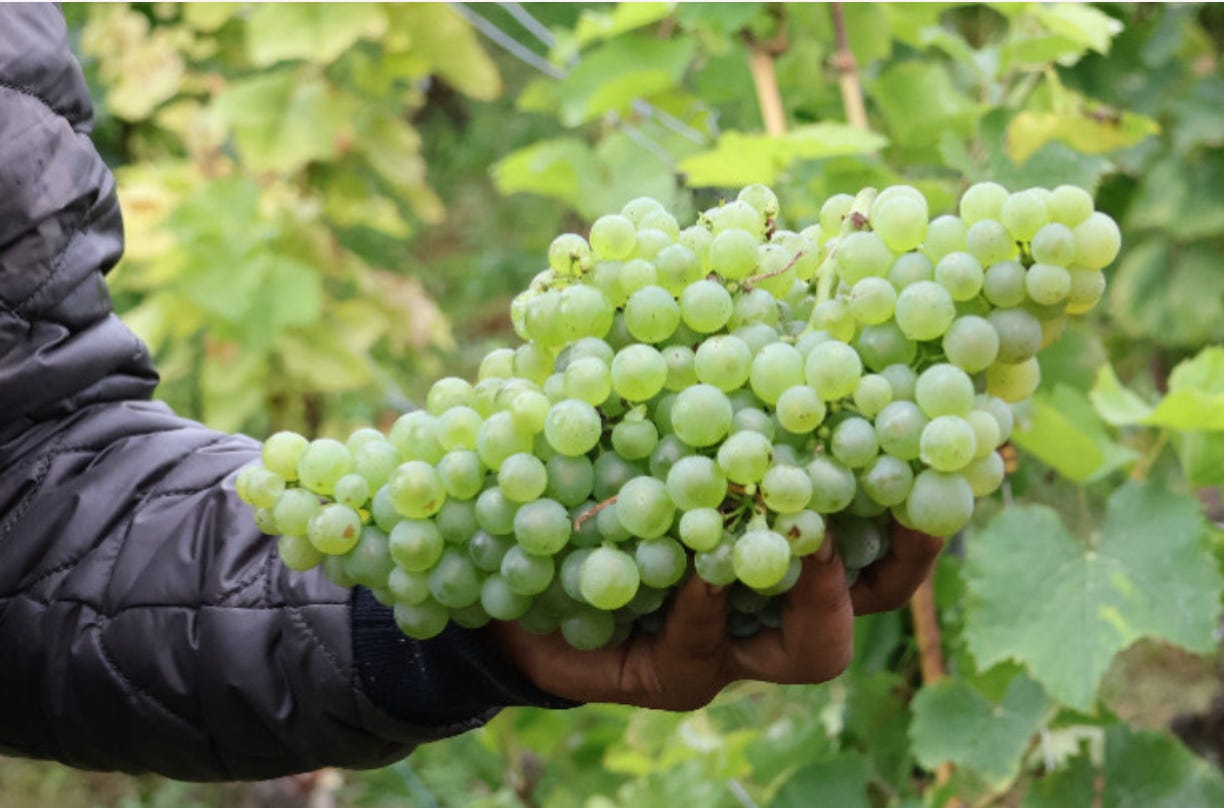
Brave new harvest: an impressive bunch of Voltis grapes, Champagne
Domaine de la Noblaie “Le Temps des Cerises” 2024, Chinon – I revisited this old favourite last week at the Charles Sydney Wines Loire tasting, where winemaker Jérôme Billard was in attendance. An early pioneer of organics – when he converted in 2005, he told me, “nobody around me was interested in organics” – his reds have a wonderful purity and joyous, bright red fruit. Classic Chinon and very good value (The Wine Society, £12.95.)
Terra Remota “Camino” 2019, Empordà – wines from Empordà, in northern Catalonia, are less common here than some other Catalan appellations but they’re worth seeking out. This red is organic and boasts gorgeous fresh cherry fruit with a bit of depth from its bottle age: really good (I drank by the glass at 67 Pall Mall; Wine & Earth has bottles of the 2022 at £27.)
Sergio Arcuri “Più Vite” 2018, Cirò Riserva - Gaglioppo is a red Calabrian grape sometimes compared to Nebbiolo for its elegance and tannins, though I admit I’d never quite got the comparison until tasting this one. This is a serious example of it from Cirò, on the western lower side of the Italian “boot”: quite pale, firm tannins, intense yet so fragrant and elegant (I drank by the glass at Tappo Enoteca, Notting Hill; bottles at The Whisky Exchange, Woodwinters, Symposium and elsewhere, from £38.35.)
Check out the new edition of my podcast with my friend and Daily Telegraph wine critic, Victoria Moore, Get Yourself a Glass, where we chew over Dry January and ask, is there a crisis in wine? Includes a live tasting of no- and low-alcohol drinks – and some surprising facts about French hospital drinking. Listen on Spotify, Apple or wherever you get your podcasts.
Transparency declaration: the PiWi wines I tasted were all free samples.