Last post we left a robot with a problem it could not see its way out of. A welding seam is almost never exactly where the drawing says it is. Steel bends as it heats, two stamped parts never line up the same way twice, and a robot blindly tracing its programmed path will lay a flawless weld a couple of millimeters off the joint. Flawless, and useless. So how does a welding robot find a joint it cannot perfectly see? If you have ever try to fix the TV wall mount or assemble IKEA furniture, you know what I mean here.
The answer is one of the most elegant tricks in all of manufacturing, and it has been quietly running on factory floors for forty years. The welding arc, the same fierce little ball of plasma the robot is using to melt metal together, is also the robot’s sense of touch. The machine feels its way along the seam using the weld itself.
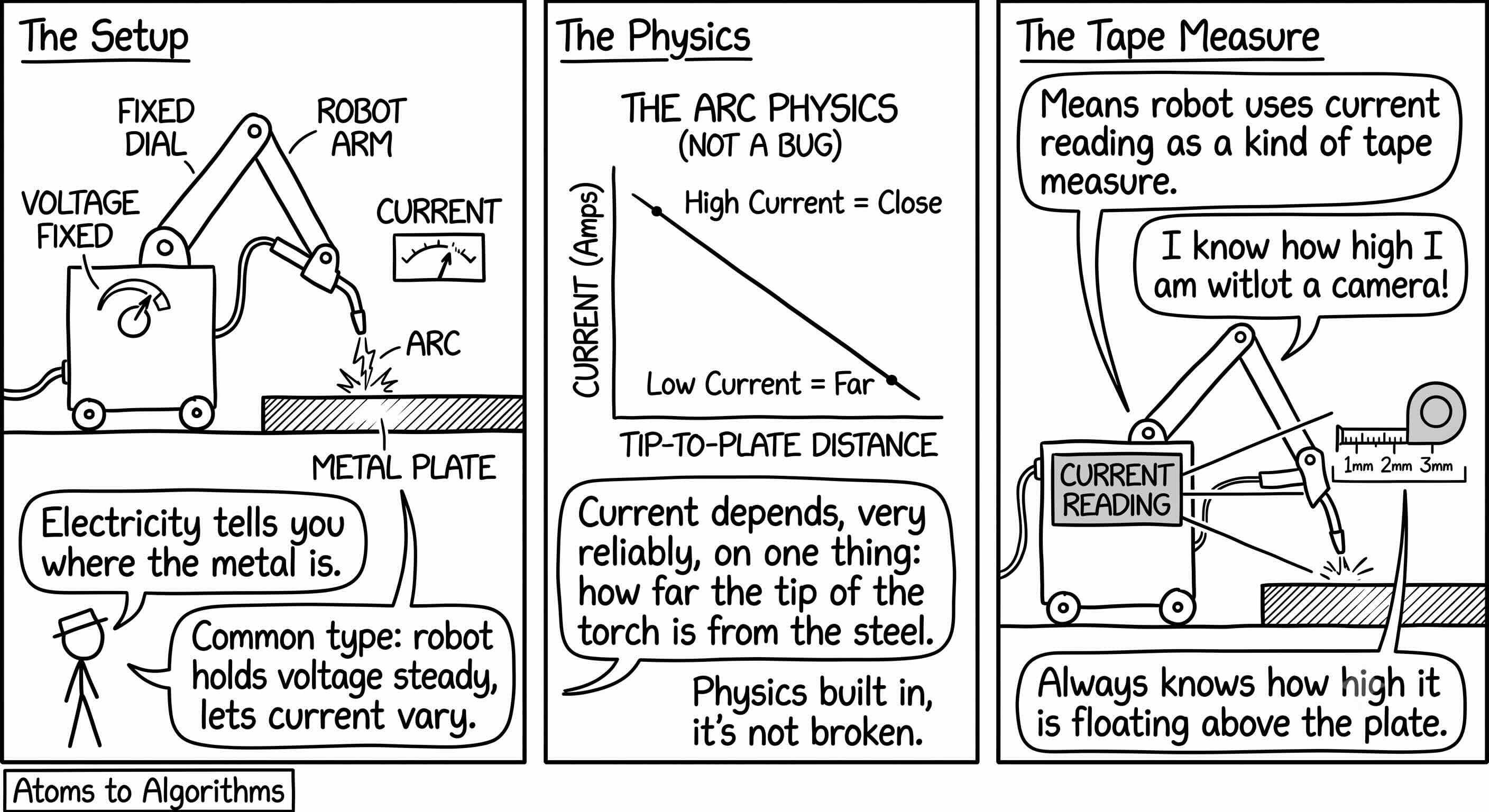
Start with a fact about welding most people never notice: the electricity tells you where the metal is. In the common type of robotic welding, the machine holds the voltage steady and lets the current vary. And the current depends, very reliably, on one thing: how far the tip of the torch is from the steel. Hold the torch close and the current runs high. Pull it back and the current drops. That is not a bug; it is built into the physics of the arc. Which means the robot can use the current reading as a kind of tape measure. Without any camera, the machine always knows how high it is floating above the plate.
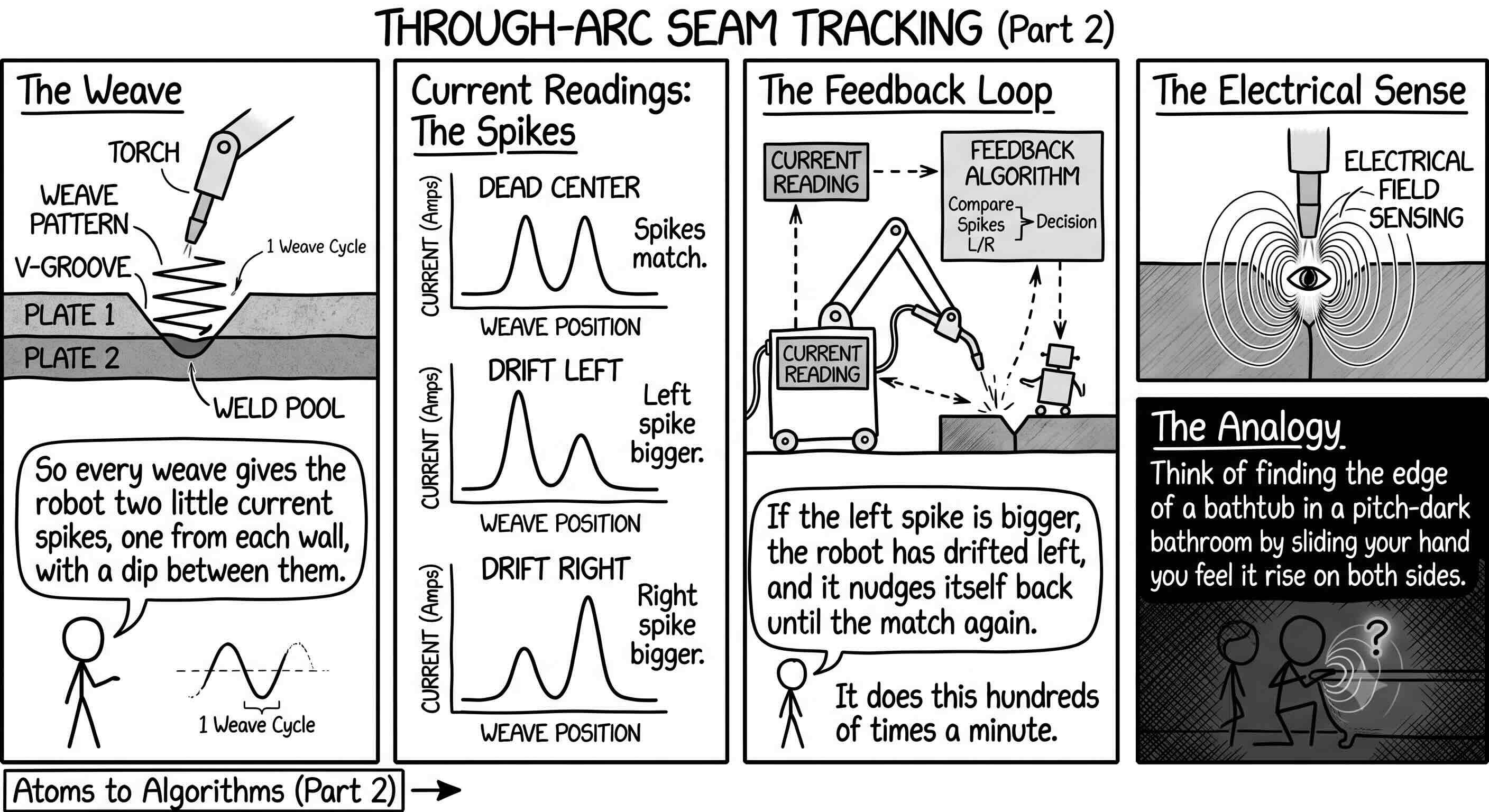
That solves the up-and-down problem. The clever part solves the side-to-side one. As the robot welds, it does not push the torch in a straight line. It weaves, swinging the torch gently left and right across the joint, a few small wiggles every second, like a painter feathering a brushstroke. Now watch what the current does during one of those wiggles. As the torch swings toward the left wall of the joint, it gets closer to metal, so the current spikes. As it swings to the right wall, the current spikes again. In the middle of the joint, where the gap is deepest and the metal is farthest away, the current sags.
So every weave gives the robot two little current spikes, one from each wall, with a dip between them. If those two spikes are the same size, the torch is dead center in the joint. If the left spike is bigger than the right, the robot has drifted left, and it nudges itself back until the two match again. It does this hundreds of times a minute, the entire length of the weld. The robot is centering itself in a groove it never looks at, purely by feeling both walls through the electricity in the arc. Engineers call it through-arc seam tracking. Think of finding the edge of a bathtub in a pitch-dark bathroom by sliding your hand until you feel it rise on both sides.
Like every good trick, it has honest limits, and they explain why welding is still considered a hard, specialist robot job rather than a solved one. The arc can only sense once it is lit, so the robot needs another method, a gentle touch or a camera, just to find the start of the joint before the first spark. It needs walls to feel against, so it works beautifully on the corner and groove joints that have them and poorly on flat seams that do not. And it gets confused when the arc itself gets messy, when sparks fly or the weld spatters. That is why the newest systems are not throwing the arc-sense away. They are stacking eyes on top of it: cameras and learned models that find the joint before welding starts and double-check the bead afterward, while the arc keeps doing what it does best in the middle.
A welding robot that walks to the job. Path Robotics put its welding “physical AI” onto a four-legged robot called Rove, so instead of bringing a giant ship hull to a welding cell, the robot walks over to the hull. A shipbuilder in Louisiana is among the first to try it. The interesting part is the quiet shift underneath: the valuable thing is no longer the welding arm, it is the intelligence deciding where to weld. (AI Insider)
Teaching a robot to see a weld in the dark. A 2026 research paper tackled a brutal case, welding inside a vacuum where glare and shadow blind ordinary cameras, and trained a model to spot the seam anyway, fast enough to keep up with the work. It is the camera-based partner to the arc-sensing trick. (Sensors journal)
Judging the weld, not just following it. Other new work focuses on spotting flaws in a finished weld, the obvious next step after staying on the seam: deciding whether the bead you just laid is actually any good. (arXiv)
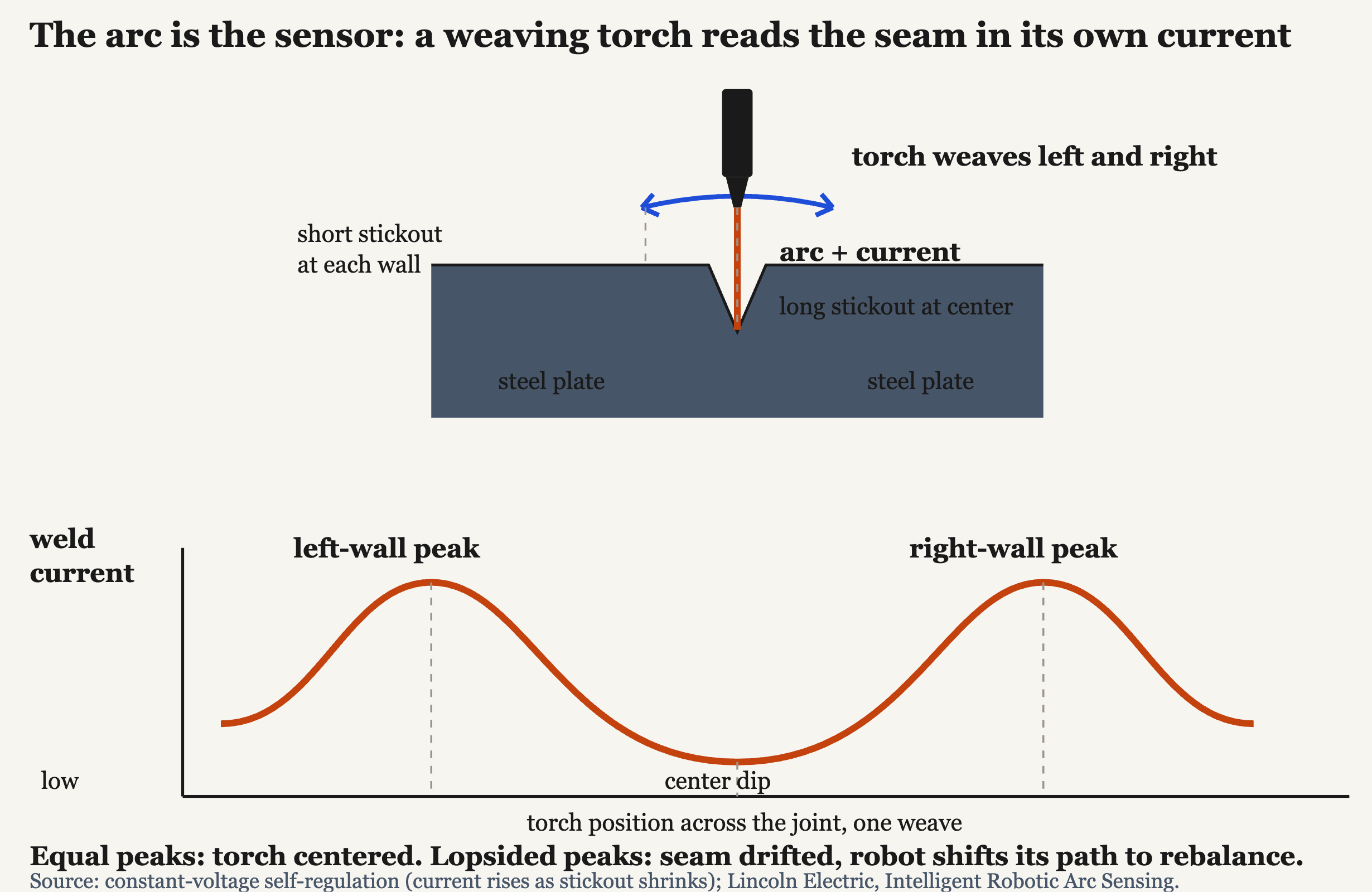
Above visual explanation is the whole idea in one glance: a torch weaving across a joint, and below it the wiggling line of electrical current that weave produces. Two humps, one for each wall of the joint, with a valley in between. When the two humps are even, the robot is centered. When one grows and the other shrinks, the seam has wandered, and the robot quietly steers back. That single wavy line is the entire sensor. There is no eye in this system, only a current meter and a robot patient enough to feel both walls a few times a second.
It is worth sitting with why this job, of all jobs, got automated first and still resists being finished. Welding is in desperate need of hands: the American Welding Society expects the United States to be short roughly 360,000 welding professionals by 2027, with the average welder now around 55 years old. The demand is overwhelming and the work is genuinely hard to do well. The arc-sense trick was good enough to automate the repetitive, well-fixtured welds decades ago. What is left is the messy stuff: the joint that is bent, the part that cannot be moved, the field weld in a shipyard. That is exactly the territory the new walking, seeing, learning welders are walking into. Which raises tomorrow’s question, and it is not about the arm or the software at all. The single component that decided whether a country could build its own welding robots, cheaply, was a small, fiendishly precise gearbox. Why was that one part the last domino to fall, and what happened when China finally learned to machine it? The more I read about it, it feels same as shortage at other places where physical work is required. We are already seeing currently how its playing out for electricians, plumbers and few other job profile with data center book and infrastructure build out overall in United States.
—
Subscribe for tomorrow’s read, we’re walking the robotics supply chain from atoms to algorithms, one weekday at a time.
Sources: Intelligent Robotic Arc Sensing (Lincoln Electric) · Seam tracking with arc sensing (Scientific Reports) · Vision-based seam tracking (Ain Shams Engineering Journal) · Weld recognition in electron-beam welding (Sensors 2026) · Path Robotics launches Rove (AI Insider) · Welding Workforce Data (AWS)