Last post, we watched a welding robot feel its way along a seam using nothing but the electricity in its own arc. I promised that the part that really decided who could build that robot wasn't the arm. It was a gearbox about the size of a hockey puck. For roughly two decades, a Chinese factory could make almost every other piece of an industrial robot itself and still had to import this one component from Japan, sometimes waiting months for it to arrive.


That is a strange thing to be true. The design of the part is not secret. The patents lapsed long ago. You can find its shape in century-old textbooks. And yet it was the single hardest thing in the whole machine to actually make, and the entire Chinese robot industry was stuck behind it.
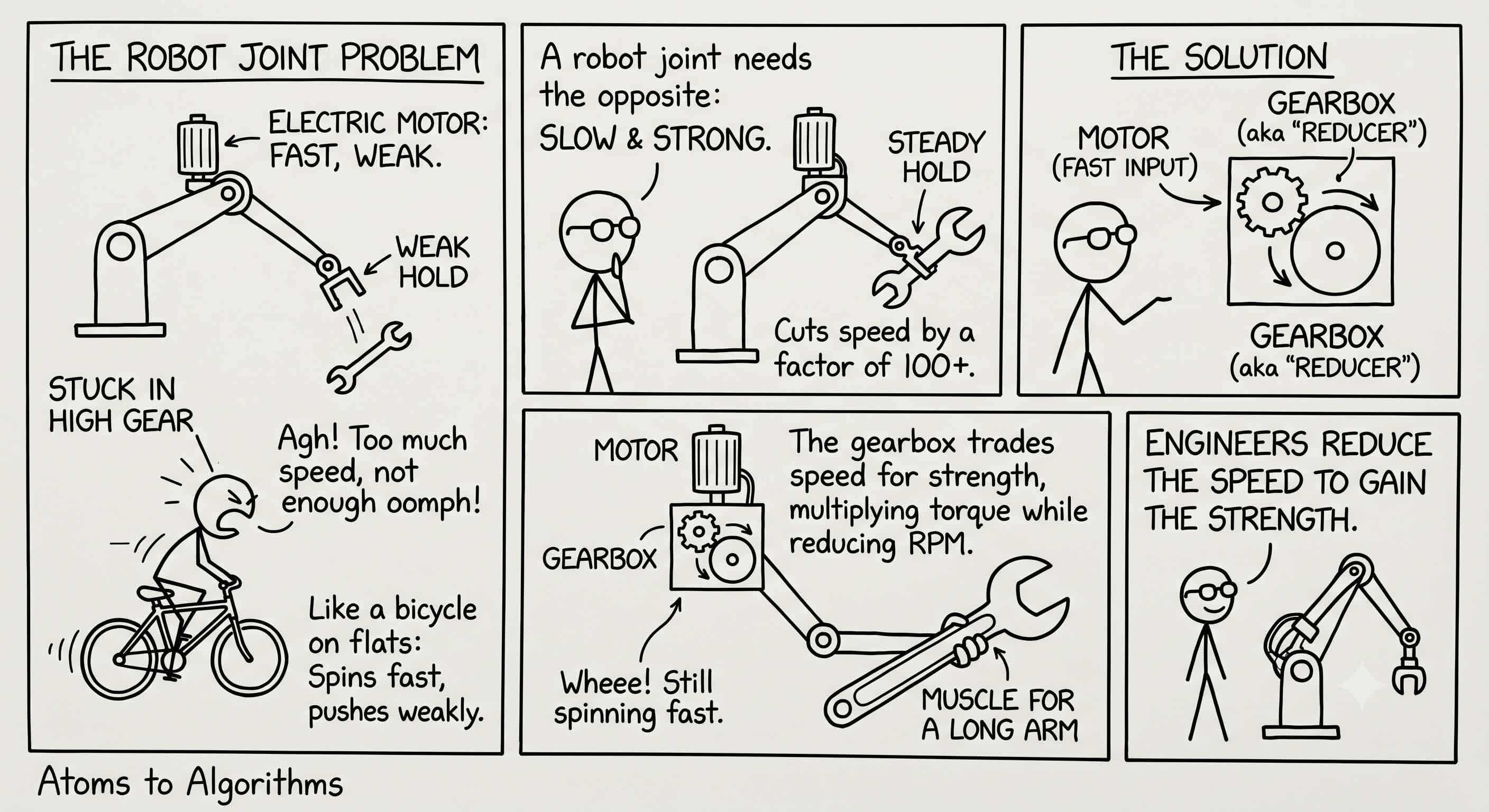
Start with the problem every robot joint has to solve. The electric motor inside it spins fast and pushes weakly, like a bicycle in its highest gear on a flat road. A robot joint needs the opposite: slow and strong, enough muscle to hold a heavy tool steady at the end of a long arm. So you put a gearbox between the motor and the joint to trade speed for strength. Engineers call it a reducer, because it reduces the speed, and in a robot it might cut the speed by a factor of a hundred or more while multiplying the force by the same amount.
The kind that goes in the big joints, the shoulder and elbow that carry the whole arm, is called an RV reducer, and the heart of it is genuinely beautiful. Imagine a disc shaped like a flower with shallow petals, set slightly off-center, wobbling inside a ring of steel pins. As the disc wobbles, its petals roll around the inside of the ring, the way a coin rolls around the inside of a slightly larger hoop. With every full wobble, the disc creeps forward by exactly one pin. That one-pin-per-turn crawl is how you get an enormous gear reduction inside a part you can hold in your palm. And because dozens of teeth are pressed together at once, the thing can take a beating without breaking.
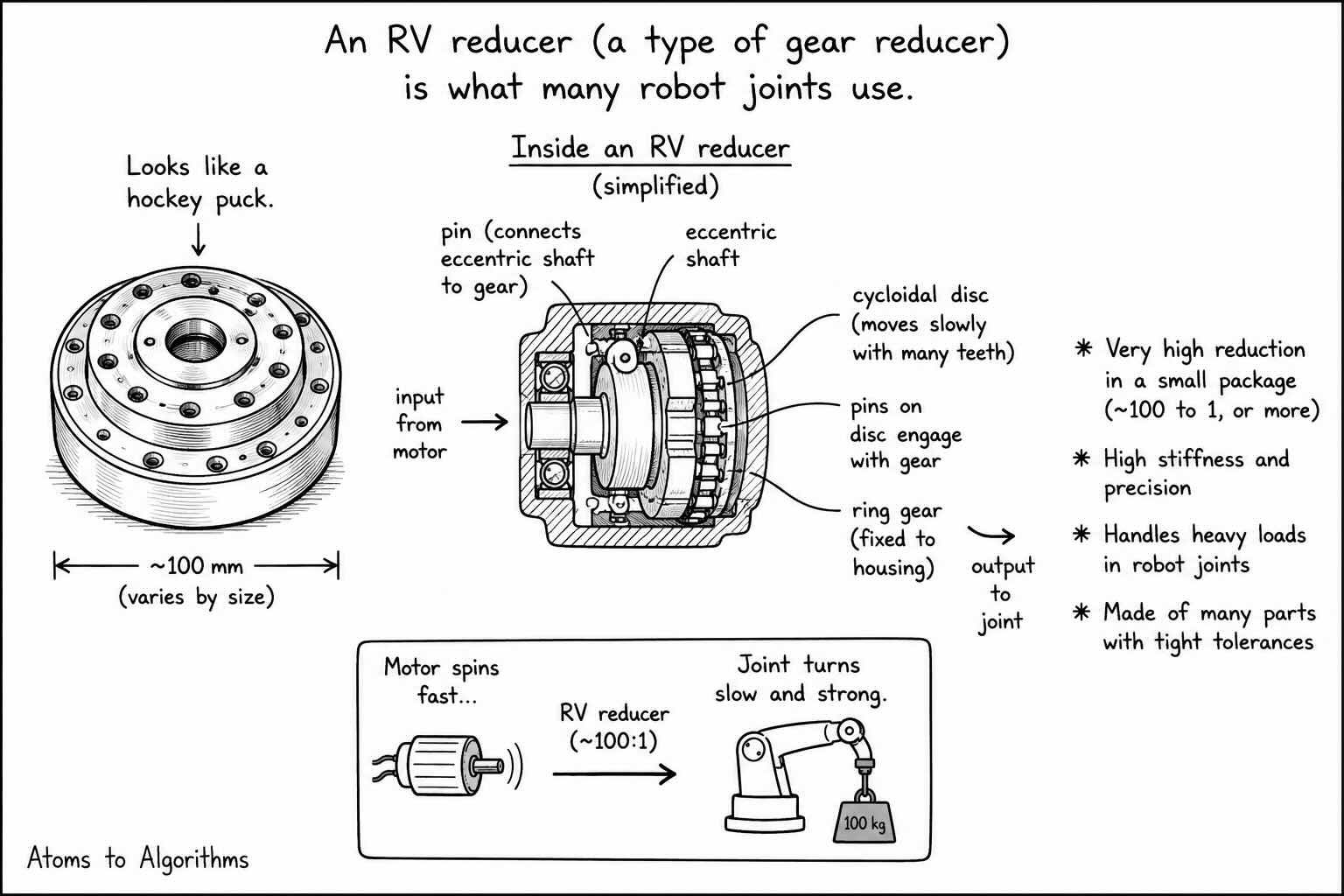
(just a reminder every RV reducer is gearbox, but not every gearbox is RV reducer)
Here is the part that matters most, and the reason this gearbox is so hard to make. When any gear changes direction, there is a tiny moment of dead slack before the teeth catch again. You can feel it in a loose bicycle chain or an old door handle. Engineers call it backlash, and in a robot that slack turns straight into wobble and positioning error. A good RV reducer keeps that slack down to about one-sixtieth of a degree, even while carrying a load. For something like welding, that is the difference between landing exactly on the joint and landing two millimeters off, which means a perfect-looking weld in the wrong place.
So why could China copy the arm, the motor, and the software, but not this? Because the hard part was never the drawing. The flower-shaped disc has to be ground to a tolerance of a single micron, a fraction of the width of a human hair, and then heat-treated so it does not warp, with every matching part held to the same standard. Get the curve a hair wrong and the gearbox hums, wears out early, and slowly loses its precision. Japan’s makers were not guarding a blueprint. They were guarding decades of hard-won skill in grinding, metal treatment, and measurement, the kind of knowledge that does not come with a license. A Chinese rival could copy the shape in a weekend and still ship a part that buzzed. It is wild that how Japan came up with this and maintained a moat for so long.
What finally changed is quiet and recent: the precision caught up. Chinese reducer makers crossed the line where their parts were good enough, and the country’s engineers started publishing the deep math of why these gearboxes misbehave, which is the very knowledge that used to live only on a Japanese factory floor. Once you can predict the wobble, you can design it out or correct for it. The moat was never really the gear. It was understanding the gear.
A robot arm may have a motor that spins at 3,000–6,000 RPM. Without a reducer, it would be like trying to hold a heavy hammer at arm's length while your muscles can only move very fast but with little force. The RV reducer transforms:
Motor:
5000 RPM
1 Nm torque
↓ RV reducer (~100:1)
Robot joint:
50 RPM
~100 Nm torque
This tiny "hockey-puck-sized" component became a strategic technology because manufacturing it requires micron-level machining, perfect heat treatment, and long-life precision bearings. For decades, companies like Harmonic Drive Systems (for harmonic drives) and Nabtesco Corporation (for RV reducers) dominated this capability, which is why many robot manufacturers around the world relied on them.
The secret math, published in the open. A 2026 paper from a Chinese rail-technology institute and a Chinese university released a software toolkit that models exactly how these precision gearboxes flex, slip, and vibrate, accurately enough to predict and correct their errors. That modeling ability, not the shape of the gear, was the real bottleneck, and now it is in a public paper. (research paper)
The other gearbox is minting billionaires. A lighter cousin of this gearbox, used in robot wrists and humanoids, is now made in China at scale too. The founders of the country’s largest maker have become billionaires this year as humanoid-robot demand surged, a sign the second Japanese stronghold is falling the same way the first did. (VnExpress)
Chinese gearboxes are going global. Reducers from Chinese makers are now reported inside Tesla’s Optimus and Unitree humanoids, and have entered the supply chain of ABB, one of the big four Western robot makers. The part China once had to import is starting to be the part China exports. (reducer market overview)
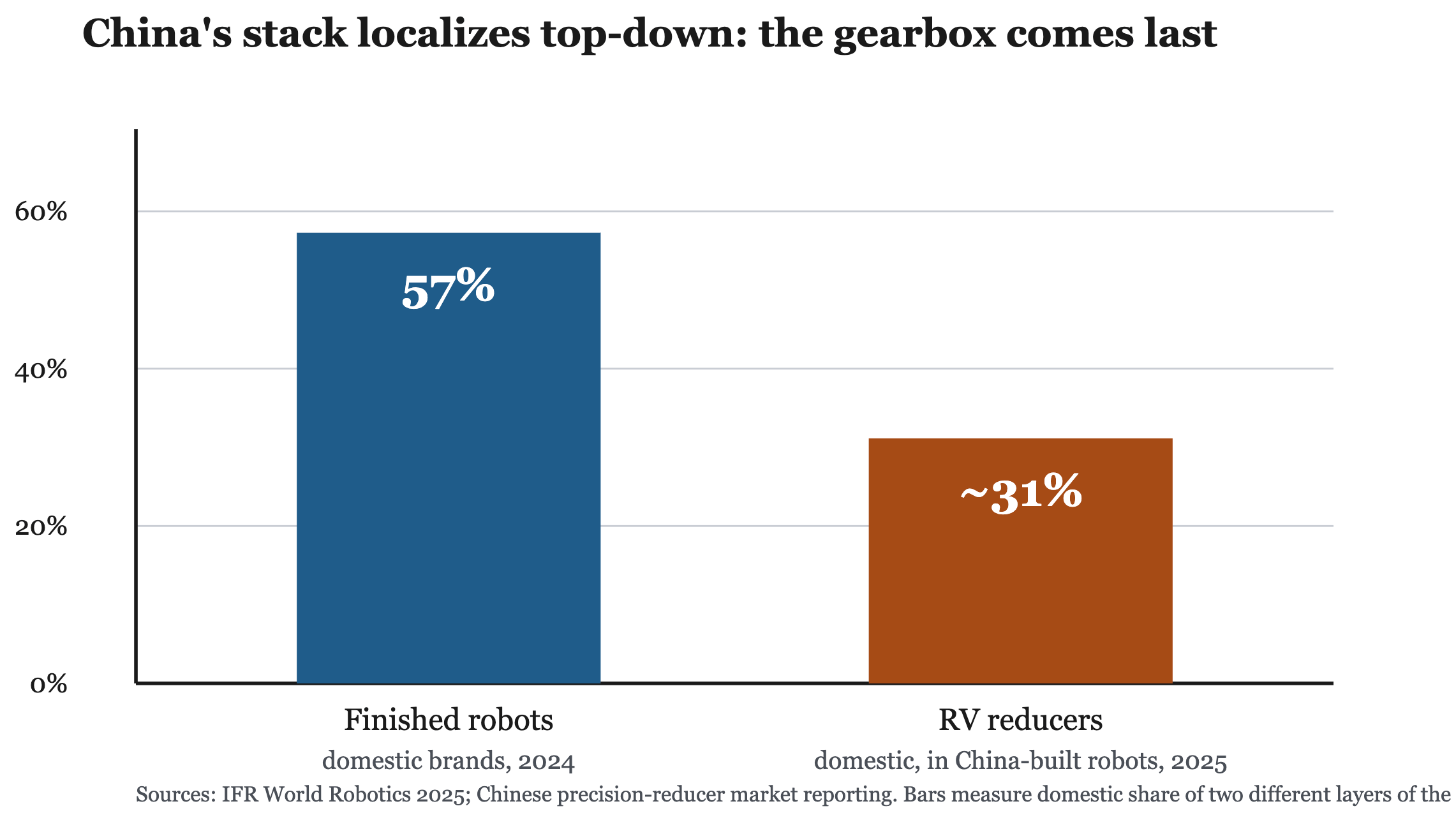
Today’s picture holds the whole week in two bars. The tall one is the share of industrial robots sold in China in 2024 that were Chinese brands: 57 percent, up from around 28 percent ten years earlier. The short one is the share of these precision gearboxes inside those China-built robots that were also Chinese-made by 2025: still only a bit above 30 percent. That gap is the lesson. A country can learn to assemble the robot, write its software, and put its own badge on the side long before it can grind the one tiny part buried in the joint. The deepest layer of the machine is always the last to come home.
Which sets up a genuine puzzle for Monday, and it flips everything we just said on its head. We spent all week treating a high-power gearbox as the prize, the harder the reduction the better. But the engineers building four-legged robots that run and jump over rough ground do the exact opposite. They deliberately use almost no gearing at all, and they have a good reason. Why would anyone building a robot that has to feel the ground throw away the very gearbox the rest of the industry fought twenty years to make?
Subscribe for tomorrow’s read, we’re walking the robotics supply chain from atoms to algorithms, one weekday at a time.
Sources: Precision-reducer dynamics toolkit (arXiv) · China leads global robot installations (IFR) · China tops 2 million factory robots (IFR) · Leaderdrive founders become billionaires (VnExpress) · Harmonic vs RV reducers (EVS) · China robotics overview (CSIS ChinaPower)