Last week we ended underneath a factory robot, at a gearbox the whole Chinese industry spent two decades learning to build: a hundred-to-one reducer that turns a fast, weak motor into a joint stiff enough to hold a car door steady without flinching. This week the robots leave the factory and learn to walk, and the first thing they do is throw that gearbox away.
Press your hand against the leg of a running robot dog and it gives a little, then pushes back, a bit like a real animal’s leg. Press the elbow of a factory arm and nothing moves at all. They use the same kind of motor and the same idea of a gearbox. They just make the opposite choice about how much gearing to use, and that one decision changes what the machine can do.
A gearbox does a simple trade. Spin a small motor fast and weakly on one side, and a gear ratio turns it into something slow and strong on the other. A hundred-to-one gear makes the motor a hundred times stronger at the joint. That is why factory arms use big ratios: they need to hold heavy tools in exact positions and ignore everything around them.
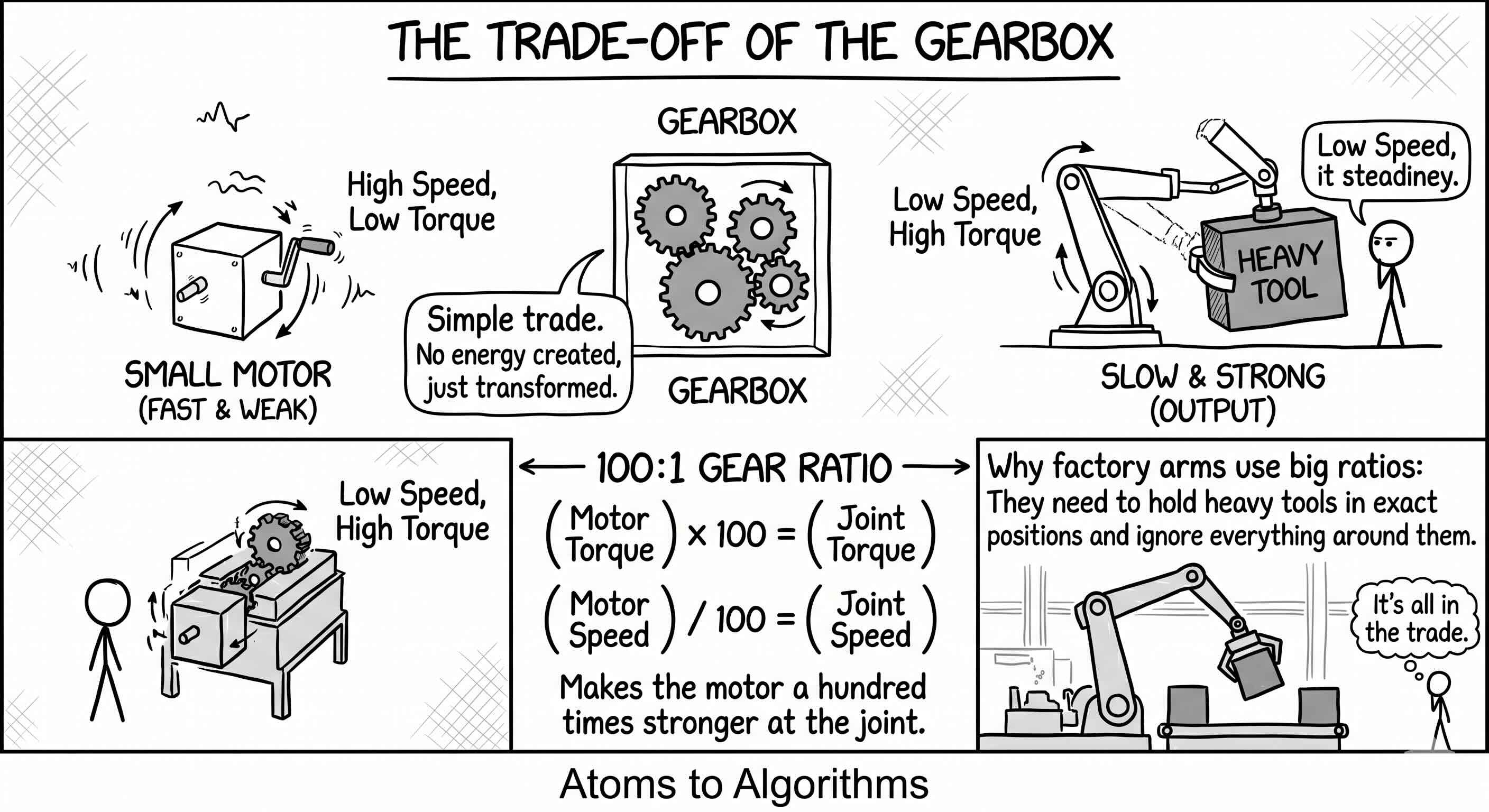
But a big gear ratio has a hidden cost, and it is the reason walking robots avoid it. Gearing does not just multiply strength. It also multiplies how heavy the motor’s own spinning core feels when something tries to move the joint from the outside, and it does that by the square of the ratio. So a hundred-to-one gear that makes the motor a hundred times stronger also makes its little spinning core feel ten thousand times heavier at the joint. A six-to-one gear makes it feel only about thirty-six times heavier.
That difference is everything. A joint with a big gear ratio is strong but sealed off from the world. You cannot push it back by hand, because your push has to overcome that ten-thousand-fold heaviness plus the friction of all those gear teeth. Engineers call such a joint not backdrivable, and a factory arm wants exactly that. It meant to do those type of tasks compared to humanoid household ones in development at various labs.
A leg wants the reverse, for a concrete reason. When a running robot’s foot hits the ground, that impact has to go somewhere. In a high-ratio joint it slams into the gear teeth as a sharp shock, which is how gearboxes break. In a low-ratio joint, the leg yields slightly, the motor spins backward a touch, and the impact drains away as motion instead of damage. The MIT Cheetah team showed years ago that a barely-geared leg could take hard foot strikes, with ground contact lasting under a tenth of a second and forces above 450 newtons, without any separate shock absorber.
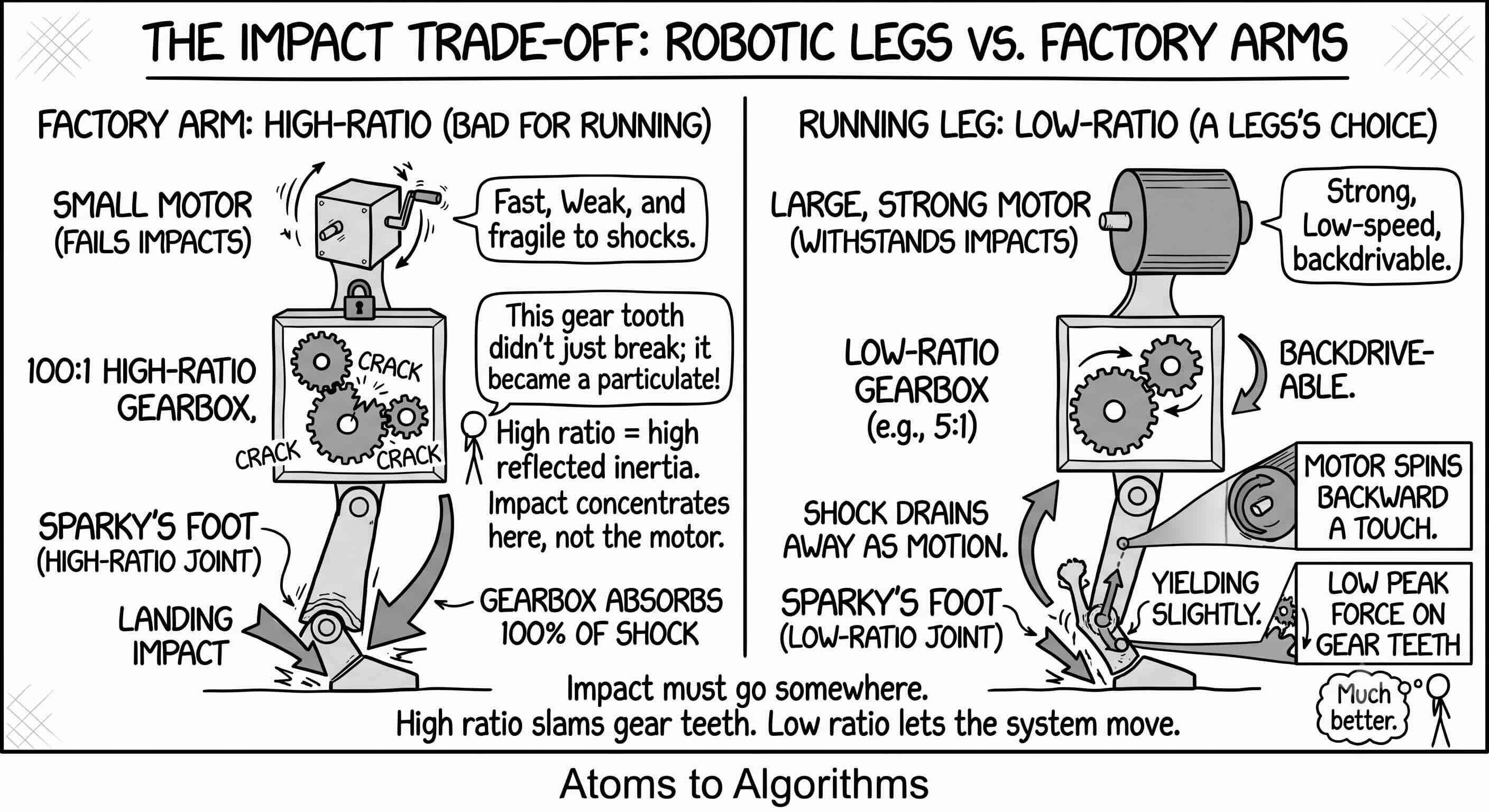
This lightly-geared approach is called quasi-direct drive, and it comes with a bonus. Because the joint is so open to the outside world, the electric current flowing through the motor becomes a direct readout of the force at the foot. The robot can feel the ground through the very same motor that moves it, with no extra force sensor bolted on. That is what people mean when they say these robots are sensitive enough to feel terrain through their legs.
None of this is free. A barely-geared joint needs a much bigger, more powerful motor to make the same strength the hard way, and it wastes energy holding a heavy pose, because it has to keep pushing current just to stand still where a big gear would simply lock in place. So this is not “low gearing is better.” It is low gearing for machines that take surprise impacts and need to feel contact, big gearing for machines that hold heavy loads all day.
There is even a middle path, and the two most famous robot dogs split on it. Boston Dynamics and Unitree went the lightly-geared way. ETH Zurich’s ANYmal kept the big gear but added a real spring inside each joint to soak up impacts, reading force from how far the spring bends. Both are sensible answers to a problem the factory arm never faced: how to meet a ground you did not get to design. The durability of this type of mechanism in long run is another thing all together.
A commercial robot dog puts numbers on the choice. Unitree’s new As2, shown in early 2026, is an 18 kg machine with joints rated near 90 newton-meters of force, able to carry around 65 kg while standing and move at roughly walking-to-jogging speed. It is a clean look at what these lightly-geared, magnet-heavy joints deliver in a product you can actually buy. (Unitree As2)

The heavy end answers with fluid instead of gears. Researchers this year taught a hydraulic four-legged robot weighing over 300 kg to walk by training it against a careful model of its own actuators. It marks the far edge of the design space: when a machine has to be very strong, hydraulics still beat electric motors, and getting the actuator model right is the hard part either way. (research paper)
Last post’s gearbox, redesigned to feel. A design study takes the same cycloidal gear family that gated China’s factory robots and rebuilds it to stay sensitive and pushable, adding software that estimates force from the motor. It is the direct sequel to last Friday: the same gear, tuned for feel instead of stiffness. (research paper)
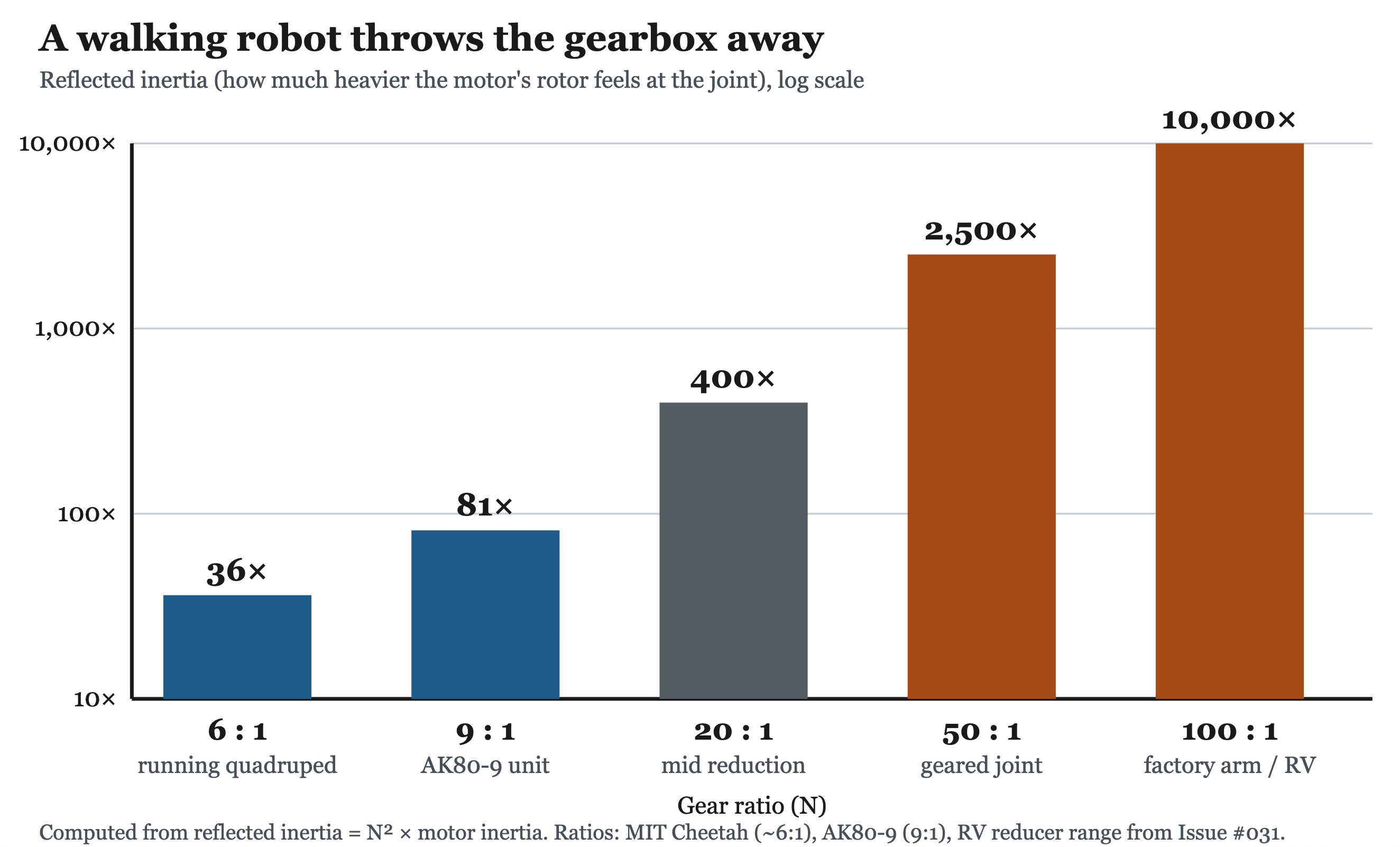
Above plot shows the one number that splits the whole field. As the gear ratio climbs, the amount by which gearing makes the motor’s own core feel heavier at the joint rises as the square of that ratio. At a robot dog’s six-to-one it is about 36. At the factory arm’s hundred-to-one it is ten thousand. The gap is the lesson: the same gearing that makes an industrial joint strong and unmovable is exactly what makes it unable to feel anything, and a walking robot trades most of that strength back in order to feel the floor under its feet.
Which raises the question this week has to answer next. If legs are this demanding, needing big motors, careful impact handling, and a constant trickle of energy just to stand, why build legs at all? A wheel rolls for almost free on a flat floor and asks none of this. Tomorrow we put the two side by side and find the exact kind of ground where a leg stops being a luxury and a wheel stops being enough.
Subscribe for tomorrow’s read, we’re walking the robotics supply chain from atoms to algorithms, one weekday at a time.
Sources: MIT Cheetah proprioceptive actuator (IEEE T-RO) · Unitree As2 specifications · Heavy hydraulic quadruped learning (arXiv) · Cycloidal quasi-direct-drive actuators (arXiv) · ETH Zurich actuators, ANYdrive