A humanoid can win a ninety-second demo without being good at anything. Ninety seconds is one folded shirt, one poured cup, and a hard cut before the second attempt. The honest number is the one the stage hides: how long the robot runs before a person has to step in. In May, Figure livestreamed three robots sorting packages for more than twenty-four hours and counted the failures, which is a different kind of claim than a highlight reel. Agility, going public this month, leads with deployment hours rather than a trick. The backflip measures the ceiling. The interval between interventions measures the floor, and the floor is what a customer actually rents.
This week is humanoids, and we start with the hype, because most of the hype is a category error. Every demo answers one question: can it do the thing once. Almost every buyer is asking a different one: will it do the thing for a whole shift, on its own. Those two questions have very different answers, and the space between them is where a lot of the 2026 humanoid excitement lives. Today is that space, measured plainly.
The metric that matters has a plain name: the mean time between interventions, or how long a robot runs before a human has to take over, reset it, or rescue it. Its close cousin is the autonomy rate, the share of tasks the robot finishes with no help at all. A demo is built to show neither. A real shift is made of nothing else.
Put numbers on it. Figure says its robots sort a package in about three seconds, close to a human worker. An eight-hour shift is 28,800 seconds, so call it about 9,600 packages. Now ask how reliable each pick must be to run that shift with nobody stepping in. If it succeeds 99% of the time, it still fails about 96 times in a shift, which is a stoppage every five minutes. At 99.9%, it fails about ten times, once an hour. To get through a whole shift expecting just one stoppage, it has to succeed about 99.99% of the time.
If you have ever heard a website’s reliability described in “nines,” this is the same idea. Each extra nine is a tenfold cut in failures, not a small final polish. The distance from an impressive demo to a paid shift is not “a little better.” It is two or three more nines, and each nine is its own hard project. That is also why a demo and a shift can both be honest. A robot that succeeds 99% of the time looks perfect for ninety seconds and stops a dozen times an hour on the floor.
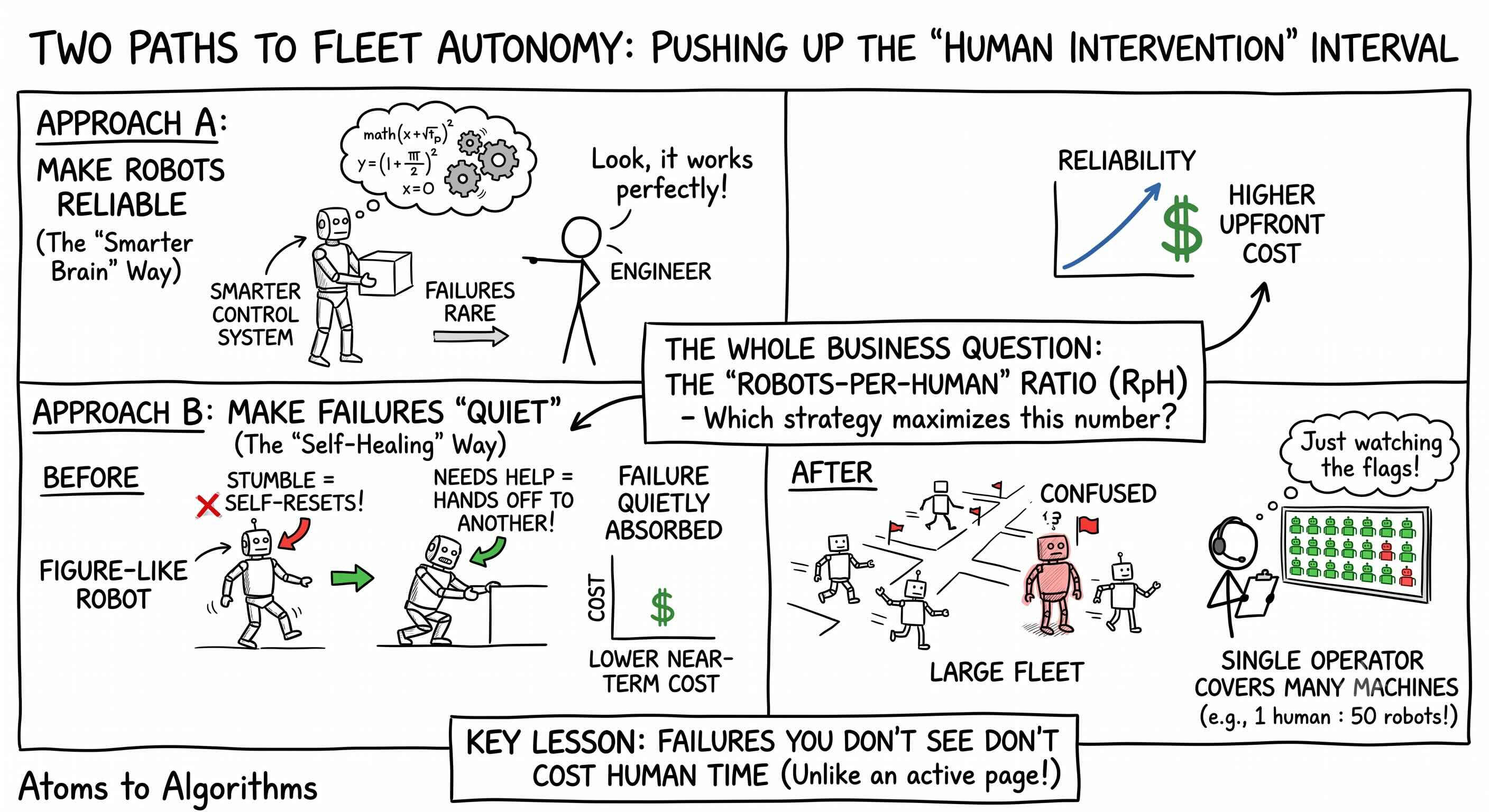
There are two ways to push that interval up, and the big humanoid companies are split between them. One is to make the robot more reliable on each attempt, which means a smarter control system. The other, cheaper in the near term, is to make failures recover themselves so a stumble does not cost a human’s time. When Figure described its long run, the interesting part was not only that the robots rarely failed, but that a robot which got confused reset itself, and one that needed maintenance handed off to another. A failure the fleet quietly absorbs does not cost you the way a failure that pages a person does. Researchers are chasing the same goal: a recent system watches each robot, flags only the ones that drift into trouble, and lets a single operator cover many machines instead of babysitting one. That ratio, how many robots one human can watch, is the whole business question.
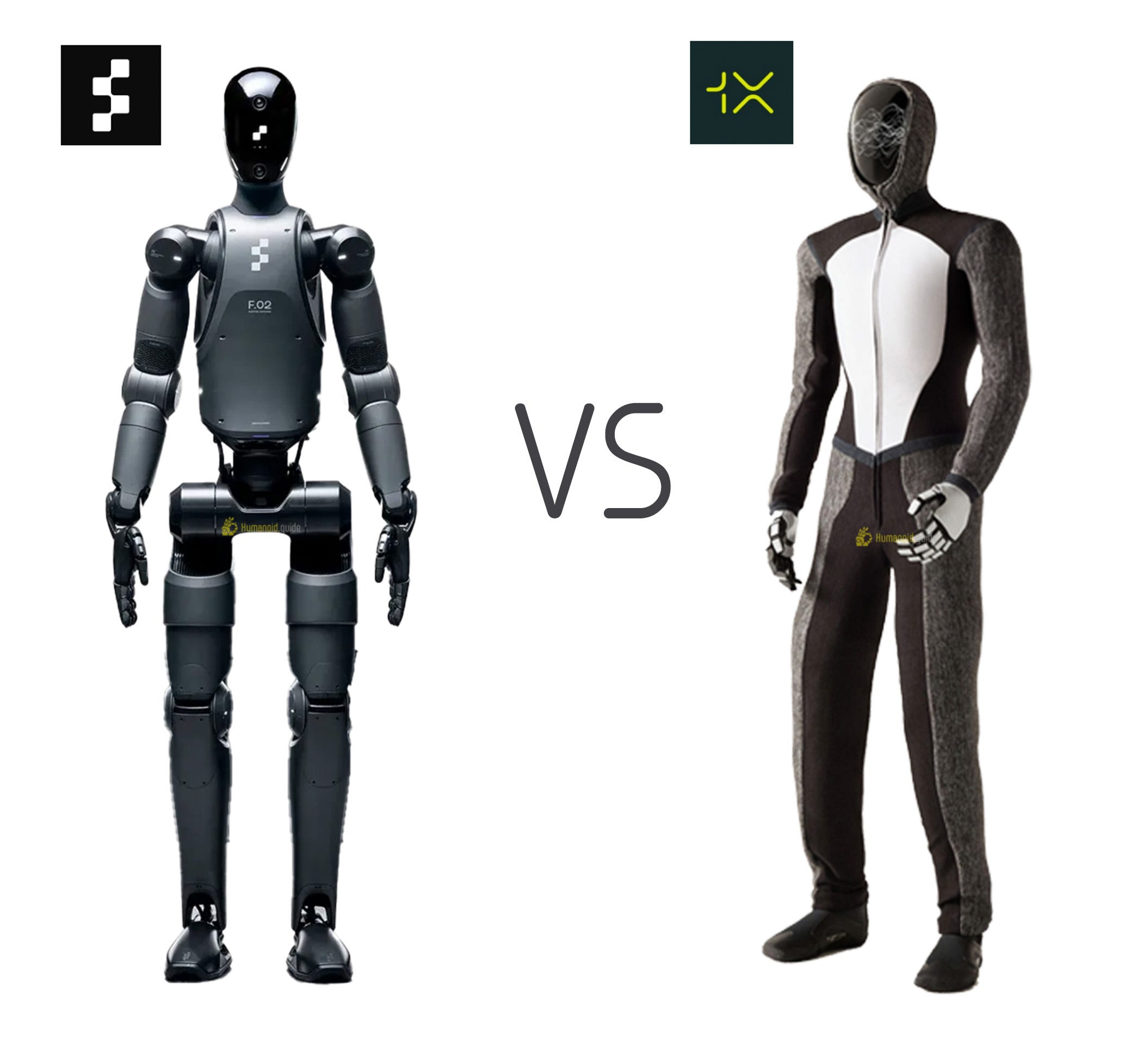
Which is why remote human control, teleoperation, is the thing to watch rather than the thing to hide. 1X is shipping its NEO home robot with a feature that schedules a human operator to guide it through any chore it cannot yet do on its own, finishing the task and collecting training data at the same time. That is a reasonable product, and it sits at the opposite end of the scale from Figure’s package sort. Both can be true, because the tasks are not equal: a warehouse pick under fixed lighting is a far narrower problem than an unscripted kitchen. So when you read that a robot worked “autonomously,” two questions tell you almost everything: what share of the work it really did alone, and how structured the task was. A high share on a narrow task is an honest start; a high share implied on an open task usually means a person in a headset, just out of frame.
Agility Robotics signed a deal to go public on Nasdaq as AGLT, valued near $2.5 billion, the first US company dedicated purely to humanoids. Its case is built on logged work, more than 65,000 operating hours and over 100,000 totes moved at a single site, rather than a flashy demo, though the headline “$300 million in orders” is conditional on milestones and comes from one undisclosed customer. Most of the deals, comes with asterisk, you just have to dig little deeper.
Figure ran three robots sorting more than 28,000 packages over twenty-four straight hours, near human speed, and its CEO said there was no remote control involved and that the robots reset themselves when confused. It is a company demonstration, not an audited test, but it measured the right thing: how long the machine runs before it stops. And 1X opened preorders for its NEO home robot at $20,000, or $499 a month, with a human teleoperator on call for any task NEO has not yet learned, a candid picture of where home humanoids really are today.
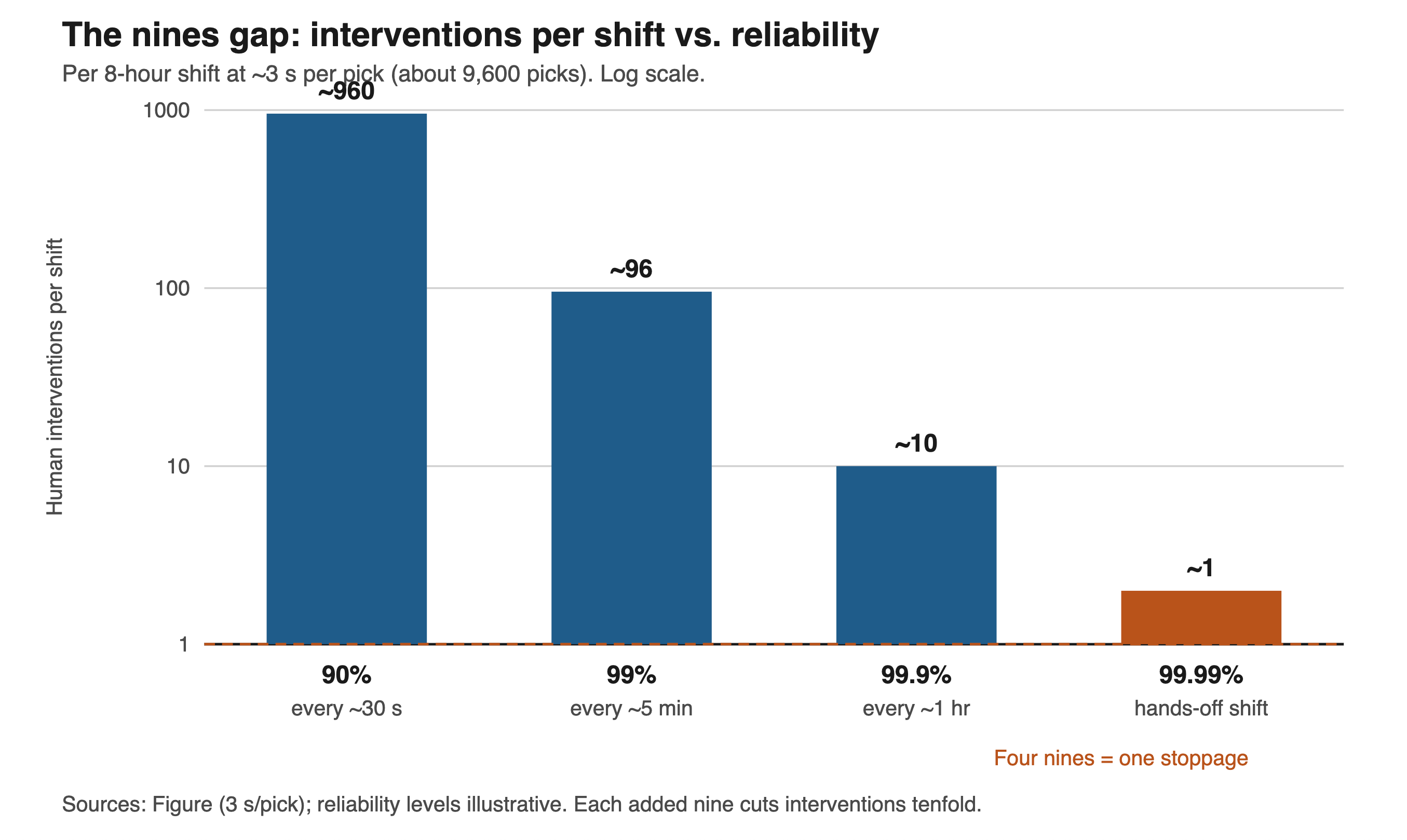
The above visualization plots how many times a human has to step in during an eight-hour shift against how reliable the robot is on each task. The bars drop by a factor of ten with every added nine of reliability: roughly 960 stoppages at 90%, 96 at 99%, ten at 99.9%, and about one at 99.99%. A hands-off shift sits at the far right of that chart, three nines past where a demo that looks flawless actually lives. The scale has to be logarithmic because nothing else makes the gap fit on a page.
So a humanoid can win a demo and still be hours of human help away from a shift. The harder question opens tomorrow, when we stop asking how well the robot works and start asking why it is shaped like us at all. Standing upright on two legs costs motors and computing power every second, just to keep from falling, before the robot does a single useful thing. Is the human shape worth that bill? Tomorrow, the balance tax, and whether a wheeled base quietly wins the same job.
Subscribe for tomorrow’s read, we’re walking the robotics supply chain from atoms to algorithms, one weekday at a time.
Sources:
Agility Robotics Signs SPAC Deal for Nasdaq Debut (Tech Times)
Figure AI humanoids sort 28,000 packages in 24-hour autonomous test (Interesting Engineering)
ARMADA: Autonomous Online Failure Detection and Human Shared Control (arXiv)
NEO humanoid designed for household use, available for preorder (The Robot Report)