In the last post we measured a humanoid by how long it runs before a person has to step in. There is a smaller number sitting underneath that one. When researchers at Duke University told their two-legged robot to hold still, its standard controller did not hold still. It stepped in place, shifting its weight from foot to foot, because a robot balanced on two small feet is never really at rest. It is a tower being caught, many times a second, before it falls. A wheeled robot parked next to it draws almost nothing to stay put. That difference, the power and the motors a two-legged machine spends just staying upright, is what I want to price today, before we credit the human shape with anything it buys.
This week is humanoids, and question on last post was whether a robot can work a full shift without a person rescuing it. Today’s question is more basic: whether the robot should be shaped like us at all. A body with two legs can go where people go, up stairs, over a curb, down a narrow aisle that has no ramp. It pays for that reach every second it is switched on, in energy and in constant balancing effort, whether or not it is getting anything done. Different company are working with different view and domain niche. Lot of floor robots have wheels and more like rolling compared to humanoids getting build for general purpose or some of the factory work.
There are two ways for a machine to stay upright. The first is to be stable on its own. A four-wheeled cart, a table, a tripod: their weight sits over a wide base, so they hold their position with no effort, and a gentle push just makes them settle back. The second way is to be caught continuously. A bicycle only stays up while someone is balancing it; let go and it falls. A walking robot is the bicycle. The only ground holding it up is the small patch under its feet, sometimes just one foot in the middle of a step, and its weight spends most of each step hanging outside that patch. It does not fall because a fast control loop is constantly nudging it back.
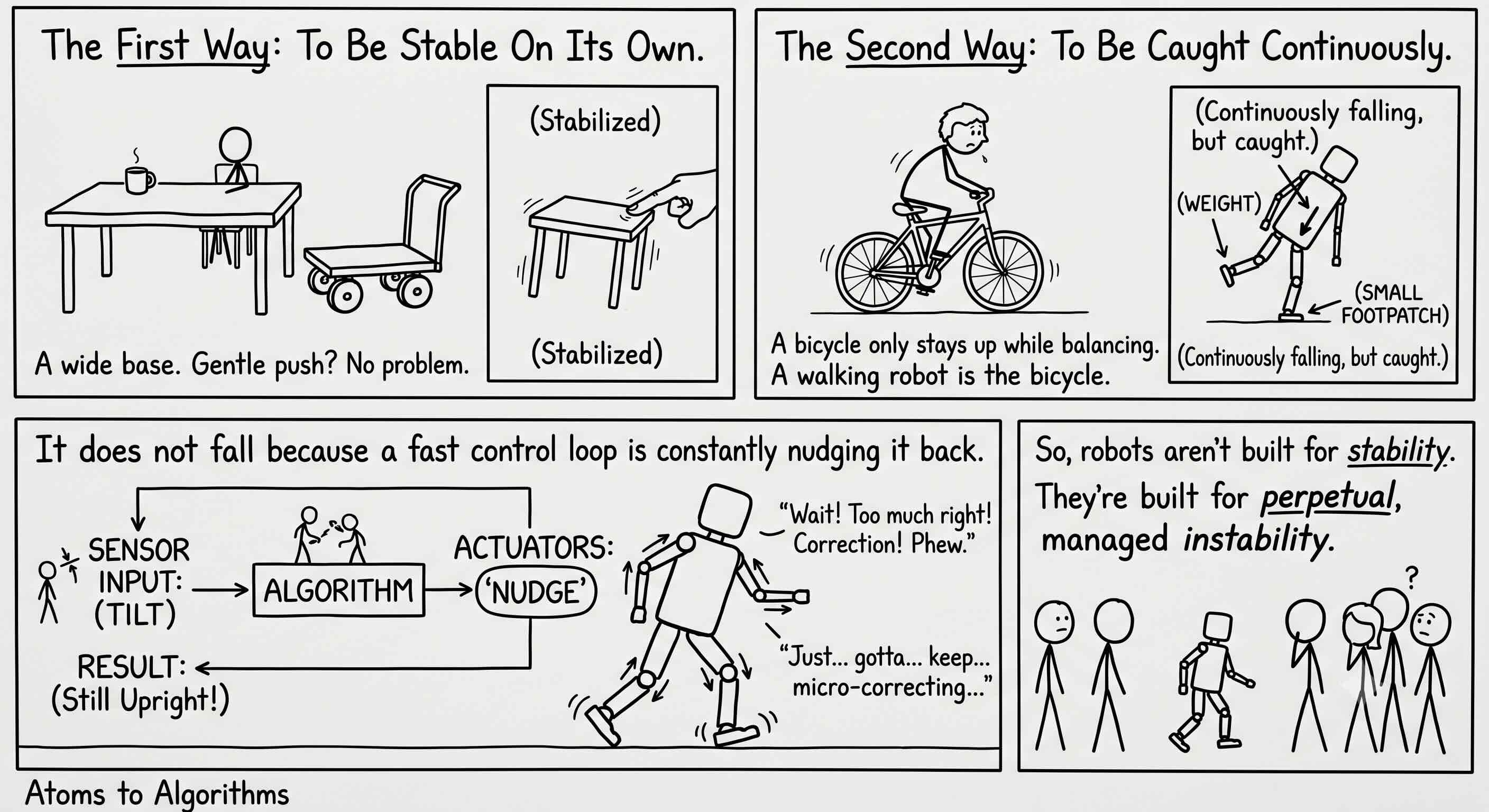
That loop reads how the body is tilting and how fast and answers with small pushes at the ankles and hips, hundreds or thousands of times a second; on Figure’s latest robot a dedicated balance network does it a thousand times a second. None of that effort lifts a box or turns a screw. It is pure overhead, the cost of not falling over, paid so the rest of the robot can do useful work.
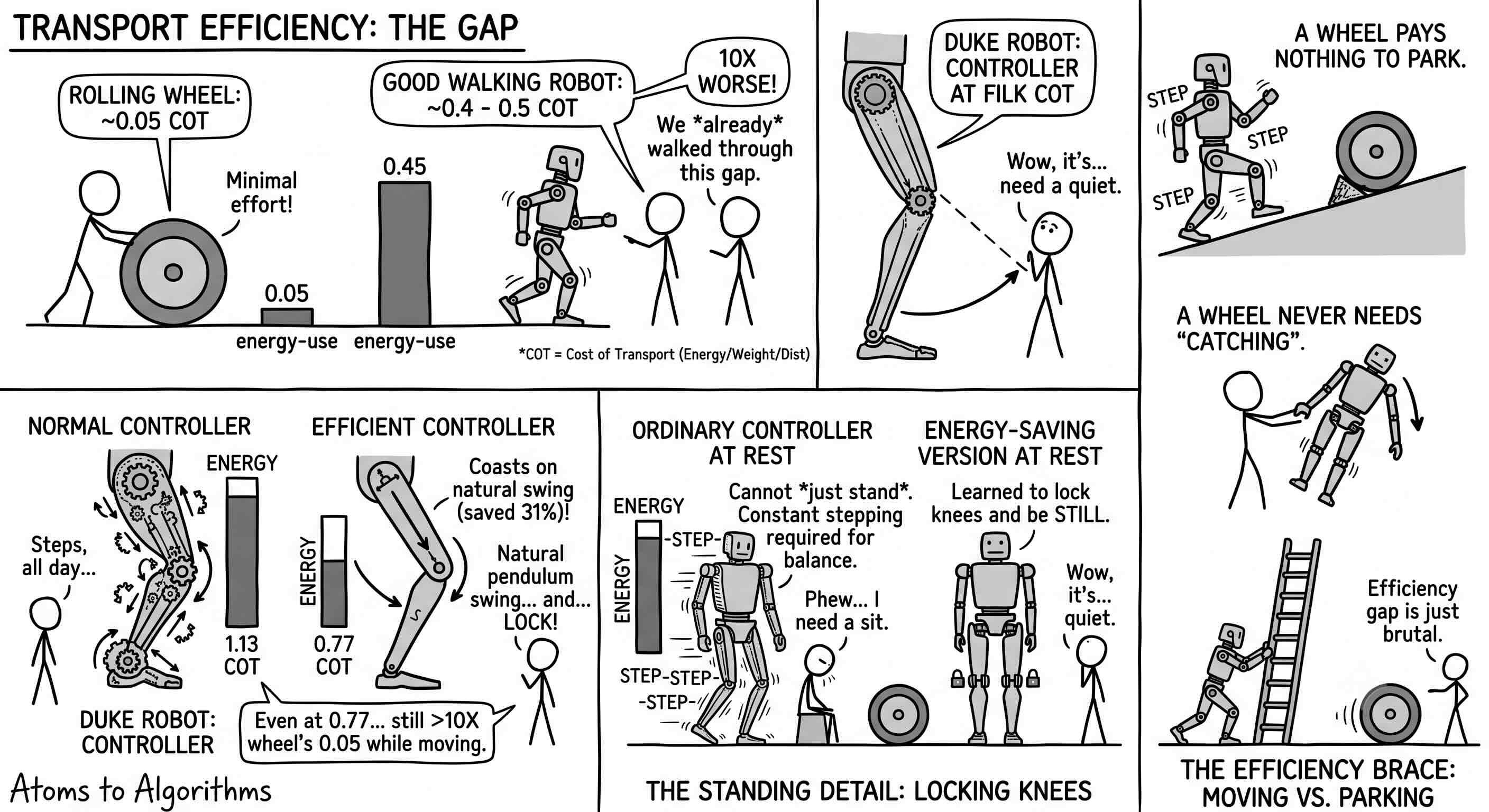
That cost shows up in two places. The first is the battery. Engineers measure walking efficiency with a number called cost of transport, basically how much energy it takes to move a given weight a given distance. A rolling wheel comes in around 0.05. A good walking robot is closer to 0.4 or 0.5, about ten times worse, a gap we walked through a few issues ago. The Duke robot, built specifically to walk efficiently, measured about 1.13 with a normal controller and 0.77 after the team taught it to coast on the natural swing of its legs, a real 31 percent saving. Even that better number is more than ten times a wheel’s, and that is while it moves. The detail that sticks with me is the standing one: at rest, the ordinary controller could not actually stand, it kept stepping in place to stay balanced, and only the energy-saving version learned to lock its knees and be still. A wheel pays nothing to park, and it never needs catching.
The second place the cost shows up is in the hardware itself. A two-legged robot needs a lot of joints just for the legs, and those joints are busy keeping the thing upright before they ever help it carry anything. Boston Dynamics’ production Atlas has 56 separately controlled joints, and many of them exist to keep it standing and stepping rather than to handle objects. There is a whole line of recent research devoted just to balance: one 2025 project trained a humanoid to hold extreme one-legged poses without tipping over when shoved, and the entire study is about staying up, with no manipulation in sight. On a two-legged robot, staying upright is a big chunk of the real work, not the easy part before it.
So choosing the human shape is a trade, not a slogan. Legs earn their cost when the place demands them: a stairwell with no elevator, a messy floor, a step up into a vehicle. Where the floor is flat and open, a warehouse, a battery assembly line, a hospital corridor, the legs are a bill with nothing to show for it, and a robot on wheels can do the same reaching and carrying for a fraction of the energy and with far less to go wrong.
BMW has started running a wheeled humanoid called AEON, built by Hexagon, on its production line in Leipzig, with a June 12 update putting the robot to work on high-voltage battery assembly and parts handling. AEON is about human height and weight, but instead of feet it has wheels, so it rolls across the flat factory floor at up to 2.5 meters per second and only steps when it has to. It is the whole argument made concrete: on a flat line, do not pay for balance you do not need.
A Chinese robotics group, AgiBot, published a machine called X2-N that goes further. It transforms between walking on legs and rolling on wheels built into those same legs, switching modes without bolting on extra motors, so it pays the balancing cost only on ground that requires legs and rolls cheaply everywhere else. The robots attracting the most factory interest this year are the ones refusing to commit to one shape.
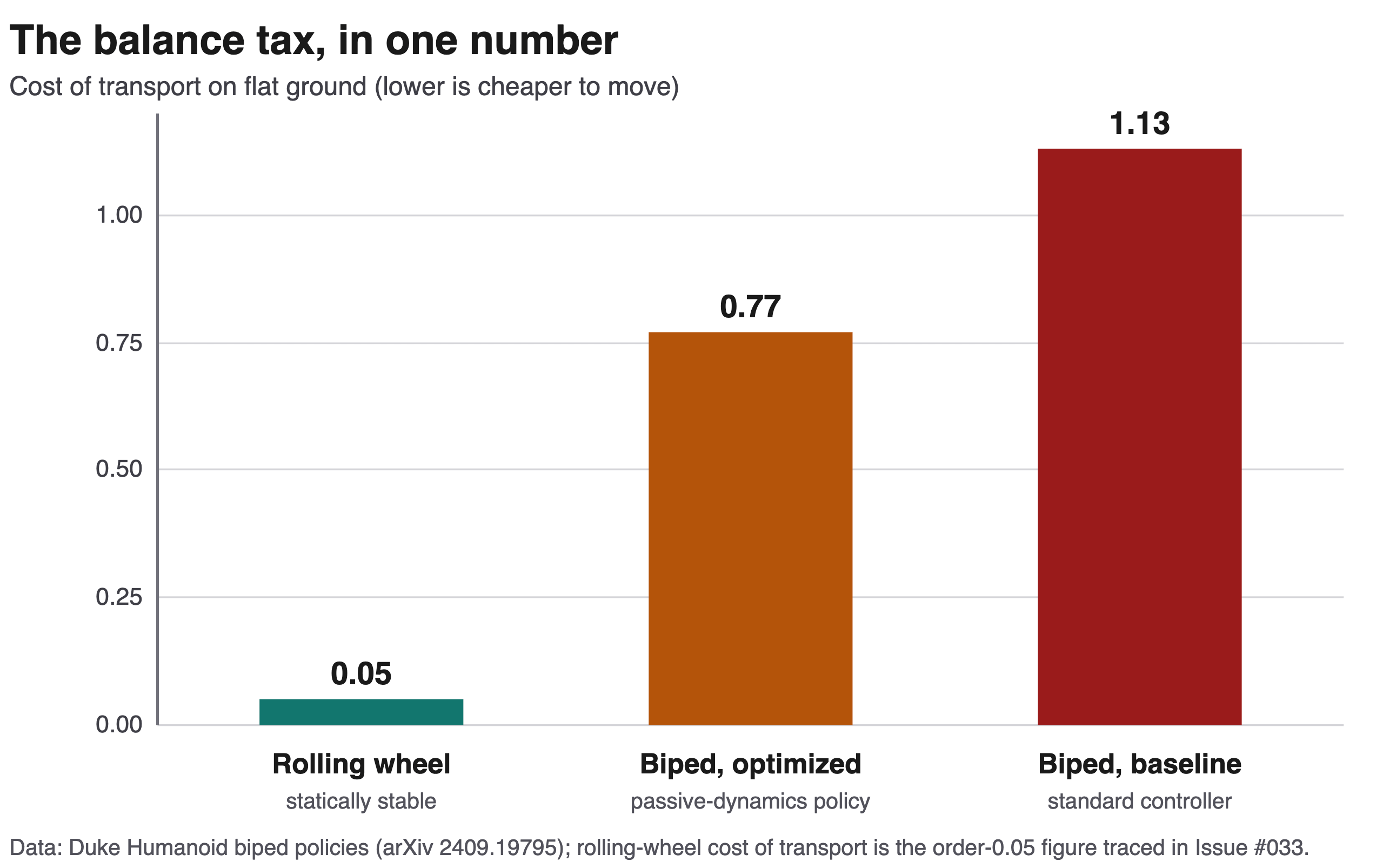
The chart compares cost of transport on flat ground for a plain rolling wheel and the Duke robot under each of its two control policies. The wheel sits near 0.05. The robot’s energy-optimized policy lands at 0.77 and its ordinary one at 1.13, both towering over the wheel even at the robot’s best. That tower is the balance tax in one picture, and it is paid before any work gets done, since the same robot paces in place rather than resting when you ask it to stand still.
So a humanoid can be the most capable machine on the floor and still carry a bill the cart beside it never sees. If the human shape costs this much, the robot had better be very good at the human tasks that justify it, and that skill has to be learned from somewhere. Tomorrow we go looking for it. Where does a humanoid’s training data actually come from, and what happens at the awkward step where recorded human movement has to be bent onto a robot whose joints are not shaped like ours?
Subscribe for tomorrow’s read, we’re walking the robotics supply chain from atoms to algorithms, one weekday at a time.
Sources: