A parked car pays nothing to sit in a lot. On Monday we met a robot dog that pays a small bill just to stand, because its legs have to hold a pose with motor current instead of gearing. A hovering drone pays the biggest bill of the three, and it never gets to stop. To hang in still air, a drone has to grab a column of air and throw it downward, every second, forever. The energy in that downward gust is simply gone. That continuous payment is why a camera drone rated for thirty minutes drops to twenty the moment you bolt a better camera onto it. There is one number that governs the whole thing, and it is called disk loading: the weight of the drone divided by the area its spinning blades sweep out.
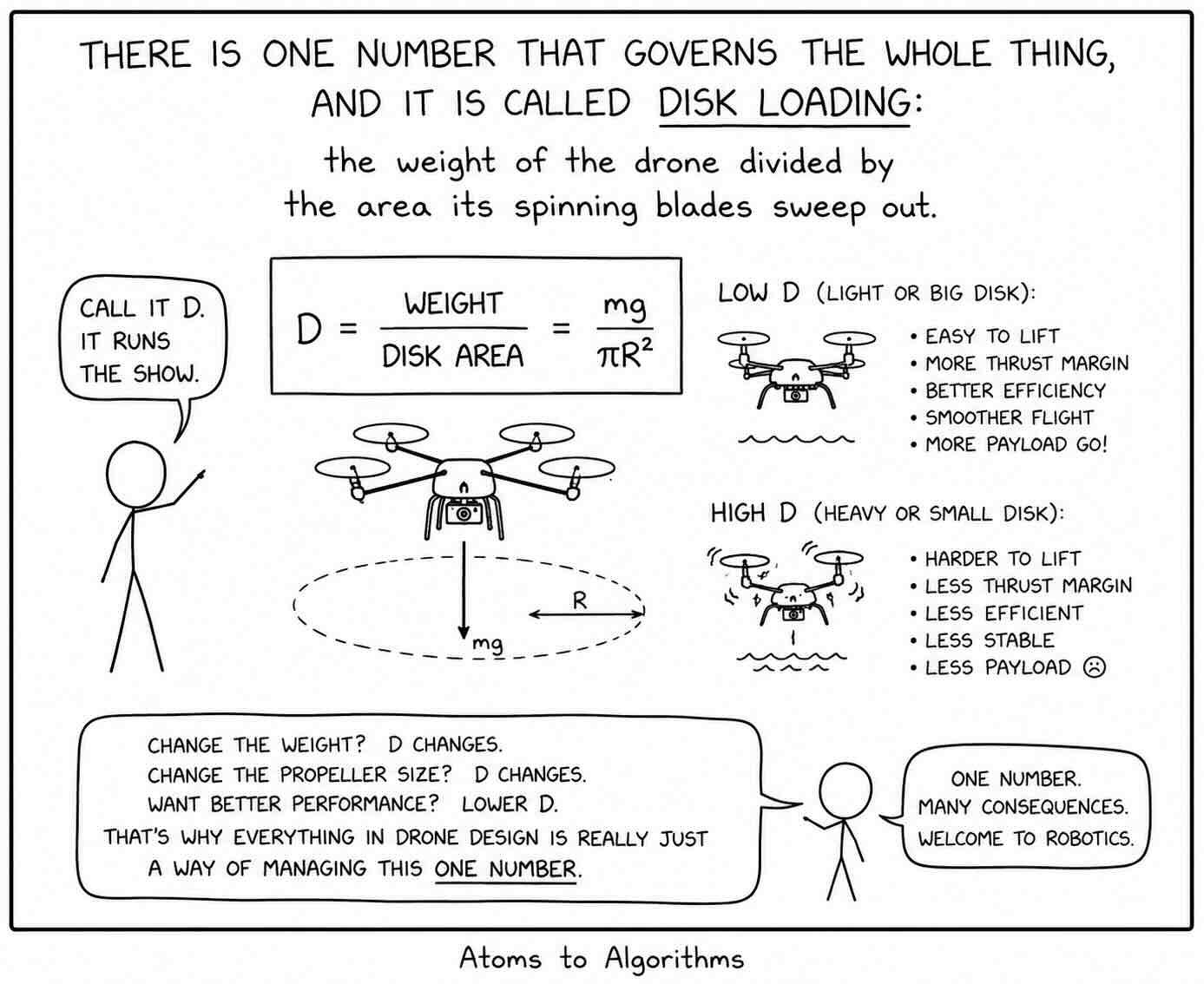
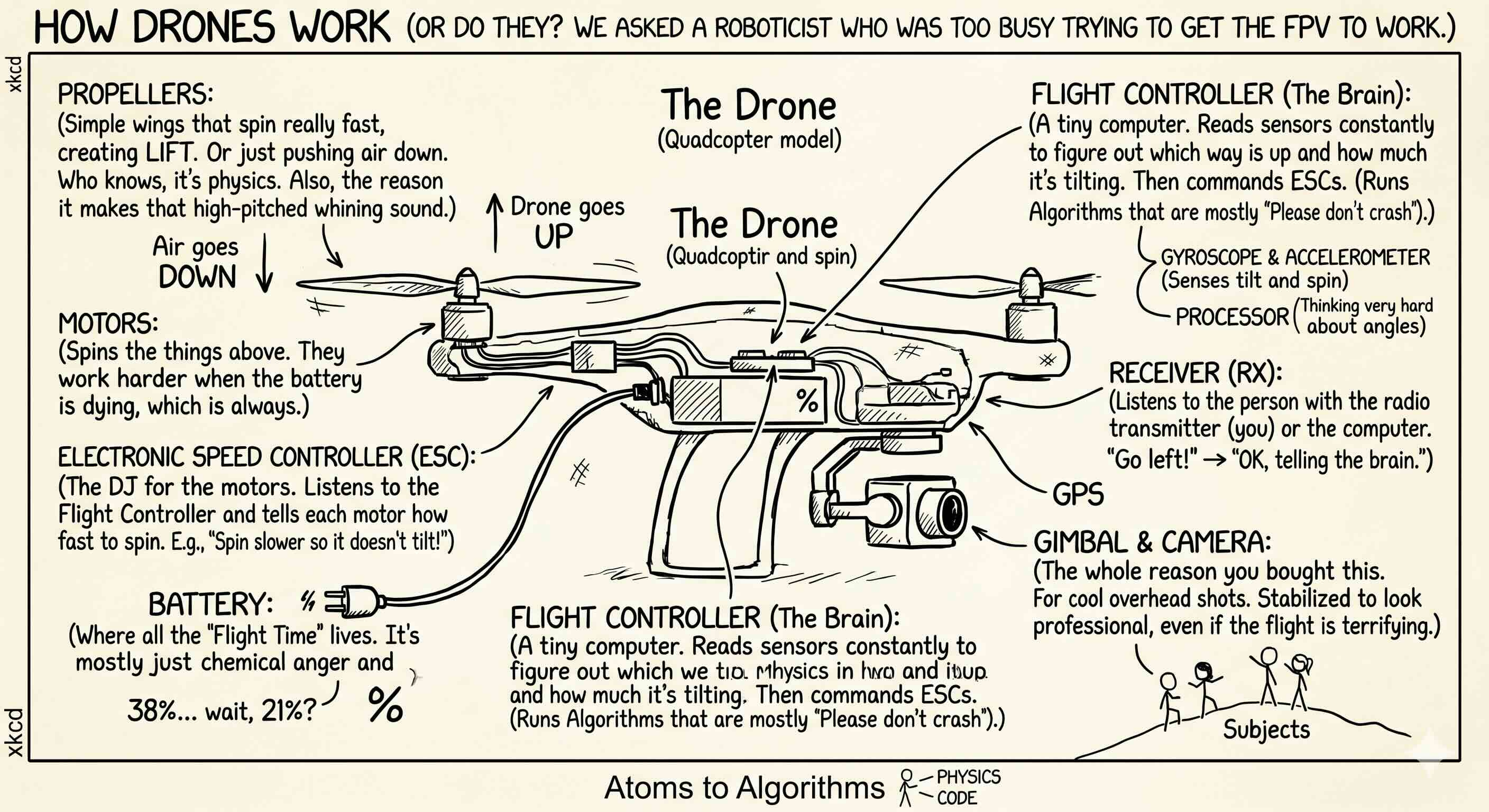
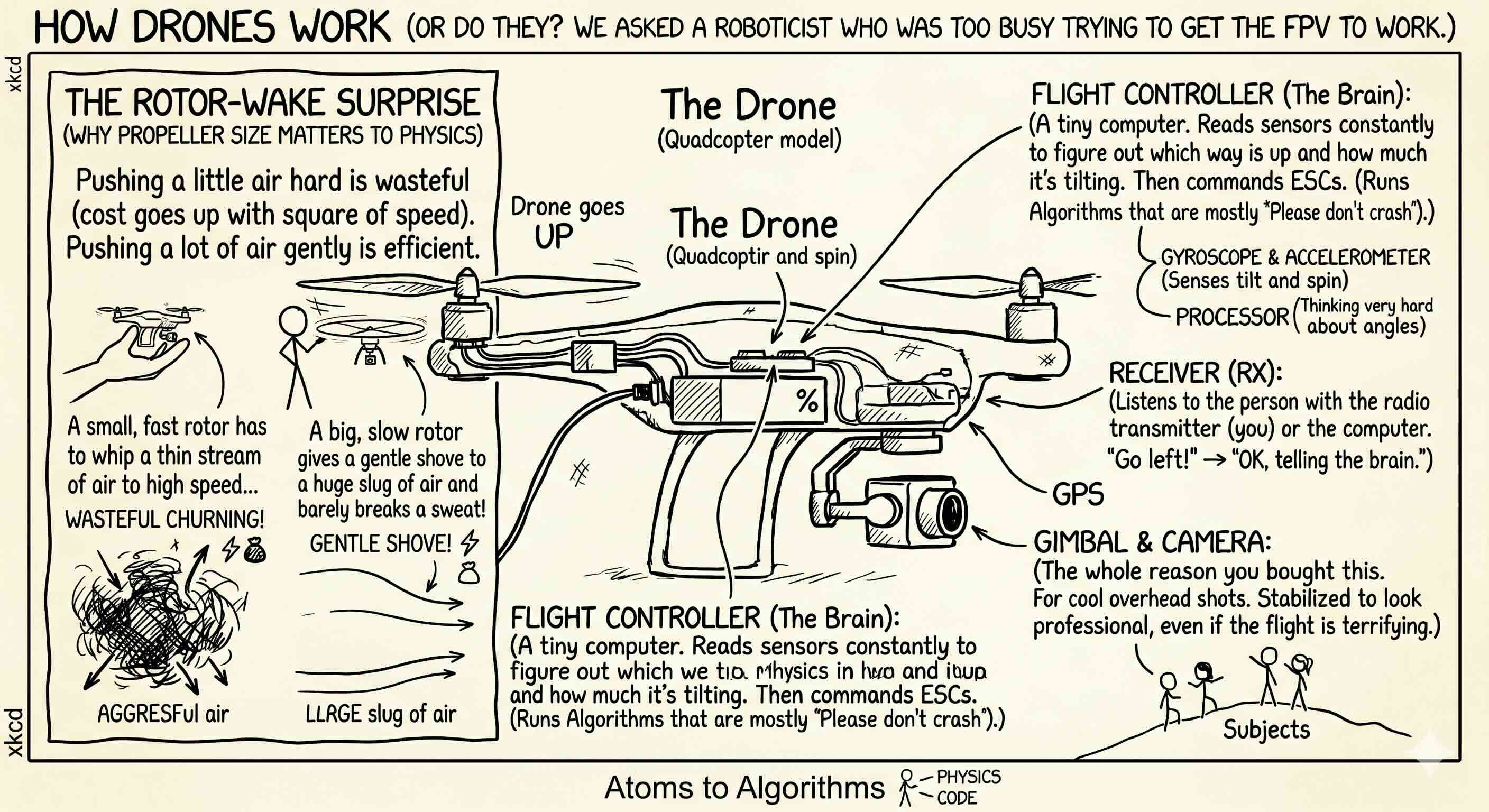
Think of the blades as tracing out a flat disk in the air. To stay up, the drone has to push enough air down through that disk to balance its own weight. Here is the part that surprises people: it matters enormously whether you push a lot of air gently or a little air hard.
Pushing a little air hard is wasteful, because the energy you spend goes up with the square of how fast you throw that air. A big, slow rotor gives a gentle shove to a huge slug of air and barely breaks a sweat. A small, fast rotor has to whip a thin stream of air to high speed, and most of that effort ends up as wasted churning in the wake below. So for the same weight held up, a small disk costs far more power than a big one.
That trade-off has a clean rule. The power a drone needs to hover, per kilogram it carries, grows with the square root of its disk loading. Spread the same weight over twice the disk area, and hovering gets about thirty percent cheaper. Cram it onto half the area, and the bill climbs the same way. This is not a quirk of one design. It is the reason helicopters have enormous rotors and the reason a pocket-sized quadcopter, whose props are tiny next to its weight, drains its battery in minutes. Small drones live at the expensive end of this rule, and no amount of clever software moves them off it.
It also explains the cameras. Because the power penalty grows faster than the weight that causes it, adding a payload hurts more than you would guess. Make a drone twenty percent heavier with a sharper sensor, and you do not pay twenty percent more to hover. You pay about a third more. The extra weight eats directly into the flight time you needed that sensor for. Designing an inspection drone is, underneath the autonomy and the obstacle avoidance, a grinding fight over every gram and every centimeter of propeller.
Engineers know only a few real ways to beat the hover tax, and each one costs something. You can use bigger, slower rotors to lower the disk loading, but then the drone no longer fits inside the tank or under the bridge it was sent to inspect. You can stop hovering altogether: land or perch on the structure, take the shot, and move on, which is why researchers are building drones with feet and grippers. You can run a cable down to the ground and feed the drone power from a generator, trading the freedom to roam for the ability to stay up all day. Or you can carry the weight with a balloon, a helium envelope that does the lifting so the rotors only nudge, which drops the hover cost toward nothing but leaves you with a slow, wind-shy blimp. A good picture for all this is treading water. A fixed-wing plane floats along on its wings; a hovering drone is treading water, and it gets tired.
The inspection-drone business is heating up at home. In April 2026, the autonomy company Skydio raised $110 million and pledged $3.5 billion to expand US manufacturing. Its niche is exactly the one where short flight time is fine, because inspection missions are quick and focused. One Air Force program using its drones reports cutting the time to inspect a C-17 cargo plane by more than ninety percent, which is the whole economic argument in a single figure. (DroneLife)
The biggest name in drones is shut out of new US sales. Because a required security review went unfinished, US regulators added DJI, the Chinese market leader, to a restricted list in December 2025, blocking new models from import while letting existing ones keep flying. As of June 2026 that is still the rule. Who gets to sell inspection drones in America is now a policy decision as much as an engineering one. (UAV Coach)
Researchers are trying to cheat the hover bill. A 2026 study fits tiny drones with a helium envelope and light-harvesting panels, so buoyancy carries the weight and the rotors barely have to work, pushing the hover cost toward zero. The honest catch, which the authors note, is that small batteries still limit how long the thing can actually operate. (arXiv)
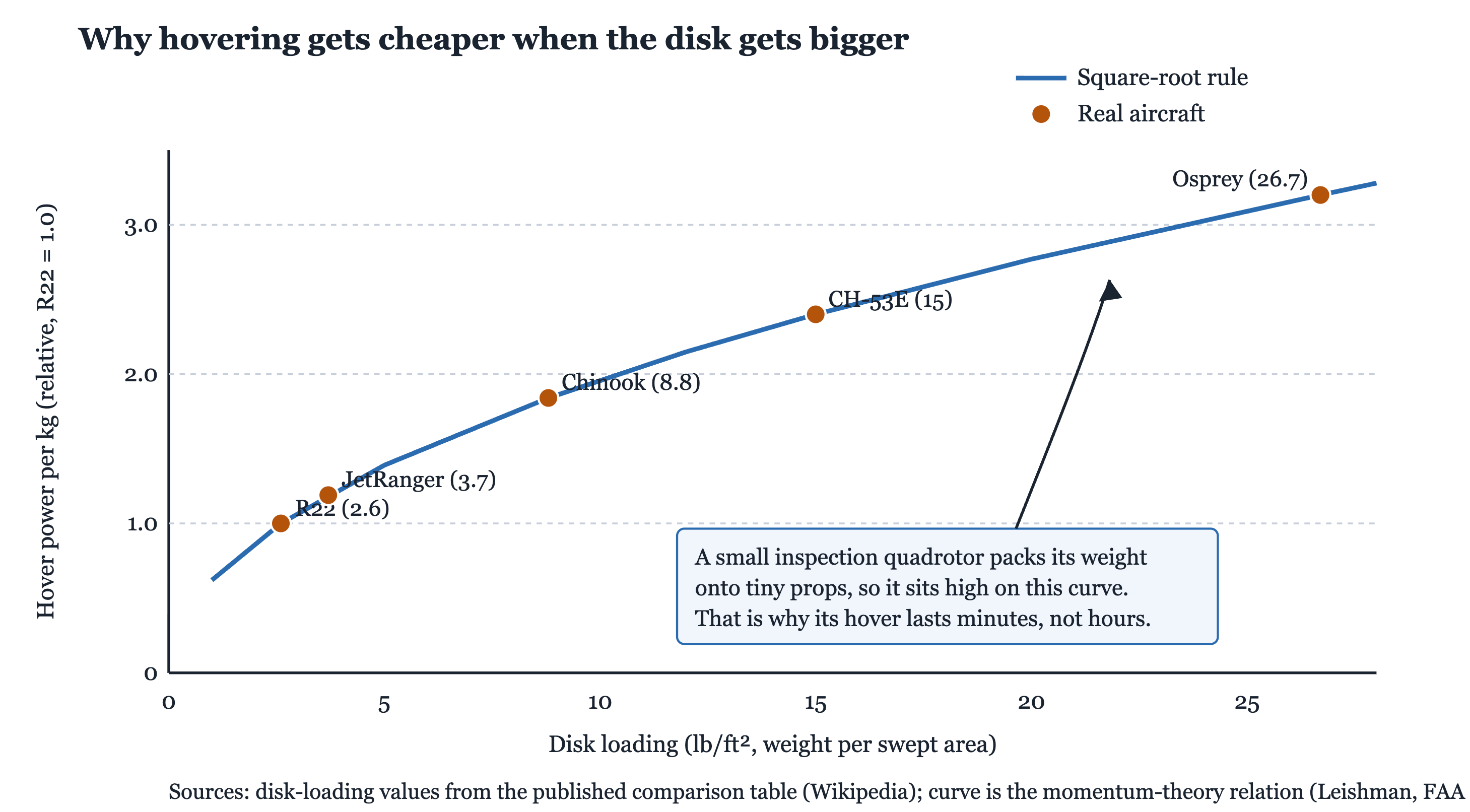
Today’s chart plots how expensive it is to hover against disk loading, for five real rotorcraft from a light helicopter up to the V-22 Osprey tiltrotor. The line through them is the square-root rule, drawn straight from the physics rather than fitted to the dots. The shape is the message: the curve is steep on the left and flattens out, so the cheapest hovering happens at low disk loading, where weight is spread across a wide disk. A small inspection drone sits high and to the right, in the costly zone, which is the picture-form answer to why it cannot stay up for long.
Which sets up tomorrow. For three days we have watched machines that move across a surface, or just above one, and pay an energy bill to do it. Tomorrow the field robot comes back down to earth and rolls into a row crop, where the binding constraint is no longer power but time. A weeding or spraying robot moving down a row gets only a few milliseconds to look at each plant, decide whether it is a crop or a weed, and act before it has already driven past. So the question becomes: how does a machine make a correct life-or-death call on a single seedling, hundreds of times a second, without slowing the whole farm down?
Subscribe for tomorrow’s read, we’re walking the robotics supply chain from atoms to algorithms, one weekday at a time.
Sources: Disk loading and momentum theory (Wikipedia) · Skydio $110M Series F (DroneLife) · The DJI ban, 2026 status (UAV Coach) · Lighter-than-air micro-drones (arXiv 2601.13088) · Tethered drone power stations (Unmanned Systems Technology)