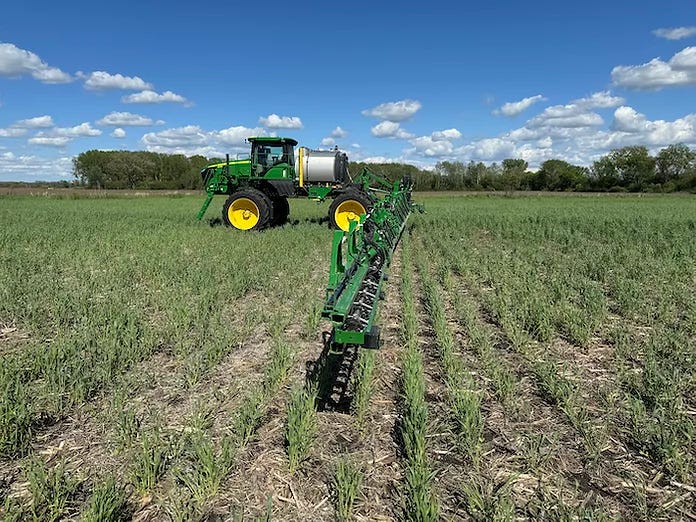
In last post drone paid an energy bill to stay up. The farm robot that comes back to earth today pays a different kind of bill, and it is paid in milliseconds. A John Deere See & Spray boom scans more than 2,500 square feet of ground every second at up to 15 miles per hour. As the plants rush by underneath, it has to look at each one, decide whether it is a crop worth keeping or a weed worth killing, and fire the single spray nozzle sitting right over that weed before the boom has carried the nozzle past the plant. At that speed a weed is under any given nozzle for only a few tens of milliseconds. See it, name it, predict where it will be, and squirt, all inside that blink. Miss the window and either the weed survives or the crop takes a hit it did not deserve.
This week we have followed machines onto ground they did not design, paying to walk, roll, or hover. Today the hard part is no longer energy. It is time. A robot rolling down a crop row gets one quick look at each plant and one chance to act, and the reward for getting it right is a number farmers have wanted for a long time.
The decision the robot makes comes in two flavors, and the difference between them is most of the story.
The easy version is spotting green on bare brown soil. If the field has been plowed and nothing has come up yet, anything green is a weed, full stop, and a simple color rule can find it. That is cheap, and it is what the budget version of these systems does.
The hard version is finding a weed growing in the middle of a healthy crop. Now the robot has to tell a baby soybean from a weed that looks almost exactly like it at that age, under changing sunlight, in a mess of overlapping leaves and shadows. There is no simple color trick for that. It takes a trained AI vision model, the same kind of object detector that spots faces or cars in a photo, except it has to run on a computer bolted to a sprayer and return an answer in a heartbeat.
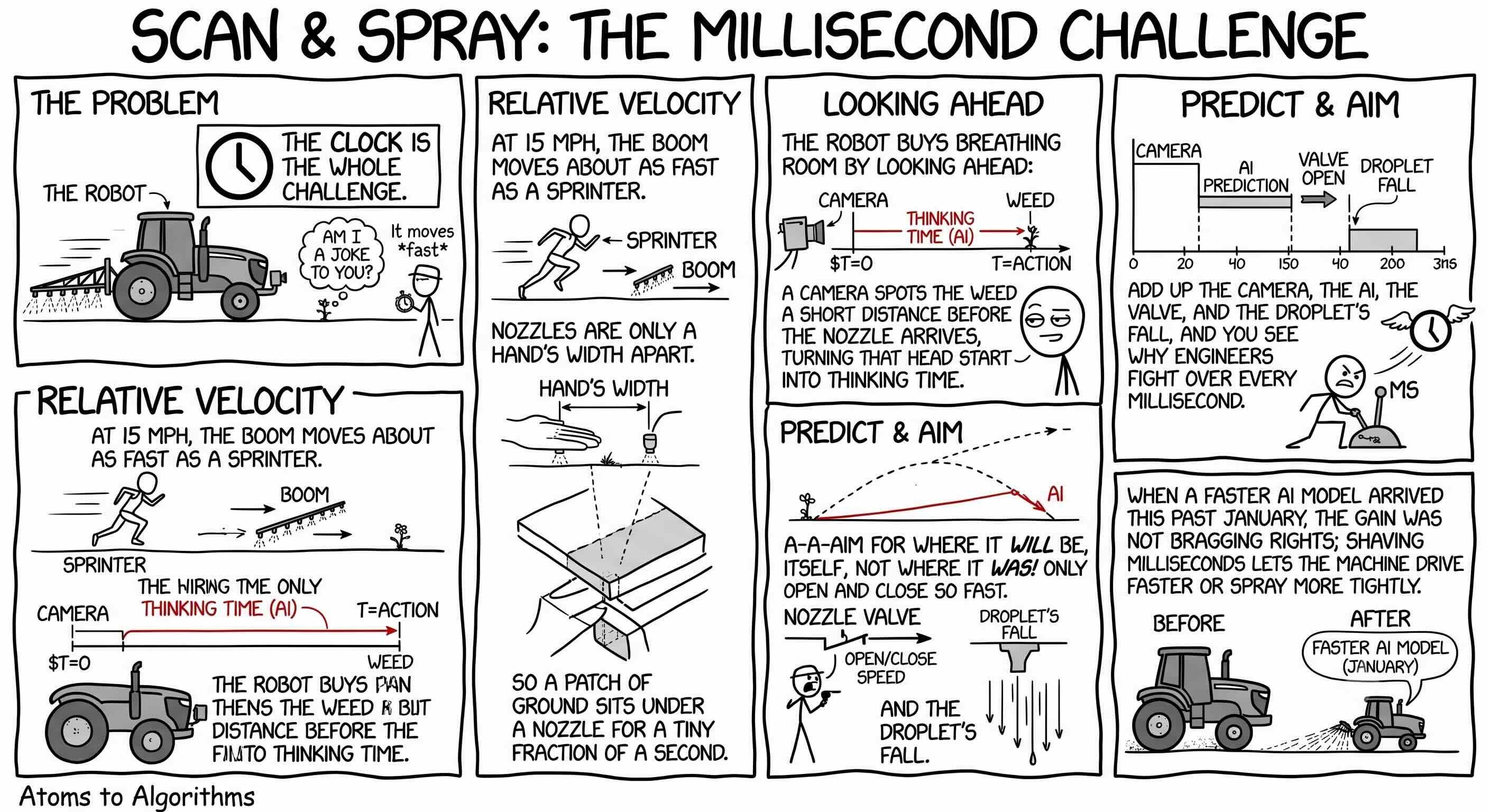
The clock is the whole challenge. At 15 miles per hour the boom moves about as fast as a sprinter, and the nozzles are spaced only about a hand’s width apart, so a patch of ground sits under a nozzle for a tiny fraction of a second. The robot buys breathing room by looking ahead: a camera spots the weed a short distance before the nozzle arrives, turning that head start into thinking time. But it also has to predict, aiming the spray at where the weed is going to be, not where the camera first saw it. Then there is the nozzle itself, a valve that can only open and close so fast. Add up the camera, the AI, the valve, and the droplet’s fall, and you see why engineers fight over every millisecond. When a faster AI model arrived this past January, the gain was not bragging rights; shaving milliseconds lets the machine drive faster or spray more tightly.
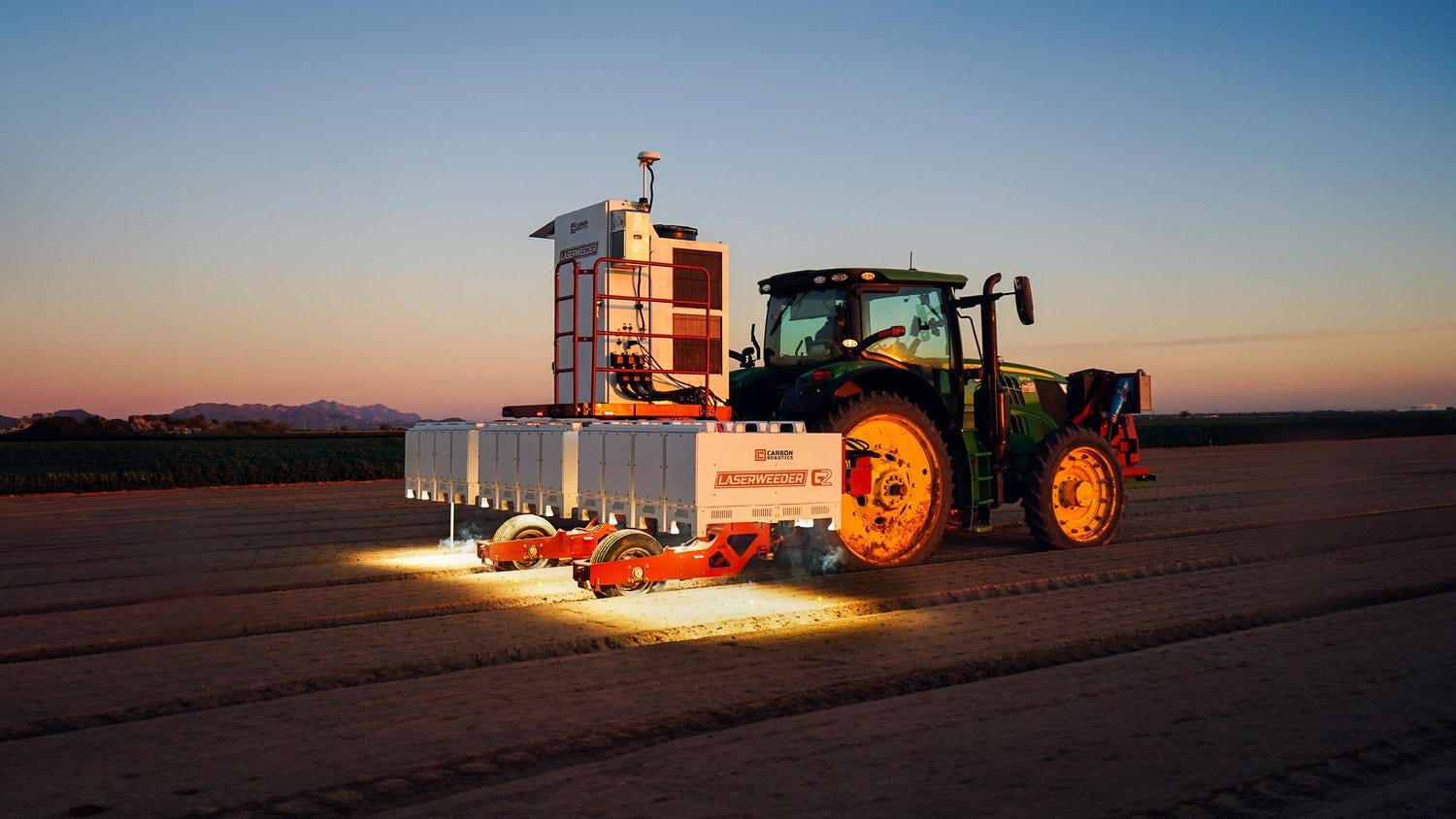
There is a second way to answer the same question, and it skips chemicals entirely. Carbon Robotics’ LaserWeeder makes the same crop-versus-weed call, then, instead of spraying, it aims a laser and burns the weed’s growing point with a quick pulse of heat. Nothing toxic touches the soil. The catch is that the laser has to pause on each weed for an instant, so it covers less ground per hour, which is why lasers tend to work high-value vegetable fields while the spray boom handles the vast acres of corn, soybeans, and cotton. Both approaches lean on the same hard thing: an AI that can correctly name a plant in a few milliseconds, outdoors, in any light.
That AI is the real prize, and it is built from data only a company with machines already in fields can gather. Carbon spent years photographing plants under a custom light rig bright enough to erase shadows, so every training picture is clean. Once the machines are out working, they keep collecting labeled pictures every day, and the model keeps improving. The goal everyone chases is a model you can drop into a field it has never seen, tell it “this is the crop and these are the weeds,” and have it just work.
The savings are now measured in millions of gallons. John Deere says its See & Spray system ran across more than five million acres in 2025 and cut weed-spray use by an average of nearly half, which it puts at about 31 million gallons of spray mix not applied. A company-commissioned trial across seven states also found a small yield gain, because the crop takes less chemical damage. That roughly 50% cut is the entire economic argument for putting cameras on a sprayer. (John Deere)
The laser-weeding company is teaching its AI to handle crops it has never seen. Carbon Robotics, whose laser weeders now run in 14 countries, is rolling out what it calls a “Large Plant Model” that can be pointed at an unfamiliar crop without being retrained first, and it raised fresh funding to keep building. It is a bet that the biggest advantage in this business is the pile of plant data you have already collected. (The Robot Report)
Researchers are squeezing the AI to run faster and travel better. A new study pairs a powerful image-understanding model with this year’s faster detector and reports that it holds up well on crops from earlier seasons, not just the one it trained on, while still running in real time. Working across seasons is the quiet, hard part, because last year’s field never looks quite like this year’s. (arXiv)
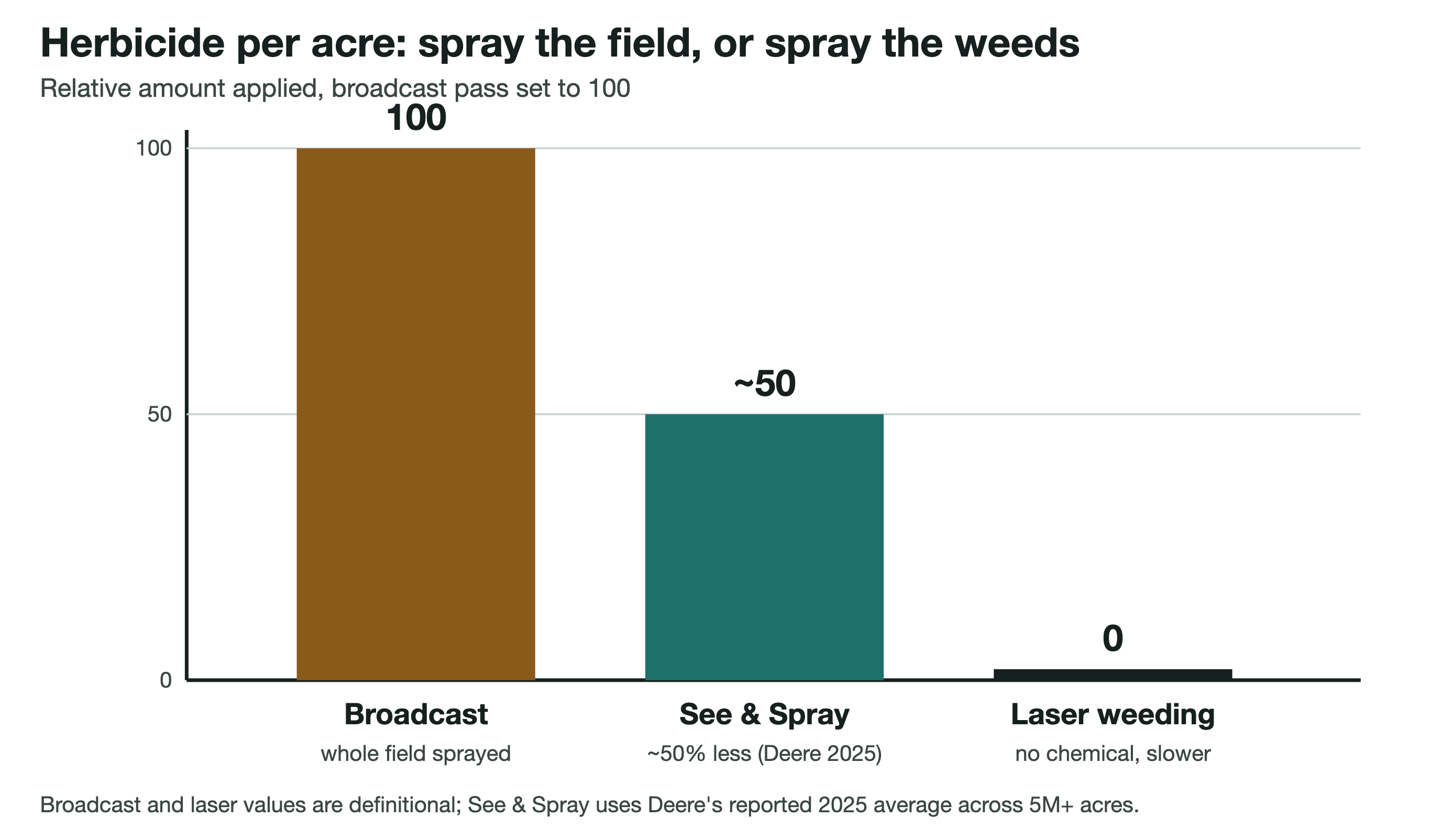
Today’s chart compares, roughly, how much herbicide lands on an acre under three approaches: a conventional broadcast pass that sprays the whole field, a See & Spray pass at the average Deere reported for 2025, and laser weeding, which uses no chemical at all. The thing to see is how much taller the broadcast bar is than the others. Targeting does not shave a little off the chemical bill. On average it removes about half of it, and the laser route removes the chemical line entirely, paying for it instead in slower coverage and a pricier machine.
Which sets up tomorrow. For four days the machines have been moving across the ground, or just above it, and the question has always been how they cope with terrain they did not build. Tomorrow the machine stops trying to travel over the ground and starts trying to change it. We move to the autonomous excavator on a construction site, where the job is not to reach a point on a map but to dig a hole to an exact depth and slope, over and over, with no operator in the seat watching the bucket. So the question becomes: how does a driverless machine hold its bucket to a grade it cannot actually see?
Subscribe for tomorrow’s read, we’re walking the robotics supply chain from atoms to algorithms, one weekday at a time.
Sources: See & Spray across five million acres (John Deere) · Carbon Robotics’ large plant model (The Robot Report) · DINOv3 meets YOLO26 for weed detection (arXiv 2603.00160)