There is a way to teach a robot arm a new job that feels like magic the first time you see it. You flip the arm into a special mode, and suddenly all that metal goes weightless. You take it by the wrist, walk it through the motion you want, picking up a part here, setting it down there, and let go. The arm remembers. Press play and it does the whole thing again on its own. No code, no engineer, no manual. An afternoon’s work.
That trick is real, and it is genuinely useful. But it also hides the central tension of the modern factory. The most natural way to teach a robot is the hardest one to scale. And scale is the whole game, because the prize everyone is chasing is the “lights-out” factory, a plant that runs all night, three shifts, with the lights off and nobody on the floor.
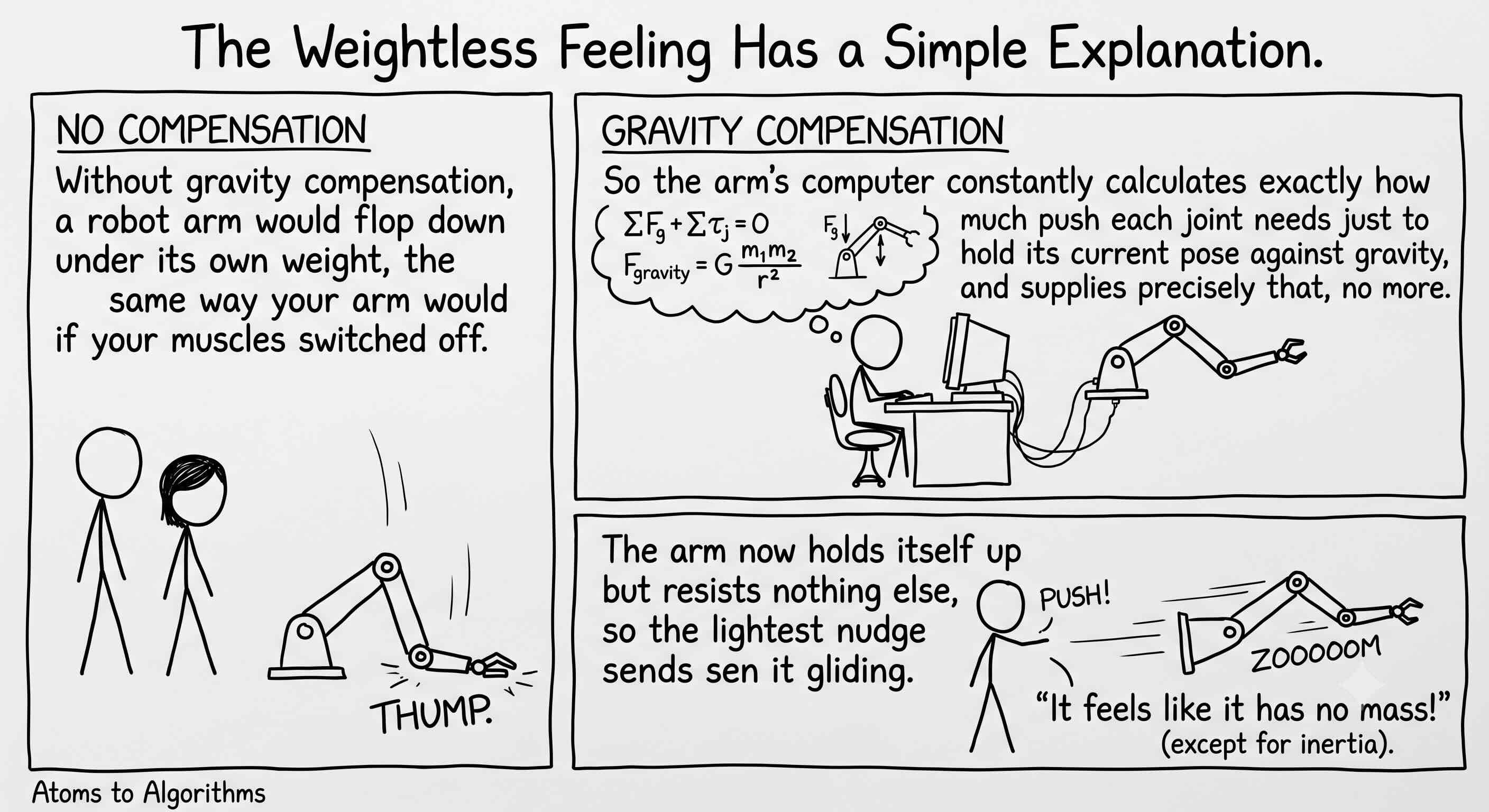
The weightless feeling has a simple explanation. Left alone, a robot arm would flop down under its own weight, the same way your arm would if your muscles switched off. So the arm’s computer constantly calculates exactly how much push each joint needs just to hold its current pose against gravity, and supplies precisely that, no more. The arm now holds itself up but resists nothing else, so the lightest nudge sends it gliding. Roboticists call this gravity compensation. To you, it just feels like the arm is floating. As you guide it, sensors in every joint record the path, and that recording becomes the lesson.
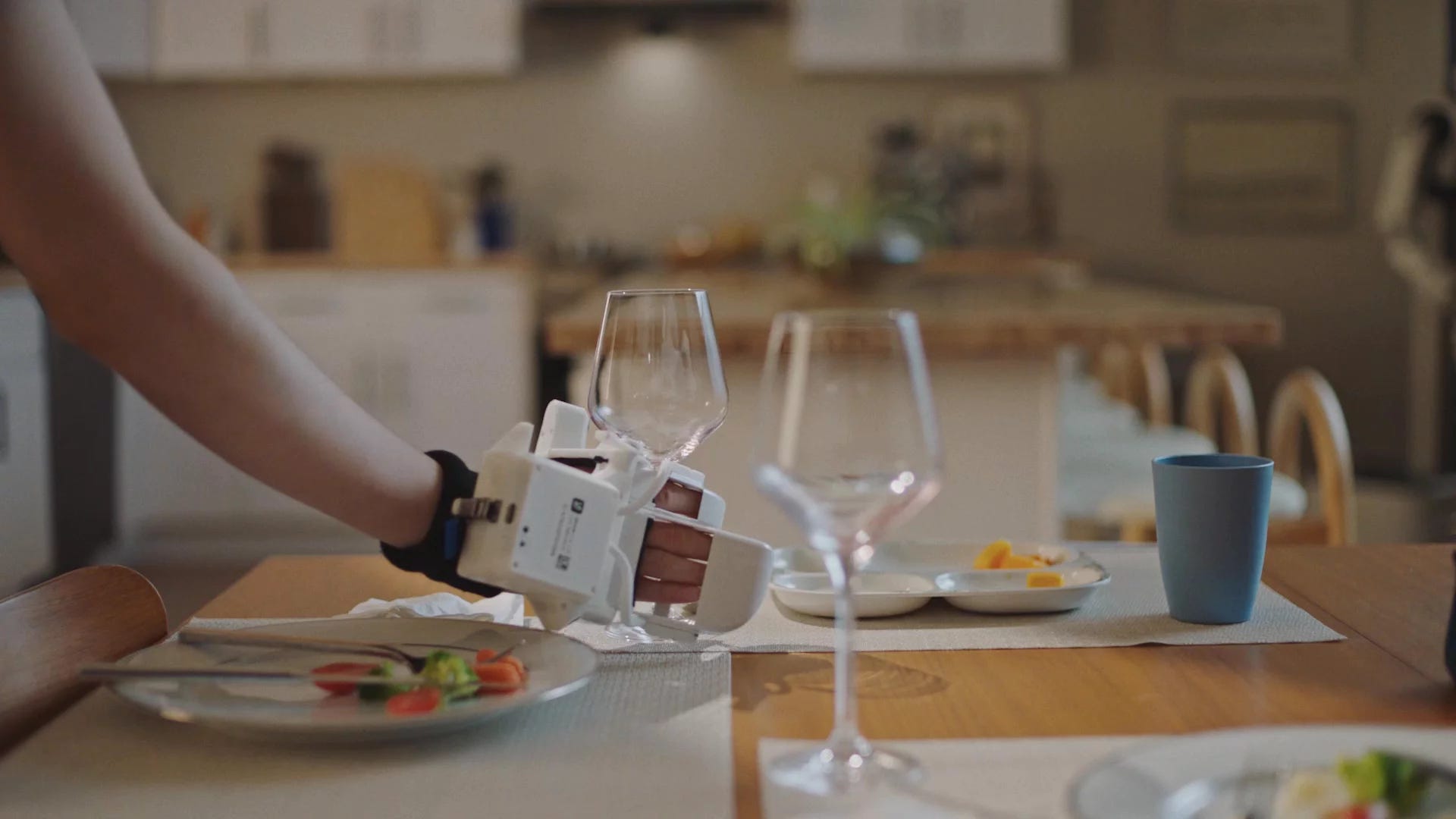
The robot does not simply memorize the exact path. If it did, moving the part even slightly would make the replay miss. Instead it learns the shape of your motion as a kind of flexible rule, a gesture it can recreate from a new starting point and recover if something bumps it partway through. One demonstration becomes one reusable skill. Its like learning by mimicking.
The word “one” is where the trouble starts, and it comes in two parts. First, the teaching itself is surprisingly clumsy. A 2026 study had two dozen people teach the same simple task two ways, by guiding a robot arm by hand and by showing the motion with a tracked pointer in their own hand. Guiding the arm was about eight times slower and roughly twice as tiring, and the results were messier. Dragging a heavy, many-jointed arm through a precise path is just awkward. Second, and more important, one demonstration teaches the robot about exactly one situation. The moment the bin is turned the other way, or the lighting changes, or the part sits an inch from where it sat before, the robot is in unfamiliar territory and its confidence falls apart. Its more like you are 80% there, but last 20% gives you run for equal amount of effort as 80%, you are never quite there .
So the clever people stopped trying to teach more. They started multiplying what little they had. The idea, now built into tools like NVIDIA’s robot-training pipeline, is to take a handful of human demonstrations and have a simulator replay them across thousands of slightly different situations, different positions, lighting, clutter, automatically. NVIDIA says it turned a small set of demos into 780,000 practice runs, the equivalent of roughly nine months of a human demonstrating by hand, in about 11 hours of computer time. Training on that flood of synthetic practice, mixed with a little real data, made the robot 40% better. The human still teaches by hand. The computer manufactures all the variety the human never had time to show. Sunday Robotics is doing kind of same thing, capture human movement data using proprietary wearable smart devices, creating a massive dataset of over 10 million real-world household task episodes.
That, not the wrist-grab, is what makes a dark factory imaginable. And it comes with an honest warning the engineers say out loud: garbage in, garbage out. Multiplying a sloppy demonstration just gives you 780,000 sloppy practice runs. And the factories running lights-out today do it with rigid setups and narrow, repetitive tasks. The hard part is still the surprise, the dropped screw, the jammed feeder, the thing nobody demonstrated. Which is exactly why, in even the darkest factory, someone’s phone is on the nightstand.
Teaching with your hands, not the robot’s. New work this month on wearable “teaching gloves” tries to capture the fine detail of how human fingers actually handle an object, in a form the robot can still copy. It is aimed straight at the gap where a human demonstration looks nothing like what the robot can physically do. (arXiv)
Show it once, on video. Another June result lets a robot attempt a brand-new task after watching a single demonstration video of it, instead of the usual hundreds of hands-on practice runs. The “teach it once” dream, stated as a research goal. (arXiv)
A humanoid on a real line. Xiaomi reported one of its humanoid robots installing fasteners at a car-parts plant, hitting the line’s required pace and succeeding about 90% of the time. Impressive, and also a reminder: 90% is not a number you walk away from overnight. (TechNode)
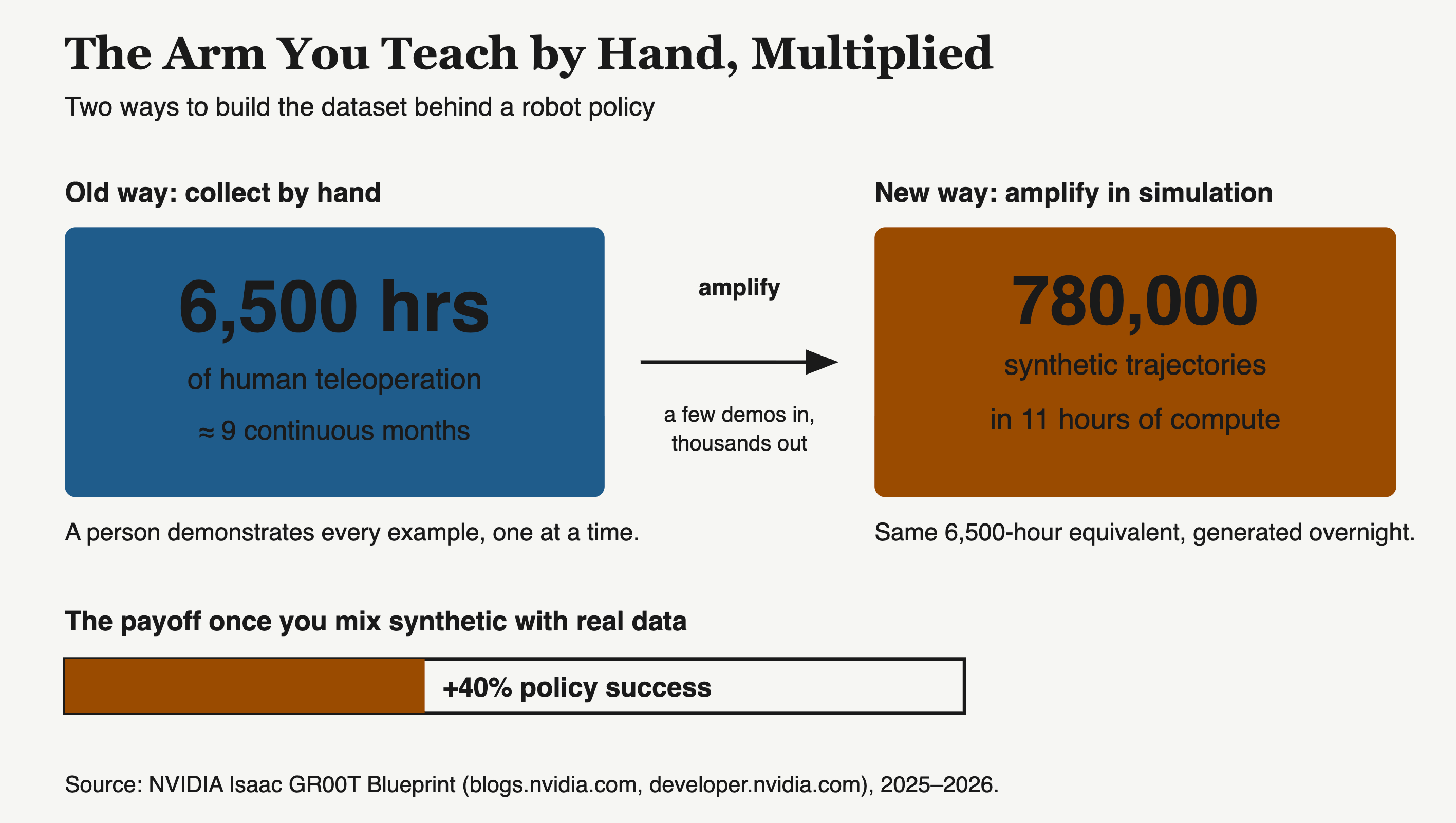
Today’s chart is one ratio. On one side, the old way of teaching robots: about 6,500 hours of a human patiently demonstrating, roughly nine months of work. On the other, a few demonstrations multiplied by computer into 780,000 practice runs in 11 hours, with the robot ending up 40% better for it. The gap between those two columns is the entire reason a lights-out factory went from fantasy to engineering project. The bottleneck used to be how fast a person could teach. Now it is how well a computer can multiply a single good lesson.
So the wrist-grab is not really the answer to teaching a robot. It is the seed. A human still has to show the robot a good example, by hand, the way you would show a new hire. The machine’s job is to imagine that one example in ten thousand variations until it has seen enough to work alone at 3 a.m. But notice what that leaves out. Multiplying a demonstration teaches a robot the situations you thought of. It cannot teach the one you didn’t, the snapped part, the misfed tray, the spill. That gap, between the tasks we can demonstrate and the surprises we cannot, is the real border of the dark factory. Tomorrow we walk up to one of the oldest and most demanding robot jobs of all, welding, and meet a machine that has to do something a taught-by-example robot still struggles with: feel its way along a seam that is never quite where the blueprint promised. How does a welding robot find a joint it cannot perfectly see?
—
Subscribe for tomorrow’s read, we’re walking the robotics supply chain from atoms to algorithms, one weekday at a time.
Sources:
Kinesthetic teaching vs human demonstration (arXiv 2403.10140)
NVIDIA Isaac GR00T Blueprint (NVIDIA)
Synthetic motion generation pipeline (NVIDIA Developer)