Richard Dawkins popularized this idea in *The Selfish Gene* (1976): we, and every living thing, are elaborate survival machines, built to protect and replicate little pieces of DNA. Life, in this framing, is simply what happens when information learns to persist.
But Dawkins went further. He coined the word **meme**, a unit of cultural transmission, to describe how ideas replicate and evolve the same way genes do. A tune, a political slogan, a style of joke: each one spreads or dies based on how well it copies itself in human minds. And no, he wasn't talking about funny pictures on the internet. Those came decades later, and they're just one small example of the idea.
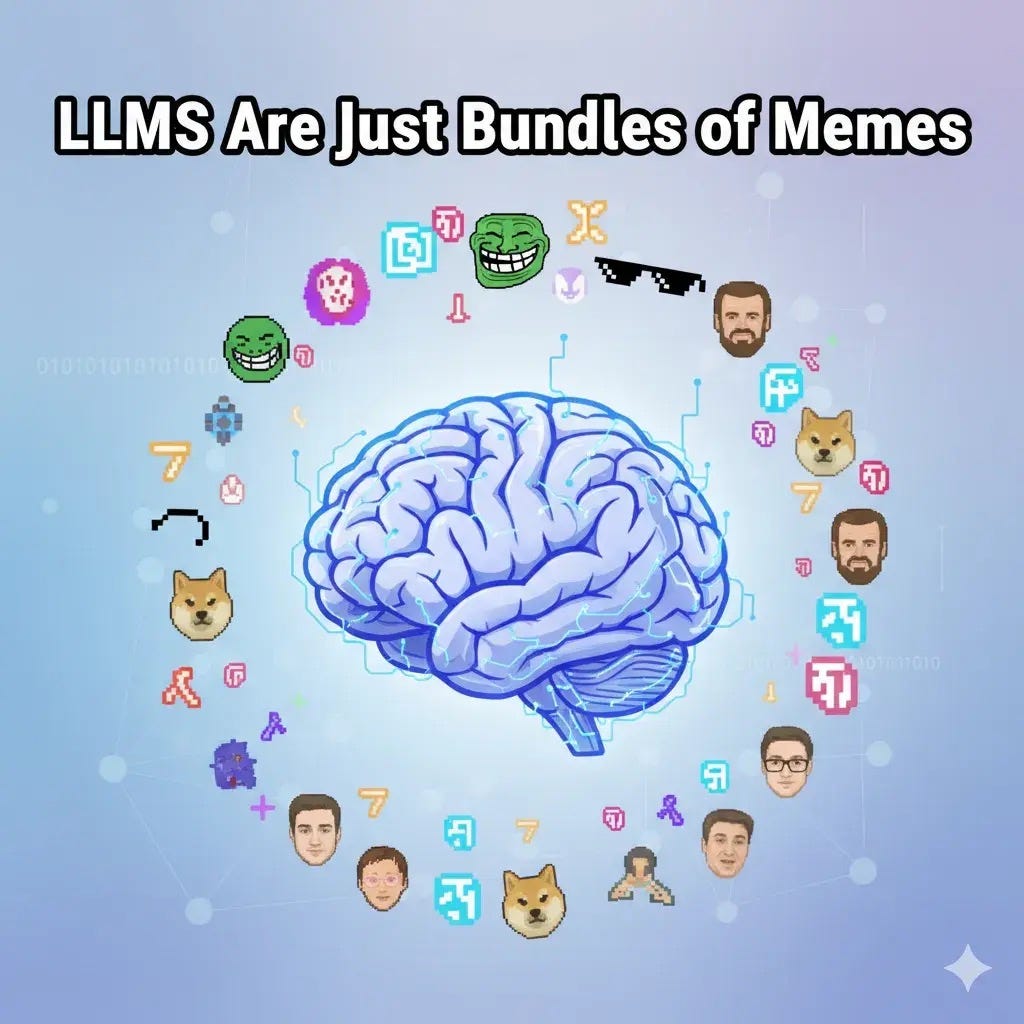
Fast forward almost fifty years, and we're building something that looks eerily similar. Large Language Models (GPT, Claude, Gemini, LLaMA) are not made of genes or DNA. So what are they made of? Memes. The patterns encoded in their parameters are compressed representations of human culture, distilled from trillions of words of text.
Think about it this way: if humans are combinations of genes, LLMs are combinations of *memes*.
Dawkins' "selfish gene" isn't literally conscious or greedy. It's shorthand for how certain patterns of information naturally outcompete others at replication. Genes that build better organisms spread. Memes that capture attention spread.
LLMs take this process digital. They're trained on our collective output, everything from academic papers to Reddit arguments, and they learn the statistical regularities that make language work. In doing so, they internalize millions of successful memes: linguistic motifs, reasoning shortcuts, cultural assumptions, even ideological biases.
So every generated answer is, in some sense, a remix of surviving memes. When you prompt an LLM, you're stirring the memepool and watching which fragments bubble up.
We started as DNA machines that learned to replicate genes. Then we became cultural animals that replicate memes. Now we're building artificial minds that replicate memes faster than we can follow them.
Maybe the story of intelligence (biological, cultural, or artificial) is just the story of information finding new substrates to copy itself. The selfish gene became the selfish meme. And now, perhaps, it's becoming the **selfish model**.