After you close the case, AirPods Pro can play a quiet burst of tones. Apple already confirms it as a self-check of the earbuds' speakers and microphones, added together with the hearing-health features (Hearing Test and Hearing Aid) in iOS 18.1. I took the sound apart and compared at how hearing devices are normally calibrated in a lab, to understand why AirPods do this trick.
Here the sound:
Since late 2024, owners of AirPods Pro 2 have been reporting a strange, faint "chime" coming from the closed charging case. It usually happens in a quiet room, a little while after the earbuds have been put away. One user on the Apple Community forum describes a "very quiet, high pitch tone" that happens "after the AirPods have been put back in their case and have been stationary for a while".
Apple answers the question in its own user guide:
"To help ensure that your AirPods microphones and speakers are operating at their best (for example, to help provide high-quality hearing test results), your AirPods may periodically play a quiet chime when they're in their charging case."
— Apple, Use hearing health features with AirPods Pro 2 or AirPods Pro 3
Note the wording! It is the AirPods that play the sound, not the case
The story was discussed it in several places:
News: MacRumors, heise, Macworld, TechRadar, BGR, nextpit, Apfelpatient, Michael Tsai's blog.
Forums: Apple Community – "Strange, quiet AirPods Pro chime", MacRumors Forums – quiet chime, with a recording in the thread, MacRumors Forums – "It's a Feature", Apple Community – "AirPods Pro 2 case chiming", Apple Community – beeps in intervals.
So the sound is real and intentional. The interesting questions are what it is made of and why it is needed.
All sound pictures below are spectrograms. Read them in the following way:
left to right is time;
bottom to top is the played frequencies;
darker means louder.
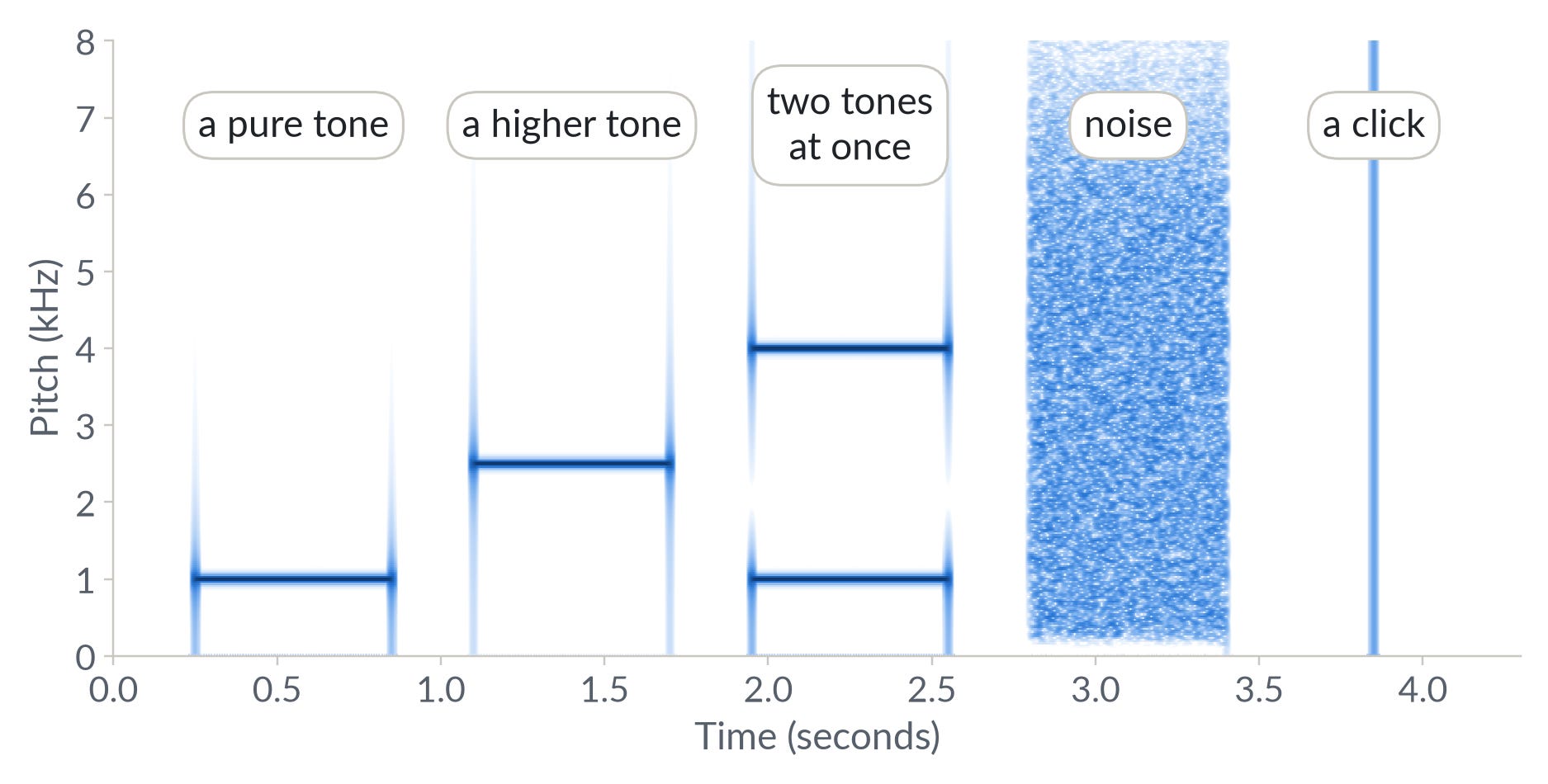
A few units you will meet:
Hz (hertz): vibrations per second, i.e. pitch. 1 kHz = 1,000 Hz, roughly a high whistle.
Pure tone: a sound with a single frequency and nothing else.
dB (decibel): a scale for loudness differences. +6 dB is about twice the sound pressure, and +10 dB sounds is about twice as loud.
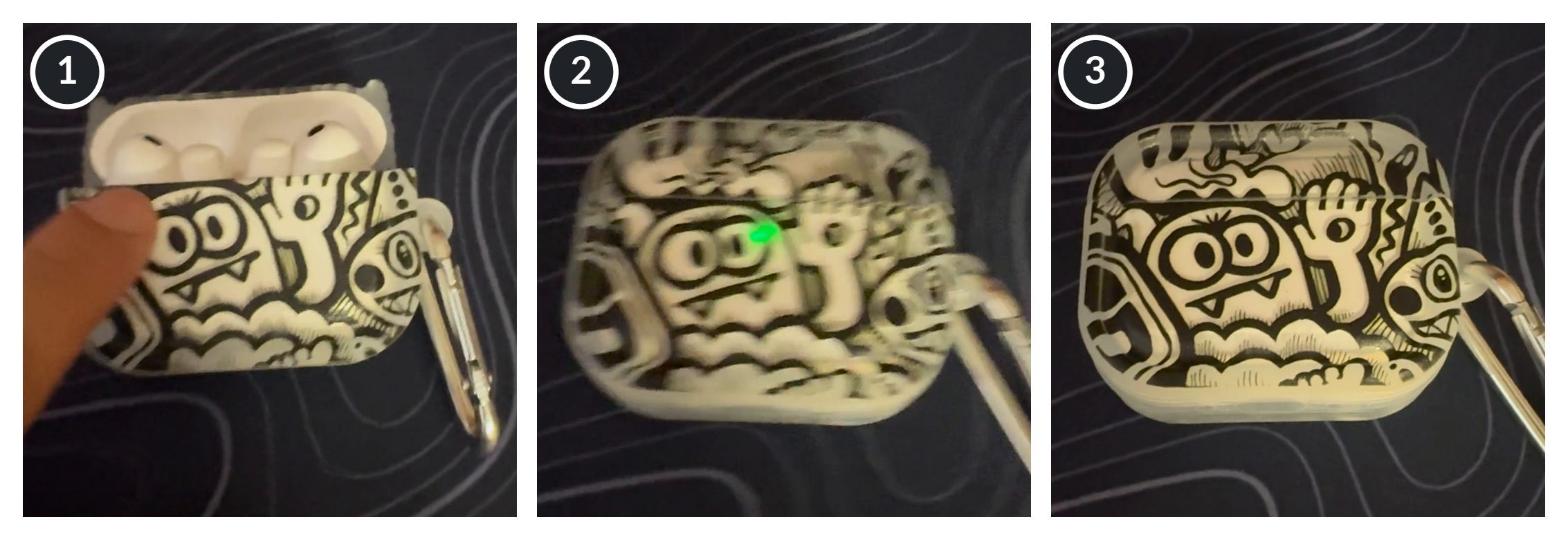
A short video shared on Reddit captures exactly this moment. Someone opens an AirPods Pro case, closes it, and leaves it alone on a desk. I extracted the soundtrack of that video and analysed it.
Here is the whole 27-second soundtrack as a spectrogram. I removed the steady background hum of the room so that anything new stands out:
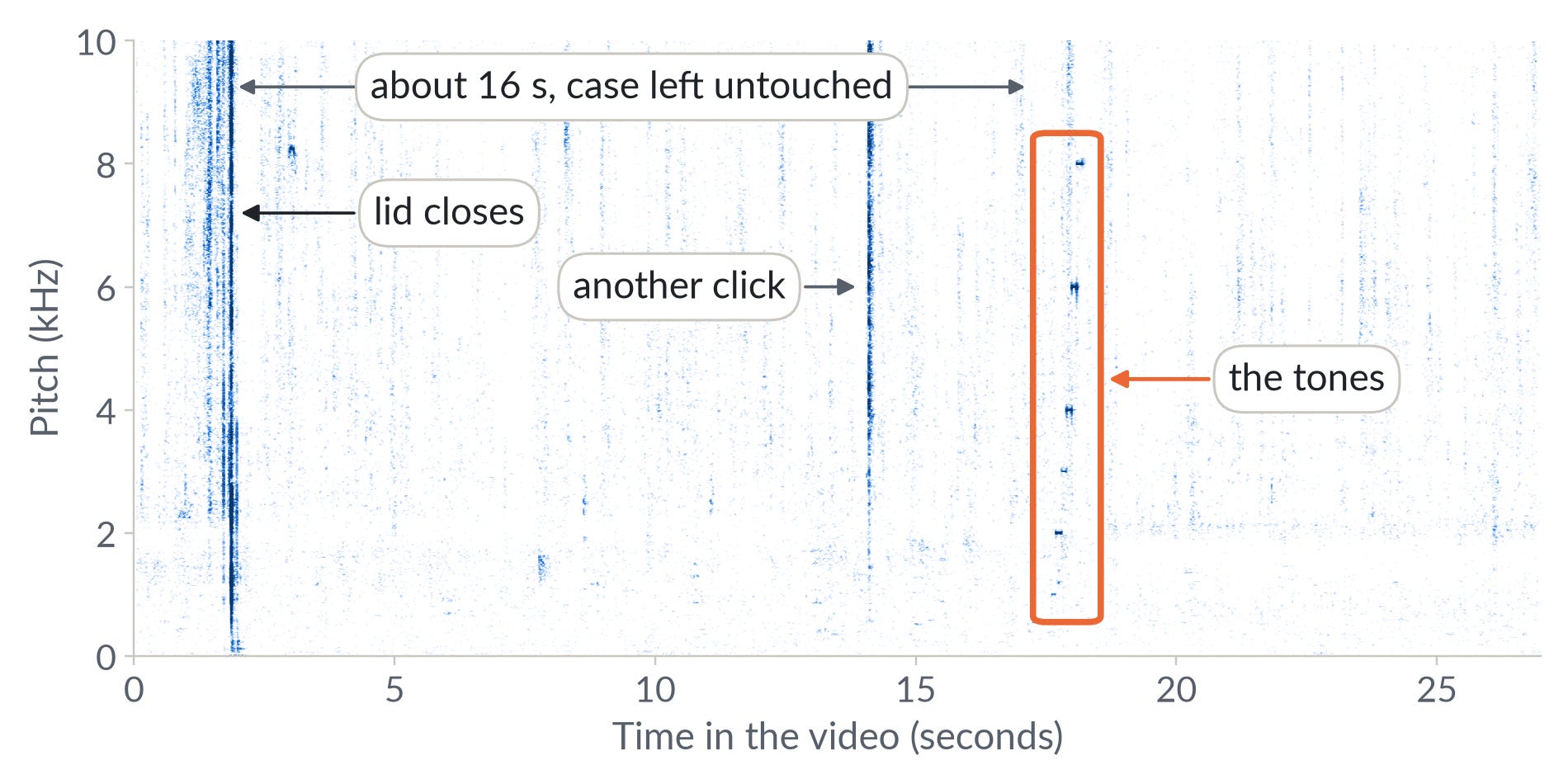
Zooming in on the orange box:
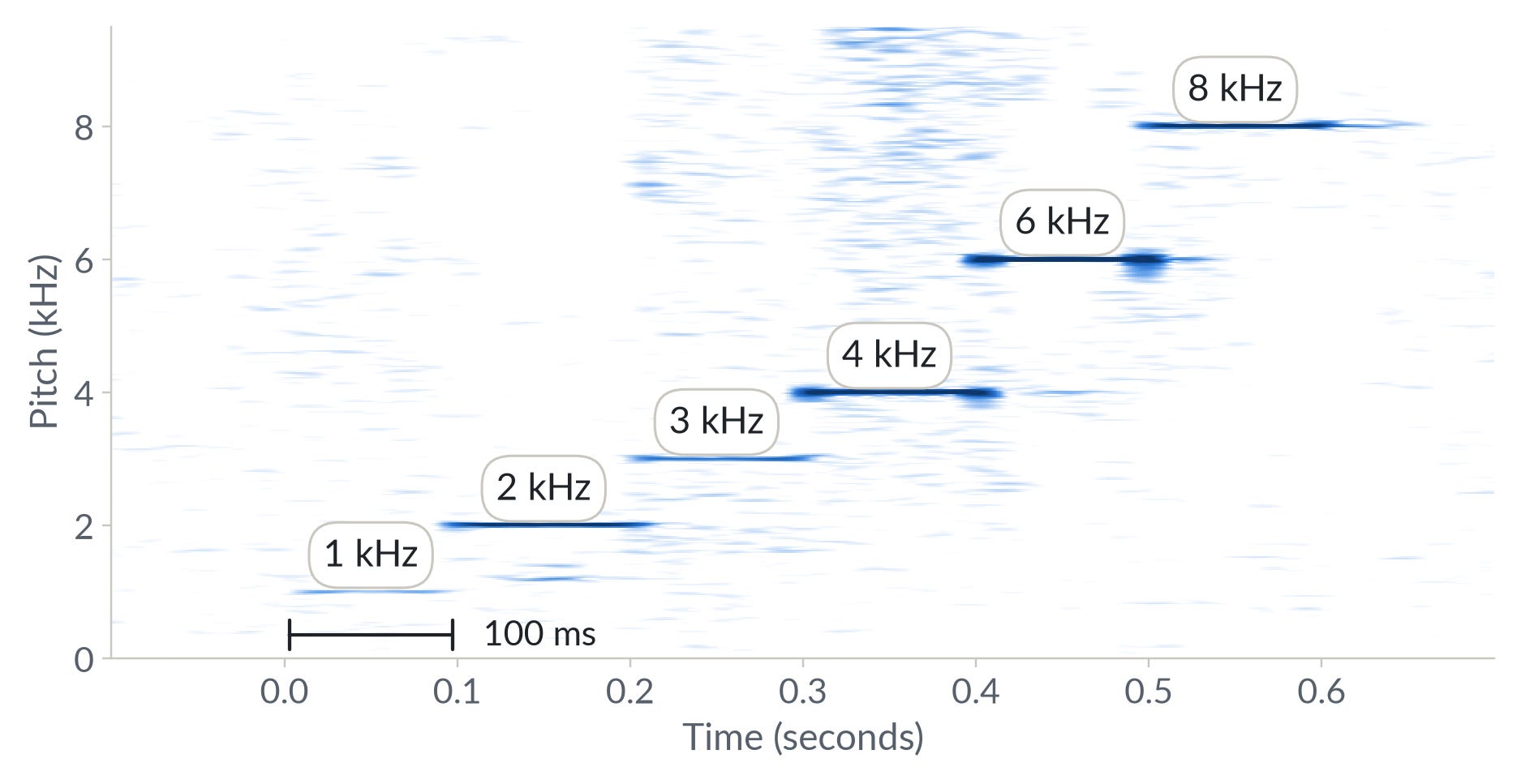
What the measurements show:
Exact round numbers. Every tone lands within about 1 Hz of its round value.
One tone at a time. In each 100 ms slot only that slot's pitch rises above the background.
No gaps, no fades. Each tone switches straight to the next one in less than 5 ms. The whole sequence lasts 0.6 seconds.
Very quiet. In the video the tones are barely above the room's background noise. Due to the AirPods case.
Played once. In the 27 seconds of video there is only one sequence.
The pitches are not random either: 1, 2, 3, 4, 6 and 8 kHz are standard frequencies of a clinical hearing test. Pure-tone audiometry, which also uses 125, 250 and 500 Hz, that maybe are not easy to capture by the phone or to reproduce with the AirPods.
To see why AirPods bother, we need to know what a hearing test needs.
A hearing test plays tones at different pitches, quieter and quieter, until you stop hearing them. The quietest tone you can hear at each pitch is your hearing threshold, and the chart of those thresholds is your audiogram.
This only works if the device knows exactly how loud each tone is at your eardrum. Imagine the earphone has lost 5 dB at 4 kHz. Every 4 kHz tone then arrives 5 dB quieter than the test believes. You stop hearing it sooner, and the test concludes that your hearing at 4 kHz is 5 dB worse than it really is. A hearing aid tuned from that result would then amplify the wrong amount.
That's why, in clinics and factories, earphones and hearing aids are calibrated with an artificial ear:
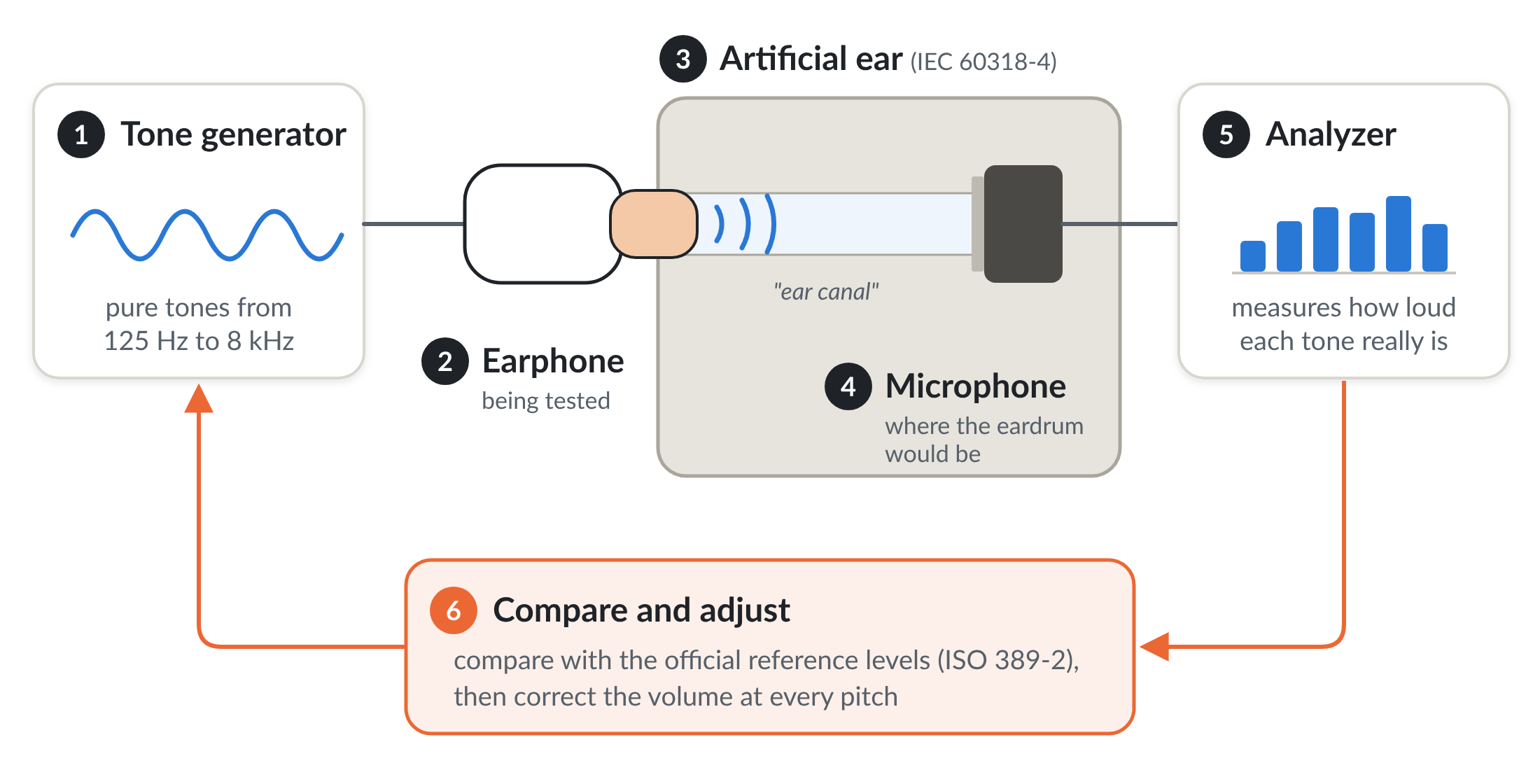
The main standards involved:
IEC 60318-4: the occluded-ear simulator, i.e. the artificial ear for earphones that sit in the ear canal.
ISO 389-2: the reference levels, i.e. how loud each test tone must be at the artificial ear for insert earphones.
ISO 8253-1: how hearing tests are performed, including routine checks of the equipment.
IEC 60118-0: how hearing-aid performance is measured.
In a clinic the equipment is not calibrated once and forgotten. ISO 8253-1 describes regular listening checks, periodic measurements and full calibrations, because earphones drift over time.
AirPods can't go back to the lab every week, or months, or year. But they carry something almost as good: their own case.
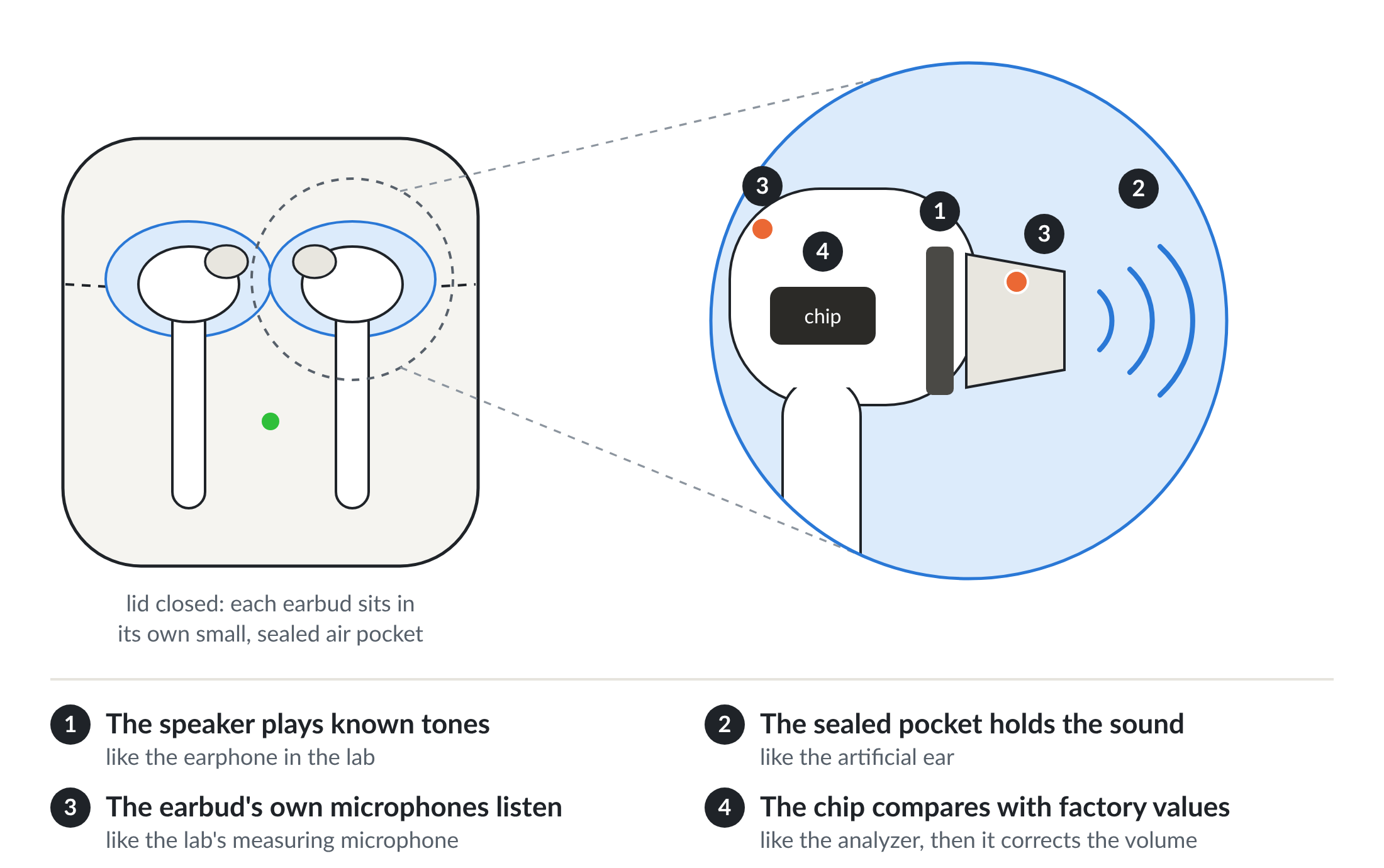
Every piece of lab equipment has a stand-in. The earbud's speaker replaces the lab earphone. The sealed pocket replaces the artificial ear. The earbud's own microphones replace the measuring microphone. The chip, comparing with values stored at the factory, replaces the analyzer and corrects the settings.
The test needs the right conditions, and they explain when you hear it:
Lid closed. The pocket must be sealed so it has the same shape and volume every time.
Not moving. Handling noise and bumps would spoil the measurement, and the lid must stay shut.
Quiet surroundings. The tones are very soft. Background noise would mix into the measurement. A soft test sound is also less likely to bother you.
A short wait. In the video it started about 16 seconds after the lid closed. Apple says it happens periodically, not every time the lid closes.
In my experience the sound shows up especially at night, and that fits the conditions above. At night the AirPods are put away, the case sits still, and the room is at its quietest, which is both when the test can run and when you are most likely to notice it.
What could the test find? Here is an example with random numbers. Imagine that earwax partly blocking the speaker and steals the high pitches.
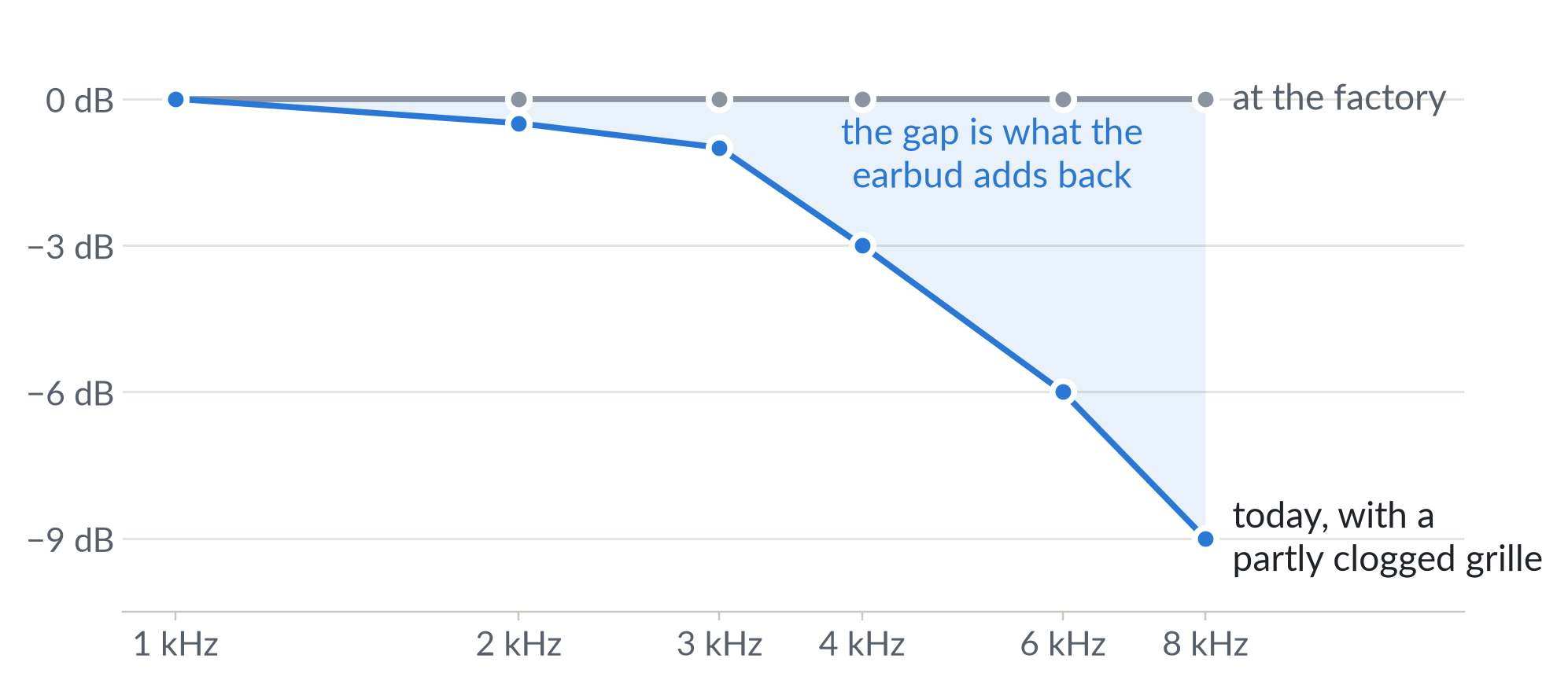
In practice, a check like this can catch:
a speaker or microphone that is getting less sensitive with age or humidity;
a grille blocked by dust or earwax;
a damaged speaker, which distorts the tones;
a mismatch between the microphones, which matters for noise cancellation, Transparency mode and calls.
Engineers at other companies have described the some similar ideas. A Bose patent plays test signals from the earpiece's driver into the cavity of the storage case and measures them with the earpiece's own microphones, then adjusts microphone and driver sensitivity. A Google patent describes "a tone of a certain frequency, a sweeping range of tones of various frequencies, or pink noise" played in a closed case to calibrate speaker, microphone and noise-cancellation gains. Research also shows why this matters: Guo et al. (2021) ran hearing tests with consumer true-wireless earbuds and had to calibrate them carefully to get reliable results.
Apple and regulators
Apple – Use hearing health features with AirPods Pro 2 or AirPods Pro 3
Apple – Charge your AirPods (includes how to turn off charging case sounds)
U.S. FDA – FDA Authorizes First Over-the-Counter Hearing Aid Software (12 September 2024)
News coverage
MacRumors – Hearing a Mysterious Chime From Your AirPods Pro Case? It's a Feature
heise – AirPods Pro 2: Why a quiet noise has recently been heard in the case
Macworld – Did your AirPods case just beep? Here's why
TechRadar – Wondering why your AirPods Pro case has started chiming?
BGR – Hearing A Mysterious Beep From Your AirPods Pro? Here's What It Is
Apfelpatient – Quiet sounds from the AirPods Pro 2 charging case
Michael Tsai – AirPods Pro Case Chime Sound
Forums, recordings and sound collections
Apple Community – Strange, quiet AirPods Pro chime
YouTube Short linked from that thread – 5QqEkJGbhSI (appears to be no longer available)
MacRumors Forums – Why do AirPods Pro 2 make a quiet chime (recording now in thread)?
MacRumors Forums – Hearing a Mysterious Chime… It's a Feature
Apple Community – AirPods Pro 2 case chiming
Apple Community – 2nd gen AirPods Pro case makes beeps in intervals and flashes green
AirPodNoises.net – "Mic Diagnostic Test" clip
Accidental Tech Podcast – Episode 622, "Duplicate Garbage Generation Process" (14 January 2025)
Patents and research
Bose – US10764699B1, Managing characteristics of earpieces using controlled calibration
Google – US11026034B2, System and method for self-calibrating audio listening devices
Guo et al., Trends in Hearing (2021) – Utilizing True Wireless Stereo Earbuds in Automated Pure-Tone Audiometry
Standards mentioned (not freely available online): IEC 60318-4 (occluded-ear simulator), ISO 389-2 (reference levels for insert earphones), ISO 8253-1 (audiometric test methods), IEC 60118-0 (hearing-aid measurements).
The video frames come from a video shared on Reddit. The spectrograms were made from that video's soundtrack, and the drawings are schematics, not to scale.