Astronomers' Appeal

25 min read Original article ↗

Safeguarding the Astronomical Sky (IT)

paper_I_arXivpaper_II_(arXiv) -> the FULL paper <- press EN_PDFpress IT_PDF

THIS APPEAL HAS BEEN SIGNED BY

2107+ ASTRONOMERS

VIEW SIGNATURES

(the refresh rate of the counter may slow down).

To sign/subscribe follow this link.

This is an international appeal by professional astronomers open for subscription to ask for an intervention from institutions and governments.

Astronomical observations from the ground can be greatly harmed by the ongoing deployment of large satellite fleets in preparation for the next generation of telecommunications.

For centuries the astronomical observations from the ground have led to exceptional progress in our scientific understanding of the Laws of Nature. Currently, the capability of astronomical instrumentation from the ground is endangered by the deployment of satellites fleets.

Through this international appeal and following the same concerns expressed by the International Astronomical Union, IAU [1] and other institutions, we raise a formal request for greater effective protection and safeguard for professional astronomical observations from the ground, guaranteeing the right to observe a sky free from unnecessary artificial polluting sources.

In particular, all the signers, astronomers and collaborators wish to manifest humanly and personally their worry and contrariety to the sky coverage produced by artificial satellites, which represent a dramatic degradation of the scientific content for a huge set of astronomical observations.

The sky degradation is not only due to light pollution in the sky near cities and the most populated areas, but it is also due to artificial satellite fleets crossing and scarring observations with bright parallel streaks/trails at all latitudes.

Astronomers are extremely concerned by the possibility that Earth may be blanketed by tens of thousands of satellites, which will greatly outnumber the approximately 9,000 stars that are visible to the unaided human eye. This is not some distant threat. It’s already happening. The american private company SpaceX has already put 180 of these small satellites, collectively called Starlink, in the sky and plans to constellate the whole sky with about 42,000 satellites (placed at three different quota: 340km, 550km and 1150km). Thus, together with other telecommunication space projects in the near future (i.e. the English OneWeb, the Canadian Telesat, the American Amazon, Lynk and Facebook, the Russian Roscosmos and the Chinese Aerospace Science and Industry corp), there could be over 50,000 small satellites encircling the Earth (at different altitudes) for various telecommunication purposes but mainly delivering internet.

These new satellites are small, mass-produced, and orbit very close to the Earth with the intent to provide speedy internet connection with low-latency signals. But that closeness (~340Km) also makes them more visible, and brighter in the night sky especially when lighted by the Sun (satellites launched by SpaceX, 180 at the present day, are brighter than 99 percent of the population of objects visible by the Earth orbit ).

The current total number of cataloged objects in Earth orbit is less than 20,000 among spacecrafts, rocket bodies, fragmented mission and other related debrids, so with only the nominal Starlink fleet the total number of orbiting objects will triple (see pictures).(*)

In the mid and long term, this will severely diminish our view of the Universe, create more space debris, and, deprive humanity of an unblemished view of the night sky. It has been computed that most of these satellites will be visible to the naked eye (with a brightness between the 3rd and 7th magnitude particularly in the time after sunset and before sunrise, reaching the brightness of the stars in the Ursa Minor constellation (e.g. there are only 172 stars in the whole sky exceeding the expected brightness of Starlink satellites). Thus with 50k satellites the “normality” will be a sky crowded with artificial objects (every one square degree of the sky will have a satellite crawling in it along the whole observing night).

Not only observations with wide-field survey telescopes will be damaged (e.g. LSST [2] capable to scan and perform a survey of the entire sky in three nights or VST [3] with its 268MegaPixels camera and a FOV of 1 square degree or Pan-STARRS [4] with its FOV of 7 square degrees and 1.4 Giga pixels camera, …), but also deep/long exposures with small-field facilities will be unavoidably impaired, see picture and [7].

Considering that large area astronomical observations and sky survey are commonly used in NEO and asteroids monitoring and research related projects to guard the Earth planet from potential impact events, such satellite constellations could negatively impact on the ability to prevent and warn the whole humankind.(*)
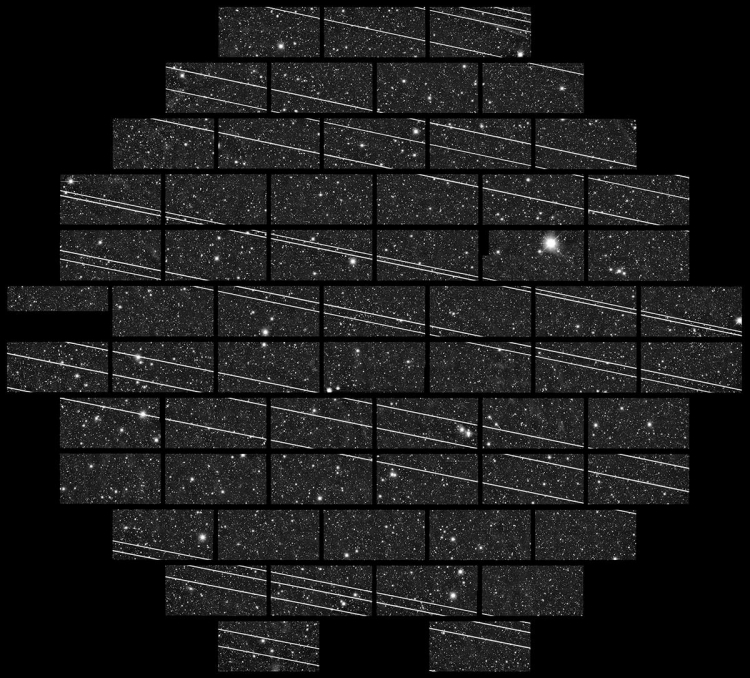
Few starlink satellites visible in a mosaic of an astronomical image (NSF’s National Optical-Infrared Astronomy Research Laboratory/NSF/AURA/CTIO/DELVE)

This light pollution is extremely damaging for astronomical observations at all wavelengths. The recent attempt to use non-reflecting paint on the body (i.e. not the solar panels which represents 75% of the reflecting surface) of one of the Starlink satellite (n.1130 DARKSAT), see [8], even if their brightness would reduce to zero (which is impossible since the solar panels, which represent 3/4 of the reflective surface, would remain uncovered), the degradation for scientific observations will remain high for two reasons: 1) the stars and other objects in the universe will be eclipsed, therefore harming time-dependent (variability) studies, and,  2) the reflectivity of surface depends on the observational wavelength, so what becomes dark in one part of the spectrum (e.g. visible) remains bright or shines in other parts of the spectrum  (e.g. infrared or radio).(**)

It should also be noted that during nominal service operations SpaceX expects to dismiss and replace from 2,000 to 8,000 Starlink satellites every year, disintegrating them in the lower atmosphere, with all related issues.(*)

What is not widely acknowledged is that the development of the latest generation telecommunication networks (both from space and from Earth) already has a profound impact on radio-astronomical observations (at all sub-bands): with LEO satellite fleets it is feared that the situation will become unbearable.

In particular, low Earth orbit satellite’s spectral windows identified to communicate with earth stations in the Ku (12-18GHz), Ka (27-40GHz) and V (40-75GHz) bands will overlap with the nominal radio-astronomy bands and so will interfere with ground radio telescopes and radio interferometers, making the radio detectors enter in a non-linear regime in the K band (18.26.5GHz) and in Q band (33-50GHz). This fact will irreparably compromise the whole chain of analysis in those bands with repercussions on our understanding of the Universe, or even, making the astrophysics community blind to these spectral windows.

To aggravate the matter, with the current technological development, the planned density of radio frequency transmitters is impossible to envisage. In addition to millions of new commercial wireless hot spot base stations on Earth directly connected to the ~50,000 new satellites in space, will produce at least 200 billion of new transmitting objects, according to estimates, as part of the Internet of Things (IoT) by 2020-2022, and one trillion of objects a few years later. Such a large number of radio-emitting objects could make radio astronomy from ground stations impossible without a real protection made by countries’ safe zones where radio astronomy facility are placed. We wish to avoid that technological development without serious control would turn radio astronomy practice into an ancient extinct science.

FOR ALL THESE REASONS

We, astronomers subscribing to this appeal state THERE IS NO MORE TIME TO DISCUSS, IT IS TIME TO ACT!

ASK GOVERNMENTS, INSTITUTIONS AND AGENCIES ALL AROUND THE WORLD

  1. to be committed to provide legal protection to ground astronomical facilities in all of the available observation electromagnetic windows.
  2. to put on hold further Starlink launches (and other projects) and carry out an accurate moratorium on all technologies that can negatively impact astronomical observations from space and from the ground, or impact on the scientific, technological and economic investments that each State engages in astrophysical projects.
  3. to put in place a clear evaluation of risks and predictive impacts on astronomical observatories (i.e. loss of scientific and economic value), giving stringent guidelines to private individuals, societies and industries to plan satellite investments without clearly understanding all of the negative effects on outstanding astronomical facilities.
  4. that the US Federal Communications Commission (FCC) and any other national agency be wary of granting permission to ship non-geostationary low-orbit  satellites into orbit or alternatively to limit the authorization of only satellites  being above the airspace of the “home country”.
  5. to demand a worldwide orchestration, where national and international astronomical agencies can impose the right of veto on all those projects that negatively interfere with astronomical outstanding facilities.
  6. to limit and regulate the number of telecommunication satellite fleets to the “strictly necessary number” and to put them in orbit only when old-outdated technology satellites are deorbited, according to the Outer Space Treaty (1967) – the Art IX [5], and the United Nations Guidelines for the Long-term Sustainability of Outer Space Activities (2018) – guideline 2.2(c) [6], requiring the use of outer space be conducted “so as to avoid [its] harmful contamination and also adverse changes in the environment of the Earth” and […omissis…] risks to people, property, public health and the environment associated with the launch, in-orbit operation and re-entry of space objects”.

FINALLY

All of these requests come from the heartfelt concern of scientists arising from threatens to be barred from accessing the full knowledge of the Cosmos and the loss of an intangible asset of immeasurable value for humanity. In this context, all co-signers of this appeal consider ABSOLUTELY NECESSARY to put in place all possible measures to protect the night sky right also on the legal side. It would be desirable to adopt contingent and limiting resolutions to be ratified with shared international rules, which must be adopted by all space agencies to ensure protection for astronomical bands observable from the ground. All of this to continue to admire and study our Universe, for as long as possible.

References:

[1]  https://www.iau.org/https://www.iau.org/news/announcements/detail/ann19035/?lang

[2]  https://www.lsst.orghttps://en.wikipedia.org/wiki/Vera_C._Rubin_Observatory

[3]  https://www.eso.org/public/https://en.wikipedia.org/wiki/VLT_Survey_Telescope

[4]  https://panstarrs.stsci.edu/

[5]  https://www.unoosa.org/oosa/en/ourwork/spacelaw/treaties/introouterspacetreaty.html

[6]  https://www.unoosa.org/res/oosadoc/data/documents/2018/aac_1052018crp/aac_1052018crp_20_0_html/AC105_2018_CRP20E.pdf

[7] Simulated prediction of “only” 12k Starlink satellites in the sky: https://youtu.be/LGBuk2BTvJE and https://www.youtube.com/watch?v=z9hQfKd9kfA

[8] Visualization tool to find, plot and search satellite orbits: https://celestrak.com/cesium/orbit-viz.php?tle=/satcat/tle.php?INTDES=2020%2D001&satcat=/pub/satcat.txt&orbits=20&pixelSize=3&samplesPerPeriod=90

This appeal/petition can be signed by professional Astrophysicists & Astronomers, Technologists/Engineers , Collaborators & PHD Students involved in professional astronomical observations.

Note that (*) Such a sentence was added the 13/01/2020.

Note that (**) Such a sentence was added the 16/01/2020.

To sign/subscribe this appeal/petition you can follow this link.

In the meanwhile in California…

That was the reason why we claim from the beginning to sue in the ICJ (International Court of Justice) and not to a US Federal Court, because US army intensively uses the SpaceX / STARLINK infrastructure so there was no possibility to have an independent judgment from an US Court. The only possibility should have been to point out the non-compliance of the Pacific Use of Outer Space UN Regulation.

In the meantime spaceX has more than 6thousand satellites orbiting in LEO and now astronomers think to Appeal tò a supreme Court?

There Is no way!

The SKY is actually LOST and the fault IS OUR!

Let’us hang our profession tò a nail on the wall!

Astronomers Lose in Court

=======================

Last Friday, July 12, 2024, a 3-judge panel of the U.S. Court of Appeals for the D.C. Circuit gave the green light to SpaceX to keep on destroying our night sky and filling our atmosphere with metallic dust and toxic chemicals.

On December 29, 2022, the International Dark-Sky Association, representing astronomers all over the world, had appealed the decision of the Federal Communications Commission to grant SpaceX a license to launch up to 30,000 more satellites without performing an environmental review. See my newsletter of April 30, 2024 for details.

In Friday’s decision, the court ruled that satellite launches and deployment, no matter how many, “are deemed individually and cumulatively to have no significant effect on the quality of the human environment and are categorically excluded from environmental processing.”

The astronomers have 45 days to decide whether to appeal the 3-judge panel’s decision to the full 15-member Court of Appeals. Even if they do not do so, they can still appeal the panel’s decision to the U.S. Supreme Court within 90 days.

Here is the court decision:

We have only one possibility here: that the claimed military use will lead other countries to trigger the Kessler’s Syndrome through a LEO Explosion. No other way out!

link: https://www.universetoday.com/163552/starlinks-are-easily-detected-by-radio-telescopes/

Three images of Starlink satellites detected at 137.5 MHz. Credit: Grigg, et al

Radio astronomy and satellite communication have a long common history. Advances made in one field have benefitted the other, and our modern era of spacecraft and mobile internet is a product of this partnership. But there are times when the goals of radio astronomy and the goals of communication satellites are in opposition. This is most clearly seen in the development of satellite constellations such as Starlink.

The Starlink constellation differs from earlier communication networks in that it consists of a large number of satellites in low orbit. Currently, there are about 5,000 Starlink satellites, but that number could grow to 40,000 in the next decade. With low orbits, the latency between satellite and ground-based receivers is small, making it more effective for internet communication. And with thousands of satellites, you can access the network from almost anywhere on the planet. But Starlink will make radio astronomy more challenging, as a recent study shows.

This new work is based on test data for the Square Kilometer Array (SKA), which is a radio telescope designed to capture high-resolution images at low radio frequencies. SKA has several science goals, ranging from testing general relativity to mapping neutral hydrogen throughout the cosmos, to studying the atmospheres of potentially habitable exoplanets. It’s being constructed in radio-quiet regions of Australia and South Africa and has the potential to revolutionize our understanding of the early Universe.

Since SKA will capture large sections of the sky at once, Starlink satellites will be in almost every image it gathers. The authors analyzed data from the Engineering Development Array version 2 (EDA2), which is a prototype array for SLA-Low. Even without the sensitivity of the full SKA array, the team detected radio emissions from Starlink that were both intentional and unintentional. In some cases, the emissions were brighter than the brightest sky objects at low frequencies.

While intentional signals can be mitigated through exclusion zones, where Starlink avoids transmitting when in an observatory’s field of view, the unintentional signals are troubling. It is notoriously difficult to shield low-frequency emissions, and any mitigation implemented would only apply to future satellites. The authors conclude that stray signals from Starlink could significantly impact some of the research goals for SKA.

This is not the first time that stray radio signals from Starlink have been detected. An earlier study based on LOFAR also found unintended signals from several satellites. As radio observatories continue to become more advanced and more sensitive, dealing with radio light pollution from satellites. That means we will need to make some hard choices about where the balance is between the convenience of satellite internet and the exploration of the radio sky.

Starlink launches first “cellphone towers in space” for use with LTE phones

T-Mobile field tests begin soon—texting to be available before voice and data.

SpaceX last night launched the first six Starlink satellites that will provide cellular transmissions for customers of T-Mobile and other carriers.

SpaceX said it launched 21 satellites overall, including “the first six Starlink satellites with Direct to Cell capabilities that enable mobile network operators around the world to provide seamless global access to texting, calling, and browsing wherever you may be on land, lakes, or coastal waters without changing hardware or firmware. The enhanced Starlink satellites have an advanced modem that acts as a cellphone tower in space, eliminating dead zones with network integration similar to a standard roaming partner,” the company said.

Besides T-Mobile in the US, several carriers in other countries have signed up to use the direct-to-cell satellites. SpaceX said the other carriers are Rogers in Canada, KDDI in Japan, Optus in Australia, One NZ in New Zealand, Salt in Switzerland, and Entel in Chile and Peru.

While SpaceX CEO Elon Musk wrote that the satellites will “allow for mobile phone connectivity anywhere on Earth,” he also described a significant bandwidth limit. “Note, this only supports ~7Mb per beam and the beams are very big, so while this is a great solution for locations with no cellular connectivity, it is not meaningfully competitive with existing terrestrial cellular networks,” Musk wrote.

Starlink’s direct-to-cell website says the service will provide text messaging only when it becomes available in 2024, with voice and data service beginning sometime in 2025. Starlink’s low Earth orbit satellites will work with standard LTE phones, unlike earlier services that required phones specifically built for satellite use. SpaceX’s direct-to-cell satellites will also connect with Internet of Things (IoT) devices in 2025, the company says.

T-Mobile plans field testing “soon”

T-Mobile said that field testing of Starlink satellites with the T-Mobile network will begin soon. “With well over half a million square miles of the US and vast stretches of ocean unreachable by terrestrial network coverage, due to terrain limitations, land-use restrictions and more, this new service aims to give customers a crucial additional layer of connectivity when and where they need it most,” T-Mobile said.

T-Mobile noted that yesterday’s SpaceX launch was “the first of many” to include Starlink satellites with cellular capabilities, but was vague on when exactly the different components of direct-to-cell service will become available to customers. “Initially, the service will begin with text messaging, with voice and data coverage to follow in the coming years,” T-Mobile said.

The SpaceX/T-Mobile partnership was announced in August 2022. At that time, Musk said it could provide beta service before the end of 2023. The companies said in March 2023 that they were still planning to test the service before the end of the year, but it later became clear that it wouldn’t happen until 2024.

Link: https://arstechnica.com/tech-policy/2024/01/spacex-launches-first-starlink-satellites-that-will-work-with-t-mobile-phones/

Link: https://www.theparliamentmagazine.eu/news/article/good-heavens

The swarms of satellites in low-Earth orbit are causing light and noise pollution, which is in turn creating ecological chaos

Scientists predict that, by the time children born in 2023 become adults, they will be able to see fewer than half the stars in the sky that we see today. 

The reason? Each year, the night sky around the world is becoming about 10 per cent brighter, from the effects of satellites, growing urbanisation and more and more lights on the ground, according to a study published in Science Magazine this year.  

The growing brightness of the skies, particularly the kind created by roaming satellites, poses a problem for astronomers, whose telescopes need minimal light and sound interference to collect images and data. The brightness is also a threat to the natural cycles of humans, animals and plants, and, of equal importance, to the simplest of treats: the ability to look up and see a velvet sky blanketed with sparkling stars.  

The situation has become concerning enough that scientists, government officials and activists have banded together in a battle to keep at least some portion of the Earth’s skies dark and quiet.  

“If this problem isn’t controlled, the night sky is going to really change,” says Dr Andrew Williams, external relations officer at the European Southern Observatory, which has its headquarters in Garching, Germany. Dr Williams is also the co-lead of the policy hub of the International Astronomical Union’s Centre for the Protection of Dark and Quiet Skies From Satellite Interference, or the IAU CPS, of which the European Southern Observatory is a contributing member.  

light pollution
Illustration by Bernard Leonardo for The Parliament

Dr Williams adds: “This is a bit sad if you think about the impact the night sky has had on our society, from our timekeeping systems to modern agriculture practices, and religious practices still maintained by many indigenous societies.”  

The sources of this growing light pollution are both ground and sky-based. Scientists have been studying ground-based light pollution for years and have developed various methods for mitigating its effects on the environment, including putting timers on lights so they are either switched off or dimmed while people sleep; placing shields around light sources to prevent diffusion; and directing the lights to shine where they are needed, often towards the ground.  

Dr Richard Green, an astronomer and the assistant director for government relations at the Steward Observatory at the University of Arizona in the United States, says his observatory works with local governments to find ways to reduce their light pollution. For example, the city of Flagstaff in Arizona has established a curfew for commercial signs, and uses streetlights that emit light only in specific portions of the light spectrum. Cities including Pittsburgh and Tucson have followed, instituting their own dark skies ordinances.  

But although there are established ways to mitigate light pollution from ground sources, the skies are a different story. Above us, where there were once a few thousand large satellites stationed many thousands of kilometres away from the ground, there are now swarms of small, constantly moving, low-Earth orbit satellites.  

Let’us take a look to this image!

This incredible image is made up of 343 photos. The author recounts: “In late January I went to the Pinnacles, Western Australia, to take pictures of the stars. After checking my photos, I noticed an unusually large amount of lines in my photos. There were satellite trails visible in almost all photos of more than 3 hours of footage. Instead of trying to get rid of them, I decided to combine the satellite traces into one image to show how polluted the night sky is.”

Crediti: Joshua Rozells (Instagram: @joshua_rozells)

What about a constellation of more than 100 satellites that will enhance the diffuse night glower to unprecedented level…?

This is not alarming this is the END for Astronomy!

This is the comparison of apparent magnitudes observed the 24 november after the deployment of BlueWalker antennas and the blue distribution taken the 11 november before the deployment. The difference is 40-times in brightness! Credits Anthony Mallama.

The brightness distribution depend on the Phase angle of the satellite’surphace respect the Sun orientation and the observer. Let’us think on flares coming directly where the Sun light is directly reflected in front of the observer…!

Credits Anthony Mallama.

Links & References: “Visual Magnitude of the BlueWalker 3 Satellite” Anthony Mallama, Richard E. Cole, Scott Harrington, Paul D. Maley -> https://arxiv.org/abs/2211.09811

AST Space Mobile plans to send into orbit six BlueWalker 3 satellites each month! For a total of more than 100 satellites at an altitude between 500 and 600Km above sea level and emitting radiation in the L and V band (from 400MHz and 800MHz to 40-50GHz).

These satellites will be directly connected to the Starlink constellation in order to provide mobile connection directly to final users without passing through radio stations on the Earth surface. The STARLINK CEO Elon Musk already admit that there is a statement of understanding with Apple in order to modify apple phones to directly connect to satellites signal… a portable, mobile microwave owen in your pocket!

In the meantime IAU found the BlueWalker program (only 6 months after us) and released a new statement against these constellations! Well done… Now AST Space Mobile, SpaceX Apple and all other stuff will be extremely scared!

Here is the link: https://www.iau.org/news/pressreleases/detail/iau2211

In the meatime 2nd generation of starlink satellites will be 2 times bigger with a luminosity 4 times greater… bye bye ground based RADIO ASTRONOMY!

Here we are!

The LSST-Vera Rubin Observatory at sunset

Here we have one of the best astronomical ground based observatory, which is called Vera Rubin (LSST) Observatory: it is a very large area FOV telescope located in Cerro Pachon (north of Chile) at an altitude of 2600m. and for this reason it is considered the most damaged telescope by the trails of telecommunications satellites.

We knew that a dedicate conference it will take place in Rome in October: the LSST europe-4 group has organized a conference to talk about the project, but the conference will be crippled by the political impossibility of talking about what will surely compromise the scientific content of this telescope observations.

The reason is that to focus a conference slot or create a round-table on treats generated by the satellite constellations (not only by Starlink@SpaceX constellation) could have created frictions between colleagues, especially those Americans who do not see any problems in this regard!

Considering that Starlink is currently used as military asset in US “peace-keeping” military campaigns it is clear that US astronomers are unable (or warned) from taking a position, regardless of their professional ethics: they should say “with LSST we will do science even if we have to invent astronomical images from scratch!”

from this monitoring video of LSST of 16August 2020, the number of orbiting starlink satellites has increased by a factor of 6 since then (currently there are ~2500 orbiting satellites) and 420 were in the 2nd week of august 2020. In order not to alarm public and private investors, they immediately stopped making these kind of videos!

The LSST project cost is more than $ 350 million and so an inert astronomical community in the face of such scientific damage will eventually have to account for all this wasted public money without doing anything!

These considerations should be extended to any astronomical ground based facility, especially those built up with public investments from all around the World.

NASA’s APOD: Image Credit & Copyright: Joshua Rozells

During a panel discussion held at the 240th meeting of the American Astronomical Society, scientists discussed the scientific impact of the Starlink satellite constellations, demonstrating concern that the last 53 satellites launched are brighter than the previous ones and that the second ones. generation will be significantly larger and potentially brighter.

While from NASA’s Kennedy Space Center launch pad 39A on Friday, June 17, SpaceX put another 53 Starlink satellites into orbit – bringing the total number of Starlink satellites in orbit to over 2450 – on the other side of the United States of America. , in Pasadena, astronomers had devoted a round table of the 240th meeting of the American Astronomical Society just a few days earlier to discuss the scientific impact of these constellations of satellites.

Scientists fear that Elon Musk’s company decides to pull the oars in the boat in an effort to reduce the brightness of its satellites. The fear is dictated by the fact that they found that the last 53 satellites are different from the previous ones. In fact, this is version 1.5, in which the visors present in the satellites launched in 2020 have not been installed to prevent sunlight from reaching reflective surfaces and therefore reduce their brightness from the ground. The decision to remove the visors was dictated by the fact that they were not compatible with the laser inter-satellite links installed on version 1.5.

An increase of more than 1 visual magnitude because of the remove of the “visor” in the visorsat configuration.

Our comment:

We could only reiterate that Starlink has always given a damn about astronomers and has only done what was convenient for him to avoid hitches, revocation of authorizations, etc. Today with the war we have understood (we hope so) that that fleet of satellites is certainly not used for commercial purposes. And … Consequently, the problem will not be solved by the IAU or the AAS or RAS… , but Russia will solve it by triggering a chain reaction by destroying those that are in effect spy satellites.

It is a total fail of the Astronomical world wide institutions and it could be represent the end of astronomical ground based observation…

But only mad people (and children) could believe to lobbysts!

Other References:

https://gizmodo.com/starlink-spacex-satellites-astronomy-1849076758

https://www.cnn.com/videos/world/2022/06/11/satellite-pollution-threatens-night-sky-fisher-pkg-ndwkd-vpx.cnn

The irradiation of Heaven and Earth continues to accelerate, as SpaceX marches ever more quickly toward a constellation of 42,000 satellites. It launched 53 satellites on May 13; 53 more on May 14; and 53 more on May 18. And it has reached agreement with UK-based OneWeb, which plans its own fleet of 7,088 satellites, on how to share the skies. OneWeb will sell its services to telecommunications providers, governments, airlines, and ships, while SpaceX will sell to individuals.

OneWeb, which was launching its satellites from the Russian-operated Baikonur Cosmodrome in Kazakhstan, has been forced to temporarily halt its launches because of the war in Ukraine. But it is expected to resume launching satellites shortly. As part of its agreement with SpaceX, OneWeb’s satellites will be launched from the United States on SpaceX’s Falcon 9 rockets going forward.

Honey bees, birds, whales and trees the world round, their future in peril, are depending on the human race to wind down, and get rid of, their satellites, their antennas, and the devices that are creating the demand: their mobile phones. And people from many countries are beginning to organize together to spread that message widely. Stay tuned.

References: https://oneweb.net/resources/oneweb-resume-satellite-launches-through-agreement-spacex