Introduce OSDK
Asterinas Operating System Development Kit (OSDK) helps OS devs to create, build, run, and test Rust projects for OS kernels effortless. Imagine crafting kernels with the same simplicity as apps!

Jump start

Crate reuse

Rapid testing

Safe coding

Jump start

With OSDK, you can start building your own Rust OS kernel with three simple steps.
1. Install Asterinas OSDK
cargo install cargo-osdk
2. Create a Rust project for your "Hello World" kernel.
cargo osdk new my-first-os --kernel
3. Compile the kernel, generate a bootable image, and run it in a VM with just one single command.
cd my-first-os && cargo osdk run

Crate reuse
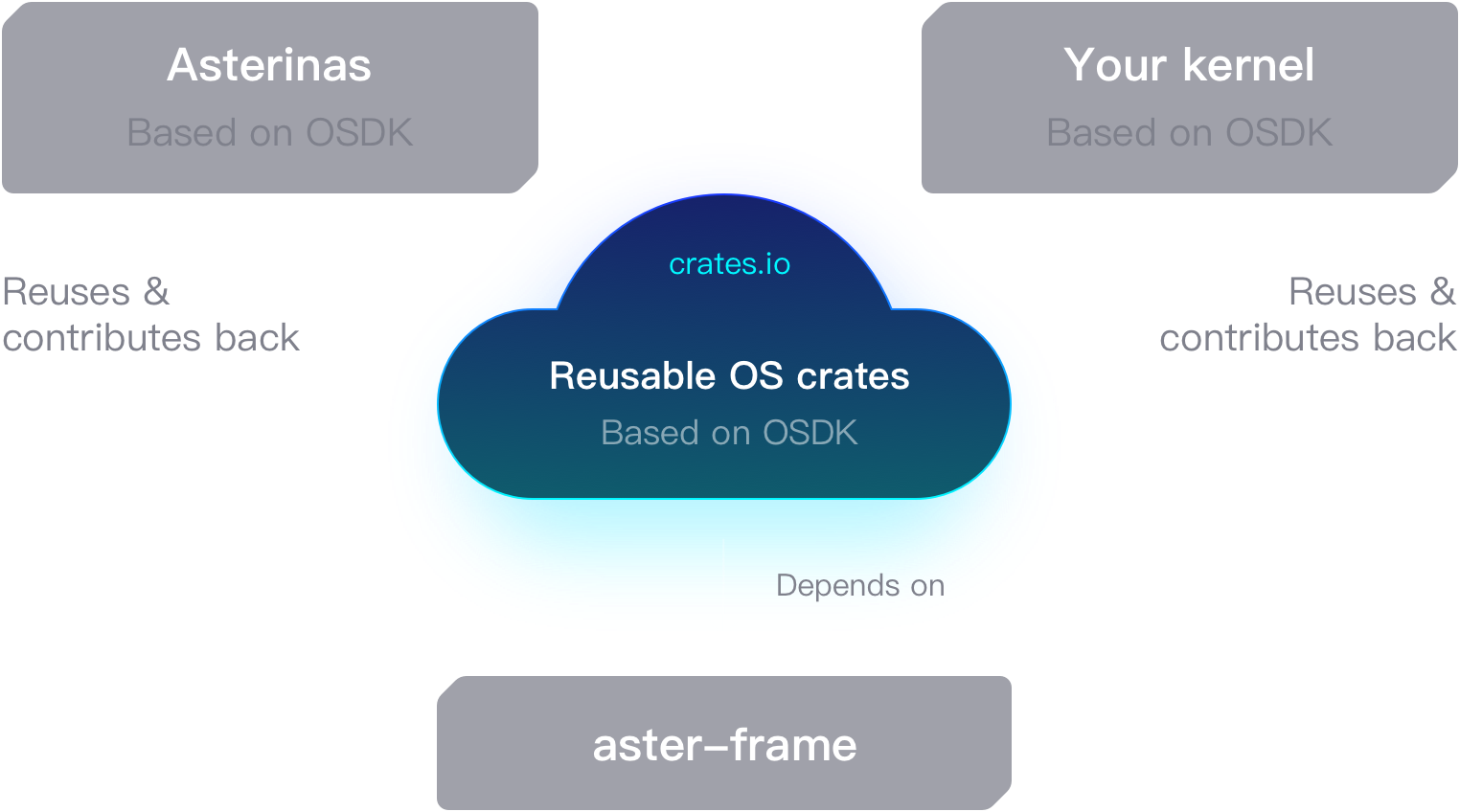
All OSDK-based Rust crates for an OS kernel or library share a common foundation, a crate called ostd. This fosters a more vibrant ecosystem of OS crates, reusable across different Rust OSes.

Rapid testing
Writing unit tests for OSDK-based Rust projects is a breeze with ktest.
                              #[cfg(ktest)]
mod tests {
    #[ktest]
    fn it_works() {
        assert_eq!(true, true);
    }
}
Running these unit tests in the kernel mode can be done with a simple command:
cargo osdk test

Safe coding
OSDK is based on ostd, a minimal, expressive, and solid foundation that enables OS devs to implement OS functionalities on top of it in safe Rust.
The effectiveness of ostd has been validated by our extensive experience in developing Asterinas. In Asterinas, all unsafe Rust code is confined to ostd, whereas the rest of the kernel, including all drivers for peripheral devices, is composed of safe Rust code exclusively.
With OSDK, you can start building your own Rust OS kernel with three simple steps.
1. Install Asterinas OSDK
cargo install cargo-osdk
2. Create a Rust project for your "Hello World" kernel.
cargo osdk new my-first-os --kernel
3. Compile the kernel, generate a bootable image, and run it in a VM with just one single command.
cd my-first-os && cargo osdk run
Writing unit tests for OSDK-based Rust projects is a breeze with ktest.
                              #[cfg(ktest)]
mod tests {
    #[ktest]
    fn it_works() {
        assert_eq!(true, true);
    }
}
Running these unit tests in the kernel mode can be done with a simple command:
cargo osdk test
All OSDK-based Rust crates for an OS kernel or library share a common foundation, a crate called ostd. This fosters a more vibrant ecosystem of OS crates, reusable across different Rust OSes.
OSDK is based on ostd, a minimal, expressive, and solid foundation that enables OS devs to implement OS functionalities on top of it in safe Rust.
The effectiveness of ostd has been validated by our extensive experience in developing Asterinas. In Asterinas, all unsafe Rust code is confined to ostd, whereas the rest of the kernel, including all drivers for peripheral devices, is composed of safe Rust code exclusively.
OSDK can be utilized to build any Rust kernel based on the framekernel architecture: Asterinas is built with OSDK; your kernel can too!