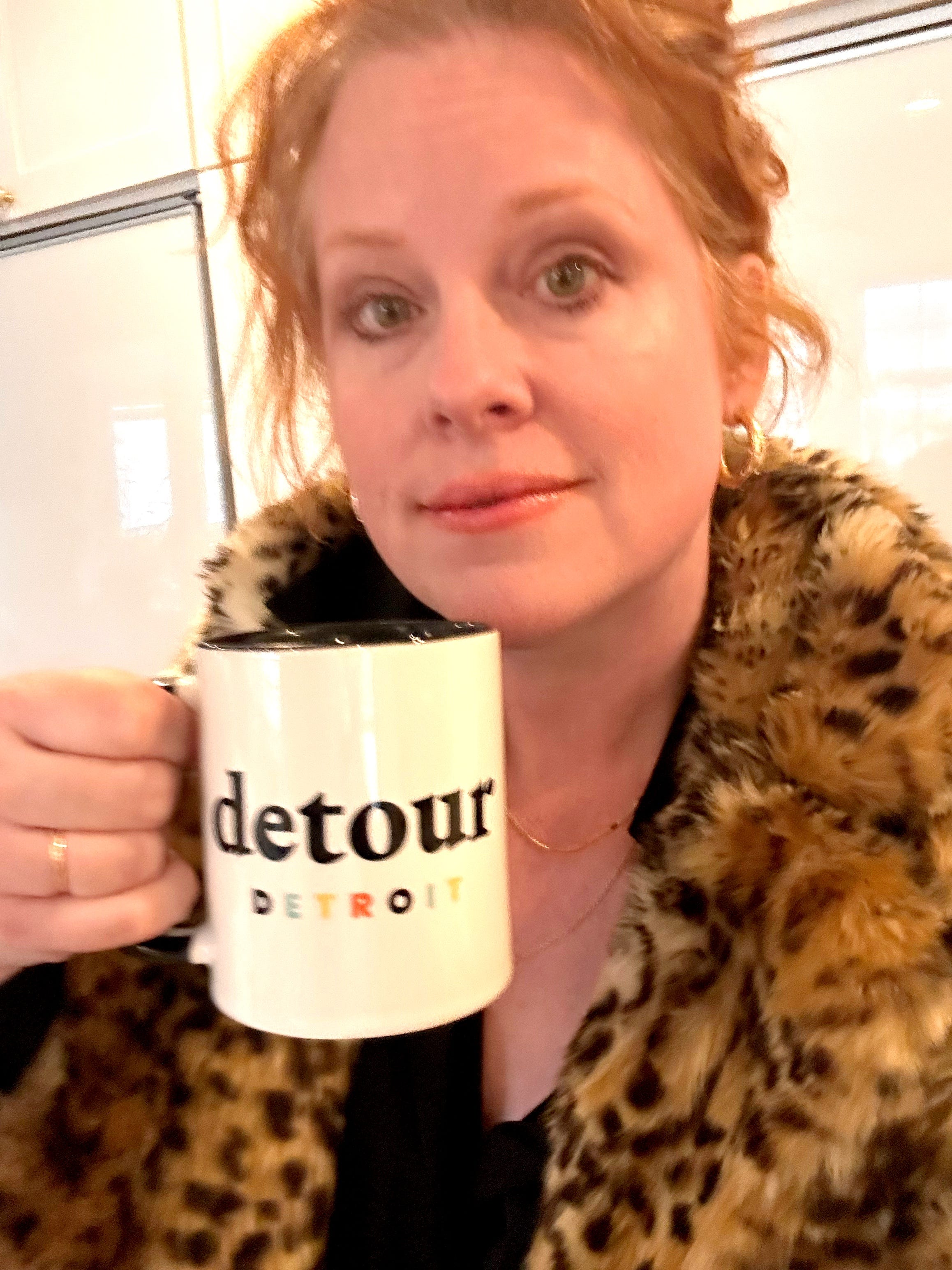
I took a picture of myself the other day on the way to happy hour and almost didn’t recognize what I saw. Not because I looked different. It was more that I looked like someone I used to be.
All black. Eyeliner. Cheetah print fake fur coat. The kind of outfit I would have worn in 2006 without thinking twice. Ready for a cigarette, some loud guitars and a night at Comet Bar or the Old Miami. And you know what? I still looked fucking fabulous, even at 41.
It made me think about who I was when I used to wear that coat. Much younger, bolder, more reckless. And it made me think about everything that’s happened between then and now. Specifically, the startup I built, the one I lost, and everything it taught me.
Detour Detroit was a community-first digital news organization I founded in 2017. I left a big corporate job at one of the most respected newsrooms in Michigan to do it. People thought I was an idiot. Honestly, they were mostly right. But I did it anyway, because I believed there was a better way to do local journalism—one that actually listened to people. And I also don’t like being told what to do.
Both Detour Detroit and I failed to survive in our original form. Detour merged with the fine folks at Outlier Media. A year later, I stepped away. I became a mom. I stopped wearing cheetah print anything. And for a long time, I lived in the space between pride and grief, trying to figure out what went wrong, what went right, and what any of it meant.
Here’s what I’ve landed on.
---
What I Got Wrong
1. I thought I had to build alone before I could ask for help.
There’s this mythology in startup culture that you should be building in your garage, heads down, humble, grinding away until someone notices. I believed it. I kept thinking: I’ll build it bigger, I’ll build it better, and then I’ll figure out what to do with it.
But if you’re doing something big, you can’t spend a long time being small and then suddenly change. I built community. I built a team. Those were real. But I didn’t cultivate people who could truly support me — people with the means and experience and knowledge to help build something different.
I didn’t know I could ask. I figured if someone had something to offer, they’d come to me. The reality is that people are extremely busy and nobody is ever going to do that. You have to ask, and ask again. And I was afraid to ask. It was easier to put my head down and grind than to put my head up, look them in the eye, and tell them I was worth their investment.
I’m not as afraid anymore. Or rather, I’m not afraid of being afraid. That’s one of the gifts that came out of this. More below.
2. My business plan didn’t account for the fact that I was a human being.
My business plan for Detour Detroit could have been boiled down into one sentence:
I can work myself into the ground!
That was what I’d always done. So I built around that assumption.
I didn’t fundraise. I didn’t have savings. I worked on Detour and consulted on the side, and once I had a kid, daycare cost as much as I was paying myself, so I was essentially working for free. The math only worked if I never stopped.
And then, frustratingly, I couldn’t stop being a person. Postpartum depression. A child’s developmental challenges. Moving to the suburbs to live near my stepdaughter’s school and feeling like I’d lost my authority to engage with the city I built for.
None of that should have been fatal. But I’d built something that required me to be superhuman every single day, and when I wasn’t, there was nothing underneath to catch it. I could have gone slower. I could have found partners earlier. I could have built a structure that didn’t collapse the moment I needed to be a person and not just a founder.
3. The people who celebrated me on stage wouldn’t fund me or invite me into the room.
This one burns, and it’s not unique to me. Many organizations and funders will put you on a panel. They’ll invite you to speak about how you’re changing journalism. They’ll use your story to show the world that innovation is happening.
But when it’s time to actually invest? They fund scale and institutions, not risk-takers. Not experiments. Not you.
If I could go back, I would have spent less time performing innovation and writing proposals for people who were never going to back me, and more time finding and engaging the people who actually would. Don’t waste your energy or pin your strategy on people who will co-opt your narrative to suit their own needs but won’t stand with you when you actually need them.
I could go on for a lot longer about this, but you are readers, not therapists.
4. I didn’t understand that business knowledge is creative power.
When I was younger, I thought business and creativity were opposing forces. I was an English major. Capitalistic values were, in a word, garbage. And I didn’t see how understanding equity structures, compensation models, or organizational design could possibly serve my values.
I was wrong.
I never made Detour Detroit a nonprofit. I said I didn’t want to give up control. In reality, I didn’t understand governance. I didn’t know what a board was for or how it could help me. That left me isolated. It signaled to funders I wasn’t serious. And it meant I forked over a percentage of crucial revenue to fiscal sponsors who were only there to collect checks, not help me grow. I thought taking the time to build a professional structure would slow me down. In reality, it hobbled my growth potential.
Business can be profoundly creative. When you understand how things work, you can build structures, teams and systems that reflect your values and your vision instead of just hoping those feelings will be enough to get you through the hard times. It also builds trust with your team — you’re not talking the talk, you’re walking the walk.
Your values are the compass. Business knowledge is how you build the path forward.
---
What I’d Do Again
1. I built community before the field had language for why it mattered.
In 2017, building a community-first news organization was a radical idea. We wrote stories, we made product decisions, we tried things — all because we listened to the people we served. We made them feel like they mattered. We involved them.
I talked to a publisher in Louisiana recently who told me Detour was a blueprint for what they built. It’s a fact I’m finally allowing myself to own. I have gone back and forth on cutting this section like three times, which shows you HOW HARD it still is for me to do this.
The lesson anyone can take: find your true believers. Build for them. Listen to them. If you do it that way, no matter what happens to the company, you’ll be at peace with the work. It’s slower going, but it’s the right way. And it leaves you whole.
(For another post: why have I internalized that arrogance is the worst thing for a woman to demonstrate?)
2. I became someone who experiments.
Detour wasn’t just one thing we tried. It was dozens of experiments, hundreds of small bets, a constant practice of surfacing ideas, investigating risk and acting anyway. And that practice changed who I am.
Now, when my husband and I tell people we’re opening a restaurant, they say it’s risky. (Yes, we are aware that restaurants fail, thank you for your advice!) Then they talk to us and they see the calculations, the plans behind the dream.
Risk doesn’t have to be as scary once you’ve developed the muscle and the practice to work within it. Risk doesn’t have to be terrifying if you build with intention. It’s actually addicting.
3. I chose my family when I needed to, and now I get to try again.
When I started Detour, I had a little gold necklace that said #girlboss. I wore it like armor. The girlboss narrative says you push through everything, you never stop, you sacrifice everything for the vision and that’s what makes you strong. And when I began falling apart, I thought I wasn’t good enough instead of realizing how incomplete and false it all was.
The #girlboss narrative has no room for ambiguity. It only celebrates the grind. It doesn’t make space for the woman who walks away from the thing she built because her kids need her and she’s crumbling.
When I decided to walk away from Detour, that’s exactly who I was. I needed to focus on my kids. I needed to stop keeping an organization alive and start keeping myself alive. That was the right call. But I was terrified that people would think I was a failure.
I don't need to be a girlboss anymore. I don't want my kids growing up believing their worth is tied to how hard they work or what they produce. I want them to see that it’s okay to listen to their own needs, that their overall happiness matters more than what other people think, more than living up to some narrative, more than what their LinkedIn bio will say.
And now, my kids are older. I’m stronger. More durable. More ready. And I get to show them something I couldn’t show them before: that it’s a back and forth. Your identity, your needs, your future — none of it is fixed. Sometimes you withdraw and protect yourself. And sometimes you step back out into the ring for another shot.
---
The Cheetah Coat
Here’s what nobody tells you about the worst-case scenario: once you’ve actually lived through it, once you know what real loss feels like, you understand something that changes everything.
It’s just not that bad.
The failure of my first company was not the end of my story. It was the beginning of knowing who I am.
And that cheetah coat? It still fits. And that coat is why I'm writing. Because to write and publish out loud is to rebuild the muscles of courage and ownership and out-loud experimentation that I let atrophy these past years.
I want to be Cheetah Print Ashley again, not Dead Mommy Ashley withering away in silence.
Let’s go.