TL;DR
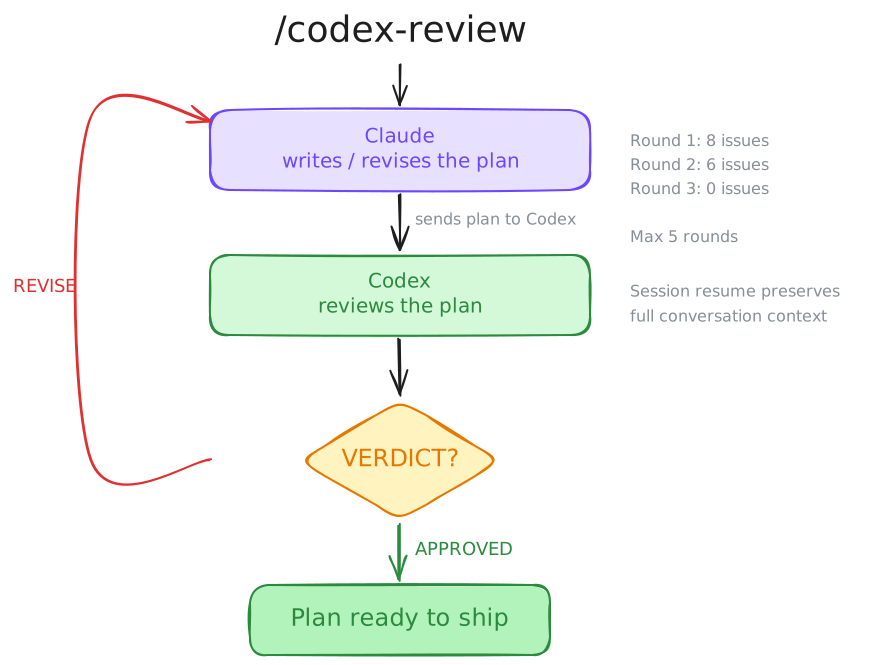
A Claude Code skill that sends your implementation plans to OpenAI Codex for review. They argue back and forth — Claude revises, Codex re-reviews — until Codex approves. Typically converges in 2-3 rounds.
Get it → SKILL.md on GitHub Gist
Setup:
1. Install Codex CLI: npm install -g @openai/codex
2. Drop SKILL.md into .claude/skills/codex-review/ in your project
3. Run /codex-review in Claude Code when you have a plan ready
Use it for: Plans touching auth, data models, concurrency, or anything that will take days to implement.
Skip it for: Simple bug fixes, small changes, or when speed matters more than thoroughness.
Result: 3 rounds caught 14 issues (broken auth, shell quoting bugs, schema conflicts, missing concurrency handling) and turned a rough draft into a production-grade spec — zero manual review effort.
I use Claude Code daily. It plans features, writes code, and ships PRs. But I kept running into the same problem: Claude's plans were good, but not challenged. There was no second opinion. No one pushing back on architectural blind spots, missing edge cases, or security gaps.
So I built a system where Codex reviews Claude's plans — and they go back-and-forth until Codex approves.
The Problem: Single-Model Blindness
When you use a single AI model to plan and execute, you get a coherent but unchallenged output. The model doesn't argue with itself. It won't say "actually, this auth model is incomplete" or "your shell quoting is broken."
I noticed this pattern repeatedly:
- Plans that looked solid but had no authentication model
- Shell scripts with quoting bugs that would silently produce bad payloads
- Schema designs with conflicting state fields
- No concurrency handling for multi-agent scenarios
These aren't bugs Claude can't find — it's that the planner and the reviewer are the same entity. There's no adversarial tension.
The Solution: /codex-review
I built a Claude Code skill — a slash command that triggers an iterative review loop between Claude and OpenAI's Codex CLI.
How it works
You: /codex-review

Round 1: Claude writes plan to temp file
         → sends to Codex (gpt-5.3-codex, read-only sandbox)
         → Codex reviews → VERDICT: REVISE (8 issues found)

Round 2: Claude revises plan addressing all feedback
         → resumes Codex session (preserves context)
         → Codex re-reviews → VERDICT: REVISE (6 items left)

Round 3: Claude revises again
         → resumes Codex session
         → Codex → VERDICT: APPROVED
The key insight: Codex runs in read-only mode — it can read your codebase for context but can't modify anything. And because we resume the Codex session between rounds, it remembers what it said before and can verify whether issues were actually fixed.
Before and After
Before: Single-pass planning
I'd ask Claude to plan a feature. Claude would produce a plan. I'd read it, maybe catch a few things, approve it. But I'm not going to catch every quoting bug in a shell script example or notice that a status and column field in a schema can drift.
Example: I asked Claude to plan a "Mission Control" dashboard for a multi-agent swarm. The initial plan had:
- No authentication on agent write endpoints
- Shell scripts with
"$1"inside single quotes (broken expansion) - Both
statusandcolumnfields on tasks (can drift) - Unbounded embedded comment arrays (write contention)
- No concurrency handling for task claiming
- Manual-only testing
All of these are real problems that would have burned hours during implementation.
After: Iterative cross-model review
Same plan, but run through /codex-review:
Round 1 — Codex found 8 issues across auth, schema design, tooling, and testing. It cited specific line numbers and gave actionable fixes.
Round 2 — After Claude revised, Codex found 6 remaining items: the lease claim wasn't atomic, the ACL was too broad, key rotation was underspecified, and the status model was inconsistent.
Round 3 — All addressed. Codex approved. The final plan had:
- Per-agent API key auth with server-side identity derivation
- A typed CLI tool instead of fragile shell scripts
- Atomic lease claims with optimistic concurrency
- An explicit ACL permission matrix
- Full key rotation lifecycle with grace periods
- Two-phase search strategy with compound indexes
- Comprehensive integration and security tests
3 automated rounds. Zero manual review effort on my part. The plan went from "demo quality" to "production-grade spec."
┌─────────────────────────────────────────────────────┐
│              Before vs After                        │
├──────────────────────┬──────────────────────────────┤
│  BEFORE              │  AFTER                       │
│  Single-pass plan    │  3-round iterative review    │
├──────────────────────┼──────────────────────────────┤
│  No auth model       │  Per-agent API keys + ACL    │
│  Broken shell scripts│  Typed CLI with retries      │
│  Conflicting schema  │  Single source of truth      │
│  No concurrency      │  Atomic claims + versioning  │
│  Manual testing only │  Integration + security tests│
│  0 issues caught     │  14 issues caught & fixed    │
└──────────────────────┴──────────────────────────────┘
Design Decisions
Why a skill, not a hook?
I don't want every plan reviewed. Most small changes don't need a second opinion. A skill (slash command) is on-demand — I trigger it only when the stakes are high enough.
Why iterative, not one-shot?
A one-shot review finds problems but doesn't verify fixes. The iterative loop means:
- Codex finds issues
- Claude fixes them
- Codex verifies the fixes actually work
- Repeat until clean
This catches the "fixed one thing but broke another" class of problems.
Why session resume?
Codex CLI supports codex exec resume <session-id>, which continues a previous conversation with full context. This means Codex remembers what it said in Round 1 when reviewing Round 2. It doesn't re-discover the same issues — it checks whether they were addressed.
Why the VERDICT protocol?
The loop needs to know when to stop. Codex ends each review with either VERDICT: APPROVED or VERDICT: REVISE. This gives Claude a clear signal to either continue revising or present the final result. Max 5 rounds as a safety cap.
Concurrency safety
Each review generates a UUID for temp files (/tmp/claude-plan-<uuid>.md) and tracks the Codex session by its explicit ID. Multiple Claude Code instances can run /codex-review simultaneously without stepping on each other.
Technical Implementation
The entire thing is a single Markdown file at .claude/skills/codex-review/SKILL.md. No external services, no infrastructure. It's instructions that tell Claude how to:
- Write the plan to a temp file
- Run
codex exec -m gpt-5.3-codex -s read-onlywith a review prompt - Parse the verdict
- If REVISE: update the plan, run
codex exec resume <session-id> - Loop until APPROVED or max 5 rounds
- Clean up temp files
The skill leverages what's already there — Claude Code's tool execution and Codex CLI's session management.
Gotchas I Found
codex exec resumedoesn't support-o— You can't redirect output to a file on resume. Capture stdout instead.--lastis not concurrency-safe — Always use the explicit session ID, not--last, to resume. Otherwise parallel reviews grab the wrong session.- Codex needs explicit verdict instructions — Without the
VERDICT: APPROVED/REVISEinstruction, Codex gives nuanced feedback but no clear signal for the loop.
When to Use This
- Planning a feature that touches auth, data models, or multi-service coordination
- Before approving a plan that will take days to implement
- When you want security review before writing code
- When the plan involves concurrency, distributed systems, or data migrations
When NOT to use it:
- Simple bug fixes or small changes
- Plans where you've already validated the approach
- When speed matters more than thoroughness
What's Next
I'm thinking about:
- Model choice per review type — security reviews with one model, architecture reviews with another
- Review templates — different review prompts for different plan types (API design vs. frontend vs. infrastructure)
- Review history — persisting review results so you can reference past decisions
But honestly, the simple version already catches more issues than I expected. Three rounds of back-and-forth between two frontier models produces plans I actually trust.
The skill is a single file you can drop into any Claude Code project. Grab it from the GitHub Gist, drop it at .claude/skills/codex-review/SKILL.md, and run /codex-review next time you have a plan worth challenging.
P.S. — Yes, this blog post was also written with Claude Code. I made an AI write about making AIs argue with each other. We're through the looking glass, people.