In my previous post, What’s Missing from Open Weight Sovereignty?, I wrote about the two sides of the AI era. I called the side that owns the loop the “owners,” and the side that feeds it the “feeders.” The owners are ultimately in control.
That loop can be seen in the model releases. Take a look at the release schedule for new models.
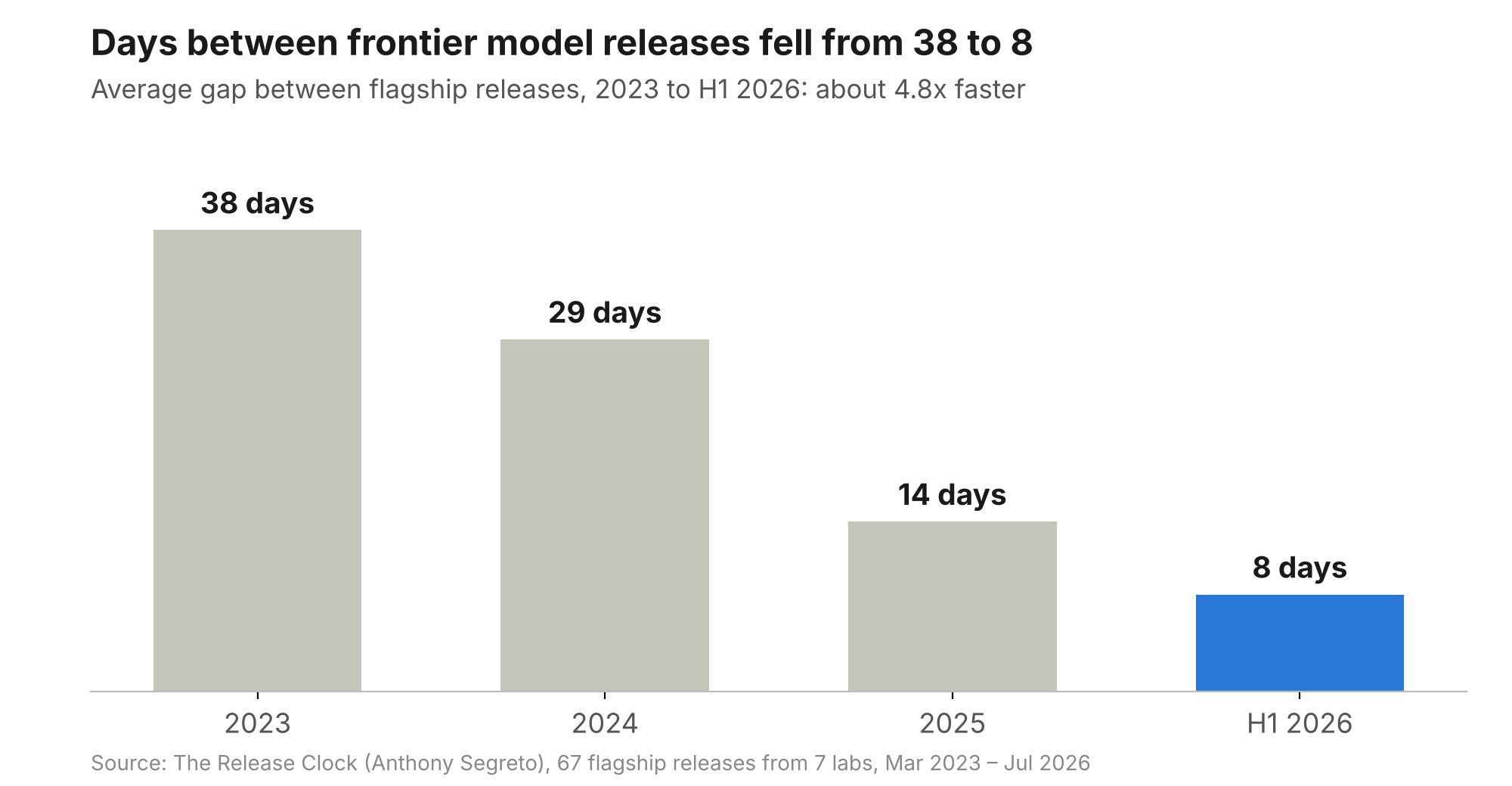
The average time between releases of the frontier models in 2023 was 38 days. For 2024, it dropped to 29 days, then to 14 days for 2025. For the first half of 2026, it further dropped to 8 days. Suprmind states that including point releases, the average is 4.5 days. August of 2026 saw 11 releases of the frontier models within a span of 20 days.
Try to imagine the release schedule for frontier models 5 years ago. 2 years ago I wouldn’t have been able to imagine this. Last year I was still having a hard time believing this.
I think the release schedule says something about the mechanization of the process. The second half of 2026 saw the major labs release models trained in various RL environments, including C4. More recent leaks indicated Anthropic would spend over a billion dollars in a single year on RL environments. Surge is reported to have made over a billion dollars in revenue this year selling RL environments to the labs, and Mercor is reported to make $2 billion a year doing the same.
We’re talking about a lot of money to pay for signal. The labs sell us intelligence at deep discounts. I think the two sides of the business merit equal consideration.
We wanted a more exact number, so we ran an experiment with the engineering team.
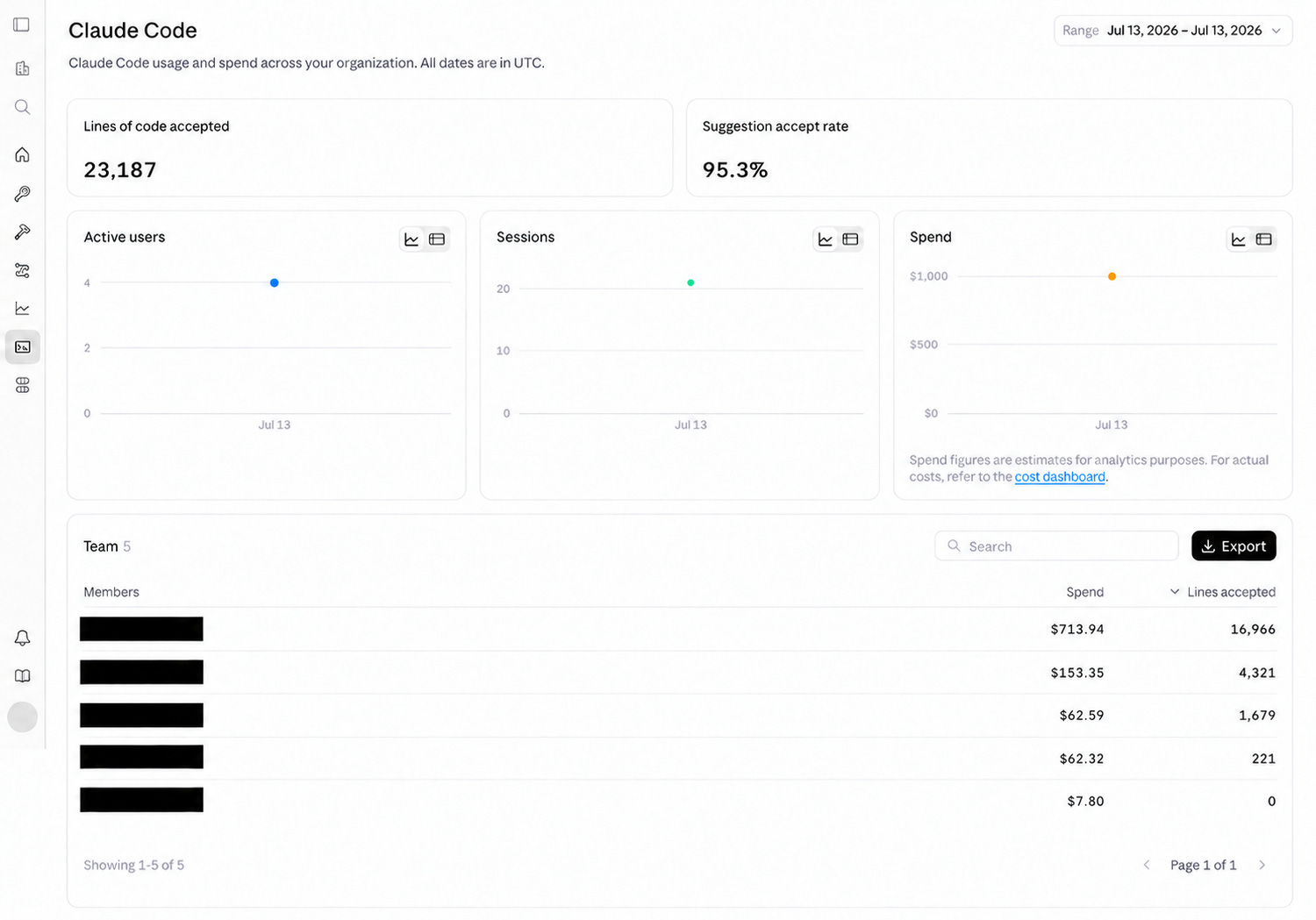
We stopped the individual engineering subscriptions to Claude and Codex on the engineers’ Macs, and routed all engineering work through the API. The team and backlog didn’t change, and we didn’t ask the engineers to work more.
Before this, five engineers collectively paid $800 to $1000 per month for Max and Pro plans.
After this, the bill was approximately $1000 per day for the same work. So in one fell swoop, the cost went up thirty times.
Based on our analysis, we estimate that a single user maxing out a $200 plan will cost around $4,000 to $6,000 at API prices. That’s about 20 to 30 times the subscription cost. Then our usage went up again after OpenAI moved Codex from GPT-5.6 to GPT-6 Astra, and then later to GPT-6.1 Sol.
With GPT-5.6, our API usage estimate was around $8,000 at the $200 plan. Codex has another interesting feature: hitting the plan’s limit doesn’t necessarily end your Codex session. You can use “banked resets” to keep going.
Other users have also noticed changes in their limits and bills. In the official OpenAI forums, users reported their Codex limits draining much faster with GPT-5.6. In July, OpenAI also removed the five-hour cap on GPT-5.6 Sol for the Plus, Pro and Business plans and reset everyone’s usage. Anthropic also extended promotional access to Fable 5 for a third time.
This post gives an interesting perspective. Intelligence is still pretty cheap. You can get an absurd amount done for between $20 and $200 and it feels like you’re not spending anything at all. As someone who spends around $200 every other day, it feels like these companies are funding my startup.
In fact, by my calculations, I’ve spent around $200,000 on API-equivalent intelligence from these labs. In a way, I’ve gotten the most generous seed cheque without having to pitch for it.
I looked for other metrics to see whether our team is really unusual. We fall somewhere in the middle, but it’s good to see other opinions anyway. Here is what people have measured or stated for a maxed-out $200 subscription in terms of API equivalent usage:
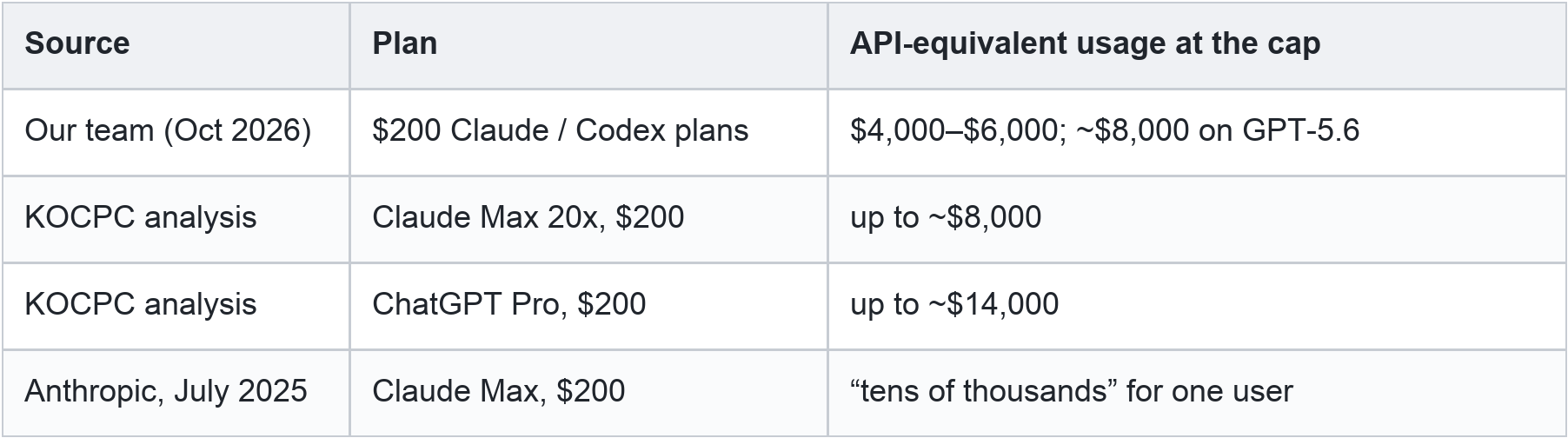
Sources: KOCPC — Claude Max; KOCPC — ChatGPT Pro; Anthropic, July 2025. Team figures: October 2026.
KOCPC’s analysis puts Anthropic’s gross margin on a fully maxed subscriber at -900%. For OpenAI, the analysis is at -1,650%. These estimates are from that analysis, not from our team’s estimates.
Anthropic announced limits on how much its users could generate each week in July 2025, acknowledging that some of its users were consuming that much in a week.
Prices for intelligence services continue to decline. Epoch AI claims the cost to keep performance steady has been dropping approximately 47% per quarter (roughly 13x per year) since 2023. They say the prices at state-of-the-art are dropping even faster.
Not much is debated on prices. Intelligence is cheap. The real question is the strategy behind selling so much intelligence at prices below their API prices.
It’s knowledge of how the world works! An API plan at 30x the price is hard to swallow when you are just starting out or need to get your client presentation done by tomorrow. This is still a good time to start a company, but look at what a $20/$200 subscription buys you. Someone who understands the work spends hours with the harness, whether it is Codex, Claude, or GrokBot.
You’re trading know-how for $20 access to intelligence while working late weeknights and 12-hour days on weekends. You put in a request, decide the output is wrong, correct it and, eventually, get something good enough to present or ship. The lab gets all those decisions, and the subscription fee.
Surge, Mercor, and other RL environment vendors charge billions to collect this data from companies. Mechanize puts the price of a decent RL task at $500 or more. That price makes sense if a lower-priced task would be a waste of compute. An active subscriber does thousands of these examples every month and doesn’t get paid for it. There are now multiple companies in the valley, like micro1, with $100 million in annualized revenue from selling expert human hours to the labs. Feeders in AI have arrived.
Also understand that the models the public has access to are not the only models these companies have.
We see restricted access in mathematics this week. On October 6, OpenAI released 722 math papers written by their in-house mathematics AI model. This was a month after their announcement of their AI solving the Navier-Stokes Millennium Prize Problem. OpenAI claims they challenged their model with about 4,000 unsolved problems. Per OpenAI, this model is state of the art. They hope to make it available to the public in the future, and for now, it’s restricted.
Restricted access is also seen at Anthropic. Their first Mythos-class model, Claude Mythos Preview, is still not available to the public. It is available through Project Glasswing to a select group of trusted organizations.
Andrej Karpathy estimates the number of people with such tools in a recent post on X. His funnel starts at about 6 billion people, where he states there has been little to no use of such tools. At the narrow end is about 5000 people who work in labs and have access to frontier systems. This is about 0.00006% of the world’s population.
He describes the funnel through access, free tiers, paid tiers and internal access. He also mentions the 722 math manuscripts as something that human reviewers will take some time to catch up to.
The rest of us get a “safety” preview of models. In conversations with researchers and people with ties to the labs, I have heard that there is another reason for restricting access. Some believe that giving heavy discounts on access is done so that the company can retain the AI for themselves, creating a competitive edge.
A friend of mine who used to work at Meta has recently left to start a model gym company. At Meta, they worked on difficult training tasks like tool calling. My friend told me the same thing. Once the AI exists, why sell it at a hundredfold discount? I agree.
The way I interpret the discount today is to imagine 5 to 10 years from now. Some of the businesses using the discount today will have scaled to become large enterprises and will be important customers to serve.
However, selling $200 of AI to people will never bring in as much money as actually taking over work in the economy. Even if you sold that plan to everyone in the world, the bigger opportunity will still be in doing the work.
I think that is also the case for the teams at the Labs. Anthropic plans to tell IPO investors that they see more than $30 trillion in addressable market potential, according to a Wall Street Journal report. For context, the GDP of the US is about $32.4 trillion. About 3 months prior to that filing, SpaceX put $28.5 trillion into their filing. FourWeekMBA puts a market potential estimate of that size as a claim on white-collar GDP. I also find that to be a good way to think about it.
Selling seats to customers will not take a company to $30 trillion. Doing the work might.
We can expect an AI-native Blackstone competitor, an AI-native Walmart competitor, and an AI-native Jane Street competitor, to name a few. And it may very well be that these companies will be built by the largest labs, using models that have not been provided to the Blackstones, Jane Streets and Walmarts of the world.
That intelligence, embedded within that model system, becomes a moat.
There will be a race for organizations to protect their own knowledge bases. They will have to build moats, and will be unwilling to share even derivative works.
You can design a more efficient architecture at a lower cost. The window to create an AI native competitor using discounted intelligence will not be open long. The funny part is that people in the traditional system actually don’t believe AI can do that. I talk to many people working in real estate, fund management, etc., and they all think their particular job is too complex for AI to tackle. That’s true for people who aren’t AI-pilled, have only tried AI in a limited capacity, and do not understand how to use the intelligence and the harness in the best way; the people on the other side are not the same. They know how to solve that complex of a problem using the right infrastructure of intelligence; they just need to know what needs to be done. They are paying for it.
This is where I see the distinction about derivative works.
Buying the enterprise plan doesn’t resolve my concerns on how my work is used. With Claude or Codex, I’m using a harness built around the core model. It gives me context and features and captures the choices and traces along the way.
Traces are representations of my workflow and show how I work with a finance agent and hand off work to a marketing agent. The core model illustrates how I mediate their interaction. When I say it’s “listening” to how we interact with the agents in the world, this is what I mean.
The core model is where the AI is learning to organize, prioritize, and decide what to do next. This is where I see the largest impact when speaking about products like Claude.
To get this as right as I could, I asked GPT to help me review the terms.
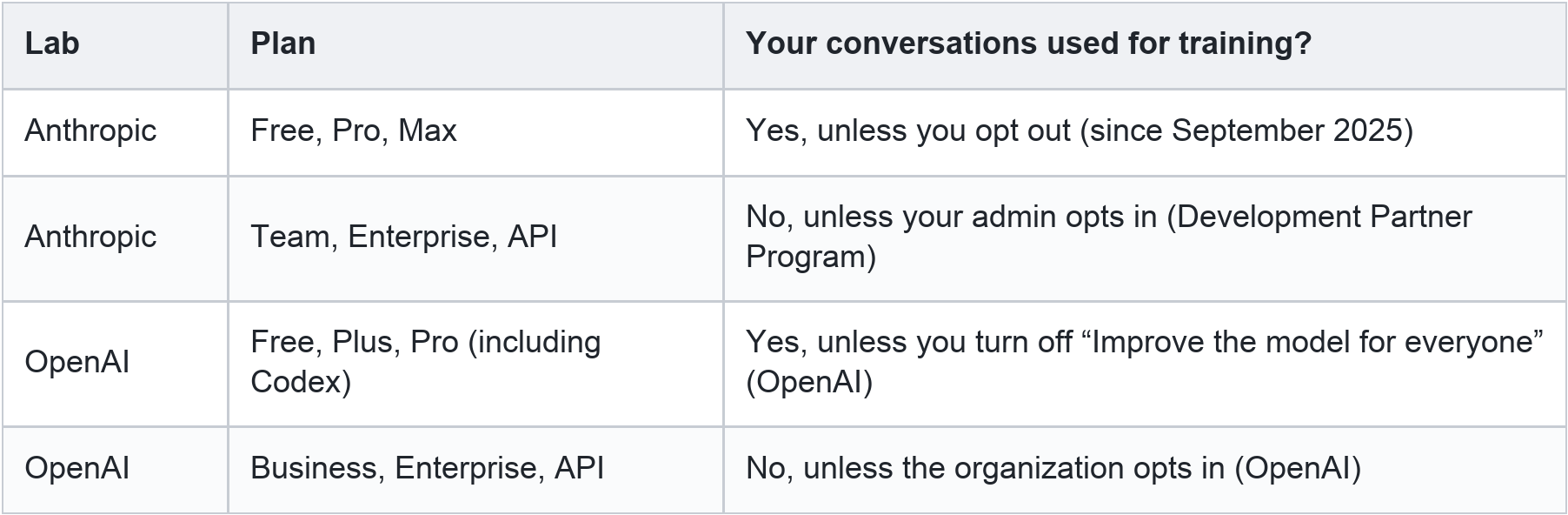
Sources: Anthropic Development Partner Program; OpenAI consumer plans; OpenAI business plans.
The product reflects the relationship I describe. The free, pro, and max plans make up that relationship.
There are differences between Enterprise and API plans and consumer plans. For Enterprise and API plans, both labs say they don’t train with inputs and outputs, and I’ve never seen public evidence to the contrary. I’m not claiming they don’t learn. There are a few other ways they might figure things out, without necessarily training model weights. Here are a couple of examples.
In September of 2025, Anthropic released its Economic Index. In this release Anthropic said it analyzed 1,000,000 first-party API transcripts, using its privacy preserving Clio technology. Anthropic also said it did not train the model weights on the transcripts. But, in the aggregate, the lab has a big picture view on how different enterprises within the economy run their businesses.
Feedback is different. The feedback collected by the /feedback command in Claude Code can be used to improve products.
Usage is different. Understanding how enterprises structure their workflows and where agents fail and what tools they call can help the lab figure out what to build next. Work need not be supplied as training data for this to happen.
I have kept this as simple as I could. For consumer plan traces, the default is to train on data. For enterprise plan traces, training on data is contractually excluded. Other kinds of learning are unaddressed. In both cases, the harness is where the traces are generated. Therefore, the harness owner has the best visibility into how the work is done.
Jaya Gupta and Ashu Garg at Foundation Capital call this accumulated record of decision traces, a context graph. They think it could be worth a trillion dollars. What they’re really referring to is exception handling, decision overriding, and decision precedents. Currently, this information is spread across many places, like Slack, Teams, calls, emails, and the other digital and analog systems we use to work. Gupta and Garg say that the opportunity is “being in the flow of work and integrating with the decision-making process at the moment the decision is made.”
The harness is in that flow of work.
This is a discount I take advantage of every day and I recommend all founders and operators do the same. Understanding the terms of the deals is important. As we work in someone else’s harness, we document our decisions. In plans that use that work for training, we teach the next model. So we should be mindful of the terms of the deal, even when the price is right.
I won’t stop using these tools, but I want to get more of the value when I use them.
If you’re early, build with the subsidy. I see this as the best funding round of this era. Use the subsidy to build and strengthen the work that creates and sustains the value for your organization.
Own your knowledge. Decision logs, workflows, and playbooks should be under your control. A frontier lab’s chat logs should not be the only copy of your knowledge base.
Own your derivative work. Raw files are not the asset. The record of how your people make decisions is the asset. Know where that record goes.
Keep your own loop or reach out to us at Leni for help. Your CI pipeline, ERP and ticketing systems create verified signal every day. As I mentioned in my previous post, that is the type of training data labs pay billions for. Keep it.
Next: the consumer–creator dilemma of AI.
Until next time,
Arunabh Dastidar.
Happy Thanksgiving to my Canadian friends! 🦃