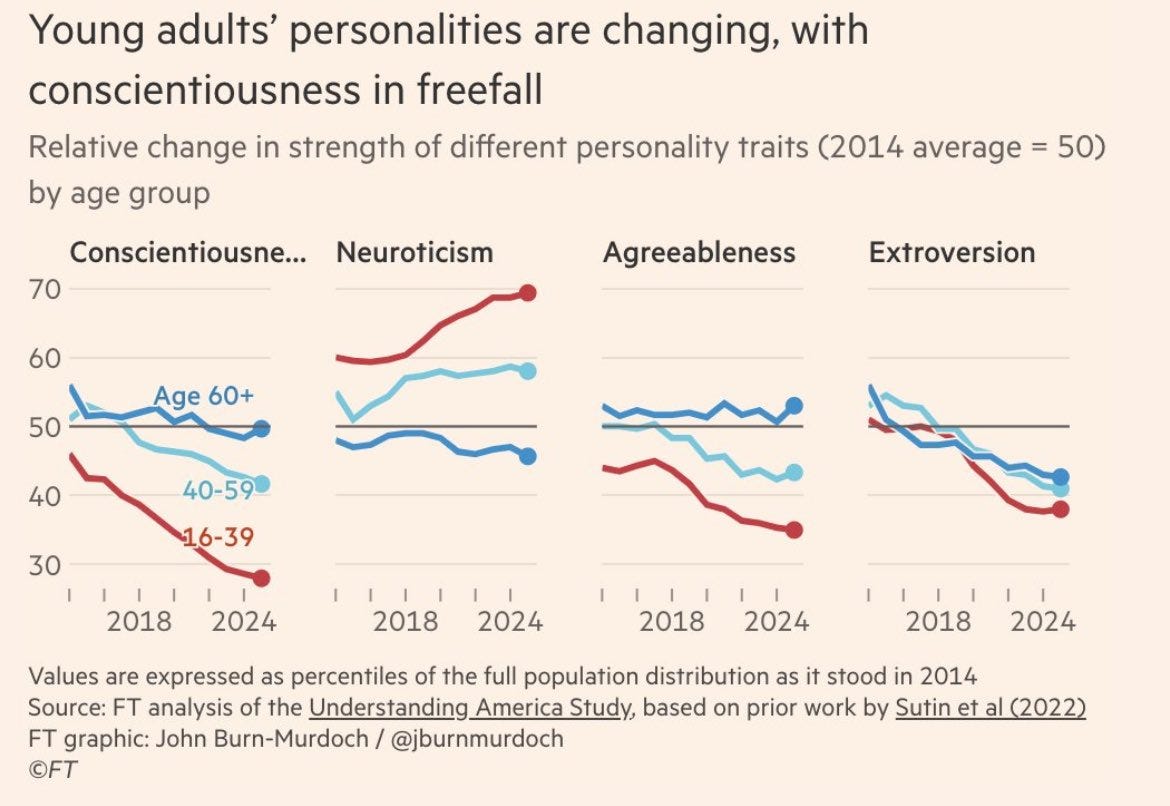
Let’s start with the facts: young Americans today are less outgoing, less agreeable, more neurotic, and less conscientious. That’s not all because of social media, but honestly, what else has had this much influence and control over our lives in the past decade? These platforms were originally built under the guise of connecting us, but somewhere along the way, the promise of digital community gave way to something darker. Two forces are primarily to blame: the rise of the algorithmic feed and the proliferation of short-form content.
The Rise of the Algorithmic Feed
Remember when Instagram showed us posts from friends in the order they shared them? Sadly, that era is dead and has been replaced by the ever profit seeking algorithm. What we see now is whatever will keep us scrolling. It’s no longer about connection, rather about trying to hold our attention, no matter the cost.
You click on one video about fitness, and suddenly your feed is only diet hacks and workout routines. You watch one controversial clip, and your feed fills up with outrage and hot takes. Before you know it, you’re living in a custom-built echo chamber.
Clearly, that has side effects. When you only see the same perspectives reflected back at you, your worldview narrows and your empathy for other viewpoints erodes. We’re less open, less curious, less willing to compromise. And when our feeds are flooded with fear, anger, and constant comparisons? Of course anxiety goes up. Of course we feel more on edge.
No wonder young Americans today are more neurotic and less agreeable than they used to be. It’s not because we’ve suddenly changed as people, but because we’re swimming in systems designed to provoke us.
The Proliferation of Short-Form Content
If algorithms influence what we see, short-form content influences how we think, whether we are aware of it or not.
Most of us don’t open TikTok, Instagram, or X with a focused, analytical mindset. We open them when we’re bored. Tired. Waiting in line. Half-watching TV. And that’s exactly when short-form content is most dangerous.
Think about the difference in mindset when you’re reading a book vs. scrolling TikTok. With a book, you’re fully engaged, wrestling with ideas and questioning arguments. Our skepticism is heightened; we are active participants.
With short-form content, it’s the opposite. We make snap judgments, swipe after three seconds, and move on. There’s no time to process or reflect. As psychologist Daniel Kahneman would put it, current social platforms lock us into System 1 thinking: fast, emotional, impulsive. They starve us of System 2 thinking: slow, deliberate, rational.
And this isn’t just about information, it’s about attention. We’ve trained our brains to crave novelty and constant stimulation. We’ve made it harder to sit with discomfort, harder to focus deeply, harder to finish the things we start. Over time, of course that’s going to make us less conscientious — less able to stick with goals, less willing to delay gratification and less patient with ourselves and others.
Ultimately it comes down to the platforms opting to maximize for engagement. The result isn’t stronger communities or healthier minds, rather it’s a generation less outgoing, less agreeable, more neurotic, and less conscientious. It blows my mind that someone as rich as Mark Zuckerberg will happily make that tradeoff. And don’t get me started on the AI friends he’s pushing on his platforms. Alas, a topic for another day.
Social media didn’t have to turn out this way. I still believe in its power to connect and have a positive impact on the world, which guided me as I built a new platform called Rhome. It’s a place where friends recommend their favorite long-form media, the media that has influenced the way they view the world. The goal is simple: to globally increase attention spans and actually understand one another better.
In using Rhome myself, I’ve been amazed how much I’ve learned about close friends I thought I already knew inside and out. It’s like getting a peek behind the curtain — a glimpse into the ideas, stories, and perspectives that are quietly shaping who they are. It offers me an understanding of not just what they think, but also why they think it. Even if Rhome doesn’t grow from here, I am so glad I built it because I truly do feel closer to those in my life.