When NYU art professor David Darts shows people his lunchbox, “a smile just starts creeping up on their face.”
Painted black with a white skull-and-crossbones, the metal box doesn’t hold a pastrami on rye; instead, it’s stuffed with networking equipment and batteries, and it hosts a Debian Linux install running a barebones Python-powered Web server. The goal of this “PirateBox”: to create an open file-sharing network in any public space, and to do with total privacy.
Inside the PirateBox sits a Free Agent Dockstar, an Asus WL330GE wireless router, and a SanDisk 16GB flash drive. The software, including Debian Linux and the DD-WRT open-source router firmware, is all free. The total build cost is under $100, not counting the lunchbox enclosure and the optional battery pack (the PirateBox can alternately run on AC power).
Darts’ tiny Web server has one unique feature: it doesn’t connect to the Internet, and it keeps no logs of any kind. Anyone who connects to the PirateBox’s WiFi network is automatically directed to a basic Web interface for uploading and downloading files to the box, but privacy and security concerns mean that only local access is provided.
The PirateBox idea was really about “scratching an itch,” Darts tells Ars. “I really couldn’t find anything that fulfilled my need.”
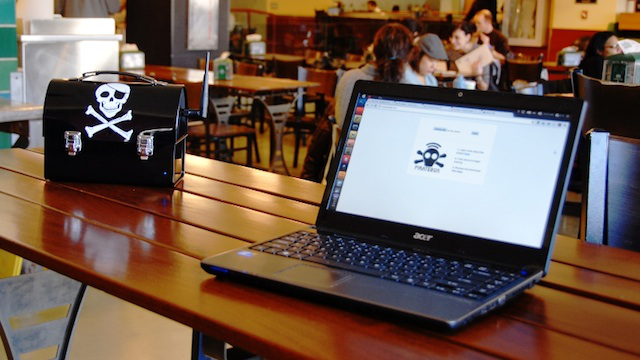
The PirateBox leaves the lab
Darts was looking for something that would allow people in the same physical space to share files, but it had to be dead simple—no extra software or hardware allowed. So he built a PirateBox prototype and started taking it to his NYU classes. When he wanted to distribute a file to the class, he used the PirateBox, and the class used it to distribute their own documents and files to everyone else. Eventually, Darts just left the box running.