that’s gonna have to come off
“Ants are able to diagnose a wound, see if it’s infected… and treat it accordingly.”
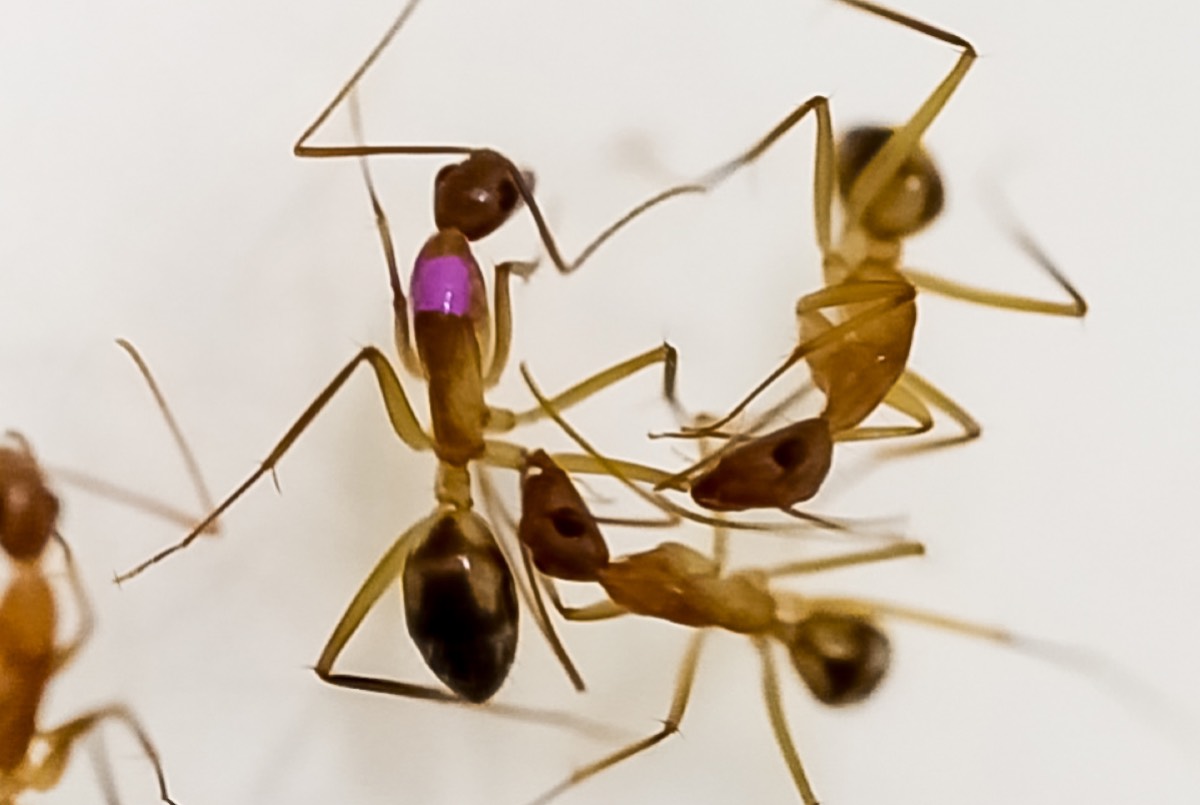
Scientists have observed wound care and selective amputation in Florida carpenter ants. Credit: Danny Buffat/CC BY-SA
Scientists have observed wound care and selective amputation in Florida carpenter ants. Credit: Danny Buffat/CC BY-SA
Florida carpenter ants (Camponotus floridanus) selectively treat the wounded limbs of their fellow ants, according to a new paper published in the journal Current Biology. Depending on the location of the injury, the ants either lick the wounds to clean them or chew off the affected limb to keep infection from spreading. The treatment is surprisingly effective, with survival rates of around 90–95 percent for amputee ants.
“When we’re talking about amputation behavior, this is literally the only case in which a sophisticated and systematic amputation of an individual by another member of its species occurs in the animal kingdom,” said co-author Erik Frank, a behavioral ecologist at the University of Würzburg in Germany. “The fact that the ants are able to diagnose a wound, see if it’s infected or sterile, and treat it accordingly over long periods of time by other individuals—the only medical system that can rival that would be the human one.”
Frank has been studying various species of ants for many years. Late last year, he co-authored a paper detailing how Matabele ants (Megaponera analis) south of the Sahara can tell if an injured comrade’s wound is infected or not, thanks to chemical changes in the hydrocarbon profile of the ant cuticle when a wound gets infected. These ants only eat termites, but termites have powerful jaws and use them to defend against predators, so there is a high risk of injury to hunting ants.
If an infected wound is identified, the ants then treat said wound with antibiotics produced by a special gland on the side of the thorax (the metapleural gland). Those secretions are made of some 112 components, half of which have antimicrobial properties. Frank et al.’s experiments showed that applying these secretions reduced the mortality rate of injured ants by 90 percent, and future research could lead to the discovery of new antibiotics suitable for treating humans. (This work was featured in an episode of a recent Netflix nature documentary, Life on Our Planet.)
Amputation in Camponotus maculatus. Credit: Danny Buffat.
Those findings caused Frank to ponder if the Matabele ant is unique in its ability to detect and treat infected wounds, so he turned his attention to the Florida carpenter ant. These reddish-brown ants nest in rotting wood and can be fiercely territorial, defending their homes from rival ant colonies. That combat comes with a high risk of injury. Florida carpenter ants lack a metapleural gland, however, so Frank et al. wondered how this species treats injured comrades. They conducted a series of experiments to find out.
Frank et al. drew their subjects from colonies of lab-raised ants (produced by queens collected during 2017 fieldwork in Florida), and ants targeted for injury were color-tagged with acrylic paint two days before each experiment. Selective injuries to tiny (ankle-like) tibias and femurs (thighs) were made with sterile Dowel-scissors, and cultivated strains of P. aeruginosa were used to infect some of those wounds, while others were left uninfected as a control. The team captured the subsequent treatment behavior of the other ants on video and subsequently analyzed that footage. They also took CT scans of the ants’ legs to learn more about the anatomical structure.
Assessment and treatment
The researchers found that in the case of all the femur injuries, nest mates would first lick the wounded area with their mouthparts, presumably to clean or disinfect the wound, and then chew off the leg to amputate it. However, if the injury was to the tibia, the nest mates only licked the wound clean and didn’t subsequently amputate. Both classes of injured ants showed remarkably high survival rates upon receiving either treatment: 90–95 percent for amputee ants (compared to less than 40 percent for untreated injuries) and about 75 percent with just the wound cleaning (compared to 15 percent for untreated injuries). Surviving amputee ants were able to resume their full range of duties despite losing one of their six legs.
Woundcare in Camponotus floridanus. Credit: Danny Buffat.
The fact that the ants selectively treated two different kinds of wounds suggests that they can assess the nature of those injuries and tailor their treatment methods accordingly, per the authors. Frank et al. wondered why injuries to infected lower legs (tibias) weren’t amputated and conducted additional experiments in which they amputated the infected tibias themselves. They were surprised to find that when they did so, only about 20 percent of the ants survived.
The CT scans helped explain why. It turns out that ants don’t have a heart to centrally pump blood throughout their bodies; instead, they have several heart pumps and muscles distributed throughout their bodies to ensure circulation of the hemolymph (ant blood). The thigh area has many such muscles, so if that area is injured, the muscles are impaired, hindering circulation. This, in turn, lowers the risk of infection since bacteria cannot spread from the wound into the body as fast. So it’s worth the effort to amputate the leg, a labor-intensive process that can take 40 minutes or more.
That’s not the case for injuries to the lower leg (tibia), which doesn’t have circulatory muscles. So bacteria can spread through the body very quickly; there simply isn’t enough time to perform an effective amputation.
“Because they are unable to cut the leg sufficiently quickly to prevent the spread of harmful bacterial, ants try to limit the probability of lethal infection by spending more time cleaning the tibia wound,” said co-author Laurent Keller, an evolutionary biologist at the University of Lausanne—a treatment that has a much higher survival rate than if the ants attempted to amputate legs with wounded tibias. “Our study proves for the first time that animals also use prophylactic amputations in the course of wound treatment. And it shows that the ants orient the treatment to the type of injury.”
DOI: Current Biology, 2024. 10.1016/j.cub.2024.06.021 (About DOIs).

Jennifer is a senior writer at Ars Technica with a particular focus on where science meets culture, covering everything from physics and related interdisciplinary topics to her favorite films and TV series. Jennifer lives in Baltimore with her spouse, physicist Sean M. Carroll, and their two cats, Ariel and Caliban.