The ice sheets sealed off the northern third of the continent around 26,000 years ago.
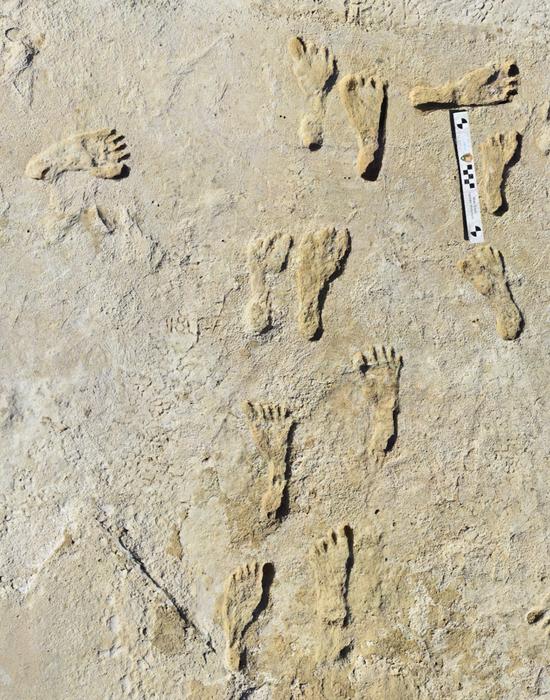
Seeds and pollen trampled into the ground by ancient footsteps helped date these tracks. Credit: National Park Service
The evidence points in the same direction
To support a claim that extraordinary, Bennett and his colleagues (including Pigati, who led the most recent study and was also involved in dating the ditchgrass seeds) needed to present solid, undeniable evidence to their fellow archaeologists. And when they published their first paper in 2021, they knew they didn’t quite have it—what they had instead was ditchgrass.
Ditchgrass, as its name suggests, is an aquatic plant, exactly the kind of thing you’d expect to find along the shore of a lake. But aquatic plants tend to soak up groundwater, which can contain older carbon than the rain that waters more landlubberly plants. Seeds from aquatic plants like ditchgrass can (but don’t always) look older than they really are when radiocarbon-dated—sort of like the radiocarbon version of carrying a fake ID.
Land-dwelling plants, like the conifer trees whose pollen Pigati and his colleagues dated in their more recent study, don’t have that problem. And optically stimulated luminescence is based on how much of certain types of radiation a mineral has absorbed since it was last exposed to sunlight, so if those different lines of evidence point in the same direction, it makes a very strong argument.
But it’s not news to everyone.
“The indigenous folks that are out there tell us they already knew this,” said Springer. “They have their oral history that they were always there. ‘We’re just putting numbers on your story,’ I tell them.”
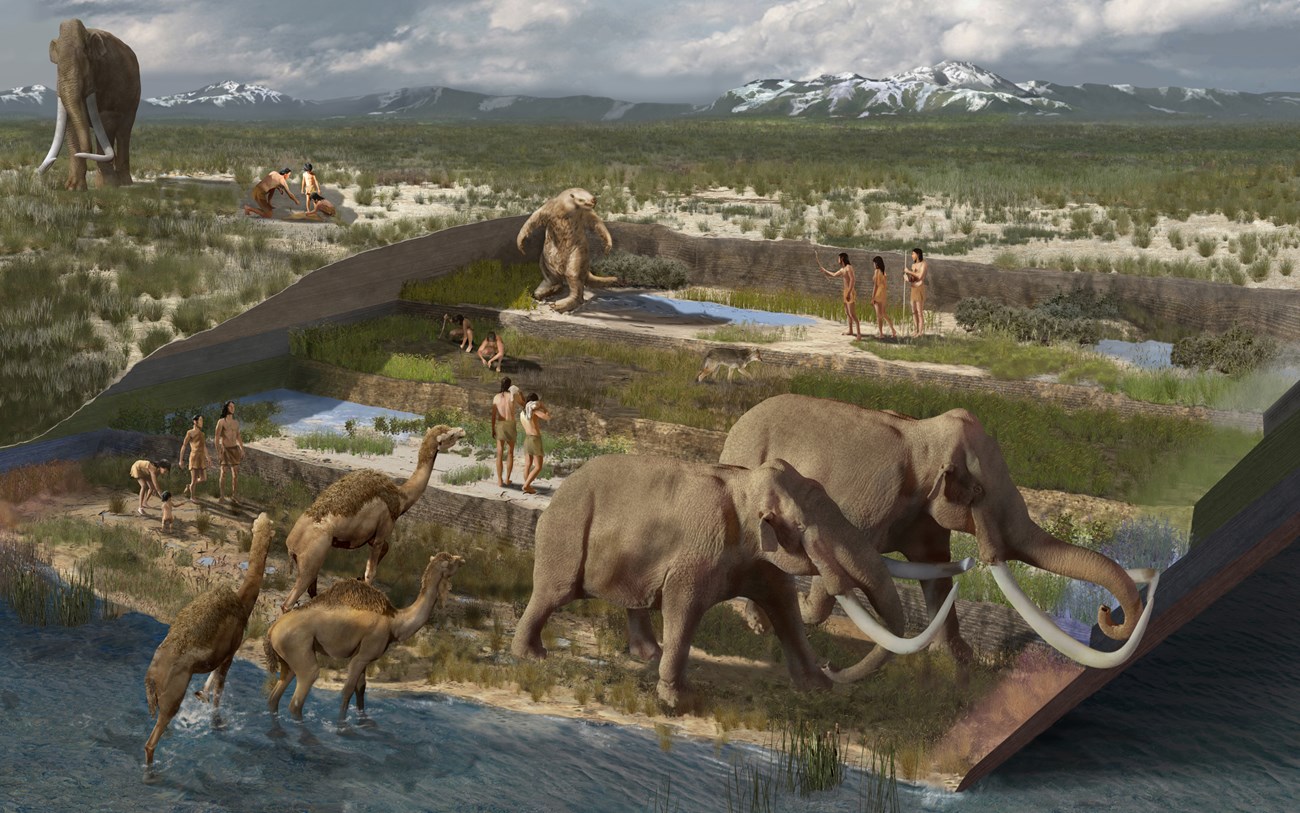
This illustration shows slices of life during different periods at what’s now White Sands, as revealed by ancient footprints.
Credit: Karen Carr
This illustration shows slices of life during different periods at what’s now White Sands, as revealed by ancient footprints. Credit: Karen Carr
Who was here, and when?
It’s possible that people simply walked into North America (it’s not Mordor, after all) sometime before 26,000 years ago, and a group of their descendants eventually ended up squelching through the mud in a cooler, wetter version of what’s now New Mexico. That scenario could also explain the stone tools unearthed from a 30,000-year-old layer of sediment in Chiquihuite Cave, Mexico. And it doesn’t rule out another wave of people venturing onto the continent later once the ice started to recede.