They can monitor the Antarctic year round and sail straight into hurricanes.
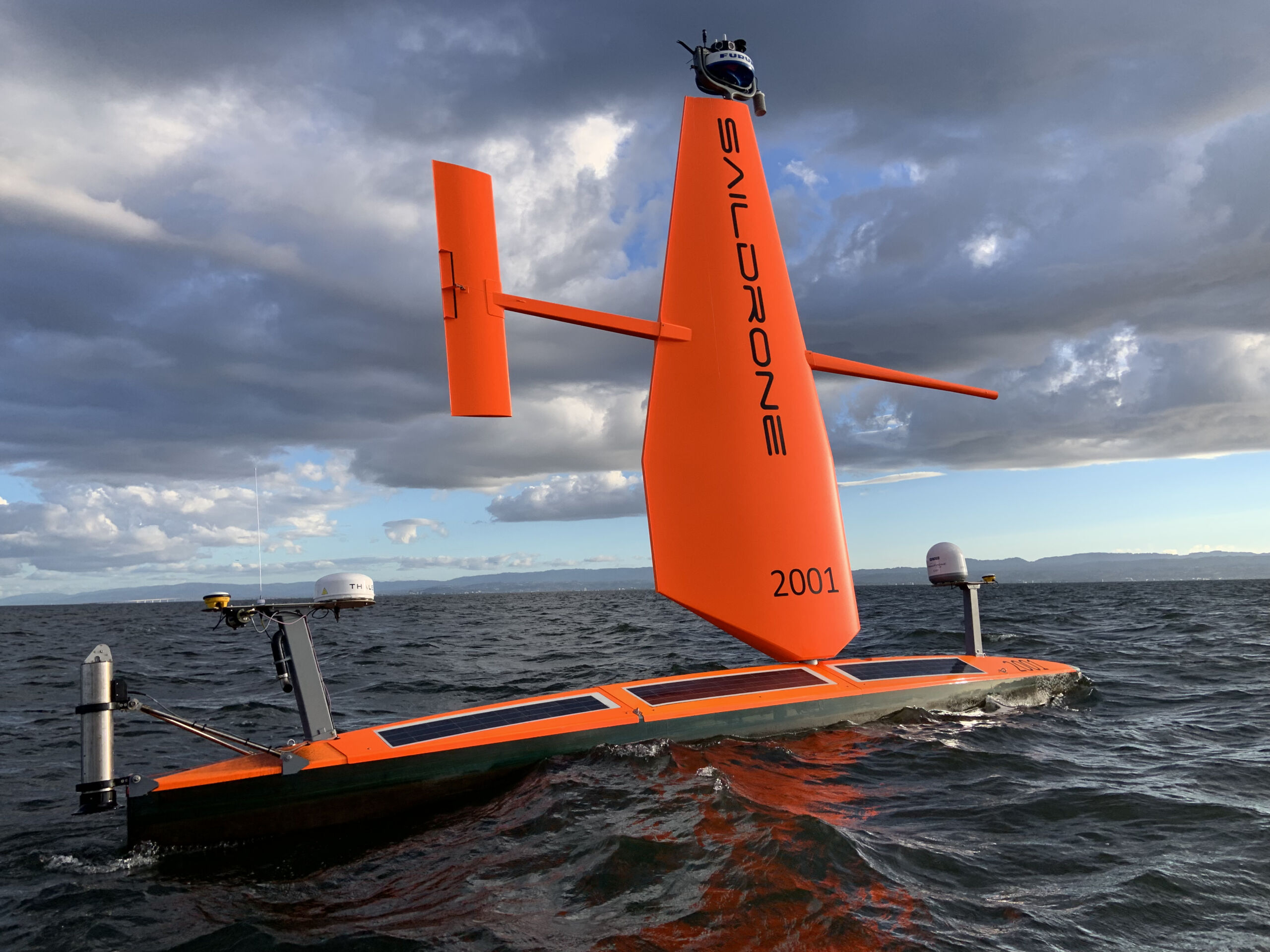
A Voyager-class saildrone. Credit: Saildrone
A Voyager-class saildrone. Credit: Saildrone
Science fiction often paints a terrifying picture of the future—think aliens decimating humanity, à la The War of the Worlds. But sometimes the future becoming the present can be pretty amazing—who doesn’t love successful space launches majestically catapulting humans skyward?
Or take Earth’s oceans, which are currently in the middle of a technological revolution that, outside of some very nerdy circles, has gone largely unnoticed.
“We’re at the cusp of a proliferation of lots of autonomous vehicles in the ocean,” said Alex De Robertis, a biologist at the Alaska Fisheries Science Center of the National Oceanic and Atmospheric Administration (NOAA). “Things that were science fiction not so long ago are kind of routine now.” That includes saildrones, which look like oversized orange surfboards, each with a hard, carbon-fiber sail (called a wing) and a stash of scientific equipment.
Droning on
Saildrones are sailboat-like uncrewed surface vehicles (USVs) that travel the oceans on wind and solar power, although larger versions do boast a diesel backup engine. Remote pilots who work for Saildrone (the company, capitalized) can guide a saildrone (the USV, not capitalized) via satellite-communicated commands, which provide a designated path, called a corridor, to get to a target waypoint. The drone’s software autonomously adjusts the wing to keep it on track (pilots cannot take direct control of this hardware). Using only wind and ocean currents, saildrones cruise on average at about 3 knots, or about 3.5 mph.
NOAA and other science teams commission Saildrone to deploy these scrappy USVs all over Earth’s oceans. Saildrones serve as mobile meteorological stations, biological monitoring devices, and even ocean floor mappers—all without the need for people on board. They can survive terrifyingly tall waves, hurricane-force winds, and seas studded with ice, and they can stay out for months at a time.
“The ocean covers 70 percent of the world, [but] when you think of actual volume, we know so very little about it,” said Noah Lawrence-Slavas, an engineer at NOAA’s Pacific Marine Environmental Laboratory (PMEL). Saildrones could provide some answers.
Drones at sea
Saildrone offers its craft in three sizes. The Explorer is the little workhorse—a 23-foot-long vehicle propelled by wind that can sail the seas for a year at a time. With sensor packages powered by solar panels, it can monitor meteorology and ocean chemistry, track fish, and/or measure carbon dioxide at the ocean-atmosphere interface. The 33-foot-long Voyager comes equipped with diesel power to supplement wind and solar. It can map the ocean floor to a depth of 300 meters, and it’s used for maritime security. The longest, largest option, the Surveyor, was designed for deep ocean mapping, down to 7,000 meters. The first Surveyor was 72 feet long, but new vehicles will be 65 feet in length.
The Voyager and Surveyor have fewer sensor options because their payloads are optimized for mapping and maritime security, but the Explorer can have between 15 and 20 sensors, configured into a customizable package for customers, said Matt Womble, director of Ocean Data Programs at Saildrone.

A Surveyor-class saildrone. Credit: Saildrone
That sort of customization wasn’t always an option. A little over a decade ago, recalled Lawrence-Slavas, PMEL began to explore ways to replace or supplement ship-based observations, partly because ships are incredibly expensive. In 2014, Saildrone reached out to give a presentation about its concept vehicle’s successful voyage from the San Francisco Bay to Hawaii, he said. Autonomously crossing a substantial amount of ocean piqued PMEL’s interest, but there was still a big gap when it came to utility.
“They had a vehicle, but the vehicle didn’t measure anything,” Lawrence-Slavas said. “[PMEL is unique because] we can do things like design a sensor or system from the ground up.” To ease the development of saildrone sensors, NOAA entered into a cooperative research and development agreement, or CRADA, with Saildrone in 2014. CRADAs set out project goals, describe agreements on intellectual property, and streamline paperwork, he said.
They started easy, with sensors like air temperature and barometric pressure—off-the-shelf sensors that are standard on moorings. Critical to early success was testing the sensors in the ocean. “Because the ocean throws a lot of curveballs, we can fail really quickly,” said Lawrence-Slavas, but “we can also learn really quickly.” He described one instance where he and others pipe-strapped a buoy monitoring system to a piling in San Francisco Bay to serve as the control. “Then we strapped instruments onto a saildrone and we just sailed around [the piling] for a while and looked at the data.”
These early tests gradually become more complex, with increasing amounts of time being spent in the open ocean. By 2015, Saildrone was running missions for NOAA in the Bering Sea and the Gulf of Mexico.
Fishing missions
One of the early (but more complicated) sensors to be installed was a sonar system to track fish. “From the point of view of a sonar,” said De Robertis, “a fish is like an air bubble sitting in the ocean because most of the reflected sound is due to the density contrast between water and a fish’s swim bladder, if it has one.” If you know what the acoustic return is from a single fish, fish abundance can be calculated from the total measured energy in a given area. “It’s basically long division,” he said.
Fishery surveys often involve a crewed ship that features a sonar for estimating biomass and people trawling for fish, De Robertis explained. In acoustic-trawl surveys, trawling helps determine what species (or mix of species) is swimming underfoot, as well as the age of those fish. Combining trawling with sonar helps biologists track population increases and decreases with respect to age, which plays into decisions about ensuring that fish populations are sustainably harvested, he said. Though saildrones cannot trawl, they work well in areas that are biologically simple, like the Bering Sea, where fish populations tend to be dominated by a single species because ecosystems become simpler at higher latitudes.
Polar problems
Saildrones have survived trips to the top of the world, with a 2019 effort yielding unexpected results. The goal was to see how close a saildrone could get to sea ice while measuring the interaction between air and sea in the marginal ice zone—the transition between solid ice and open ocean that is characterized by ice chunks floating in the water, said Chidong Zhang, the director of the Ocean Climate Research Division at PMEL. Because of the presence of many bergy bits (small chunks of ice), there was an unexpected encounter between ice and saildrones. One of the main conclusions of this work was that some ice is simply too small to detect using satellite data—a conclusion based on the fact that the saildrone got stuck in ice after the collision.
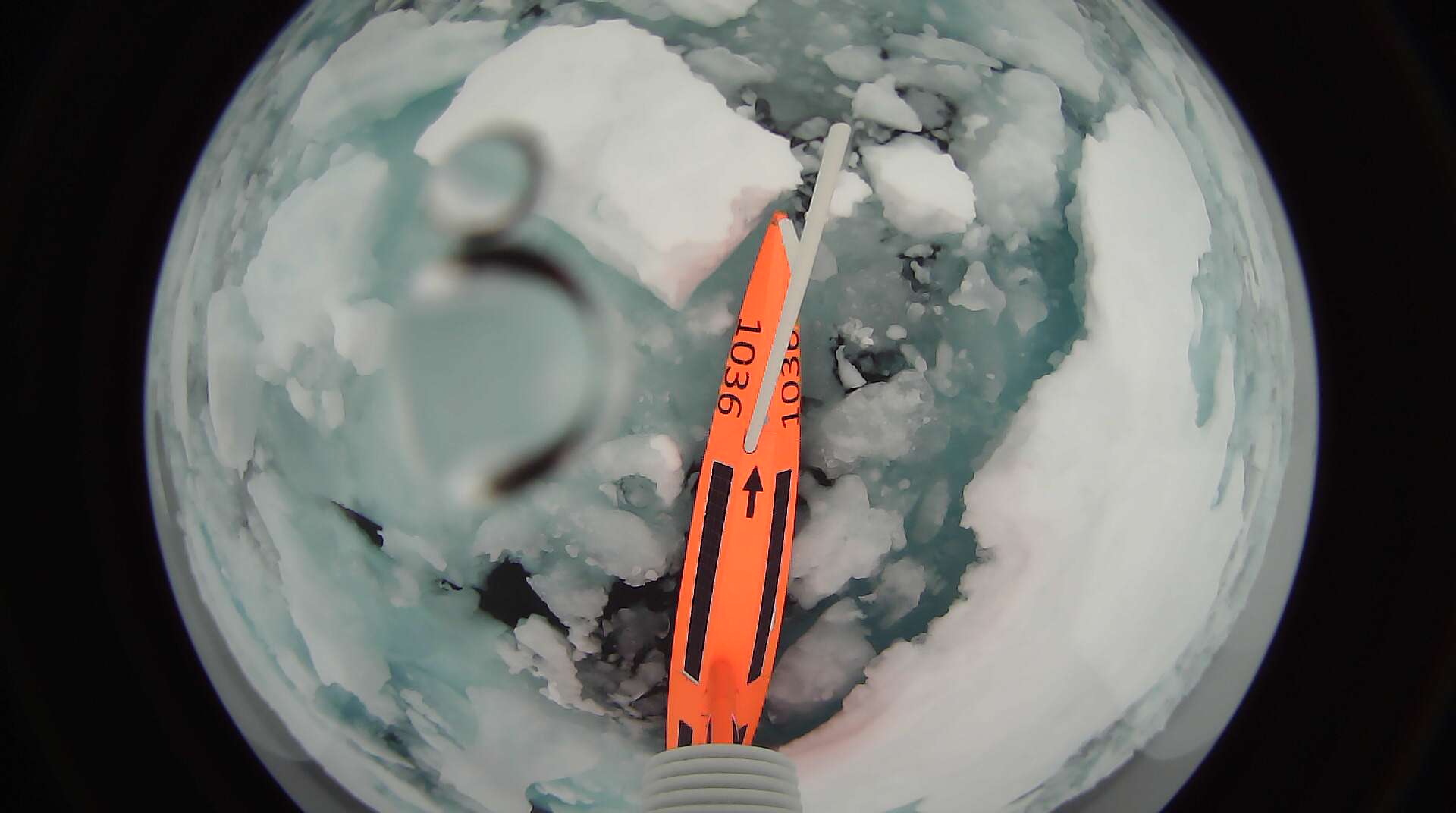
Science meets some bergy bits. Credit: Saildrone
That same year, Saildrone started working on the bottom of the world, when two saildrones began to circumnavigate Antarctica during austral summer.
The Southern Ocean—the body of water surrounding Antarctica—is like a wheel’s hub that links all the other oceans. The currents created by this great circle, as well as the temperature differences between water layers, result in an effective mechanism for getting heat and carbon dioxide out of the atmosphere and into the deep ocean via downwelling currents. “We think that [this] ocean plays a pretty outsized role in that ocean carbon uptake,” said Adrienne Sutton, a PMEL oceanographer.
However, the Southern Ocean is also the least studied. “It’s just not a pleasant place to be, and it’s not safe,” Sutton said. Scientists put carbon dioxide instrumentation on any willing vessel—research or commercial—that’s already set to sail through the frigid waters. However, ocean traffic tends to slow during the winter because of high winds and waves, resulting in a huge knowledge gap about what’s happening at a time when those same high winds and waves should result in more rapid exchange of heat and carbon dioxide.

An eventful voyage took a saildrone around Antarctica and back to New Zealand. Credit: Saildrone
Enter Saildrone, combined with the Autonomous Surface Vehicle CO2 system, or ASVCO2, which was developed by PMEL. It’s a version of a technology that has existed for decades, and it’s designed to determine the amount of carbon dioxide exchanged between air and sea. For the 2019 mission, the main question was whether a saildrone—equipped with the ASVCO2 and other standard sensors—could survive the conditions of the Southern Ocean. It did.
“I was shocked,” said Sutton. One made it all the way around the continent, ending its mission in August. (The researchers also recovered the second saildrone, which did not complete its mission.) Though the saildrone ran into an iceberg about halfway through, damaging some of the meteorological equipment, the ASVCO2 system worked, yielding intriguing results. During winter in the Indian Ocean, the system detected strong areas of CO2 outgassing from ocean to atmosphere that had not been observed before, Sutton said.
Underwater mountains
Among the ocean’s many unknowns, perhaps the most perplexing is that much of the ocean floor hasn’t been mapped in detail. Imagine trying to forecast weather without knowing where mountains rise from Earth’s surface or where valleys cut through the landscape.
“Same thing for all the global climate change models that involve [the] ocean,” said Larry Mayer, director of the Center for Coastal and Ocean Mapping at the University of New Hampshire. “The turbulence created by water going over the sea floor is a very important parameter that controls the distribution of heat in the water column,” he explained. The ocean floor also matters for navigation, safety, and understanding vulnerable habitats. “You can’t protect and you can’t manage what you don’t know,” he said.
To that end, Mayer and colleagues are using the largest saildrone—the Surveyor. “If you want to get very high resolution in deep water, you need a [multi-beam] sonar,” he said. A multi-beam sonar requires a vessel large enough to carry it and the power to run it. The Surveyor is big enough, and it can use solar to charge a battery that powers onboard sensor systems. It will rely on its backup diesel engine to help direct the saildrone on the rare occasions when winds and currents may not be cooperating, Mayer said.
Surveyor’s multi-beam sonar collects a swath of data with a width that’s three to four times its height above the ocean floor. “When we’re sailing, it gets about 20 percent more because it’s so quiet,” he said. “Sonar puts out a very quiet sound into the ocean and waits for those echoes to come back, so it’s susceptible to noise of any sort,” Mayer explained. “In most situations, the Surveyor can map on wind propulsion alone,” said Womble.
Surveyor’s first voyage was a 28-day sojourn from San Francisco to Honolulu. Recently, the Surveyor completed a months-long campaign, begun in July 2022, to map areas around Alaska’s Aleutian Islands. It then sailed back to San Francisco, made a pit stop at Saildrone headquarters, and mapped additional areas of the coastal Californian seafloor. Important discoveries have included potential hydrothermal vents near Alaska and a previously unknown Californian seamount.
The ultimate test
No ship wants to find itself in the midst of a hurricane, so little data from the ocean-atmosphere interface exists from the eyewall—the worst of the winds. Getting this data using saildrones can help improve hurricane intensity forecasts, said Greg Foltz, an oceanographer at NOAA’s Atlantic Oceanographic and Meteorological Laboratory.
Predicting when a hurricane will intensify—especially important in the few days before landfall—lags in terms of accuracy compared to forecasting storm tracks, said Zhang.
That’s partly because of the difficulty in collecting the necessary data to understand the energy transfer between ocean and atmosphere in a storm. Information about turbulence, calculated from wind speed in three dimensions, is needed because turbulence transfers momentum into the ocean, slowing the winds. The ocean and air temperature, humidity, and wind data also allow for an indirect calculation of surface heat flux—the exchange of heat energy between the ocean and the storm. When the ocean feeds the storm heat, hurricanes intensify, said Foltz. Saildrones collect the necessary data for calculating turbulence, and they should eventually collect the data needed to directly calculate surface heat flux, all while surviving the storm relatively unscathed.
In 2021, NOAA had five saildrones distributed along tracks in the Atlantic Ocean, where they were most likely to see hurricanes. One intrepid drone penetrated the category 4 Hurricane Sam, guided by the scientists and Saildrone’s remote pilots. In the worst of the winds and sea, the saildrone rolled upside-down but managed to right itself. After realizing that saildrone was going to make it, Foltz described the flood of relief he felt.
“There’s so much planning,” he said. “You’re so worried… that you’re not going to get it in the right position to go through the strongest winds.” But it did, and it faithfully transmitted data through the worst of the storm. 2022 saw seven drones searching for storm eyewalls in the Atlantic and Gulf of Mexico; one penetrated the category 4 Hurricane Fiona.
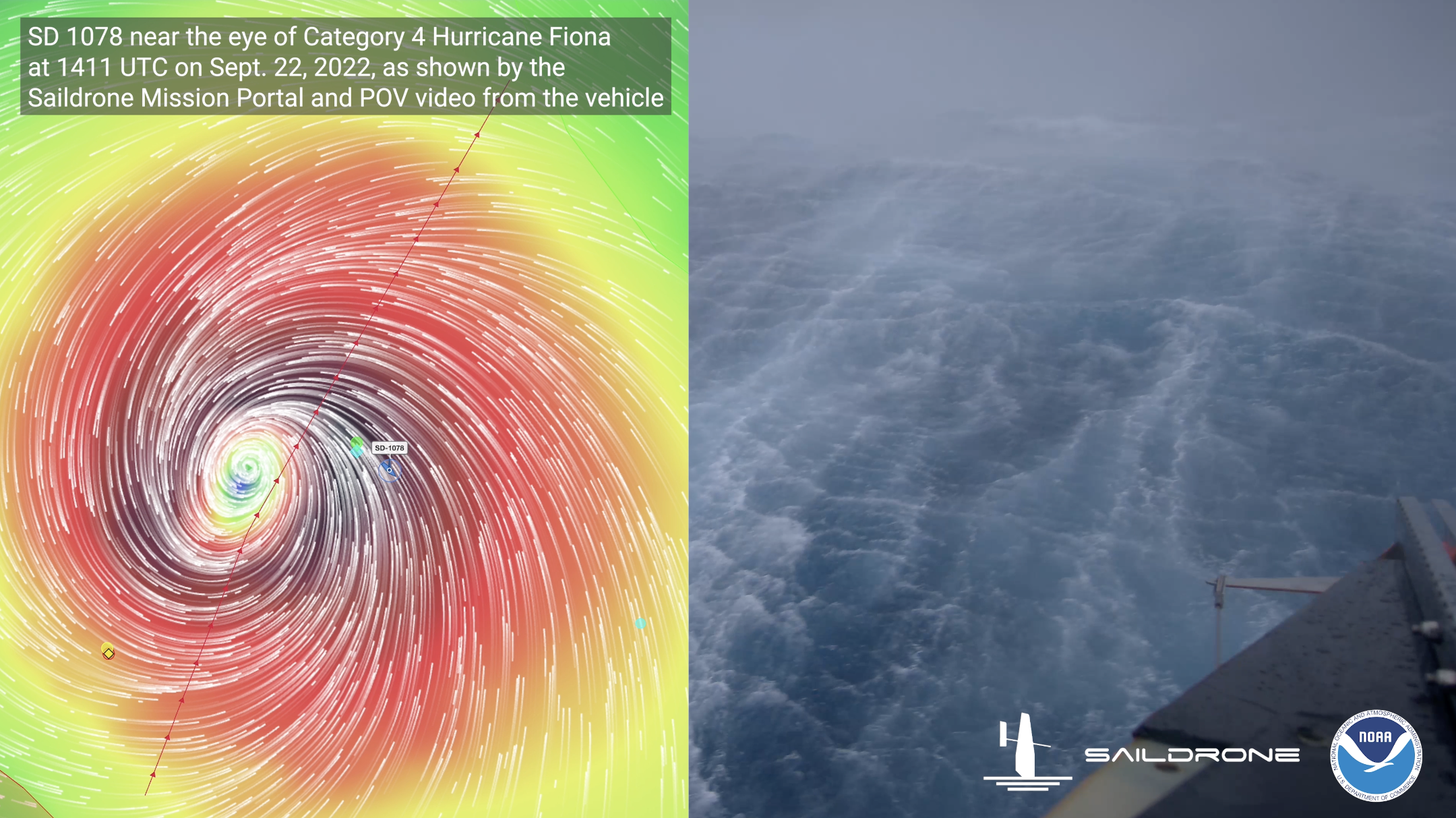
Saildrone meets the eyeball. Credit: Saildrone
One nagging question is how to validate the saildrone data when there’s minimal information collected directly from the eye of the storm at the ocean surface via other methods. NOAA’s Hurricane Hunter aircraft drop sensors on parachutes into the eyes of hurricanes that collect invaluable information on their way down, but the data they collect only provides a brief snapshot of the ocean surface compared to the continual monitoring from the saildrones.
Lucrezia Ricciardulli, a senior scientist at Remote Sensing Systems and a member of the NASA Ocean Vector Winds science team, decided to compare the saildrone data from Hurricane Sam to continuous monitoring of wind speeds done by satellite. “All the satellite data that we had, they were exactly on top of this saildrone line,” she said. “I was shocked.”
After another pass with higher-resolution satellite data, the findings remained the same. “Saildrone was actually really accurate in a hurricane environment,” Ricciardulli said.
Mission as a service
Despite their successes, adopting saildrones still requires a change in thinking for scientists. “The whole saildrone model is very intriguing, and [it’s] a very different model than my community is used to,” said Mayer.
In the past, teams built or purchased their own instruments. That way of doing oceanography, said Lawrence-Slavas, doesn’t transition very well between groups. “This data-as-a-service [model] was very interesting to us because it overcame those problems of all that speciality, expertise, and human capital that groups would need in order to make a measurement somewhere in the ocean.”
In Saildrone’s business model, the company maintains ownership of the saildrone. (For those wondering, no, you cannot buy a saildrone.) Though the scientists help design the mission and choose the right saildrone and instrument package, they purchase only the data.
Womble refers to this as “mission as a service,” with the scientists focused on the overall design and data collection but the construction and implementation left up to Saildrone.

An undersea canyon near Alaska that was mapped by a saildrone. Credit: Saildrone
A web portal connects scientists with Saildrone’s pilots and project managers during a voyage. The constant data stream can help scientists identify if there’s a problem with any sensors. Cameras let scientists see what the saildrone sees, which is how they discovered that the saildrone hit Arctic ice. Now, Zhang and others are working on creating an automated navigation system that could detect sea ice in real time using machine learning and artificial intelligence.
The data that appears in the web portal is transmitted via satellite, but because that’s expensive and satellites have limited bandwidth, that information mostly comes as five-minute averages, said Lawrence-Slavas. More detailed data is stored on board and retrieved when the drone is recovered and is then processed using a data pipeline that NOAA helped develop. “We’ve verified that at the end of that process, the data coming out matches our reference data,” he said.
Augmenting ocean research
“Our observing system right now is so ship reliant,” said Sutton. “If you’re deploying any other asset, like a buoy, you need a ship.”
A research vessel mapping the deep sea will have a crew of 15 to 30 people, and they can take about 20 scientists or so. These missions typically last about 30 days because of the need to resupply and refuel, said Mayer. Such research missions can cost on the order of $50,000 per day, with a lot of the cost tied to crew salaries and fuel. “Every time one of those big ships has to come in and out of port, it’s wasting time,” he said. Autonomous vehicles like saildrones can save on crew and transit, and they have a much larger operating window with respect to weather.
Fuel costs are far less because saildrones are predominantly powered by wind and solar. The Explorer, in particular, is appealing because it’s net-zero, said Zhang.
Though saildrones can’t completely replace crewed ships, they’re a way to augment studies, said De Robertis. “They don’t get bored, they don’t get hungry; they’re robots, they’re good at this.”
Alka Tripathy-Lang is a freelance science writer with a PhD in geology. She writes about earthquakes, volcanoes, and the inner workings of our planet.
Listing image: Saildrone