A recording device and electrodes were implanted in the very flexible cephalopods.
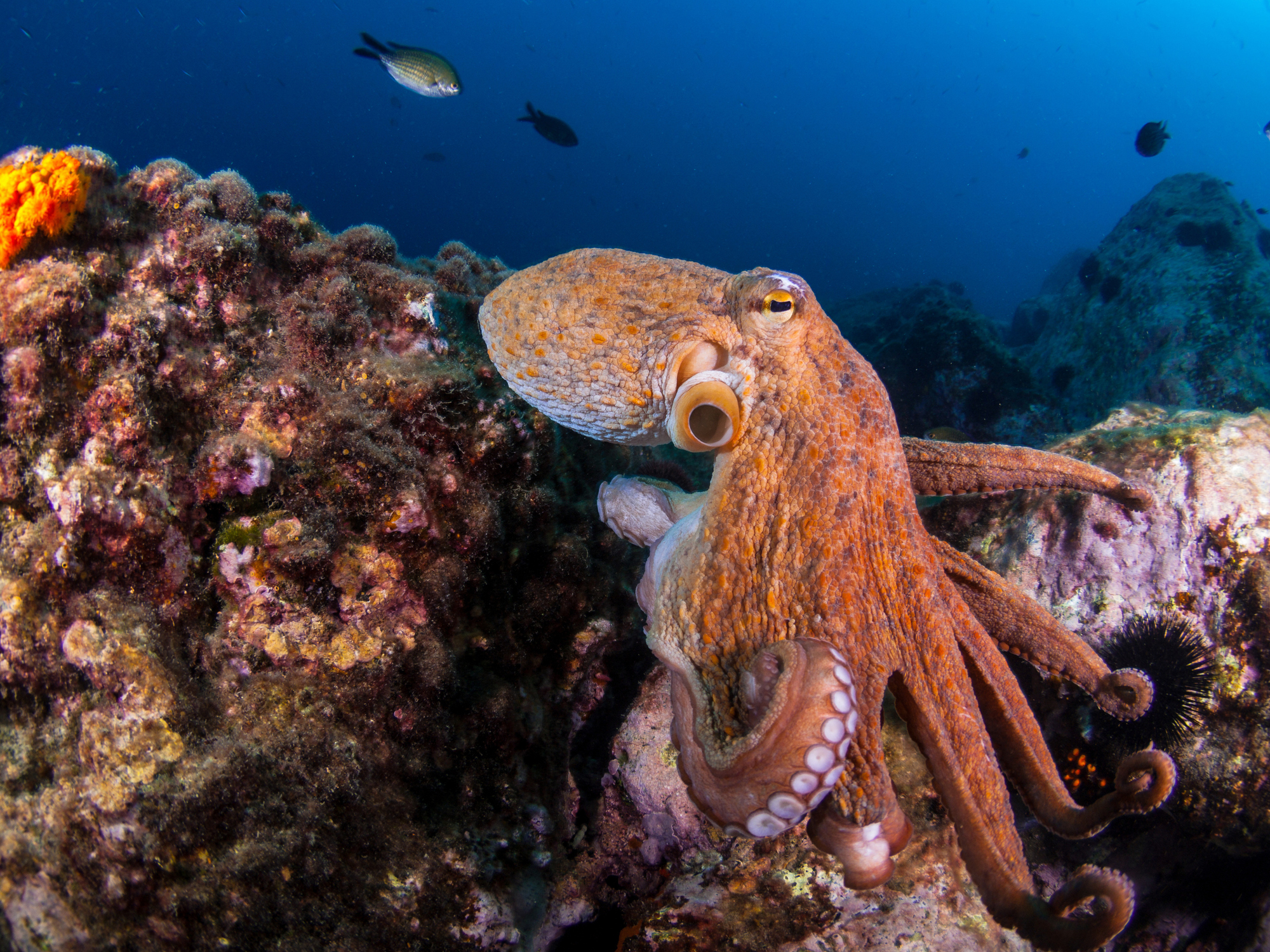
Nine brains, blue blood, instant camouflage: It’s no surprise that octopuses capture our interest and our imaginations. Science-fiction creators, in particular, have been inspired by these tentacled creatures.
An octopus’s remarkable intelligence makes it a unique subject for marine biologists and neuroscientists as well. Research has revealed the brain power of the octopus allows it to unscrew a jar or navigate a maze. But, like many children, the octopus also develops an impish tendency to push the boundaries of behavior. Several aquariums have found octopuses memorizing guard schedules to sneak into nearby tanks to steal fish; meanwhile, marine biologists have discovered that wild octopuses will punch fish… for no apparent reason.
According to Dr. Jennifer Maher, a professor at the University of Lethbridge in Canada, there are a “number of [different] types of learning [for octopuses]: cognitive tasks like tool use, memory of complex operations for future use, and observational learning.”
How does the distinct structure of the octopus’s brain enable all this complex behavior? No one had successfully studied wild or freely moving octopuses’ brain waves until a new study by researchers at the University of Naples Federico II in Italy and the Okinawa Institute of Science and Technology (OIST) in Japan, among others. In their Current Biology paper, the researchers tracked and monitored three captive but freely moving octopuses, analyzing their brain waves for the first time. Using recording electrodes, the researchers found a type of brain wave never before seen, along with brain waves that may be similar to some seen in human brains, possibly providing hints about the evolution of intelligence.
Cunning cephalopods
Our current understanding of octopus intelligence may seem unbelievable. In 2011, researchers discovered that each arm of the cephalopod has its own “brain.” Using a transparent maze with food in it, held outside of the tank, the researchers forced the octopus to navigate the maze using only its arm, even though it could see where the food was. The octopus couldn’t rely on chemical cues processed by its brain to find the food, as it typically does in the ocean, forcing the arm’s individual “brain,” or neuron bundle, to find the food on its own by processing the signals locally. Each octopus arm is thought to have around 10,000 neurons dedicated to sensing its surroundings.
Other research shows that octopuses are the only invertebrates, besides a few insects, to use tools. They will compress shells around their bodies as a type of proto-armor and camouflage against predators.
Octopuses can also mimic human movement by walking bipedally, lifting six of their legs like a skirt, and scooting along the ocean floor. However, that seems to be one of the few similarities between these cephalopods and humans, as evolution has separated us by many millions of years.
“The enormous difference between octopuses and us stems from over 550 million years of independent evolution,” explained Dr. Michael Kuba, the OIST project leader for the 2023 octopus brainwave study who now works at Naples University. “Our closest common ancestor probably resembled a flatworm.” Yet Kuba and his team are looking at the few similarities to learn more about the evolution of mental abilities.
Wiring an octopus’s brain
It’s no easy task to read an octopus’s brain. For one thing, the animals are nearly impossible to track in the wild. “Octopuses are hard to see, and besides, they are often out of water in tide pools,” Maher added. “Only some of them habituate to people, and many species are nocturnal.”
To avoid these complications, many researchers turn to captive octopuses to study their brains. But even this can prove challenging. “Since the octopuses have eight ultra-flexible arms that can reach any part of their body and have a soft body with no skull to anchor the recording equipment, the challenge of this project was to realize a new equipment that was out of reach,” said Dr. Anna Di Cosmo, a professor at the University of Naples and a researcher involved in the 2023 study.
Reach matters because the animal often removes or plays with the recording equipment. Kuba, Di Cosmo, and others decided to take a new approach by implanting their recording devices inside the octopus’s brain, far out of reach.
An octopus lobotomy
“We developed a new engineering solution, able to record signals underwater, using small and lightweight data loggers, originally utilized to track the brain activity of birds during flight,” Di Cosmo added. These repurposed loggers were carefully placed into the upper head of three captive tropical octopuses, just between their eyes. “The electrodes were implanted into an area of the octopus’s brain called the vertical lobe and median superior frontal lobe,” Di Cosmo stated, “which is the most accessible area and considered important to control learning and memory processes.”
The octopuses were anesthetized during their surgeries. They spent the next 12 hours recovering, monitored in their tanks, being the first octopuses to be studied in real time. “We also filmed them with a sensitive camera as they swam, slept, and explored their surroundings,” Kuba added. While the researchers didn’t have the octopuses complete any brain teasing activities during the next 12 hours of study, they did find some interesting brain activity in their test subjects.
When the team looked at an octopus’s brain waves for the first time, the results were shocking. As Di Cosmo explained, these signatures were “long-lasting, slow oscillations that have not been described before.” As far as we know, these signatures appear to be unique to the octopuses.
Because the researchers didn’t test the octopuses while recording them, they couldn’t link these unique brain waves to any specific activity, leaving that question to be answered by a future experiment.
A common theme of intelligence
Perhaps even more surprising was that several brain wave signatures mimicked those in humans and other mammals. “We now had an opportunity to observe memory formation in the octopus and compare it to mammals, to identify common motifs or distinct idiosyncrasies in brains that have developed completely independently,” explained Dr. Tamar Gutnick, the paper’s first author and a visiting scientist at the University of Naples. This project “gave us the chance to study brains with complex behaviors and cognition that are evolutionarily separated from vertebrates by at least 500 million years,” Kuba added. “This gives us a chance to see general principles on how brains need to work [to be considered intelligent].”
Given the success of this study for observing freely moving octopuses, Kuba, Gutnick, and Di Cosmo are already looking at ways to push their findings forward. For one thing, they are planning on repeating this experiment with other species of octopus, including Octopus vulgaris, the species often seen in aquariums. “I have [O. vulgaris] in my facility,” Di Cosmo stated. “And I have the permission from the Ministry of Health to work with these protected animals, trying to solve questions in many other areas of octopus cognition, including how they learn, socialize, and control the movement of their body and arms.”
In a separate future study, Kuba and Gutnik, along with Di Cosmo, hope to repeat this experiment but add memory and learning tasks for their octopuses to correlate specific brain waves to different activities. Ultimately, this may allow us to associate certain behaviors with activity in specific brain areas.
Going in through the genes
Other researchers are taking a genetic approach to understanding the octopus’s brain. According to a 2021 article from Scientific American, researchers at Wood Hole Massachusetts’ Marine Biological Laboratory tried to create a specific genetic tag corresponding to an activity in the octopus’s brain. Using this tag as an indicator, the scientists hoped to see which part of the octopus’s brain lit up in real time during activities. The entire genome of the two-spotted octopus was sequenced in 2015, so it may be fairly straightforward to create this genetic tag.
Instead of looking at real-time activities, other researchers at the Max Delbrück Center and Dartmouth College have been trying to find genetic similarities related to intelligence. In a November 2022 paper in Science Advances, the scientists found that octopuses had a larger number of microRNAs (tiny RNA sequences used for gene expression) in their neural tissue and that these RNAs were longer. Vertebrates include several intelligent species and also have a large number of microRNAs in their neural tissue, so researchers suspect that microRNAs could be important in developing or supporting complex brains.
More learning to come
Though these ongoing studies look at captive octopuses, many researchers hope the findings will help us understand how wild octopuses think and survive. Scientists like Di Cosmo, Kuba, and Gutnik think that by studying the behavior of captive octopuses, they may be able to better understand and track these animals in their natural habitats. As Kuba stated: “To understand octopuses and proof of their intelligence, is helping octopuses in the wild, as people will treat them with interest, care, and respect.”
Current Biology, 2023. DOI: 10.1016/j.cub.2023.02.006
Kenna Hughes-Castleberry is the science communicator at JILA (a joint physics research institute between the National Institute of Standards and Technology and the University of Colorado Boulder) and a freelance science journalist. Her main writing focuses are quantum physics, quantum technology, deep technology, social media, and the diversity of people in these fields, particularly women and people from minority ethnic and racial groups. Follow her on LinkedIn or visit her website.