Even before this year’s Fields Medal winners announcement, the Institut des Hautes Etudes Scientifiques (IHES) or the Institute of Advanced Scientific Studies, boasted a remarkable statistic. Since its founding in 1958, the institute has had 12 permanent mathematics professors; seven of them had won a Fields Medal, considered to be the Nobel Prize in mathematics. On July 5, Hugo Duminil-Copin was named a recipient of this year’s prize, and the IHES extended its remarkable record to eight. “I am extremely glad that Hugo won the Fields Medal. We were betting on him to win the prize this year,” IHES director Emmanuel Ullmo told Ars Technica.
People before topics
Duminil-Copin was recognized for his use of probability theory to tackle problems in statistical physics. The 36-year-old is the first professor at IHES specializing in probability theory, a trait that manifests the institute’s philosophy as well as the reason behind its success. “We don’t look for topics but individuals. While recruiting professors, our only focus is on finding the most brilliant mathematicians or physicists,” Ullmo says.
Ullmo recalls the process of hiring Duminil-Copin. “Around 2016, when I consulted experts to suggest names of brilliant young researchers, Hugo’s name was right at the top. Even though no other mathematics professor in IHES history had specialized in probability theory, we offered Hugo the position. If someone of Hugo’s level had been researching in some other field of mathematics, that would have suited us, too,” Ullmo says.
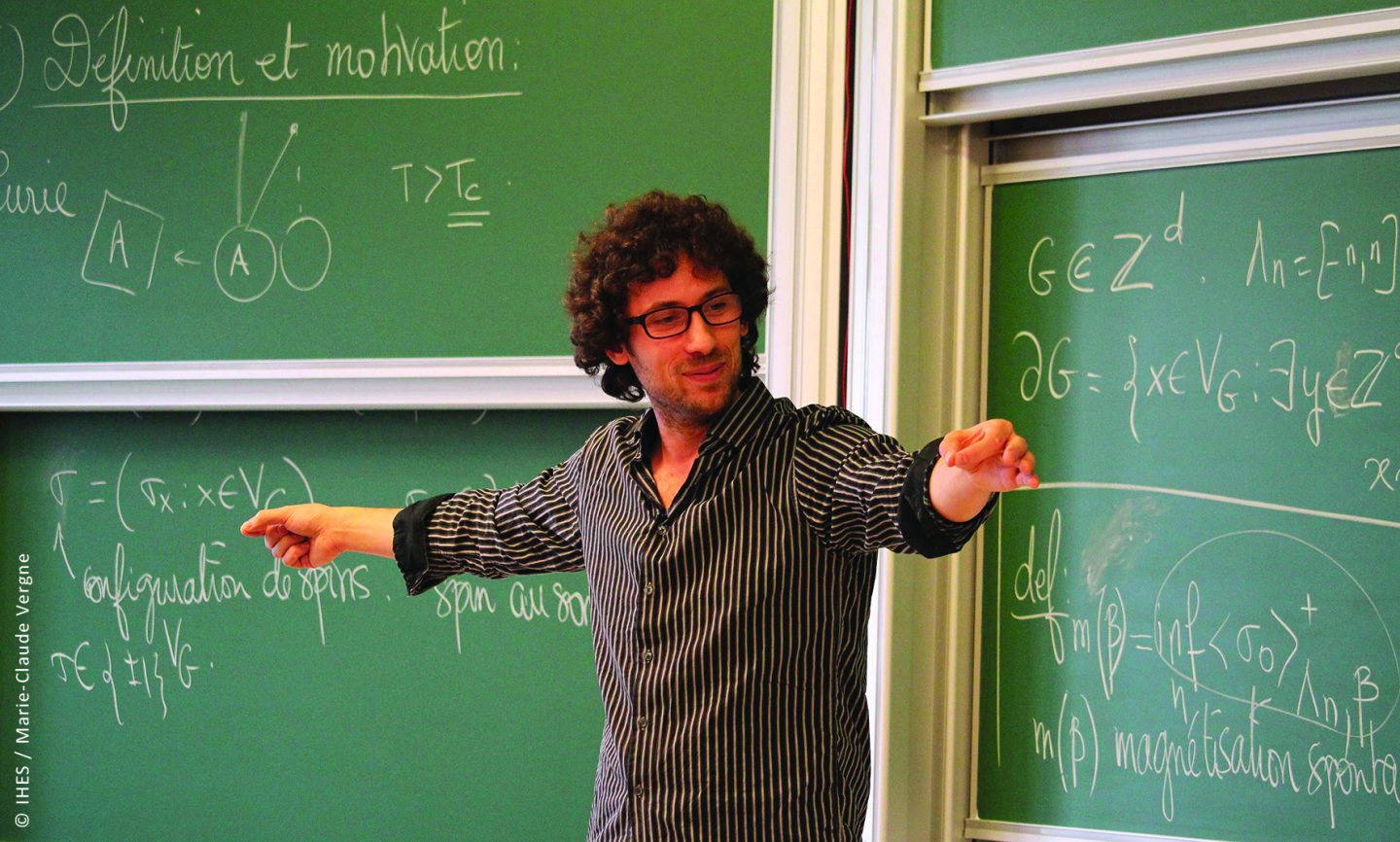
Hugo Duminil-Copin, winner of this year’s Fields Medal.
Credit: IHES / Marie-Claude Vergne
Hugo Duminil-Copin, winner of this year’s Fields Medal. Credit: IHES / Marie-Claude Vergne
The freedom to pursue any domain in mathematics and physics is supplemented by the so-called visitor program, under which around 200 researchers per year are invited to the institute from all over the world. Using this program, the permanent professors can invite experts from their fields to collaborate on their research projects.
A number of physics and mathematics luminaries have visited the 64-year-old institute as invited researchers. This includes Murray Gell-Mann, Alfred Kastler, Steven Weinberg, André Weil, Barry Mazur, and Shiing-shen Chern. “Visiting researchers can stay at the institute for days or months. I benefited a lot by inviting collaborators to discuss the ideas and problems related to my research,” Duminil-Copin says.