By late Thursday afternoon, when NASA officials held a teleconference to brief reporters, the situation appeared to be well in hand. Officials, however, declined to say how serious the situation got in Mission Control before the station returned to its proper attitude.
“Until you exhaust all your contingency plans, you’re not really starting to worry,” said NASA’s space station program manager, Joel Montalbano. “And we didn’t do that today.”
Already, Montalbano said, a team of NASA engineers was studying the effect of Thursday’s loss of control on the station’s structure. Meanwhile, Russian engineers were assessing the health of the Nauka module. Both groups should complete preliminary assessments by the end of the day Friday.
For NASA, this meant delaying the launch of a Starliner spacecraft planned for Friday. This long-awaited mission comes 19 months after an initial test flight in December 2019 went awry due to software problems. Because Starliner was not able to dock with the space station during this first test flight, Boeing agreed to fly a second test mission of Starliner before a crewed flight.
NASA moved the Starliner launch to no earlier than Tuesday at 1:20 pm EDT from Florida (17:20 UTC) on its Atlas V rocket. If the spacecraft launches next Tuesday and all goes well, Starliner will dock with the space station next Wednesday.
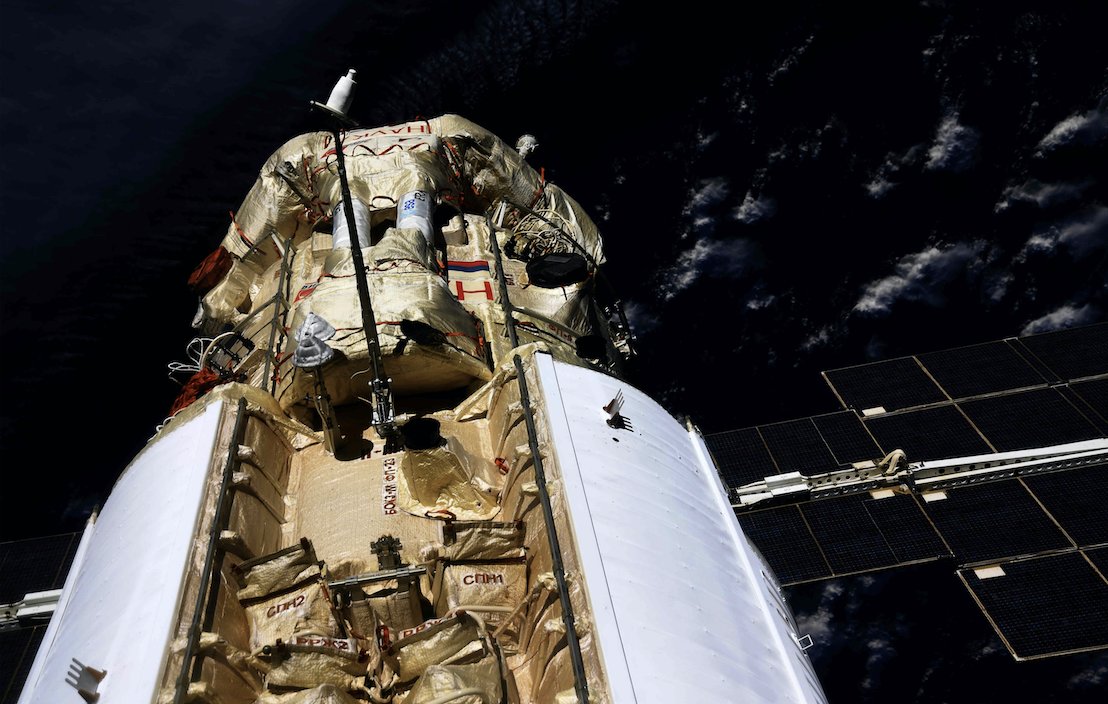
Russia’s Nauka module is seen attached to the International Space Station.
Credit: Roscosmos
Russia’s Nauka module is seen attached to the International Space Station. Credit: Roscosmos
Meanwhile, the Russians will continue to work toward integrating Nauka with the space station. This is a sizable module that includes crew quarters, an airlock for scientific experiments, and much more. With a mass of about 24 metric tons, it is roughly 20 percent larger than the biggest Russian segment of the station, the Zvezda service module.
Nauka has had a long and, so far, inglorious history. Its launch eight days ago came after more than a decade of delays due to lack of funds and technical problems. Shortly after reaching orbit, Russia had difficulties with Nauka’s main propulsion system, and docking with the space station was delayed. After using backup thrusters to raise its altitude and reach the station, Nauka docked. It’s not clear what role the propulsion system issues experienced shortly after the launch may have played in Thursday’s difficulties.