To do this, the researchers used a magnetron to generate relatively high-powered microwaves (about 1kW). The microwaves travel down a waveguide (a rectangular metal tube) that gets progressively thinner and then expands again (see picture). A quartz tube is placed in a hole in the waveguide at the narrowest point. Air is forced through the quartz tube, passes through a small section of waveguide, and then exits the other end of the quartz tube.
At the entry to the tube, the air passes over electrodes that are subject to a very high field. This rips electrons off some of the atoms (mostly the nitrogen and oxygen), creating a low-temperature, low-pressure plasma. The air pressure from the blower at the entry of the tube pushes the plasma further up the tube so that it enters the waveguide.
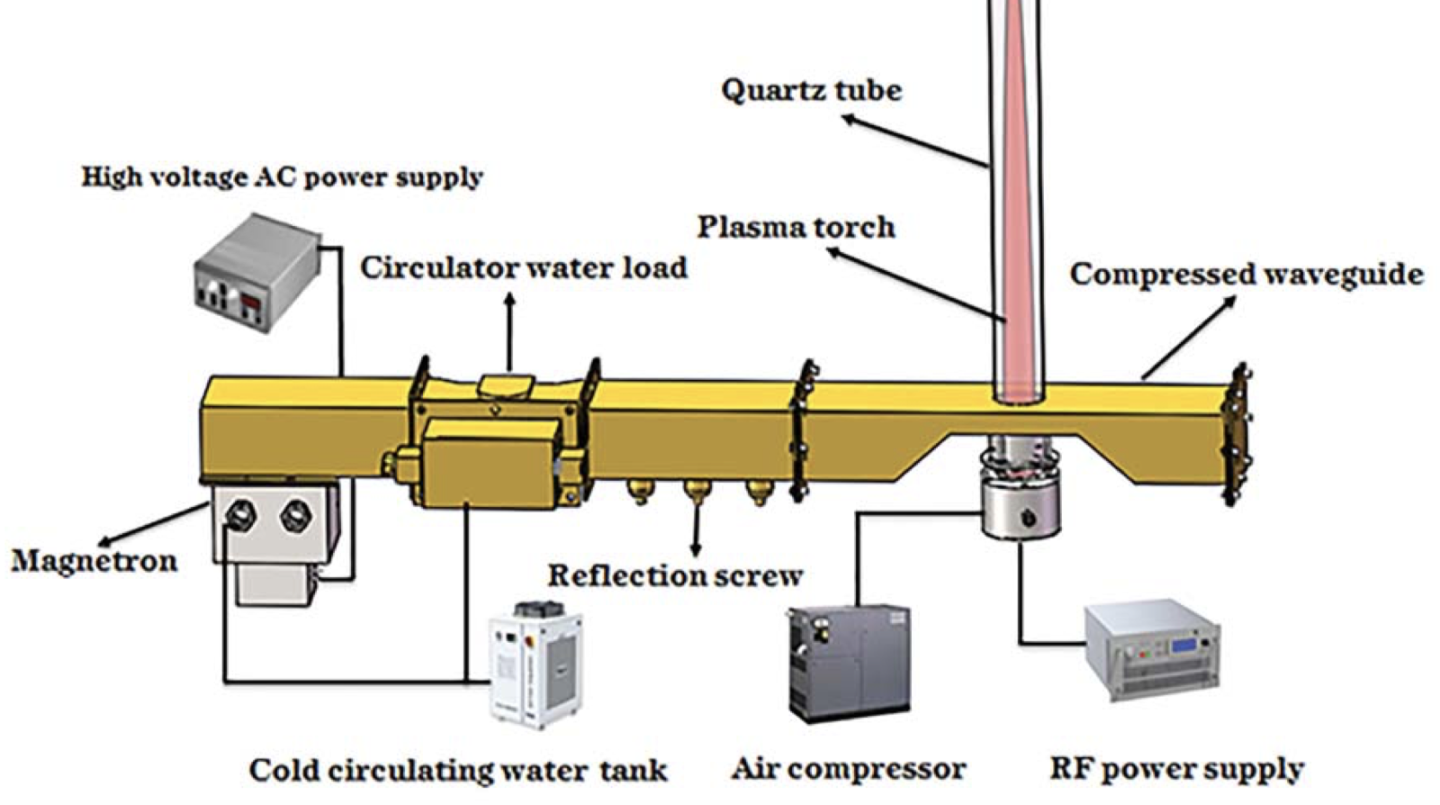
Microwave-powered plasma thruster.
Microwave-powered plasma thruster. Credit: Dan Ye
In the waveguide, the charged particles in the plasma start to oscillate with the microwave field while rapidly heating. The ions, atoms, and electrons collide with each other frequently, spreading the energy from the ions and electrons to the neutral atoms, heating the plasma rapidly. As a result, the researchers claim that the plasma rapidly heats to well over 1,000°C.
The thrust of the measurement
The heated plasma creates a torch-like flame as the hot gas exits the waveguide, generating thrust. Measuring the gas pressure (thrust) turned out to be difficult. Most pressure sensors and barometers tend to complain when placed into something akin to a blowtorch.
So the researchers got inventive. They closed the quartz tube with a hollow sphere that had a small hole in it. If the plasma thrust was sufficiently high, it would cause the sphere to rattle around on top of the tube. By progressively adding mass to the sphere, it would eventually settle on the tube and stop rattling. The researchers estimated the total force from gas by balancing it with the force due to gravity. I’m pretty sure there are better ways to measure thrust (and still stay low-tech), but as long as the researchers were consistent, the systematic offset will be the same for all measurements.