“Starting a war between Alabama and SpaceX will be the end of the Moon program.”

NASA Administrator Jim Bridenstine visits Kennedy Space Center in 2018. Credit: NASA
NASA Administrator Jim Bridenstine visits Kennedy Space Center in 2018. Credit: NASA
Speaking in front of a high-fidelity model of the Apollo program’s Lunar Module spacecraft, Vice President Mike Pence charged NASA with accelerating its Moon plans last week. Instead of 2028, Pence wanted boots on the ground four years earlier, before the end of 2024. This marked the rarest of all moments in spaceflight—a schedule moving left instead of to the right.
Understandably, the aerospace community greeted the announcement with a healthy dose of skepticism. Many rocket builders, spaceship designers, flight controllers, and space buffs have seen this movie before. Both in 1989 and 2004, Republican administrations have announced ambitious Moon-then-Mars deep space plans only to see them die for lack of funding and White House backing.
And yet, this new proposal holds some promise. Pence, as well as NASA Administrator Jim Bridenstine, have adopted a clear goal for the agency and promised enduring political support. Moreover, they have said the “end” matters more than the “means.” This suggests that whatever rockets and spacecraft NASA uses to reach the Moon, the plan should be based on the best-available, most cost-effective technology. In short, they want to foster a healthy, open competition in the US aerospace industry to help NASA and America reach its goals.
At a town hall meeting Monday for space agency employees, Bridenstine characterized the Moon 2024 initiative as a “once-in-a-lifetime opportunity for NASA.” This may be a tad hyperbolic, but it does represent a rare chance for the sprawling bureaucratic federal agency—whose human exploration programs have been adrift for decades—to embrace a brighter future.
Therefore, this marks an important, if uncertain, moment in US spaceflight. To understand how we got here and where we’re going, Ars has talked with a dozen well-placed sources in the aerospace industry, from new space companies and large aerospace contractors to senior NASA leaders and political insiders. Most of them are not named due to their sensitive positions; many of them see challenges ahead.
What is the plan?
Pence directed NASA to land humans at the lunar south pole by 2024. Most likely, this would be a two- or four-person crew that would include the first woman to visit the Moon. Landing near the poles is significant because the Apollo missions half a century ago stayed relatively close to the Moon’s equator, and NASA would like to understand whether water ice resources truly exist in abundance near the poles in shadowed craters.
The crew would descend to the lunar surface from an outpost in lunar orbit, known as the Gateway. Initially, these missions to the Moon would involve short sorties, but Pence also directed NASA to establish a permanent base on the surface of the Moon at a later date.
This gallery highlights how NASA hopes to land on the Moon by 2024.
During its lunar explorations, NASA and its astronauts would test technologies to survive and work in deep space for extended periods of time, beyond the relative safety of low-Earth orbit. By learning at the Moon, NASA could then develop plans that would allow humans to travel to Mars in the 2030s. Bridenstine insists that the agency has not lost sight of this goal.
What is behind this?
As Pence and Bridenstine have drilled deeper into the agency’s human exploration programs over the last year, they’ve grown frustrated at the pace of progress. A mid-March meeting with Boeing officials, during which the Space Launch System rocket’s prime contractor said they could not make a June 2020 test launch date, proved a breaking point.
Pence expressed this frustration during his Moon speech on March 26 at the US Space & Rocket Center in Huntsville, Alabama. In the 1960s, Pence said, the agency required just eight years to go to the Moon at a time when NASA didn’t know how to do the job. Now, NASA has said it cannot land humans on the Moon before 2028, more than 11 years after President Trump first established the goal of returning humans to the lunar surface. “Ladies and gentlemen, that’s just not good enough,” Pence said. “We’re better than that.”
Neither Bridenstine nor Pence said so explicitly, but these comments reflect their sense that NASA has become too bureaucratic, too tentative, too risk averse. During his town hall this week, Bridenstine had a telling response when asked why, by setting such an ambitious goal of a 2024 landing, was he not putting schedule over safety?

Vice President Mike Pence, left, and NASA Administrator Jim Bridenstine walk through NASA Headquarters in 2018.
Credit: NASA
Vice President Mike Pence, left, and NASA Administrator Jim Bridenstine walk through NASA Headquarters in 2018. Credit: NASA
“I would not say it’s a return to schedule over safety, I would say it’s a return to schedule,” he said. “Safety is paramount for everybody at this agency, it always has been. But the number one mission is not safety. If it was, we would all just stay in the ready room and just watch CNN.”
Pence and Bridenstine have challenged NASA to do better and sought to instill urgency into a human exploration program that has lacked it since the 1960s.
What happens next?
The agency’s leadership will try to move fast. Bridenstine has directed NASA’s chief of human spaceflight, William Gerstenmaier, to refine a plan of missions and vehicles that could meet the 2024 deadline. Meanwhile, Bridenstine is working with the White House and Office of Management to determine the costs.
The president already submitted his fiscal-year 2020 budget request to Congress more than three weeks ago, so the administration will have to amend the request with respect to NASA’s budget and then submit that to Congress. During a hearing on Tuesday, Bridenstine said he was hoping to get this amendment to Congress by April 15. This will provide the first outline of the new Moon program’s cost, although early estimates suggest it may require $2 to $4 billion annually on top of NASA’s present budget of $21 billion a year. Bridenstine said he does not want to steal from other parts of the agency’s budget to pay for the initiative.
Bridenstine said he had buy-in from both Pence and President Trump for his plan but must still sell it to Congress. “Based upon the conversations I have had, the commitment from the administration is there. I can’t speak for Congress of course,” he said at the town hall.
What hardware are they planning to use?
We have a basic understanding of how NASA plans to get to the Moon’s surface from lunar orbit—but the details are in flux, subject to change, and there’s no clear idea yet on how all of that stuff gets to lunar orbit.
NASA intends to build a small outpost around the Moon, called the Lunar Gateway, between 2020 and 2024. This will include a system to provide power and propulsion, as well as a small habitat facility. Initially, at least, this “skinny” Gateway will serve as a docking facility for visiting Orion spacecraft and a staging area for a lunar lander. The Gateway has its share of critics in the aerospace community, due in part to its expense and cost in energy required to transit from its orbit high above the Moon. But for now NASA likes having a “refuge” near the Moon for astronauts and a staging point.
From the Gateway in 2024, astronauts would descend to the Moon in a three-stage vehicle. The “transfer” stage would ferry a lander with two components to low-lunar orbit. There, a “descent” module would carry the crew as well as an “ascent” module to the surface of the Moon. From a planning perspective, NASA really needs to decide soon what those early missions will accomplish. How long will they stay? Will there be forays outside the spacecraft? These decisions will all drive requirements.
After their stay on the lunar surface, the “ascent” module would lift off from the Moon’s surface, dock with the “transfer” stage, and return to the Gateway. There, the crew would snap some selfies, perhaps tweet ZOMG!! We just went to the Moon y’all, and then climb into their Orion spacecraft for a return to Earth.
Wait, none of that stuff is built yet
That’s right. And it’s a huge ask for NASA, at least the NASA of recent decades, to take on the construction of a small outpost in lunar orbit as well as a lunar lander program. That’s all on top of its existing exploration program—continuing to fly the International Space Station and developing the Orion spacecraft and Space Launch System (SLS) rocket.
This is where additional money will be required to expedite development of the Gateway as well as lunar landers. The agency will also need that sense of urgency Pence has talked about.
NASA has begun to solicit some contracts. Already, the agency has issued a request for industry to build the power and propulsion element of the Gateway, due to be launched in September 2022, and it has been working with six contractors on designs for a habitat module.
And just in February, NASA asked industry to study potential lander designs for the transfer, descent, and ascent stages. With this solicitation, which was issued before Pence sought to accelerate the lunar program, NASA had wanted “demonstration” missions that would carry cargo, but not crew, to the surface by 2024.
The lander program is perhaps the most immediate issue facing NASA, and there are myriad questions that the agency must answer in terms of its size and capabilities. Moreover, there are important contracting questions. In particular, how “commercial” will it be? NASA had intended to require companies to co-invest by paying for 20 percent of the lander costs. It was also considering funding two separate efforts, as it did successfully with both Boeing and SpaceX in its commercial crew program. Finally, the original plan allowed for one company to build an ascent module, another the descent module, and another the transfer vehicle.
Another thing to watch is how the program will be managed. Will NASA farm out the lander program to a private company, or will a field center such as Marshall Space Flight Center be responsible for integrating the various components of the lander? Several sources said a lean, fast return to the Moon would almost certainly require a more commercial approach that allowed NASA some limited oversight of a lander program, not full management.
One thing that is clear is that these decisions must be made quickly. Even if NASA were to receive additional appropriations for a lander in the fiscal year 2020 budget and avoid a continuing resolution, it probably could not initiate a new competition for contracts until 2020. That leaves just four years to design, build, and test a lunar lander.
Asked when his large aerospace company would need contracts to start work on a lunar lander capable of setting down on the Moon in 2024, one engineer said, “What day is it today? Whatever today is.” Money for design work and trade studies are needed this year, and materials such as alloys and aluminum need to be ordered soon. By 2020, industry will need to be cutting metal for large structures and starting work on sub-structures.
What does this mean for the SLS rocket?
Bridenstine has made it clear that the easiest way for NASA to reach the Moon by 2024 is with the large SLS rocket. With key upgrades, the SLS rocket could fly both the Orion spacecraft and components of the lander to lunar orbit at the same time.
The smaller, albeit significantly less costly Falcon Heavy can only barely get Orion into lunar orbit, and even this would require significant modifications and an upper stage from a competitor, United Launch Alliance. However, the Falcon Heavy is presently flying, whereas SLS remains mired in development, with a slight possibility of making its first flight in 2020. Critics of the large rocket say it has missed so many deadlines already that any proposed launch dates should not be trusted.
“It may be politically expedient to keep SLS and not anger the constituent members and companies, but it only gets harder every year,” one source knowledgeable about the program’s development said. “What is special about one more year of delays? They were supposed to launch in 2016. They got every dime they said they needed and then some.”
It is politically expedient to keep the SLS rocket, however, because it is based at the Marshall Space Flight Center in Alabama. Bridenstine understands that there is no way he is getting NASA to the Moon by 2024 over the opposition of the Alabama delegation both in the House and Senate, which remains dead set against side-lining the rocket for cheaper commercial options.
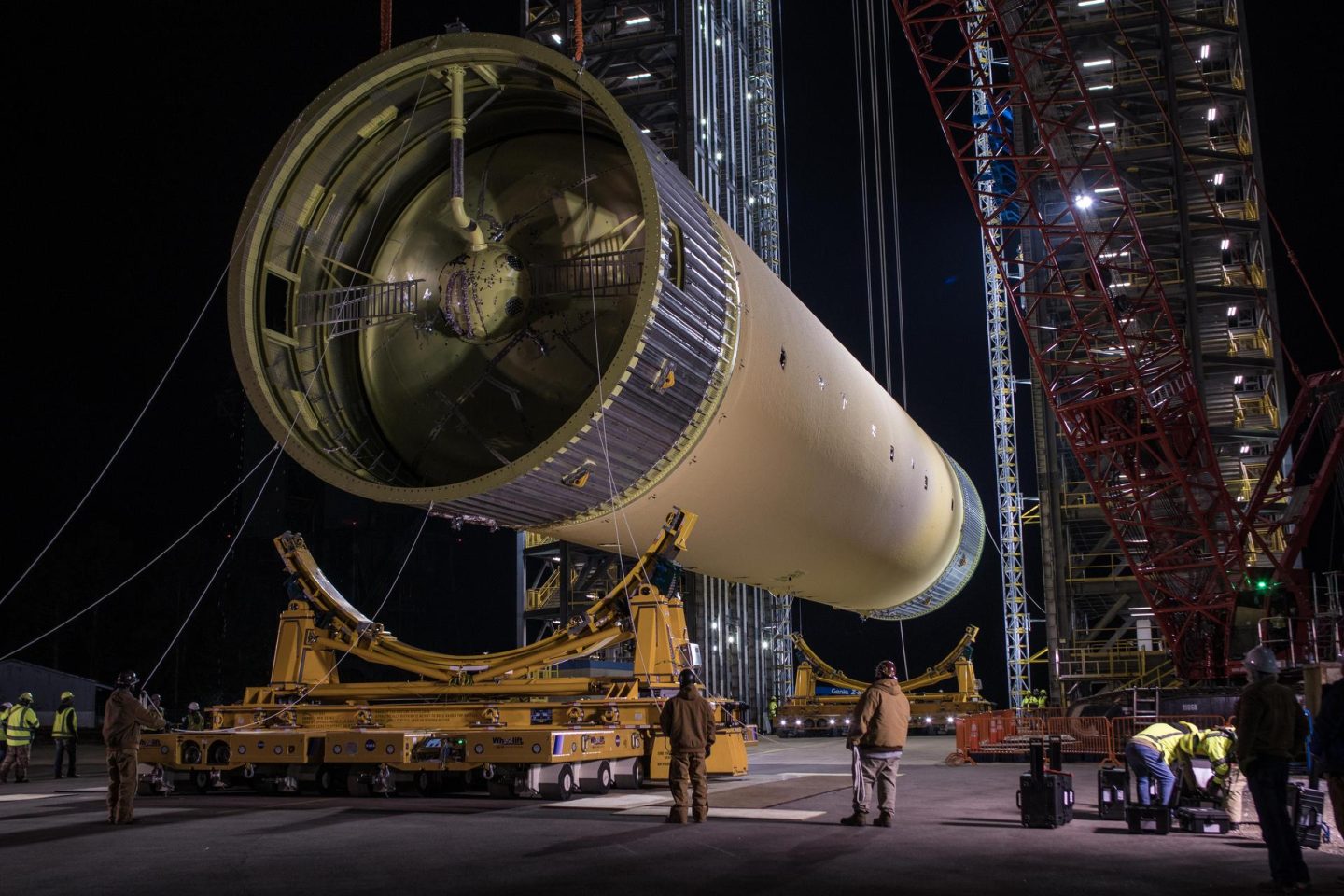
The SLS rocket’s 45-meter long liquid hydrogen tank structural test article is loaded into Test Stand 4693 at NASA’s Marshall Space Flight Center in January.
Credit: NASA
The SLS rocket’s 45-meter long liquid hydrogen tank structural test article is loaded into Test Stand 4693 at NASA’s Marshall Space Flight Center in January. Credit: NASA
So the administrator appears to be making the one play available to him: giving the SLS rocket a chance to succeed while also putting the program on notice. Bridenstine has told senior NASA engineers to take needed steps to give the rocket its best chance to launch in 2020, even to the point of waiving a traditional but time-consuming test firing of the core stage at a Mississippi center. He has also told the rocket’s primary contractor, Boeing, that this is probably their last chance to execute on a contract that has cost NASA billions of dollars. In a year or two, if SLS continues to slip, Bridenstine will be able to say he tried.
One industry source summed up the situation this way: “We have to help those programs be successful. If we don’t bring them along, we’re not going to bring Congress along.”
Such help might include improving the SLS rocket’s Exploration Upper Stage, which Bridenstine says the agency needs to launch the 2024 Moon mission. Under current plans, an Orion and the landers would launch on a single SLS rocket (with this more powerful version of the upper stage) to meet the 2024 deadline. But work has been stopped on the upper stage for months because senior NASA officials have been frustrated with the project. Boeing’s design for the stage is under-powered for the agency’s needs, and it costs too much.
NASA might be able to get a better SLS rocket, for less, by allowing industry competitors to bid on design and construction of this upper stage. After all, Boeing appears to have its hands full with just getting the core stage ready to go.
How about SpaceX?
So far, the company has been completely mum on the subject of using its Falcon Heavy rocket for a lunar program. But Bridenstine has not: he very publicly raised the possibility of flying Orion on a Falcon Heavy rocket earlier this week.
There’s a reason SpaceX has not said much. If the Moon 2024 program becomes seen in Congress as a SpaceX Moon program, support for it will dry up immediately. While the California company has its admirers on both sides of the aisle, key constituencies in Alabama and beyond think the upstart rocket company already gets too much federal money.
In the early 2010s, the Obama administration continually fought budget battles with the Republican Congress that essentially boiled down to funding for commercial crew (Boeing and SpaceX) versus spending more money on the SLS rocket (Boeing and other traditional contractors).
Lori Garver, NASA’s deputy administrator during those years, fought on the front line of those battles. Asked about the Moon 2024 plan, Garver told Ars that Bridenstine has done a “stand-up job” backing Pence’s five-year plan for a return to the Moon. But she has concerns about its implementation after her own budget battles.
“I am sympathetic to the challenge and to the headwinds against change in Washington,” she said. “It took us five years to get Congress to agree to fully fund commercial crew, but perhaps their experience will be different.”
Bridenstine, for his part, seems intent on supporting an “all-of-the-above” plan for a return to the Moon with a mix of NASA vehicles, such as the SLS rockets and private rockets. “He understands that starting a war between Alabama and SpaceX will be the end of the Moon program,” one Washington, DC-based source said.
(What about SpaceX’s Starship? To make 2024, NASA is betting on technology currently flying, that which may soon, or that which leverages existing systems. While Starship has the promise of revolutionizing interplanetary travel, NASA simply doesn’t believe it will exist as a reality any time soon, definitely not by 2024.)
Where does this stand politically
In his quest to institute these changes, Bridenstine will have to fight on multiple fronts. Large aerospace firms, with their influential lobbies, will want to protect existing contracts. NASA field centers will fiercely protect their turf. The White House Office of Management and Budget will be reticent to sign on to new, long-term costly programs. And there is simply the inertia of a large bureaucracy like NASA and managers who will resist change to their programs.
However, Bridenstine’s biggest hurdle will be Congress. In addition to the aforementioned Alabama delegation, elected officials from other big SLS and Orion states will want assurances. And then there are also Democrats to contend with.
Although Bridenstine has strived to portray this as a bipartisan effort—and since becoming administrator, he has won plaudits from some Democrats for becoming an inclusive and enthusiastic leader of NASA—at the end of the day this is a Trump-led initiative in a highly polarized political environment.

The chairwoman of the House science committee, Eddie Bernice Johnson, is skeptical about the administration’s Moon plans.
The chairwoman of the House science committee, Eddie Bernice Johnson, is skeptical about the administration’s Moon plans.
So far, the plan hasn’t won them over. On Tuesday, during a hearing before the House Science, Space, and Technology Committee, Chairwoman Eddie Bernice Johnson, of Texas, expressed skepticism. “We need specifics, not rhetoric,” she said. “Because rhetoric that is not backed by a concrete plan and believable cost estimates is just hot air. And hot air may be helpful in ballooning, but it won’t get us to the Moon or Mars.”
Last week, the chairman of the House committee that sets NASA’s budget, New York Democrat José Serrano, said he was concerned that the 2024 deadline was politically motivated, as it would occur before the end of a second Trump term in the White House if the Republican were re-elected.
However, not all Democrats are opposed. Colorado’s Ed Perlmutter said, “Quite frankly, for me, I’m OK with that, because I think it accelerates the effort to get to Mars, which I think is the underlying driving force here.” Perlmutter wants NASA to send humans to Mars by 2033.
Is this a politically motivated date?
On one hand, of course it is. Although space is far from a priority for most voters, the Trump administration wants to demonstrate that its commitment to a lunar return is serious. This is one reason why the agency has prioritized the first launch of the SLS rocket and flying an uncrewed Orion mission around the Moon in 2020. This would show progress.
Though 2024 is another election year, it has importance beyond symbolism. Previous efforts for the Moon and Mars set distant goals. For example, when the Constellation program was developed in the mid-2000s during the presidency of George W. Bush, it targeted 2020 for a lunar landing. This spanned so many presidential administrations that it was bound to eventually lose support.
By putting down a marker for 2024, Pence is avoiding this historical trap. He’s saying we can do this during this administration, and therefore it won’t be subject to cancellation. However, the schedule is so aggressive it will require an enormous effort by the White House, both financially and by convincing Congress to go along.
“I do think it would be theoretically possible for the United States to land someone on the Moon in five years if we had a well-understood, meaningful purpose, a running technical start, and a groundswell of aligned support among the public and elected leadership,” one politically connected source said. “Other than the running technical start, I do not view this as our situation today.”
What about a fully commercial lunar return?
Under Pence’s carrot-and-stick approach, NASA is being given a chance to deliver the long-promised SLS rocket and Orion spacecraft. However, there is a recognition in Washington, DC, that companies like SpaceX and, to a lesser extent Blue Origin with its ambitious New Glenn rocket, are beginning to catch up to the space agency in key capacities. Some of those realities are pretty stark, especially as SLS faces further delays.
For just $500 million of its own funds, SpaceX developed the Falcon Heavy rocket and launched it in 2018. The company sells a basic launch for $90 million, with a fully expendable mode costing more. By contrast, while it is a more capable rocket, the SLS has cost the government $14 billion to date. And although figures are not publicly available, each launch will cost NASA at least $2 billion. These are extraordinary cost disparities, all the more so because Bridenstine has now acknowledged that, technically, NASA could probably do a Moon mission with the Falcon Heavy.
But the commercialization of NASA does not have to stop there. One problem with the Orion spacecraft is that, while expressly designed for travel to lunar orbit, it is heavy, weighing about 26 tons fully loaded. By comparison, SpaceX’s Crew Dragon spacecraft has about half the mass and could be modified for Gateway flights on a Falcon Heavy. Again, the cost difference for Dragon, a few hundred million dollars, varies widely from Orion, in excess of $1 billion per mission. And while Boeing has not publicized this, the company has studied similar roles for its Starliner spacecraft in deep space. This capsule, too, could reach lunar orbit on commercial rockets.
The White House now understands the burgeoning commercial alternatives to the SLS and Orion programs. Politically, it would be easier to stay on the government vehicles. In many ways, they are more capable. But with their recent speeches, Pence and Bridenstine have sent a message that they’re not willing to wait forever. Rather, they’re effectively saying, “We’re giving you a chance. We want you to succeed. But getting to the Moon matters more than how we get there.”
Ultimately this will likely fail, but it’s worth a try
The weight of history is against such ambitious plans. Past efforts to return humans to deep space after Apollo have failed. Rhetoric is easy, but action is hard.
Nevertheless, this is worth a try. When I first began writing about these issues in depth five years ago, I concluded the space agency’s human exploration programs had gone adrift. It was accurate then, as it remains so today.
The unfortunate reality of human spaceflight today is that large aerospace contractors influence Congress, which sets the budget and prioritizes local programs and local jobs over exploration goals. This is not a recipe for sending humans into deep space for grand adventures, nor for establishing outposts on the Moon and Mars. It is a recipe, rather, for extremely drawn out and expensive development programs that lead to uncertain ends.
Only a president can bring the kind of clarity needed to accomplish large goals. And so Pence and Bridenstine seek to instill a sense of urgency into NASA, to embolden the agency, and to realize the gifts of this country’s new commercial space industry that will lower the cost of access to space and enable humans to push further into space.
Perhaps this is all political bluster. Perhaps the effort will go nowhere. But at least this effort offers a chance to go somewhere.
Listing image: NASA

Eric Berger is the senior space editor at Ars Technica, covering everything from astronomy to private space to NASA policy, and author of two books: Liftoff, about the rise of SpaceX; and Reentry, on the development of the Falcon 9 rocket and Dragon. A certified meteorologist, Eric lives in Houston.